
What allows capital in Africa to preserve value across generations while contributing to enduring economic development? The answer is not simply a longer investment horizon. Multi-generational capital Africa depends on the alignment of patient investment, credible institutional governance, and a clear understanding of the distinct conditions shaping each market.
Families and institutions face a genuine tension: capital must be protected from avoidable risk, yet excessive caution can leave productive opportunities and industrial priorities unsupported. That balance becomes more complex across a continent whose markets differ in legal frameworks, economic structures, and investment conditions. Treating Africa as a single market can obscure the risks and opportunities that matter to long-term stewardship.
This article presents a practical framework for connecting preservation with productive deployment. It examines how governance can sustain continuity beyond individual leaders, how allocation and risk assessment can reflect varied African contexts, and how patient capital may support industrial development without confusing commercial objectives with philanthropic ones. The result is a clearer basis for considering how financial, institutional, and development priorities can remain aligned across generations.
Key Takeaways
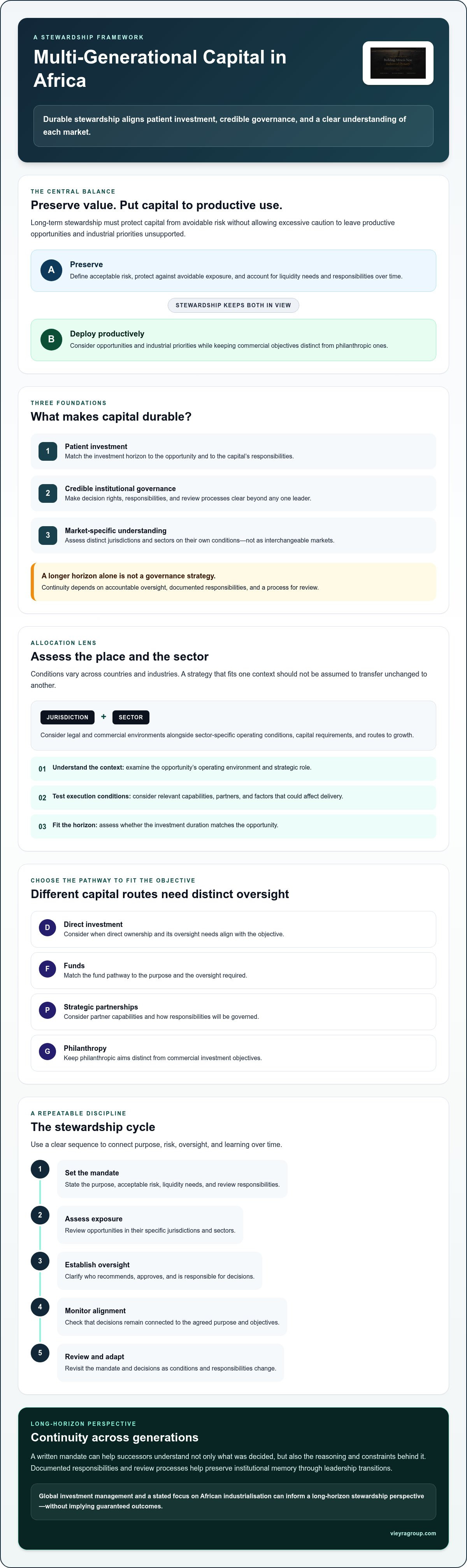
- Define a written mandate that sets purpose, acceptable risk, liquidity needs, and review responsibilities for multi-generational capital Africa.
- Assess opportunities by jurisdiction and sector rather than treating African markets as interchangeable.
- Match capital pathways, including direct investment, funds, strategic partnerships, and philanthropy, to distinct objectives and oversight needs.
- Use a disciplined cycle of mandate-setting, exposure assessment, oversight, monitoring, and review to guide long-term decisions.
- Consider how global investment management and a stated focus on African industrialisation can inform a long-horizon stewardship perspective without implying guaranteed outcomes.
What Does Multi-Generational Capital in Africa Mean?
Multi-generational capital is a pool of financial and institutional resources stewarded across successive generations, with preservation and productive deployment considered together. It is not simply wealth that passes from one generation to another. Its durability depends on how purpose is defined, decisions are continued or revised, and investment horizons are matched to responsibilities that may extend beyond the lifetime of any one decision-maker.
Multi-generational capital is the disciplined stewardship of resources across generations, combining continuity of purpose with the capacity to invest, adapt, and create lasting value. This distinguishes stewardship from asset transfer alone: ownership may change, but sound stewardship also considers who makes decisions, what principles guide them, and how the capital is expected to serve over time.
How Is Multi-Generational Capital Different from Family Wealth?
Family wealth describes assets and ownership; stewardship adds shared responsibilities and decision processes. A written mandate, for example, can help clarify which decisions require collective agreement and which are delegated, while preserving institutional memory through leadership transitions. A family office is one possible structure for coordinating wealth across generations, though families may also use other arrangements. The term is broadly described in this family office overview.
Time horizons also shape choices. A family may need liquidity for near-term obligations while reserving some resources for investments whose value develops over a longer period. Neither objective is inherently superior; the relevant question is whether liquidity needs, risk tolerance, and intended duration are made explicit. Families, family offices, and institutional investors may establish different governance structures to reflect their mandates.
Why Does the African Context Matter?
Africa is not a single investment market. Countries differ in their legal and commercial environments, while sectors within the same country can present distinct operating conditions, capital requirements, and routes to growth. A strategy suitable for one jurisdiction or industry should not be assumed to transfer unchanged to another.
Local context informs the questions investors ask: which partners have relevant capabilities, how a business is positioned within its sector, what conditions could affect execution, and whether the investment horizon fits the opportunity. For instance, assessing an industrial enterprise calls for attention to its operating environment and strategic role, rather than relying on broad regional assumptions. This country- and sector-specific discipline can make diligence more coherent and partnership choices more considered. For a wider discussion of these themes, see the analysis of African private capital markets.
How Governance and Time Horizons Shape Capital Across Generations
A long investment horizon can create room for decisions whose value develops over time, but duration alone does not ensure continuity or sound judgment. Time horizon cannot substitute for accountable governance: enduring capital requires clear decision rights, documented responsibilities, and a process for review. For multi-generational capital Africa, that framework connects purpose with the practical oversight needed to preserve it through leadership transitions and changing conditions.
A written mandate provides a foundation. It can state why capital is being stewarded, the level and kinds of risk considered acceptable, the liquidity required for foreseeable obligations, and who is responsible for recommending, approving, monitoring, and revising decisions. This clarity helps successors understand not only what was decided, but the reasoning and constraints behind it.
Which Governance Questions Should Families and Institutions Address?
Governance arrangements differ, but decision responsibilities should be intelligible. Families and institutions can document who sets the mandate, who assesses opportunities, who authorizes commitments, and who monitors alignment with agreed objectives. They should also consider how leadership succession will be handled, where key records will be maintained, and how conflicts will be identified and resolved.
These questions do not require one prescribed structure. The appropriate arrangement depends on the institution, the family’s objectives, and applicable circumstances. Where decisions involve legal rights, succession, or tax treatment, readers should seek advice specific to the relevant jurisdiction.
How Can Investment Principles Remain Consistent Without Becoming Rigid?
Continuity does not mean preserving every allocation or assumption indefinitely. Principles such as the purpose of the capital, its intended time horizon, and the importance of accountable oversight may endure; views about risk, liquidity, concentration, or particular opportunities may need to change as conditions evolve. Scheduled reviews can test whether those assumptions still serve the mandate, with material changes recorded and explained.
A practical review asks whether exposures remain consistent with the agreed risk parameters, whether liquidity remains adequate for obligations, and whether decisions continue to reflect the institution’s purpose. This enables adaptation without allowing short-term pressures to quietly displace long-term commitments. For a related discussion, see family-office governance for wealth preservation.
For readers considering how institutional stewardship connects with strategic capital, Vieyra Group’s perspective on African industrialisation offers relevant context. Clear governance does not eliminate uncertainty; it provides a disciplined basis for addressing it across generations.
How to Assess Capital Allocation Across African Markets and Sectors
Comparing opportunities requires a common framework, not a single continent-wide assumption. For multi-generational capital Africa, each opportunity should be tested against the mandate, the jurisdiction and sector in which it operates, the capital required, the expected duration, and the consequences if assumptions prove wrong. A broad strategic fit is only a starting point; decision-makers need current, independently verified information about the specific opportunity and its operating context.
Which Criteria Help Compare Long-Term Capital Opportunities?
Apply the same questions to each option: Does it fit the mandate? Is the opportunity’s scale appropriate to the capital available? Are counterparties, ownership arrangements, and oversight sufficiently understood? What jurisdictional, sector-specific, operational, and liquidity risks could affect the investment? Then assess whether the expected duration is compatible with the institution’s commitments and near-term cash requirements. An Africa-wide strategy still requires country- and project-level diligence.
Comparisons are most useful when they rest on consistent assumptions, including the same approach to time horizon, liquidity, and downside analysis. Where information is incomplete or cannot be independently confirmed, record that limitation rather than treating an estimate as established fact. No single sector or instrument is suitable for every mandate.
How Can Investment and Philanthropic Capital Be Distinguished?
Investment and philanthropy may share development priorities, but their purposes and accountability differ. An investment is assessed against its financial and strategic mandate; philanthropic capital is directed toward defined charitable or social objectives. Each requires appropriate decision authority and ways to assess progress, without suggesting that one mandate replaces the other. The following distinctions can help clarify oversight before capital is committed.
| Capital pathway | Primary purpose | Oversight emphasis |
|---|---|---|
| Direct investment | Allocate capital to a specific enterprise or asset | Assess the opportunity, counterparties, risks, and ongoing performance against the mandate |
| Funds | Gain exposure through a pooled investment structure | Review the fund mandate, decision authority, reporting, and underlying exposure |
| Strategic partnerships | Coordinate capital and capabilities toward a shared objective | Clarify partner responsibilities, decision rights, and accountability |
| Philanthropic capital | Support charitable or social objectives | Set distinct grant or programme objectives and assess outcomes appropriately |
These pathways are not interchangeable, and their suitability depends on purpose, governance, and context. For further perspective on the relationship between private capital and industrial development, read private capital in African industrialisation.
How to Govern Risk and Review a Multi-Generational Capital Strategy
Long-term investment in African markets can appear too complex when risks are treated as a single, continent-wide problem. A more disciplined approach is to examine each opportunity in its specific country, sector, and operating context, then assign clear responsibility for decisions and review. For multi-generational capital Africa, risk governance is not a prediction of certainty; it is a method for identifying what is known, what remains uncertain, and what could change the investment case.
A practical sequence can turn that method into repeatable oversight:
- Define the mandate. Record the purpose of the capital, acceptable exposure, liquidity needs, time horizon, and conditions under which a decision should be reconsidered.
- Assess exposure. Consider market conditions, currency movements, legal context, counterparty reliability, operational execution, and concentration. These risks differ in nature and may interact, so assess them in relation to the specific opportunity rather than assuming one risk profile fits every market.
- Set oversight. Specify who reviews evidence, approves decisions, monitors changes, and escalates concerns. Establish what information those responsible need to exercise their roles.
- Monitor and review. Set proportionate reporting intervals and decision thresholds. Revisit the investment thesis when new information, material changes, or emerging risks could affect alignment with the mandate.
What Should Due Diligence Examine Before Capital Is Deployed?
Due diligence should test the investment thesis against available evidence, examine counterparties and governance arrangements, and consider the relevant legal and operating context. Document assumptions, information gaps, plausible downside scenarios, and the conditions that would cause decision-makers to pause, revise, or decline the opportunity. Qualified regional and sector expertise can help focus these questions; current legal and regulatory requirements should be verified with appropriate specialists in the relevant jurisdiction.
How Should a Long-Term Strategy Be Monitored?
Monitoring should distinguish financial objectives from strategic or development objectives when their measures differ. Track each against its stated purpose, record material changes, and explain how they affect the original decision and mandate. This creates a record that successors can use to understand not only what changed, but why the institution responded as it did.
Long horizons do not require passive oversight. They require a consistent process that can accommodate new evidence without allowing short-term pressures to displace the mandate. For a related institutional framework, see sovereign investment risk management in Africa. To explore Vieyra Group’s focus on strategic capital and African industrialisation, visit Vieyra Group’s strategic capital perspective.
Vieyra Family Office and the Stewardship of African Capital
Vieyra Family Office offers an institutional perspective on multi-generational capital Africa through its stated combination of global investment management and a focus on African industrialisation. Operating at sovereign scale, the family office manages global investments across asset classes while pursuing strategic capital and long-term growth. This perspective connects stewardship to both the continuity of capital and the productive capacity that long-horizon investment may support.
What Does Vieyra Family Office Focus On?
The family office’s stated focus brings global investments and African industrialisation within a long-term institutional frame. Strategic capital, in this context, describes an orientation toward deliberate allocation over time, rather than a promise of returns, specific projects, or development outcomes. The investment perspective is therefore relevant to readers considering how capital preservation and productive deployment can be held together, while recognizing that each investment decision depends on its own mandate and assessment.
The Vieyra Foundation pursues philanthropic initiatives aligned with the investment strategy, but philanthropy and investment retain distinct purposes and mandates. Shared development priorities do not make their decision processes, accountability, or intended outcomes interchangeable. Maintaining that distinction is part of responsible stewardship, particularly where financial and social objectives may relate to one another without using the same measures of success.
Beyond these stated priorities, specific claims about governance arrangements, geographic exposure, projects, or results should be verified against current institutional information before publication. This discipline keeps the discussion grounded in confirmed facts rather than assumptions about how the family office operates.
How Can Readers Explore Long-Term Capital Stewardship Further?
The framework developed in this article provides a basis for examining how mandate, governance, allocation, and risk considerations can support capital across generations. Vieyra Family Office’s publicly described focus offers one institutional context for considering those principles, not individualized investment advice or an assurance of outcomes. Readers can assess the stated focus in light of their own objectives and the specific conditions relevant to their decisions.
For institutional readers seeking to understand Vieyra’s approach to global investment management, strategic capital, and African industrialisation, visit the Vieyra Group official website to explore its publicly described investment and capital-allocation focus.
Build a Stewardship Framework That Endures
Multi-generational capital Africa is not defined by the transfer of assets alone. Its lasting value depends on clear governance, investment horizons suited to the mandate, and disciplined, country- and sector-specific assessment. Together, these principles help families and institutions preserve continuity while adapting allocations to changing conditions.
Effective stewardship also keeps distinct objectives clear: investment decisions and philanthropic initiatives may align around development priorities, while retaining separate purposes and accountability. This distinction supports thoughtful capital allocation without treating financial preservation and African industrialisation as competing aims.
Vieyra Family Office brings a multi-generational African family-office perspective, operating at sovereign scale, with a stated focus on global investment management and African industrialisation. The Vieyra Foundation pursues philanthropic initiatives aligned with the investment strategy, while maintaining a distinct mandate. To explore Vieyra’s publicly described investment and capital-allocation focus, explore Vieyra Family Office. With deliberate governance and a long view, capital can be stewarded with greater purpose across generations.
Frequently Asked Questions
What is multi-generational capital in Africa?
Multi-generational capital Africa refers to wealth or institutional resources managed with the interests of more than one generation in view. A sound approach considers the country, sector, counterparties, and investment mandate rather than treating the continent as one market. Stewardship may bring together preservation, productive investment, governance, and periodic review. The appropriate balance depends on the institution’s purpose, obligations, risk considerations, and investment horizon.
How can families preserve capital across generations?
Families can begin by defining the purpose of their capital, documenting decision rights, and establishing clear processes for oversight and succession. They can also assess liquidity needs, risk exposure, and investment assumptions at agreed intervals, recording why decisions are made and what might prompt a change. No single governance structure suits every family. Legal, tax, and regulatory questions should be addressed with qualified professionals familiar with the relevant jurisdictions.
Why is patient capital important for African industrialisation?
Patient capital may support industrial development where planning, partnerships, infrastructure, or productive capacity require a longer investment horizon. It can suit a mandate prepared to hold through extended timelines, provided the investment case, governance, risks, and accountability are assessed carefully. A long horizon alone does not establish suitability: each opportunity must be evaluated on its evidence and alignment with the capital provider’s objectives. Neither investment returns nor development outcomes should be assumed.
How should investors assess risk when deploying capital across African markets?
Investors should assess each opportunity in its own context, examining the jurisdiction, legal environment, counterparties, governance, currency exposure, operations, liquidity, and concentration. They should distinguish confirmed information from assumptions, document plausible downside scenarios, and set monitoring and escalation responsibilities before committing capital. Conditions vary across countries and sectors, so broad regional conclusions cannot replace current due diligence informed by qualified legal, regional, and sector professionals.
What is the difference between investment capital and philanthropic capital?
Investment capital is deployed under an investment mandate, with financial objectives and defined risk considerations. Philanthropic capital supports charitable or social purposes and follows its own governance and accountability requirements. The two may share broad development interests, but they are not interchangeable. Institutions should state each mandate clearly, assign appropriate decision authority, and assess progress using measures suited to the purpose. This distinction helps preserve clarity when investment and philanthropic priorities are aligned.
Can a family office invest globally while focusing on Africa?
Yes. A family office may manage investments across global markets while maintaining a strategic focus on African development or industrialisation. The relationship between these priorities depends on its mandate, governance, allocation choices, and risk framework. Vieyra Family Office is a multi-generational African family office operating at sovereign scale, with a stated focus on global investment management and African industrialisation. Specific portfolio composition or allocation details should only be stated when confirmed by the institution.


