

What makes a social impact investment Africa opportunity worth pursuing? Look beyond the strength of its promise and assess its development contribution alongside its commercial case. Investors must compare different markets, sectors, operating conditions and impact claims, so a clear mandate and careful diligence are essential.
That challenge is real. A stated social objective does not establish that an investment will produce meaningful change, and financial discipline remains necessary for a durable enterprise. The task is to assess both dimensions without allowing either to obscure the other.
This guide provides a framework for evaluating opportunities, defining intended outcomes and testing whether an investment could contribute additional value. It covers how to align financial objectives with development priorities, establish credible measures and governance, and account for local knowledge and partnerships. A long-term perspective can bring these considerations into a coherent investment rationale, distinguishing strategic capital from philanthropy while recognizing where their aims may align.
Key Takeaways
- Assess social impact investment Africa opportunities against a clear mandate covering geography, sector, time horizon, risk and return expectations.
- Define the intended social outcome and examine whether the investment could contribute to results that might not otherwise occur.
- Use evidence, governance and ongoing measurement to evaluate impact credibility, while treating impact assessment and financial performance as distinct questions.
- Apply a disciplined due-diligence process that considers commercial, operational, governance, environmental, social and impact factors.
- Consider how a long-term investment perspective can align capital with African industrialisation, without treating philanthropic activity as investment or evidence of achieved outcomes.
What Social Impact Investment in Africa Means for Long-Term Capital
Social impact investment combines an intentional aim to contribute to defined social or environmental outcomes with financial objectives and accountable measurement. The investor identifies the change sought, explains how the investment is expected to contribute and tracks relevant evidence over time. This overview of What Social Impact Investment Means offers a starting point. The essential distinction is that impact is an explicit investment consideration, not simply a possible by-product of commercial activity.
Intent alone is not proof. A project may address a substantial need yet lack a viable operating model, while a financially sound enterprise may not deliver its claimed outcome. Strong analysis therefore considers development potential, commercial viability and evidence of realized impact as related but separate questions.
How impact investment differs from conventional investing and philanthropy
Conventional investment may generate social benefits, such as employment, without making those benefits an intentional objective or measuring them. Impact investment places defined outcomes within the investment rationale and assesses progress against them. Investment capital generally seeks a financial return, although its level and form depend on the mandate. Grants, by contrast, need not be repaid or generate financial returns, and are governed by philanthropic objectives.
The approaches can complement one another without becoming interchangeable. For example, a grant might support community engagement or early-stage research, while investment capital backs an enterprise with a model intended to sustain its operations. Each allocation needs its own objectives, oversight and measures. A philanthropic contribution does not make an investment commercially viable, and investment activity does not establish that a social outcome has been achieved.
Why African context matters to an investment mandate
A continent-wide thesis is not a substitute for market-level diligence. Conditions differ by country and sector. Local demand, infrastructure, policy environment, access to finance and depth of capital markets can shape an enterprise’s costs, growth prospects and ability to deliver outcomes. Conditions may also vary between sectors and communities within the same country.
Consider a hypothetical enterprise seeking to expand access to reliable energy. Its potential contribution may be clear, but assessment still depends on local customer demand, infrastructure constraints, operating assumptions and the conditions for raising or deploying capital. The same model may require different assumptions in another market. Local knowledge helps investors test those assumptions, understand who benefits and identify unintended effects.
For social impact investment Africa opportunities, specify the relevant geography, sector and intended beneficiaries in the mandate before assessing performance. Continental averages can provide context, but cannot establish a particular opportunity’s demand, commercial prospects or impact. Those conclusions require evidence tied to the specific market and investment.
A Practical Framework for Assessing African Impact Investment Opportunities
A disciplined assessment begins with mandate fit, not with the appeal of a project’s stated purpose. Define eligible geographies and sectors, investment horizon, acceptable risk and return expectations, then test each opportunity against those parameters. This creates a consistent basis for comparison while leaving room to account for the distinct conditions of each market.
Next, examine the proposed outcome. Identify who is expected to benefit, what change the enterprise intends to contribute to and how that outcome connects to the investment. A broad claim such as “supporting inclusive growth” needs to become a specific, relevant objective supported by a credible rationale. The Due-Diligence Process for African Impact Investing offers wider sector context, while investment-level conclusions still require evidence about the enterprise and its market.
Which questions should an investor ask before proceeding?
Before advancing, establish the target population, intended outcome and evidence behind the proposed intervention. Determine who carries delivery risk, whether local partners have the capabilities required, and how the enterprise will respond if implementation falls short. These questions help distinguish a well-articulated intention from a plan that can be executed.
Then scrutinize the financial case. How are revenue, costs and capital requirements projected? What time horizon is assumed, and are liquidity constraints acceptable? Which downside scenarios could materially affect performance? Review the operating model, governance, leadership capacity and ability to execute. Record unresolved assumptions as diligence questions rather than treating them as established facts.
How to compare opportunities across different African markets
Use the same core criteria for every opportunity, but retain a separate country-level assessment. Policy conditions, currency exposure, infrastructure reliability and governance considerations can influence commercial performance and delivery of the intended outcome. Verify these factors using current, authoritative information relevant to the specific country and sector. Do not let continental averages stand in for local evidence.
A concise scorecard can make comparisons more consistent without reducing judgment to a single rating:
- Mandate fit: geography, sector, horizon, risk and return expectations.
- Impact rationale: target population, intended outcome, relevance and supporting evidence.
- Execution: operating model, governance, management capacity and local-partner capabilities.
- Financial resilience: capital needs, liquidity, assumptions and material downside scenarios.
- Market context: policy, currency, infrastructure and governance conditions.
Record the assessment and its uncertainties. A strong result in one category should not conceal a material weakness elsewhere. For an institutional perspective on private capital for African industrialisation, Vieyra Family Office’s stated focus brings a long-term development lens alongside investment discipline, without implying specific project outcomes.
How to Test Impact Credibility, Additionality, and Financial Viability
Credible impact requires evidence, but measurement does not guarantee financial returns. These are separate tests: one examines whether an investment is contributing to a defined social outcome, while the other assesses whether the enterprise can meet its financial objectives under reasonable assumptions. A robust review considers both without allowing a persuasive mission statement to substitute for either.
Begin with additionality: would the intended outcome likely occur, at comparable scale or quality, without this investment? The answer may depend on whether capital enables an enterprise to reach an underserved population, expand a service or improve delivery. The claim should be specific and supported by evidence, not inferred simply from the presence of investment. The UNDP report on impact investment trends provides wider context on African market conditions, while additionality must be assessed at the level of the opportunity.
What evidence supports an impact claim?
Specify the population, intended change, timeframe and measurement method before capital is deployed. Establish a baseline, then monitor indicators consistently. Separate outputs, such as services delivered, from outcomes, such as changes in access or practice, and longer-term impact, which concerns enduring effects. Activity counts alone do not demonstrate lasting change.
For example, a hypothetical agricultural enterprise might report the number of farmers using a storage service. That is an output. Assessing whether farmers experience reduced post-harvest losses requires outcome evidence, a suitable baseline and attention to other factors that may influence results. Distinguish observed change from the portion reasonably attributable to the enterprise or its financing, and state the limits of that conclusion. Frameworks such as IRIS+ and the Sustainable Development Goals can help organize indicators and align terminology. Using them does not, by itself, verify a claim.
How to assess impact and financial performance together
Review the investment thesis and impact rationale as related but distinct propositions. Test commercial assumptions, including demand, operating costs, capital needs and the path to financial performance, alongside outcome indicators and the evidence plan. Neither a credible impact case nor a strong market narrative resolves weaknesses in the other.
Scenario analysis can expose risks across execution, market conditions, governance and measurement. Consider what happens if implementation is delayed, demand differs from projections, oversight is inadequate or data cannot be collected reliably. Record assumptions and revisit them as evidence develops. Avoid asserting that impact investments necessarily outperform or underperform other investments. Performance depends on the specific opportunity, terms and conditions.
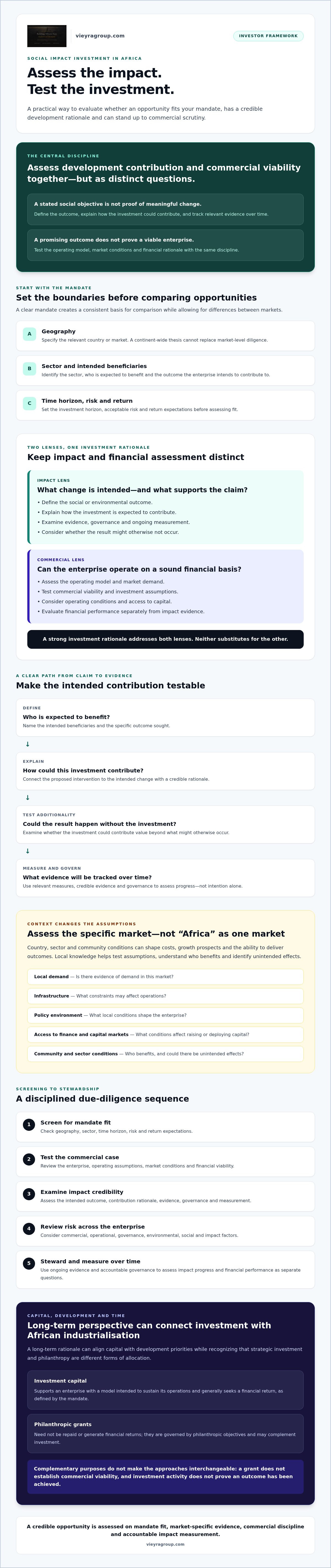
From Screening to Stewardship: A Due-Diligence Process for African Impact Investing
Investment diligence should continue beyond the decision to commit capital. A structured process establishes what must be verified before approval, who is accountable for ongoing evidence and how material changes will be addressed. For social impact investment Africa, this discipline matters because market conditions and delivery capacity can change the assumptions behind an opportunity.
- 1. Define the mandate. Record eligible geographies and sectors, intended outcomes, investment horizon, risk tolerance and return expectations. Set clear criteria for advancing or declining an opportunity.
- 2. Screen the proposal. Confirm that the enterprise and its intended outcomes fit the mandate. Identify information gaps and assumptions requiring validation before deeper diligence.
- 3. Conduct integrated diligence. Assess the commercial model, use of capital, operating capacity, management and governance. Review relevant financial, operational, environmental, social and impact evidence, including the baseline and proposed measurement approach.
- 4. Examine local and stakeholder risks. Consider country- and sector-specific conditions, stakeholder perspectives and potential unintended consequences. Review applicable legal or regulatory questions with qualified advisers familiar with the relevant jurisdiction. Make risk review proportionate to the investment and attentive to local conditions, including the principles involved in sovereign investment risk management in Africa.
- 5. Approve with documented conditions. Record the investment rationale, unresolved uncertainties, responsibilities, selected indicators and escalation procedures. Approval should reflect both the financial case and the evidence supporting the intended outcomes.
- 6. Monitor, escalate and reassess. Agree with the investee who collects and verifies data, how concerns are raised and when performance is reviewed. Compare observed evidence with the baseline, document material changes and revisit assumptions when market or operating conditions shift.
Stewardship after deployment
Monitoring works best when responsibilities and review intervals are agreed before deployment, rather than improvised after concerns arise. Investors and investees should know which indicators will be reported, who is responsible for the underlying data and what evidence warrants escalation or a change in approach. Ongoing stakeholder engagement helps investors understand whether delivery remains relevant and whether unintended effects have emerged.
Philanthropic activity may complement investment by supporting shared development priorities, but its mandate and accountability should remain distinct from those of investment capital. Vieyra Family Office’s philanthropic work through the Vieyra Foundation is institutionally distinct from its investment-management focus. To consider Vieyra’s perspective on long-term capital and African industrialisation, explore its investment approach.
How Vieyra’s Long-Term Perspective Connects Capital and African Development
Vieyra Family Office is a multi-generational African family office operating at a sovereign scale, with a stated focus on global investment management and African industrialisation. This institutional context offers a perspective on how capital allocation may consider economic development alongside investment discipline. It does not, by itself, establish that a particular investment has achieved social outcomes or that an opportunity will meet its financial objectives.
In social impact investment Africa, a long-term orientation can shape how investors consider stewardship, governance and strategic priorities across investment horizons. Patient ownership may give decision-makers room to assess how an enterprise develops and whether its direction remains consistent with its mandate. It does not remove market, execution or measurement risks. Those require ongoing scrutiny, credible evidence and a willingness to revise assumptions as circumstances change.
What a multi-generational perspective can contribute
A longer horizon can create room to weigh an enterprise’s contribution to African industrialisation alongside its commercial rationale, rather than focusing solely on near-term milestones. It can also support continuity in governance and capital allocation, provided objectives, accountability and review processes remain clear. The time horizon is a lens for decision-making, not evidence of impact or a substitute for financial and operational diligence.
Vieyra’s investment-management activity should be understood separately from the Vieyra Foundation, which pursues philanthropic initiatives aligned with its investment strategy. Philanthropy and investment may share development priorities, yet they have distinct mandates: grants need not seek financial returns, while investment decisions must be assessed against their own financial and impact objectives. Neither should be presented as proof of the other’s results.
How to explore a potential institutional conversation
Before considering whether an institutional approach is relevant, clarify the proposed geography, sector, investment objectives, time horizon and expectations of any potential partnership. A well-defined mandate makes it easier to assess alignment and identify questions requiring further diligence, without assuming that alignment guarantees investment, access or outcomes.
Readers seeking broader context may explore Vieyra’s perspective on global investment management for sovereign-scale family offices through its homepage. Review its stated institutional focus, then consider how that perspective relates to the investment criteria and evidence standards in this guide. Any assessment of a specific opportunity should rest on verified information about that opportunity, not institutional context alone.
Build a More Disciplined Approach to Long-Term Impact
Credible social impact investment Africa opportunities require more than a compelling development thesis. They call for a clear mandate, market-specific diligence and an explicit connection between investment activity and intended outcomes. Assessing financial viability separately from impact evidence, then monitoring both over time, helps investors make informed decisions without treating potential as proof.
A multi-generational perspective can bring economic development into long-term capital allocation while retaining the need for sound governance, commercial discipline and ongoing measurement. Vieyra Family Office is an African family office operating at a sovereign scale, with a stated focus on global investment management and African industrialisation. The Vieyra Foundation pursues philanthropic initiatives aligned with that investment strategy, while remaining distinct from investment-management activity. These institutional priorities offer context, not evidence of specific project outcomes.
To learn more about this perspective on capital and African development, explore Vieyra Family Office’s institutional approach. A rigorous, locally informed process can help investors pursue development objectives with greater clarity and care.
Frequently Asked Questions
What is social impact investment in Africa?
Social impact investment in Africa deploys capital with an explicit intention to contribute to defined social or environmental outcomes, alongside financial objectives and accountable measurement. It differs from conventional investing, where social benefits may be incidental, and from grants, which need not seek financial returns. In practice, investors specify the intended outcome, assess how the investment may contribute and examine evidence in the context of the relevant country, sector and community.
Can social impact investment in Africa generate financial returns?
Yes, social impact investments may seek financial returns, but neither the impact objective nor the investment label guarantees a particular result. Financial prospects depend on the enterprise’s business model, market conditions, execution, governance, investment terms and other risks. Assess the commercial case independently from the impact rationale, including projected demand, operating assumptions, capital requirements and downside scenarios. Monitor both returns and impact against clearly defined objectives over the investment period.
How do investors measure social impact?
Investors define the intended outcome, target population, timeframe and measurement method before deployment, then establish a baseline and monitor selected indicators consistently. Distinguish outputs, such as services delivered, from outcomes, such as changes in access, and longer-term impact. Activity counts alone do not prove lasting change. Assessment should also consider whether observed changes can reasonably be linked to the enterprise or investment, while documenting other influences and limitations in the available evidence.
What sectors attract social impact investment in Africa?
Areas of activity include renewable energy, climate-smart agriculture, financial inclusion and fintech, healthcare, and digital infrastructure. Their relevance and investment potential vary by country and market, so sector interest is not proof that a specific opportunity is viable or impactful. Test local demand, operating conditions, capital needs, intended beneficiaries and outcome evidence. A clear mandate helps determine which sectors align with investment objectives and development priorities.
What is additionality in impact investing?
Additionality asks whether an investment contributes to outcomes that are unlikely to occur, or would occur differently, without that capital or investor involvement. An investor might assess whether funding enables an enterprise to serve a population, expand a service or improve delivery in a way that would otherwise be less likely. Support the claim with a reasoned explanation and evidence. The presence of investment alone does not demonstrate additionality.
How can investors reduce risk in African impact investments?
Investors can strengthen risk management through country- and sector-specific diligence rather than relying on continental generalizations. Examine the business model, management capacity, governance, capital use, infrastructure, currency exposure, policy conditions and relevant legal or regulatory questions with qualified advisers. Engage local stakeholders, test downside scenarios, clarify reporting and escalation responsibilities, and monitor assumptions after deployment. These practices support informed decisions but cannot eliminate market, execution or impact-measurement risk.


