

A country-risk score can be precise and still leave important questions unanswered. Cross-border investment risk management must account for how political, regulatory, currency, legal, and operational exposures interact over an investment’s life. Treating jurisdictional risk as a one-time screening exercise can miss changes in the project, its counterparties, or the conditions around it.
Institutional investors understand that international opportunities carry distinct uncertainties. The challenge is to compare exposures consistently across markets and asset classes, clarify what protections may apply if disputes arise, and ensure that near-term controls do not undermine long-horizon industrial or development objectives. Meeting that challenge requires more than a country rating. It calls for disciplined oversight, traceable evidence, and clear accountability.
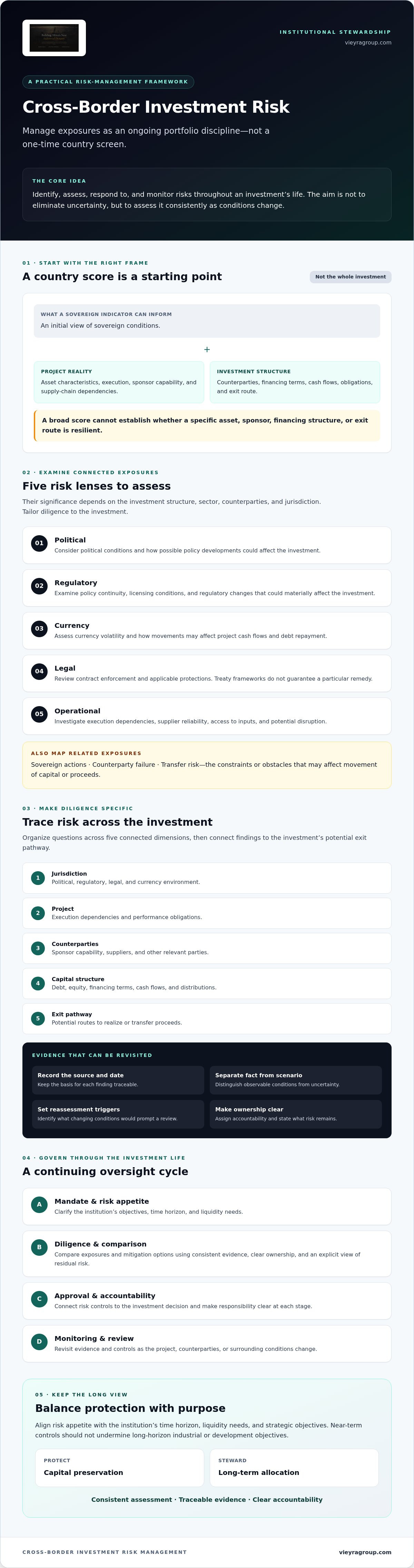
This guide presents a practical framework for identifying, comparing, and governing cross-border investment risks in a way that supports enduring capital. It covers key exposure categories, diligence and monitoring processes, and the governance that connects risk controls to capital preservation and institutional mandates. The aim is not to eliminate uncertainty, but to assess it consistently and steward investment decisions as conditions change.
Key Takeaways
- Approach cross-border investment risk management as an ongoing portfolio discipline, not a one-time assessment of a country or market.
- Assess political, regulatory, currency, legal, and operational exposures across the investment, its counterparties, and its exit pathway.
- Compare mitigation options using consistent evidence, clear ownership, and an explicit view of the risk that remains.
- Establish accountability at every stage, from the initial mandate and diligence through approval, monitoring, and review.
- Align risk appetite with the institution’s time horizon, liquidity needs, and strategic objectives so that capital preservation and long-term allocation remain in balance.
What Cross-Border Investment Risk Management Covers, and Why It Matters
Cross-border investment risk management is the continuing process of identifying, assessing, responding to, and monitoring exposures that may affect an investment across jurisdictions. It informs whether and how to commit capital, which safeguards to consider, and when changing conditions call for a review. It cannot eliminate risk and is not the same as legal dispute resolution. Dispute resolution addresses a disagreement; risk management considers a broader range of threats before and throughout an investment.
Risk management also extends beyond country-risk ratings. A rating can inform an initial view of sovereign conditions, but it does not establish whether a particular asset, sponsor, financing structure, or exit route is resilient. Jurisdiction, asset characteristics, counterparties, financing terms, and investment horizon interact. Currency movements, for example, may affect project cash flows and debt repayment differently depending on the currencies in which revenue and obligations are denominated.
Which risks can cross-border investors encounter?
Relevant exposures include political and regulatory change, currency volatility, sovereign actions, counterparty failure, operational disruption, and transfer risk, meaning constraints or obstacles affecting the movement of capital or proceeds. Their significance depends on the investment structure, sector, counterparties, and jurisdiction. No general checklist can replace diligence tailored to the investment.
For an African industrial project, an institution might examine the reliability of critical suppliers, access to imported inputs, the sponsor’s capacity to execute, and how currency movements could affect long-term financing. These are questions to investigate, not assumptions about a country or project. Record the source and date of evidence, and distinguish observable conditions from uncertain scenarios.
Why does a country score not tell the whole story?
Sovereign indicators describe one layer of exposure. Project execution, sponsor capacity, supply-chain dependencies, contract terms, and financing arrangements can create risks that a national average does not capture. Conditions may also vary by region and sector within a country, so a broad score is only a starting point for assessing a specific investment.
Legal protections require similarly careful analysis. International investment agreements describe one category of treaty framework relevant to cross-border investment, but their relevance depends on the parties, investment, and applicable instruments. Their existence does not guarantee a particular remedy. For a focused African institutional perspective, see this sovereign investment risk management framework.
How to Assess Political, Regulatory, Currency, and Operational Exposure
Effective cross-border investment risk management turns broad concerns into questions about the proposed investment. Organize diligence across five connected dimensions: jurisdiction, project, counterparty, capital structure, and exit pathway. For each finding, record the evidence source and date, separate observed conditions from uncertain scenarios, and identify what would prompt reassessment. This produces a decision record that can support subsequent monitoring, rather than a static collection of country information.
- Jurisdiction: Identify the relevant political, regulatory, legal, and currency environment.
- Project and counterparties: Examine execution dependencies, sponsor capability, suppliers, and performance obligations.
- Capital structure and exit: Map debt, equity, cash flows, distributions, and potential routes to realize or transfer proceeds.
How should political and regulatory exposure be examined?
Assess policy continuity, licensing conditions, contract enforcement, and regulatory changes that could materially affect the investment. A general political outlook is not a forecast. Instead, use scenarios to test how different policy developments could affect project economics, obligations, or timing. Research on assessing political and policy risk can help frame the importance of uncertainty without suggesting that a particular outcome is predictable.
Before relying on treaty protections, sanctions analysis, or local regulatory interpretations, seek qualified legal advice and verify current requirements for the relevant jurisdictions, counterparties, and transaction. Applicability depends on the facts and governing instruments. A general reference or country assessment cannot settle that question.
How do currency and operating risks affect project viability?
Map revenues, input costs, debt service, and distributions by currency and expected timing. Compare the currencies and timing of incoming cash with repayment and transfer obligations, then test how plausible exchange-rate changes could affect liquidity and project capacity. A currency mismatch can weaken otherwise sound project economics when revenues and obligations respond differently to exchange-rate changes.
Operational diligence should trace dependencies that could interrupt delivery or cash generation, including concentrated suppliers, infrastructure access, and counterparty performance. For an industrial project, assess whether disruption to a critical imported input could delay production and affect the ability to meet financing obligations. Keep the evidence for each exposure separate from scenario assumptions, and revisit both when conditions or project arrangements change.
These assessments are stronger when investment, finance, legal, and operating perspectives inform a shared decision record. Institutions considering how cross-border exposure connects with long-horizon allocation can explore Vieyra’s global investment management perspective.
How to Compare Risk Controls, Structures, and Mitigation Options
Mitigation choices are easier to compare when they use the same record of exposure. A single risk score can hide whether a concern is supported by evidence, who is responsible for it, and how much risk remains after a control is applied. For disciplined cross-border investment risk management, use a comparison matrix that makes these details explicit:
| Exposure | Evidence | Likelihood | Impact | Control | Owner | Residual risk |
|---|---|---|---|---|---|---|
| Illustrative: critical supplier disruption | Supplier and supply-chain diligence, dated | Rated with rationale | Effect on delivery and cash flow | Alternative sourcing or contingency plan | Operating lead | Remaining interruption and recovery exposure |
This is an analysis template, not a finding about a particular project. Apply consistent rating definitions across investments, while preserving the underlying evidence and assumptions so decision-makers can see why assessments differ. The Comptroller's Handbook on Country Risk Management offers an institutional reference for organizing country-risk assessment and monitoring.
Which mitigation approaches address different kinds of exposure?
Match each control to the risk it can realistically influence. Operational contingency planning may reduce disruption from infrastructure or supplier interruptions. Counterparty diligence, performance monitoring, and contractual provisions can clarify responsibilities and responses if agreed obligations are not met. Contracts allocate rights and duties, but their practical value depends on enforceability and the parties’ ability to perform.
Diversification may reduce concentration in a single jurisdiction, asset, or counterparty, while financing design can help align obligations with projected cash flows. Insurance, including political risk insurance, and public risk-mitigation instruments may be relevant in some cases, but eligibility, exclusions, conditions, and claims processes vary. Verify current terms and legal applicability before treating a protection as available or sufficient.
How can investors compare structures without relying on one score?
Direct investment, co-investment, and project finance can allocate control, capital commitments, liquidity, and governance responsibilities differently. A structure that offers greater influence may also require deeper oversight. Shared ownership may broaden participation while making decision rights more complex. Compare each option with the investment mandate, monitoring capacity, concentration limits, and consequences of an impaired exit. Assess control, cost, flexibility, and enforceability together rather than treating any one feature as decisive.
For a portfolio-level perspective on these choices, see global investment management principles. The appropriate structure is one whose controls and remaining exposures are understandable, governable, and consistent with the institution’s objectives.
How to Put Cross-Border Investment Risk Management into Practice
A durable process gives each investment a clear path from strategic intent to ongoing oversight. Cross-border investment risk management should rely on documented evidence, defined responsibilities, and agreed escalation points, not informal judgments or a single assessment at the approval stage.
- Mandate: Define the investment’s purpose, time horizon, risk appetite, and decision authority.
- Screening: Identify material jurisdictional and investment-specific concerns that warrant deeper review.
- Diligence: Test the thesis, assumptions, counterparties, project requirements, and principal exposures.
- Structuring: Evaluate how ownership, financing, contractual terms, and governance shape risk and control.
- Approval: Present evidence, unresolved questions, proposed mitigants, and residual risks to authorized decision-makers.
- Monitoring: Track agreed indicators, operating and financial performance, and developments that may affect the original assessment.
- Review: Reassess controls and the investment thesis at planned intervals and when material changes arise.
Assign responsibility at each stage. Investment leads own the thesis and portfolio rationale; legal advisers assess relevant legal questions; finance teams evaluate capital needs and financial exposures; operating leads monitor execution and dependencies; and designated governance bodies approve decisions within their authority. Indicators inform judgment, but they are not decisions. An accountable owner must interpret them and determine the appropriate response.
What belongs in pre-investment due diligence?
The diligence record should set out the investment thesis, jurisdictional assumptions, material exposures, evidence gaps, and scenarios considered. Review counterparties, contracts, capital requirements, permitting considerations, and operational dependencies, involving qualified advisers where appropriate. For each proposed mitigant, state what it is intended to address, who will oversee it, and what risk remains. Decision-makers should be able to distinguish verified information from assumptions and unresolved issues.
How should risk be monitored after capital deployment?
Monitoring should connect leading indicators with financial performance and changing operating conditions. Establish reporting cadence, escalation thresholds, documentation standards, and review responsibilities before an adverse development requires a decision. Thresholds might relate to a missed project milestone, a material counterparty change, or a financing assumption that no longer holds. The appropriate measures depend on the investment.
Revisit the assessment when regulations, counterparties, financing arrangements, or project milestones change. Record the rationale for decisions and any follow-up actions. Institutions considering how disciplined oversight supports long-horizon capital allocation can explore Vieyra’s global investment management.
Aligning Cross-Border Risk Decisions with Long-Term Institutional Stewardship
Institutional risk appetite should reflect the mandate it serves. Time horizon, liquidity needs, and concentration limits shape which exposures are acceptable, how much capital can remain committed, and what conditions warrant reconsideration. A long investment horizon may lead an institution to view temporary volatility differently from an investor with near-term liquidity needs. It does not remove uncertainty or excuse weak oversight.
Stewardship requires balancing capital preservation with strategic allocation. Avoiding every uncertain market may reduce some exposures while limiting investments that support durable economic activity. For African industrialization, assess each project on its own merits: consider whether its resilience, financing, and operating requirements fit the institution’s objectives and its capacity to remain engaged through changing conditions. This does not presume that risk should be accepted. It provides a basis for judging risk against purpose and resources.
How do governance and investment horizons shape risk decisions?
Sound cross-border investment risk management depends on durable decision rights: who may approve commitments, who oversees material exposures, and how decisions and assumptions are documented. Clear records support continuity when committee membership or generations change. They preserve the reasoning behind an investment while leaving past judgments open to review. Longer horizons can shift attention toward project milestones, operating resilience, and the ability to sustain oversight, but uncertainty remains. For related guidance, see family office governance for wealth preservation.
What should an institution do before proceeding?
Before committing capital, decision-makers should be able to answer six questions:
- Thesis: Is the investment rationale consistent with the mandate and long-term objectives?
- Exposure: Are material jurisdictional, project, counterparty, financing, and exit risks understood?
- Evidence: Are key claims supported by current, traceable information, with gaps made explicit?
- Controls: Do proposed protections address the identified exposures, and what risks remain?
- Ownership: Are decision authority, monitoring responsibilities, and escalation routes clear?
- Review: Are there defined events or conditions that will trigger reassessment?
Qualified legal, tax, financial, and local operating advisers can help evaluate matters that depend on jurisdiction or transaction details. Their analysis should inform, not replace, the institution’s own accountable decision-making. Vieyra Family Office’s stated focus includes global investment management and strategic capital for African industrialization, an institutional context for considering long-horizon allocation without implying a particular method or outcome. Explore Vieyra’s global investment management perspective.
Make Risk Governance a Foundation for Enduring Investment
Cross-border investment risk management works best as a continuing institutional discipline: assess exposures in the context of the specific investment, compare controls and residual risks consistently, and assign clear ownership for decisions and ongoing review. Country-level indicators can inform judgment, but they cannot replace project-specific evidence, qualified advice, or governance aligned with the institution’s mandate.
For long-horizon capital, preservation and strategic allocation need not be opposing aims. A considered framework helps institutions evaluate uncertainty while remaining attentive to liquidity, concentration, and the purpose of committed capital. That balance matters especially when investment decisions intersect with long-term industrial development.
Vieyra Family Office is a multi-generational African family office operating at sovereign scale, with global investment management and a focus on African industrialization. For an institutional perspective on capital allocation across markets, explore Vieyra Family Office’s global investment perspective. Sound governance and disciplined analysis can help institutions approach complex cross-border decisions with greater clarity.
Frequently Asked Questions
What is cross-border investment risk management?
Cross-border investment risk management is the ongoing process of identifying, assessing, responding to, and monitoring exposures that may affect an investment across jurisdictions. It considers how political, regulatory, currency, legal, operational, counterparty, and transfer risks interact with the asset, its financing, and its time horizon. The purpose is to inform decisions and oversight, not to eliminate uncertainty or replace qualified legal advice.
What are the main risks of cross-border investing?
Key risks include political or regulatory change, currency movements, sovereign actions, counterparty failure, operational disruption, and difficulty transferring capital or investment proceeds. Legal protections and dispute mechanisms can also vary according to the investment and relevant jurisdictions. Which exposures matter most depends on the asset, sector, project structure, counterparties, and financing. Supplement broad country assessments with investment-specific diligence.
How can investors assess political risk in a foreign market?
Assess political risk by examining policy continuity, regulatory developments, licensing conditions, contract enforcement, and other factors relevant to the investment. Use dated evidence from credible sources, distinguish observable conditions from uncertain scenarios, and consider how alternative developments could affect project operations, financing, or cash flows. Do not treat a political outlook as a prediction. Consult qualified legal and local advisers to verify current jurisdiction-specific requirements and protections.
How do investors manage foreign currency risk?
Begin by mapping expected revenue, operating costs, debt service, and distributions by currency and timing. Compare the currencies of incoming cash with those of financing obligations to identify mismatches that could affect liquidity or repayment capacity. Investors may consider measures such as currency diversification or forward contracts, which set an exchange rate for a specified future transaction. Suitability depends on the investment, available instruments, costs, and governing requirements.
Does political risk insurance protect every cross-border investment?
No. Political risk insurance does not automatically cover every investment or adverse event. Coverage depends on the policy’s eligibility criteria, covered risks, exclusions, limits, conditions, and claims process; terms can vary by provider and transaction. Examine the actual policy wording and confirm whether the specific investment, counterparties, and relevant events qualify. Insurance may mitigate defined exposures, but it cannot remove all political, commercial, or operational risk.
How often should cross-border investment risks be reviewed?
Review risks on a defined schedule established for the investment, and reassess sooner when a material change could affect the original analysis. Triggers may include regulatory developments, a change in counterparty, revised financing assumptions, missed project milestones, or altered operating conditions. Establish reporting cadence, escalation thresholds, and accountable owners in advance. The appropriate review frequency depends on the investment’s characteristics, risk profile, and institutional mandate.
How can investors compare risks across different countries?
Use consistent categories and rating definitions, but compare evidence rather than relying on a single country score. For each investment, document the exposure, evidence and date, likelihood, potential impact, proposed control, accountable owner, and residual risk. Assess project, counterparty, financing, and exit-pathway factors alongside sovereign indicators. This supports meaningful comparison across jurisdictions while preserving the distinctions that make each investment and its context unique.


