

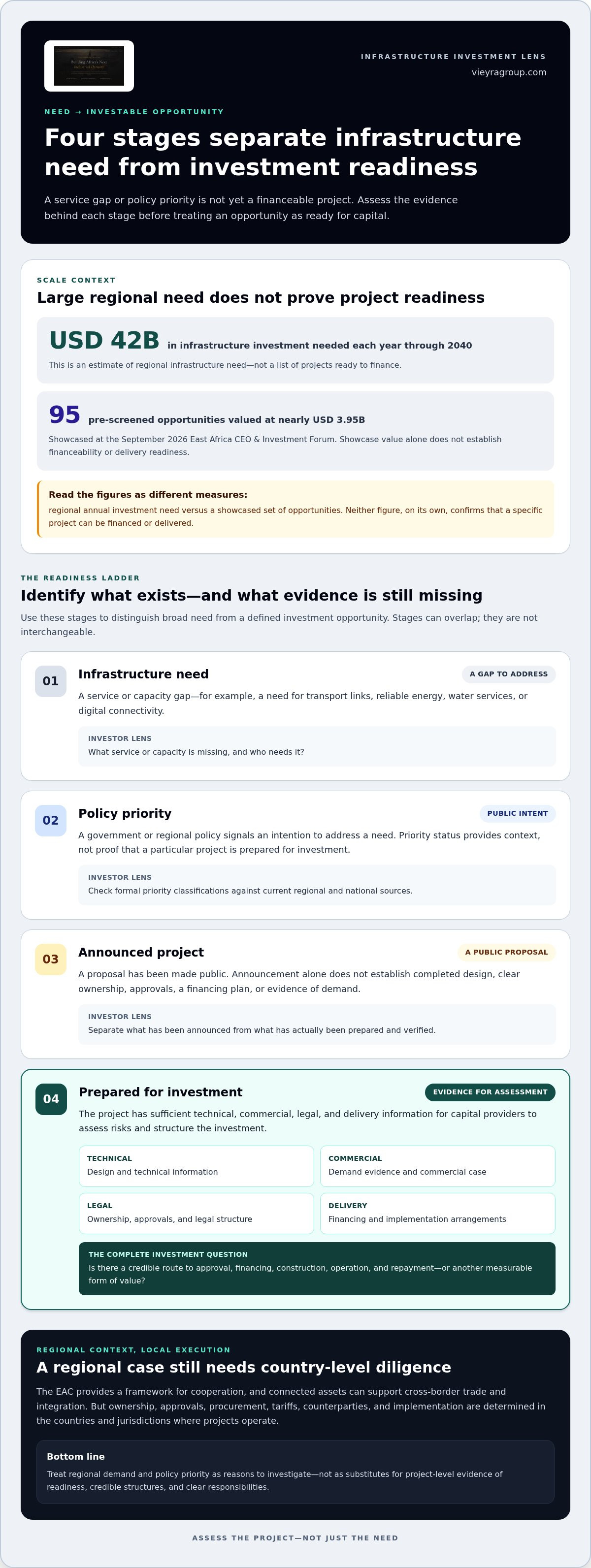
A regional infrastructure requirement is not the same as an investable project pipeline. East Africa is estimated to need USD 42 billion in infrastructure investment each year through 2040, while 95 pre-screened opportunities valued at nearly USD 3.95 billion were showcased at the September 2026 East Africa CEO & Investment Forum. These figures frame the scale of EAC infrastructure investment opportunities, but they do not establish which projects are ready to finance or deliver.
Investors need to look beyond regional priority lists: cross-border ambitions can conceal distinct country-level regulations, financing arrangements, and execution risks. The decisive question is where demand aligns with project readiness, credible structures, and a clear allocation of public and private responsibilities. This guide compares transport, energy, digital, and other essential infrastructure using a consistent investment framework. It outlines the diligence questions that distinguish strategic need from executable opportunity and considers how patient, strategic capital can complement public and development finance through disciplined allocation, industrialisation, and long-term value.
Key Takeaways
- Assess EAC infrastructure investment opportunities by separating long-term need and policy priorities from projects with evidence of investment readiness.
- Compare transport, energy, water, and digital infrastructure through demand, revenue logic, dependencies, readiness, and principal risks rather than relying on sector rankings.
- Evaluate how project finance, public-private arrangements, direct asset investment, and blended capital allocate construction, demand, policy, currency, and operating risks.
- Use a structured diligence sequence to distinguish regional integration exposure from country-level regulatory, sovereign, counterparty, currency, and delivery risks.
- Consider patient strategic capital where mandate fit, project fundamentals, governance, and contribution to long-term industrialisation align.
What EAC infrastructure investment opportunities actually include
An infrastructure need describes a gap; an investment opportunity is a defined asset or project with a credible route to approval, financing, construction, operation, and repayment or other measurable value. This distinction is central to assessing EAC infrastructure investment opportunities. A substantial regional or national need, or a policy identifying it as a priority, does not mean a project has a completed design, clear ownership, approvals, a financing plan, or evidence of demand.
Separate the opportunity into four stages. An infrastructure need is a service or capacity gap. A policy priority signals public intent to address it. An announced project is a proposal made public, but that does not establish its readiness. A project prepared for investment has sufficient technical, commercial, legal, and delivery information for capital providers to assess its risks and structure. These stages can overlap, but they are not interchangeable.
Which infrastructure assets fall within the EAC opportunity landscape?
The landscape for investigation includes transport and logistics assets, energy generation and networks, water and sanitation systems, and digital connectivity. Each can support economic activity in a different way: by reducing freight bottlenecks, enabling reliable production, extending essential services, or connecting firms and markets. The EAC Investment Guide places infrastructure among broad areas of investment interest, but a sector’s inclusion is context, not evidence that a particular project is finance-ready. Check formal priority classifications against current regional and national sources.
The East African Community (EAC) provides a regional framework for cooperation among Partner States. That framework can shape demand for connected assets, while ownership, approvals, procurement, tariffs, counterparties, and implementation are determined in the countries and jurisdictions where projects operate.
Why regional demand does not equal project bankability
Cross-border trade and integration can strengthen the case for infrastructure connecting production centres, markets, and essential networks. But the economic rationale for a corridor or regional system must be supported by project-level evidence. Investors need to know who will use the asset, how revenue or public payments will be generated, which approvals are in place, and who is responsible for construction and operation. Regional coordination can support cooperation and capital mobilisation, but it does not replace these fundamentals.
Treat regional demand as a reason to investigate, not as a substitute for diligence. Country-specific fiscal capacity, regulation, currency exposure, counterparties, and delivery conditions can materially change a project’s risk profile. For broader context on how long-term capital can support industrial development, see The Mandate for Private Capital in African Industrialization.
Which EAC infrastructure subsectors merit closer investment comparison?
Transport, energy, water, and digital connectivity serve distinct economic functions. Compare them by starting with each asset’s demand base and revenue mechanism, not an assumed sector ranking. A road or logistics facility may depend on freight volumes and network links; an energy asset on offtake and grid access; a water system on service demand and payment arrangements; and digital infrastructure on connectivity needs, access, and operating performance. In every case, the evidence needs to be specific to the project.
The framework below sets out questions for investigation, not assurances of readiness. Readiness evidence should be current, independently reviewable, and appropriate to the asset and jurisdiction.
| Subsector | Demand driver | Revenue logic | Dependencies | Readiness evidence | Principal risks |
|---|---|---|---|---|---|
| Transport and logistics | Freight or passenger use, trade flows, and network bottlenecks | User charges, access fees, or contracted public payments, where applicable | Connected networks, land access, border coordination, construction and operating capacity | Verified demand analysis, route and design studies, land and approval status, delivery plan | Construction, demand, operating, land, and cross-jurisdiction coordination risk |
| Energy | Household, commercial, and industrial electricity or fuel needs | Offtake or other documented payment arrangements | Generation or supply, transmission and distribution access, counterparties, operations | Technical studies, documented offtake, network access, approvals, and implementation plan | Construction, payment, policy, currency, and system-integration risk |
| Water and sanitation | Urban, industrial, and community service requirements | Tariffs, service payments, or public payment arrangements | Water sources, treatment and distribution systems, maintenance, accountable operators | Source and engineering studies, service-area demand, approvals, operating and payment plans | Resource availability, affordability, collection, operating, and public-counterparty risk |
| Digital infrastructure | Connectivity requirements of firms, institutions, and households | Capacity, access, or service revenues, subject to a viable operating model | Network interconnection, power, rights of way, technology, skilled operations | Demand and coverage analysis, interconnection arrangements, approvals, operating plan | Execution, adoption, technology, regulatory, and counterparty risk |
Assess networks and enabling assets together
Analyze corridors as connected systems. A transport link’s value depends on freight or passenger use, connections beyond its boundaries, and coordination across jurisdictions. Treat named corridors or projects as examples only when current official documentation establishes their status. Land access, construction sequencing, operating responsibility, and border processes can each affect delivery.
Reliable utilities and connectivity can enable manufacturing and regional value chains, but they are not manufacturing investments themselves. Energy supports production; water underpins industrial and urban services; digital networks enable communications and data exchange. The African Development Bank identifies improving regional infrastructure as a strategic focus in its East Africa integration work, useful context when considering patient strategic capital.
Suitability depends on a project’s cash flows and execution conditions, not on its subsector alone. For a broader perspective on disciplined capital allocation and industrial development, explore Vieyra’s strategic capital perspective.
How should investors compare EAC infrastructure investment structures?
Structure determines how project cash flows, contractual rights, and responsibilities are arranged, but it does not remove underlying risk. For EAC infrastructure investment opportunities, compare who funds and controls the asset, what income supports repayment or returns, and which party bears losses if delivery, demand, policy, currency, or operations diverge from plan. Use the allocation below as a review framework, not as a substitute for project agreements.
Project finance, public-private partnerships, and direct investment
In project finance, repayment generally relies on project cash flows, with lenders’ rights and sponsor support defined by financing documents. In a public-private partnership, public and private parties allocate obligations through a long-term arrangement. It is one possible model, not an automatic improvement over other structures. Direct asset investment gives an investor ownership exposure, with influence and responsibilities shaped by the asset and transaction documents.
- Project finance: Construction risk may rest with project sponsors and contractors under delivery agreements; demand and operating risks affect the cash available for repayment. Policy and currency exposure depend on the project’s contracts, revenues, and financing.
- Public-private arrangements: Construction, demand, and operating responsibilities are allocated contractually between public and private parties. Public payment commitments or policy actions may affect risk, while currency exposure depends on the project’s revenue and obligations.
- Direct asset investment: The investor’s exposure follows its ownership position and rights. Construction and operating responsibilities may be retained, delegated, or shared; demand, policy, and currency risks depend on the asset’s commercial arrangements and jurisdiction.
- Blended capital: Public, development, and private capital may be combined to address different project needs or risk tolerances. The documents must show each provider’s role and exposure; the label itself does not establish who ultimately bears any risk.
Before assessing a proposed structure, examine project cash-flow assumptions, sponsor capacity, guarantees or support obligations, termination provisions, payment mechanisms, and the allocation of currency risk. Verify applicable country laws and procurement requirements against current official sources, since rules and procedures can differ by jurisdiction.
When development and strategic capital can complement private investment
Public capital may support enabling infrastructure or public-service obligations; development finance institutions may provide financing or risk participation consistent with their mandates; and private investors may contribute capital, operating expertise, or long-term ownership. The African Development Bank's Regional Integration Strategy Paper identifies improving regional infrastructure as a strategic priority, but that priority does not establish a commitment to any specific project.
Assess whether each provider’s time horizon, return expectations, and risk tolerance align with construction duration, demand uncertainty, and operating requirements. The right structure is the one whose documented allocation is credible in the relevant jurisdiction and consistent with the investor’s mandate. For a broader framework on sovereign exposure, see Sovereign Investment Risk Management in Africa.
What diligence helps distinguish EAC infrastructure potential from execution risk?
Policy announcements, regional strategies, and investment catalogues can identify areas for investigation, but they are leads, not substitutes for project documents. For EAC infrastructure investment opportunities, disciplined screening tests whether a strategic rationale is backed by evidence of demand, defined responsibilities, credible approvals, and a practicable delivery plan. Regional integration may strengthen an asset’s economic case, while country-level conditions still shape execution.
Project readiness requires evidence across approvals, counterparties, and delivery. A gap in any one of these areas can change the project’s risk profile, regardless of its stated regional importance.
A practical sequence for screening project readiness
- Test mandate fit. Establish whether the project’s sector, geography, duration, and development purpose align with the investor’s mandate and risk tolerance.
- Verify demand and scope. Review the underlying service need, intended users, demand evidence, asset boundaries, and stated project objectives. Distinguish documented demand from projections or policy intent.
- Assess the sponsor and counterparties. Identify the project sponsor, public entities, operators, contractors, offtakers, and payment counterparties. Examine their defined responsibilities and capacity to perform them.
- Review technical and site preparation. Examine feasibility work, design assumptions, land access, permits, and environmental and social assessments. Check whether unresolved requirements could alter scope, cost, or schedule.
- Examine commercial, legal, and financing arrangements. Review procurement status, revenue or payment mechanisms, material contracts, financing plans, and allocation of key risks. Verify applicable requirements against current official sources in the relevant jurisdiction.
- Confirm execution status. Compare the latest project information with official national and regional sources. Establish what has been completed, what remains outstanding, and who is accountable for the next steps.
Separate country exposure from cross-border dependencies
Regional integration risk concerns whether an asset depends on coordinated movement, interconnected networks, or action across jurisdictions. Non-tariff barriers and coordination gaps may affect projects whose use depends on cross-border flows. These risks differ from sovereign exposure, regulatory implementation, currency movements, counterparty payment security, public-sector obligations, and construction delivery. Analyze each separately, then assess how they interact.
Strong oversight helps maintain this distinction through investment decisions and subsequent monitoring. A clear record of assumptions, unresolved diligence, decision rights, and review triggers supports disciplined capital allocation. Family Office Governance for Wealth Preservation offers related context on governance and decision discipline.
Apply this sequence to move from regional potential to a project-specific view of readiness and risk. Explore Vieyra’s strategic capital perspective on long-term investment and African industrialisation.
How can patient strategic capital contribute to EAC infrastructure development?
Patient capital can be relevant where infrastructure requires sustained investment and its economic contribution develops over a long horizon. Its potential role depends on disciplined allocation, not duration alone. Assess each opportunity against four connected considerations: mandate fit, project readiness, risk allocation, and contribution to productive economic activity. EAC infrastructure investment opportunities are more compelling when these factors reinforce one another, not simply because an asset serves a regional priority.
Aligning project horizons with institutional capital
Infrastructure may take time to construct, establish demand, and generate operating income. Capital providers therefore need to consider expected holding periods alongside liquidity requirements, governance rights, and the capacity to oversee a project through changing conditions. A long investment horizon can accommodate extended development phases, but it does not resolve weak project preparation, unclear accountability, or unsuitable financing arrangements.
Strategic relevance also depends on an asset’s relationship to wider economic activity. Reliable power, water, transport, or digital connectivity may support manufacturing and regional value chains, but that connection is a rationale for analysis, not a promise of industrial growth or financial performance. Examine whether the project’s scope, counterparties, operating model, and cash-flow assumptions support its intended role. The Principles of Global Investment Management for Sovereign-Scale Family Offices offers broader context on institutional investment discipline.
From regional thesis to disciplined next steps
Before advancing an assessment, assemble a coherent evidence base: the project’s mandate fit and defined scope; documented demand; sponsor and counterparty responsibilities; current technical studies and site status; applicable approvals and procurement information; commercial and financing arrangements; and a clear account of construction, currency, policy, and operating exposures. For cross-border assets, include evidence on network connections and coordination dependencies. This record helps distinguish a durable development case from unresolved execution assumptions.
Vieyra Family Office brings a multi-generational African institutional perspective to global investment management, with a focus on African industrialisation. It manages global investments across asset classes and deploys strategic capital to support long-term growth projects and economic development. This perspective frames infrastructure as part of a broader development system, while leaving each project subject to its own governance, readiness, and risk assessment. Patient, strategic capital can complement public and development finance where project fundamentals and oversight support a long-term commitment; it cannot substitute for them.
Vieyra Family Office’s institutional approach connects long-term investment management with strategic capital allocation and African industrialisation.
Turn Regional Potential into Disciplined Investment Decisions
Regional demand and policy priorities are starting points, not evidence of a financeable project. Assess EAC infrastructure investment opportunities by comparing subsectors against consistent commercial and delivery criteria, then examine how each structure allocates risk across public and private parties. Project-level diligence should establish demand, approvals, counterparties, financing, and execution responsibilities before capital decisions advance.
Patient strategic capital may contribute where a project’s readiness, governance, risk profile, and connection to long-term development align. This perspective is especially relevant when infrastructure supports the wider systems on which industrialisation depends. A regional thesis does not replace country-specific analysis.
Vieyra Family Office is a multi-generational African institution operating at sovereign scale, with global investment management focused on African industrialisation. It deploys strategic capital into large-scale industrialisation projects and sovereign-level initiatives. Its long-term development perspective informs disciplined capital allocation. Explore Vieyra Family Office’s approach to strategic capital allocation and African industrialisation.
Frequently Asked Questions
What are the main EAC infrastructure investment opportunities?
The main areas for assessment include transport and logistics, energy, water and sanitation, and digital connectivity. These assets can support regional trade, industrial activity, urban services, and access to essential networks. A sector’s importance does not establish that a particular project is investable. Assess each opportunity through documented demand, revenue or payment arrangements, project readiness, country conditions, and the allocation of construction and operating responsibilities.
Is EAC infrastructure investment attractive to institutional investors?
EAC infrastructure may suit institutional investors whose mandates, time horizons, and risk tolerances align with individual project fundamentals. The region’s infrastructure needs and integration ambitions provide context for investment analysis, but they do not establish bankability or expected performance. Examine project cash flows, sponsor capacity, approvals, counterparties, governance, currency exposure, and execution plans. Patient capital may have a role where these elements support a durable investment case.
Which EAC countries offer the strongest infrastructure opportunities?
There is no single country ranking that applies across every infrastructure subsector or project. Investment has been uneven, with Kenya, Tanzania, Rwanda, and Uganda attracting the majority of funding, while Burundi and South Sudan have lagged, according to the research cited in this guide. These patterns provide context, not a recommendation. Compare each country’s project pipeline, regulatory conditions, counterparties, financing arrangements, and delivery evidence before drawing conclusions.
How can investors find EAC infrastructure projects?
Investors can use official national and regional sources, investment catalogues, public procurement information, and development institution materials to identify potential projects. The East Africa Investment Projects Catalogue, launched in September 2026, and opportunities presented at regional investment forums can provide leads. Treat listings as starting points rather than proof of readiness. Verify current project status, ownership, approvals, financing arrangements, and supporting documentation against authoritative sources.
What are the main risks of investing in EAC infrastructure?
Key risks include construction delays, weaker-than-expected demand, uncertain operating performance, currency exposure, regulatory implementation, sovereign and counterparty risk, and unclear public-sector obligations. Projects relying on cross-border movement may also face coordination challenges and non-tariff barriers. Assess these exposures separately because regional integration risk does not replace country-level analysis. Review how contracts allocate each risk and whether the responsible parties have the capacity to manage it.
What financing structures are used for infrastructure investment in East Africa?
Structures may include project finance, public-private partnerships, direct asset investment, and blended arrangements combining public, development, and private capital. Their suitability depends on project cash flows, contractual rights, sponsor responsibilities, jurisdiction, and investor mandate. A partnership structure is not automatically preferable, nor does blended financing itself eliminate risk. Review who bears construction, demand, policy, currency, and operating exposures, and confirm applicable legal and procurement requirements using current official sources.
What should investors review before committing capital to an EAC infrastructure project?
Review mandate fit, documented demand, defined project scope, sponsor and counterparty capacity, feasibility work, land and permit status, procurement, environmental and social assessments, and the financing plan. Examine revenue or payment mechanisms, material contracts, governance, and allocation of key risks. Confirm the latest project status through official national and regional sources. A regional policy announcement or catalogue entry can prompt diligence, but cannot substitute for evidence of approvals, counterparties, and delivery readiness.


