
What makes capital sovereign-scale: the size of a fund, or the patience and purpose with which capital is stewarded? The phrase sovereign level capital solutions is used inconsistently. It can blur important distinctions between a government-owned fund, a conventional fundraising effort, and a long-term institutional approach to investment.
That ambiguity matters. Industrialization, resilient infrastructure, and other enduring development priorities require more than capital raised for a single transaction. They depend on alignment among strategic objectives, investment horizons, governance, and the institutions involved. Readers seeking clarity are right to ask how this approach differs from a sovereign wealth fund and what makes capital suitable for long-term development.
This article explains the characteristics of sovereign-scale capital and how capital structures and stewardship relate to strategic outcomes. It offers practical questions for assessing institutional alignment and project readiness, and considers the Vieyra Family Office as an example of a multi-generational African family office with a sovereign-scale orientation. Its global investment management and stated focus on African industrialization do not make it a government entity or sovereign wealth fund.
Key Takeaways
- Assess sovereign level capital solutions by how mandate, governance, risk, and investment horizon work together, rather than by the label attached to a fund or financing effort.
- Distinguish sovereign-scale stewardship from a sovereign wealth fund or conventional fundraising by examining who directs capital and what long-term objectives it is designed to serve.
- Use a structured evaluation to test whether an opportunity aligns with institutional priorities, has a credible duration and risk profile, and is ready for rigorous due diligence.
- Consider development value alongside commercial viability. Neither should substitute for clear evidence, sound governance, or project readiness.
- Recognize that a multi-generational African family office can connect global investment management with a strategic focus on African industrialization without being a government entity.
What Are Sovereign Level Capital Solutions, and What Are They Not?
The term sovereign level capital solutions can mean different things in investment and advisory contexts. Some uses refer to sovereign wealth fund investment; others describe capital raising or the name of an investment business. The label alone does not establish who owns the capital, how it is governed, or whether it serves a long-term strategic purpose.
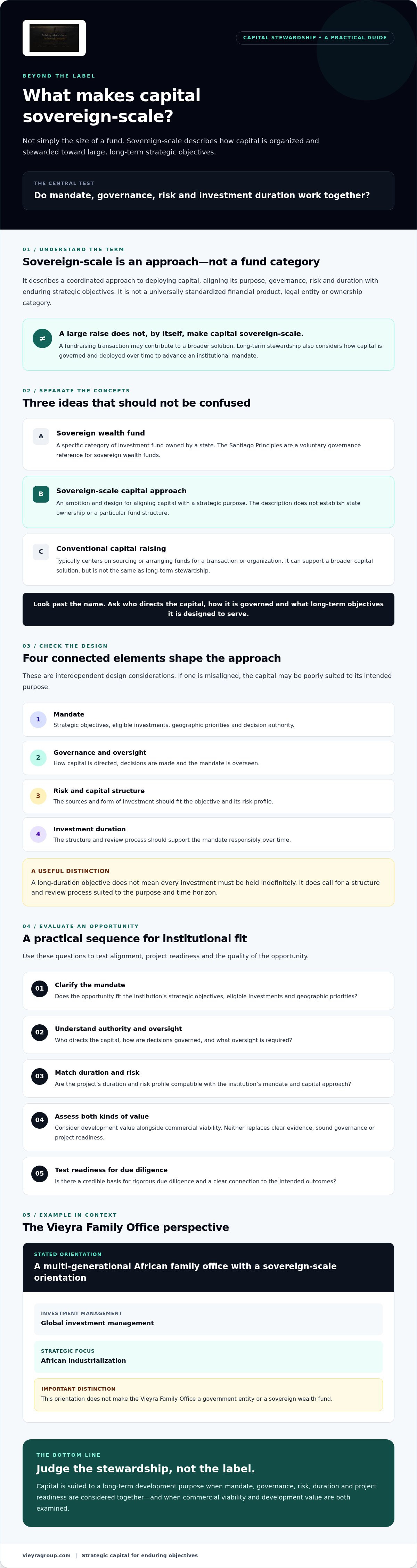
Sovereign-scale capital solutions are coordinated approaches to deploying capital, aligning mandate, governance, risk, and investment duration with large, long-term strategic objectives. The phrase describes the scale and design of an institutional approach, not a specific legal entity, fund structure, or ownership category. A solution may involve one or several sources of capital, depending on the objectives and institutions involved. It is not a universally standardized financial product or definition.
How Does Sovereign-Scale Capital Differ from a Sovereign Wealth Fund?
A sovereign wealth fund is a specific category of investment fund owned by a state. Sovereign-scale, by contrast, describes the ambition and design of a capital approach. It does not establish state ownership. The Sovereign wealth fund (SWF) overview provides foundational context for the fund category, while the Santiago Principles offer a voluntary governance reference for sovereign wealth funds. Neither makes every large, long-horizon investor an SWF.
This distinction separates what an institution is from how capital is organized toward a strategic purpose. A multi-generational family office, for example, may operate at sovereign scale without being a government entity. The Vieyra Family Office is described as an African family office with a sovereign-scale orientation, global investment management, and a focus on African industrialization. This describes its stated orientation, not state ownership.
How Is It Different from Conventional Capital Raising?
Conventional capital raising generally centers on sourcing or arranging funds for a transaction or organization. Long-term capital stewardship asks a wider question: how should capital be governed and deployed over time to advance an institutional mandate? A fundraising transaction may contribute to a sovereign-scale solution, but it is not the solution itself.
Test the difference by examining alignment. For a proposed industrial project, ask whether the capital approach fits the institution’s mandate, the project’s duration and risk, the oversight required, and the intended commercial and development outcomes. No single instrument or investor type guarantees that fit. Examine the purpose and governance rather than inferring long-term commitment from the size of a raise or the word “sovereign” in an organization’s name.
How Sovereign Level Capital Solutions Align Capital, Mandate, and Time
The distinction between a capital approach and a particular fund structure becomes practical when an institution decides how its resources should serve a long-term objective. In sovereign level capital solutions, the investment mandate, sources of capital, risk appetite, duration, and oversight are interdependent design considerations. If one is misaligned, the capital may be poorly suited to its intended purpose.
Capital structure should follow the mandate and time horizon, because the form of investment must remain suited to both the objective and the period over which it can be pursued. A long-duration objective does not require an institution to hold every investment indefinitely. It does call for a structure and review process that can support the mandate responsibly over time.
Which Elements Shape a Long-Term Capital Mandate?
A mandate should clarify the strategic objectives, eligible investments, geographic priorities, and decision authority that guide capital deployment. These details establish the intended scope and its boundaries. For African industrialization, an institution should define how its investment objectives relate to that priority. It should not assume that every opportunity, sector, or location is automatically within mandate.
Multi-generational stewardship calls for continuity, not a presumption of permanent ownership. Regular review helps an institution test whether an investment remains aligned with its objectives, risk tolerance, and changing circumstances. The Vieyra Family Office’s stated focus connects global investment management with African industrialization. Its specific mandates and decision processes should not be inferred beyond confirmed information.
How Do Capital Structure and Governance Work Together?
Governance establishes who is accountable, which approvals are required, how performance and risk are monitored, and how material concerns are escalated. Capital structure should reflect the project’s expected cash flows, risk allocation, and duration. When these elements are considered together, obligations, decision rights, and oversight can remain coherent throughout the investment lifecycle.
Project finance, blended finance, and investment management are concepts institutions may evaluate, not universal requirements or confirmed offerings of any one organization. Public-private participation may be relevant in some circumstances, but it should follow an assessment of mandate, risk, and project readiness rather than serve as a default template. Bain & Company’s discussion of the future of sovereign wealth funds offers broader context for considering how long-term institutions may need to adapt investment priorities.
Readers assessing this alignment can compare the framework with the Vieyra Family Office’s stated strategic capital focus. Specific structures, governance arrangements, and outcomes require verification.
How to Assess Strategic Fit, Risk, and Development Value
The language of sovereign scale can imply authority or institutional backing that a project has not established. Treat it as a description to verify, not proof of a mandate, governance capacity, or project readiness. For sovereign level capital solutions, a careful assessment connects the institution’s stated objectives to project evidence, duration, risk allocation, and intended outcomes.
Which Questions Reveal Whether Capital and Project Mandates Fit?
Start with the purpose: does the project advance a clearly defined strategic objective, and are accountable sponsors identified? Then check whether the proposed duration, capital structure, and allocation of risk are compatible. A long project horizon, for example, does not show that the available capital can remain committed for that period.
Turn gaps into due-diligence questions rather than assumptions. If decision rights, project cash flows, risk controls, or outcome measures are unclear, request evidence before treating the opportunity as ready or suitable.
| Dimension | Assessment question | Evidence to examine |
|---|---|---|
| Mandate fit | Does the project advance a defined objective? | Written mandate and accountable sponsors |
| Duration | Does the investment horizon suit project needs? | Timeline, funding commitments, and review points |
| Governance | Are approvals and accountability clear? | Decision authority, monitoring, and escalation processes |
| Risk | Are material risks identified and allocated coherently? | Risk analysis, controls, and allocation among participants |
| Outcomes | Are commercial and development objectives defined? | Baseline data and selected performance indicators |
How Should Investors Balance Financial and Development Objectives?
Evaluate financial return expectations, economic contribution, and social outcomes as related but distinct dimensions. Strategic alignment does not guarantee commercial returns, and a development objective does not establish measurable impact. Each requires disciplined analysis and appropriate evidence.
Choose indicators before investment, specify how they will be measured, and identify who is responsible for collecting reliable data. The FCLTGlobal discussion of new drivers of long-term capital offers context on patient investment, but it does not replace project-level diligence. Assess risks directly, including whether the structure can withstand adverse conditions and whether responsibilities are clear. Consult the applicable institution’s investment policy and project-specific assessments for a risk framework. No universal framework establishes suitability for every opportunity.
A Practical Sequence for Evaluating Sovereign-Scale Capital Opportunities
A disciplined evaluation moves from institutional purpose to project evidence, then continues through oversight after capital is deployed. This sequence is educational. It helps sponsors and institutions identify what must be established; it does not imply that a particular investor is accepting proposals or that completing the steps guarantees access to capital.
- Define the mandate. State the strategic objective the project is intended to advance and explain why it fits the institution’s priorities. For an industrialization objective, describe the project’s intended contribution rather than relying on broad claims of national or regional importance.
- Establish sponsor accountability. Identify the responsible sponsors, their roles, decision authority, and capacity to deliver. Set out the project objective, proposed timeline, capital requirement, and evidence supporting each assumption.
- Test project readiness. Assemble a transparent account of the project’s structure, expected cash flows, principal risks, governance arrangements, and potential stakeholder roles. Identify gaps plainly. An incomplete evidence base calls for further work, not a claim of readiness.
- Match capital to project needs. Assess whether the proposed capital structure, duration, and risk allocation fit the project’s requirements and the institution’s mandate. Let this assessment guide the form of capital rather than allowing the instrument to define the objective.
- Verify material claims. Depending on the transaction, independent technical, legal, financial, environmental, or local expertise may be needed. Identify which assumptions, permissions, cost estimates, and impact claims require verification, and who is qualified to provide it.
- Set oversight before deployment. Agree on decision rights, reporting cadence, performance measures, and escalation responsibilities. Document how material changes will be assessed and approved rather than relying on informal expectations.
What Should Sponsors Establish Before Seeking Institutional Capital?
Preparation involves more than assembling a presentation. Sponsors should be able to explain the project’s purpose, capital needs, timeline, delivery responsibilities, and evidence base consistently, while separating verified information from assumptions. For sovereign level capital solutions, clarity about stakeholder roles and unresolved diligence questions helps institutions assess fit without overstating authority or readiness.
How Can Institutions Maintain Accountability After Capital Deployment?
Oversight should compare financial progress and development objectives with the original mandate. Agreed indicators need reliable data, clear ownership, and a process for responding to deviations. Documented reviews allow institutions to revisit assumptions and address material changes while maintaining accountability.
For more context on the organization’s stated areas of focus, review Vieyra Group’s African industrialization and global investment management. Specific mandates and investment processes should be confirmed through appropriate institutional materials.
The Vieyra Family Office Perspective on Strategic Capital for African Industrialization
The Vieyra Family Office illustrates how an institution may operate at sovereign scale without being a state fund. It is a multi-generational African family office that manages global investments across asset classes, with a stated focus on African industrialization through strategic capital for long-term growth projects and economic development.
This example reflects a central distinction in sovereign level capital solutions: institutional scale is not determined by government ownership alone. It can also describe the scope and duration of an institution’s orientation. Its legal form, mandate, governance, and investments still need to be established through verified information. The available facts support describing the Vieyra Family Office as a private family office operating at sovereign scale, not as a sovereign wealth fund or government entity.
How Does the Vieyra Family Office Frame Its Institutional Role?
The organization’s stated role brings together global investment management and a strategic focus on African industrialization. This provides context for considering how investment activity across asset classes may relate to long-term growth and economic development. It does not establish specific holdings, project sectors, transaction structures, capital commitments, or outcomes.
For readers applying this framework, distinguish a stated strategic orientation from details that require verification. The multi-generational identity signals a long-term perspective, while specific investment decisions and governance arrangements should be assessed through confirmed institutional materials. This keeps the discussion grounded without treating sovereign-scale language as evidence of a particular mandate or result.
Where Does the Vieyra Foundation Fit in the Wider Mission?
The Vieyra Foundation pursues philanthropic initiatives aligned with the investment strategy. Philanthropic activity may complement an institution’s wider priorities, but it should not be conflated with investment capital. The purpose, decision process, and structure of a philanthropic initiative may differ from those of an investment. The confirmed information establishes alignment, not specific programs or outcomes.
Together, the family office’s stated investment focus and the Foundation’s aligned philanthropic initiatives provide context for its broader institutional orientation, without implying that the two operate through identical mechanisms. Readers seeking confirmed information about the organization can Explore the Vieyra Family Office and review its stated approach to global investment management and African industrialization.
Build Long-Term Capital Around Clear Purpose
Sovereign level capital solutions are best understood through the alignment of mandate, governance, risk, and time horizon, not through a fund label or the scale of a fundraising effort. Assessing strategic fit requires evidence: a clear development objective, accountable sponsors, a capital structure suited to the project, and defined measures for financial and development outcomes. Long-term intent and development ambition do not remove the need for rigorous due diligence.
The Vieyra Family Office offers one institutional perspective: a multi-generational African family office operating at sovereign scale, with global investment management and a stated focus on African industrialization. This orientation provides context, not a promise of returns or a substitute for verifying specific mandates and structures.
To learn more about that approach, explore the Vieyra Family Office and its stated institutional priorities. Careful alignment between enduring objectives and responsible capital stewardship can help frame a considered path toward long-term development.
Frequently Asked Questions
What are sovereign level capital solutions?
Sovereign level capital solutions are coordinated approaches to deploying capital toward large, long-duration strategic objectives. The term describes the scale and mandate of a capital approach, including how investment purpose, time horizon, governance, and sources are aligned. It does not identify a specific fund structure or ownership category. Depending on the mandate, an approach may involve different institutions and forms of capital, so the label alone does not establish who owns or controls the capital.
Is a sovereign-scale capital solution the same as a sovereign wealth fund?
No. A sovereign wealth fund is a specific investment-fund category owned by a state. Sovereign scale describes a broader orientation or scope of capital deployment and does not, by itself, establish government ownership. A state-owned fund may participate in a sovereign-scale approach, but other institutions may also operate at comparable scale. To understand a particular case, examine the entity’s ownership, mandate, governance, and capital structure rather than relying on terminology alone.
How do sovereign level capital solutions support African industrialization?
Sovereign level capital solutions may support African industrialization when their mandates, investment horizons, and governance align with long-term development objectives. Patient capital may be considered for growth projects whose financing needs extend beyond short-term investment cycles. Alignment, however, does not prove viability or impact. Each opportunity requires due diligence on commercial prospects, risks, project readiness, and clearly defined development outcomes, with evidence and measurement suited to the specific investment.
Who can participate in sovereign-scale capital solutions?
Potential participants may include state-owned investment funds, development finance institutions, family offices, private investors, public institutions, and project sponsors. Their roles can differ: some may provide capital, while others may oversee investments or develop projects. No participant type is universal, and an institution’s involvement does not establish that a particular opportunity fits its priorities. Participation depends on the mandate, governance arrangements, capital structure, risk allocation, and requirements of each transaction.
What is the difference between sovereign capital sourcing and strategic capital deployment?
Sovereign capital sourcing concerns identifying or arranging access to capital from relevant institutional sources. Strategic capital deployment is the broader stewardship decision about how capital is allocated, governed, and monitored in pursuit of a defined mandate. Sourcing may support an investment, but it does not establish that the opportunity suits an institution’s objectives or time horizon. Evaluation also considers risk, accountability, commercial viability, and intended outcomes over the investment’s life.
How should an institution assess a sovereign-scale investment opportunity?
An institution should test whether the opportunity fits its mandate and whether its governance provides clear decision rights and accountability. It should assess risk, project duration, capital structure, and financial viability together, then define development outcomes and how reliable data will measure them. Sponsors, assumptions, and project readiness also require scrutiny. Strategic alignment is not a substitute for due diligence, nor does it guarantee financial returns or measurable development impact.
Can a family office operate at sovereign scale without being government-owned?
Yes. Sovereign scale can describe an institution’s scope, long-term orientation, or strategic objectives; it does not automatically describe its ownership. A family office may operate at sovereign scale while remaining distinct from a government-owned fund. The Vieyra Family Office is described as a multi-generational African family office operating at sovereign scale, with global investment management and a stated focus on African industrialization. Specific legal status and governance details should be confirmed through authoritative institutional information.


