
What if the most compelling property opportunity is not the one with the strongest headline, but the one whose fundamentals, country context and role in a long-term portfolio withstand scrutiny? The question at the heart of family office real estate investment Africa is not simply where demand is rising, but how each opportunity serves a defined investment mandate.
Comparisons across countries and asset classes require care. African markets differ in legal frameworks, capital conditions, infrastructure and development priorities, so broad opportunity narratives cannot substitute for evidence at asset and market level. For a multi-generational family office, that evidence should also show how a property investment could contribute to portfolio objectives and what capital, oversight and time it would require.
This guide sets out a practical framework for evaluating property sectors, markets and investment structures. It covers questions to address early, from local demand and asset quality to ownership, governance and portfolio fit. The aim is not to treat the continent as a single investment thesis, but to assess each opportunity against its own fundamentals and the family office’s long-term objectives.
Key Takeaways
- Assess property through income potential, asset value, liquidity and investment horizon, rather than relying on a broad market narrative.
- Evaluate how family office real estate investment Africa may serve a defined portfolio mandate, while recognizing that diversification and development impact are not automatic.
- Compare sectors and structures by their capital requirements, income drivers and diligence demands before selecting an investment route.
- Advance opportunities through a disciplined review of asset fundamentals, ownership documents, counterparties, financing and execution capacity.
- Test each decision against governance readiness, investment capacity and multi-generational stewardship objectives.
What Family Office Real Estate Investment in Africa Involves
Family office real estate investment in Africa is an institutional capital-allocation decision, not residential purchase advice. It asks whether a property, investment structure and market context serve the family’s objectives over an appropriate period. Start by identifying the expected role of the investment, then assess its prospective income, valuation basis, potential exit routes, capital requirements and ongoing oversight needs.
“Property investment is defined by the objectives, risks and time horizon of the capital committed, not by the sector label attached to the asset.” An office building, logistics facility or residential development is not an investment case in itself. For each, examine evidence of demand, operating assumptions, ownership, counterparties and the conditions needed to preserve or realize value. A general Family Office Overview provides useful context on family-office functions and investment areas; the allocation decision itself depends on the institution’s mandate and the evidence available.
How family-office objectives shape a real estate allocation
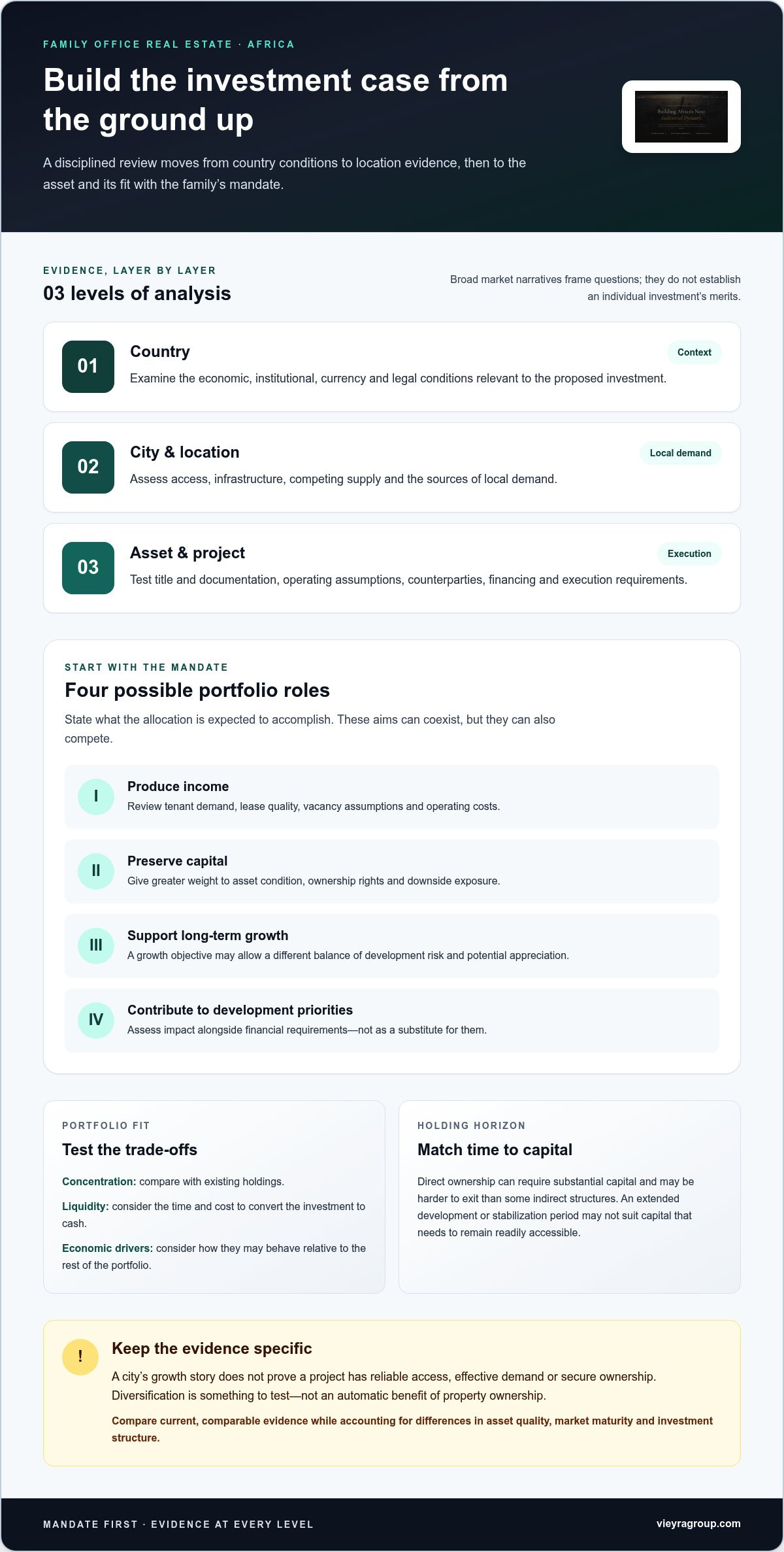
Objectives determine which characteristics matter most. A mandate emphasizing recurring income calls for close attention to tenant demand, lease quality, vacancy assumptions and operating costs. A capital-preservation objective places greater weight on asset condition, ownership rights and downside exposure. A growth objective may allow a different balance of development risk and potential appreciation. Development impact can inform selection, but it should be assessed alongside financial requirements, not used in place of them.
Liquidity and holding horizon also shape suitability. Direct ownership can require substantial capital and may be harder to exit than some indirect structures. A project with an extended development or stabilization period may not suit capital that needs to remain readily accessible. Before comparing opportunities, set out the family office’s liquidity needs, governance arrangements, risk tolerance and intergenerational priorities. There is no universal allocation that fits every institution.
Why African property markets require country-specific analysis
Africa-wide narratives can help frame questions, but they cannot establish the merits of an individual investment. Economic conditions, institutions, infrastructure and property rules vary across countries. Conditions also differ among cities, neighborhoods and asset types within the same market. For example, a city’s growth story does not prove that a particular project has reliable access, effective demand or secure ownership.
Translate broad context into evidence at progressively narrower levels:
- Country: examine the economic, institutional, currency and legal conditions relevant to the proposed investment.
- City and location: assess access, infrastructure, competing supply and the sources of local demand.
- Asset and project: test title and documentation, operating assumptions, counterparties, financing and execution requirements.
Use current, comparable evidence when assessing markets, and account for differences in asset quality, market maturity and investment structure. A ranking can obscure these differences if it treats unlike opportunities as comparable. The investment case becomes clearer when measurable property fundamentals align with the family’s objectives, capacity and intended holding period.
How African Real Estate Can Fit a Long-Term Investment Mandate
Property earns a place in a portfolio only when its expected role is clear. For a family office, that role might involve producing income, preserving capital, supporting long-term growth or contributing to development priorities. These aims can coexist, but they can also compete. An asset with a long development horizon, for example, may not suit a mandate that prioritizes near-term liquidity.
The longer the investment horizon, the more the portfolio-fit case must rest on durable evidence about cash flows, asset quality, governance and the conditions for eventual exit. A long holding period can allow time for an asset or market to mature, but it does not remove execution, concentration or liquidity risk.
Connecting property exposure to portfolio objectives
Begin by stating what the allocation is expected to accomplish, then test whether the proposed exposure can plausibly serve that purpose. Review concentration alongside existing holdings, the time and cost required to convert the investment to cash, and how its economic drivers may behave relative to the rest of the portfolio. Diversification is something to test, not an automatic benefit of property ownership. Broader principles of global investment management can help frame allocation decisions across asset classes and time horizons.
Sector labels alone are insufficient because income and value respond to different underlying conditions:
- Commercial property depends on occupier demand, lease terms, operating costs and the capacity to retain tenants.
- Residential property is shaped by household affordability, location, product suitability and the depth of effective demand.
- Logistics property relies on the movement and storage of goods, access to transport networks and the needs of tenants and supply chains.
- Industrial property is connected to productive activity, servicing requirements, utilities and the operating needs of businesses.
For each exposure, compare income assumptions and capital requirements with the office’s preservation, growth and liquidity priorities. Ask whether the investment adds a distinct source of risk or increases dependence on a market, tenant group or economic driver already prominent elsewhere in the portfolio.
Where property intersects with African industrialisation
Industrial and logistics assets may support productive activity by providing space for manufacturing, storage or distribution. Their development relevance, however, does not prove investability or financial return. The investment case still depends on demand, infrastructure, counterparties, operating feasibility and the capital required to deliver and maintain the asset. Strategic capital for African industrialisation provides a broader context for considering how investment can relate to productive capacity, while keeping strategic alignment separate from commercial evidence.
Family offices assessing family office real estate investment Africa can distinguish three judgments: whether an asset meets its own investment criteria, whether it fits the portfolio, and whether its wider economic contribution aligns with institutional purpose. Vieyra’s global investment perspective places allocation decisions within a broader, long-term capital mandate.
Comparing African Real Estate Sectors and Investment Structures
Sector selection and investment structure are related decisions, but they answer different questions. The sector identifies the property’s economic exposure; the structure determines how capital is committed, how decisions are governed and how much direct oversight is required. A disciplined approach to family office real estate investment Africa compares both against the mandate, market evidence and the family office’s execution capacity.
Comparing residential, commercial, logistics and industrial property
Each sector has distinct demand drivers and operating demands. The following framework identifies where diligence should begin; it does not imply that one sector is inherently superior or performs consistently across African markets.
| Sector exposure | Potential income drivers | Capital intensity | Principal diligence questions |
|---|---|---|---|
| Residential | Occupancy, rent collection and tenant retention | Varies with scale, condition and required improvements | Who can afford the units? How strong is effective demand? What are the condition and maintenance requirements? |
| Commercial | Leases, tenant quality and continued occupier demand | Can include substantial fit-out, refurbishment and operating needs | How concentrated are tenants? What lease obligations apply? Does the location suit intended occupiers? |
| Logistics | Occupancy by storage, distribution or supply-chain users | Depends on site, building specifications and access requirements | Are transport connections and utilities adequate? Is demand supported by identifiable users and activity? |
| Industrial | Leases to productive businesses and facility use | Can require specialized facilities, infrastructure and ongoing maintenance | Can the asset support the intended operations? Are services, access and counterparties suitable? |
Across sectors, test asset condition, location, infrastructure dependencies and the reliability of income assumptions. A property with several tenants may still carry concentration risk if revenues depend on a narrow group of industries or one local demand source. Base the assessment on evidence specific to the asset and market, rather than assumptions drawn from the sector label.
Direct investment, pooled exposure and strategic partnerships
Direct ownership can provide closer control over asset-level decisions, while placing greater responsibility on the investor for oversight, operations and governance. Pooled exposure may distribute responsibilities through a common structure, but requires careful review of decision rights, reporting, fees and exit provisions. Co-investment and other strategic partnerships can combine capital and expertise; they also require clear alignment on authority, risk allocation, information access and dispute resolution.
These structures differ in liquidity, transparency and demands on internal capacity. Before advancing, establish who makes material decisions, how performance and risks are reported, what happens if additional capital is needed, and how an exit may be pursued. Suitability depends on the mandate, country and asset-level evidence, and the ability to execute the chosen structure with disciplined governance.
A Due-Diligence Framework for African Property Opportunities
Property diligence should move from strategic fit to verifiable evidence, with each stage establishing whether further analysis is justified. Verify project-level evidence before relying on market-level narratives. A compelling account of a city’s growth cannot establish a specific asset’s ownership, operating viability or ability to meet its obligations.
Screen the asset, project and operating assumptions
Begin with the mandate and the proposed asset’s role, then test the project against documented facts. Separate records and independently supportable information from sponsor projections. Identify assumptions that would materially change the decision if they proved inaccurate. For an existing property, occupancy, condition and operating history may be central. For a development, examine demand evidence, delivery milestones and who is responsible for execution.
- Screen mandate fit. Define the intended portfolio role, investment horizon, acceptable risk and liquidity needs. Set out the conditions that would disqualify the opportunity before committing significant resources.
- Establish asset fundamentals. Examine location, condition, access, infrastructure dependencies and relevant demand or occupancy evidence. Tailor the review to the asset’s use and stage of development.
- Test financial assumptions. Review projected revenue, operating costs, capital requirements, financing terms and proposed exit pathways. Model adverse as well as base-case conditions, and record which assumptions rely on estimates rather than observed performance.
- Verify ownership and counterparties. Review ownership records and transaction documents through appropriate independent channels. Clarify each counterparty’s authority, obligations, experience and responsibility for delivery or ongoing operations.
- Assess jurisdiction and structure. Obtain market-specific analysis of legal rights, tax treatment, currency exposure and applicable regulatory requirements from qualified advisers. Consider how the investment structure affects governance, cash movement and possible exit routes.
- Review execution capacity independently. Determine whether the project team, financing plan and governance arrangements can support delivery and oversight. Subject material assumptions and documentation to independent review before reaching an investment decision.
Assess governance, counterparties and country risks
Country context should sharpen, not replace, project analysis. Political, legal, currency and execution exposures differ by jurisdiction and can affect ownership, operating continuity, financing and realization of value. Identify who bears each material risk, how decisions are authorized, what information reaches investors and how unresolved issues are escalated. A broader sovereign investment risk framework can place these questions within institutional oversight.
Conclude with a written decision record: evidence reviewed, unresolved matters, key assumptions, risk mitigations and reasons to proceed, defer or decline. This creates accountability across an investment horizon that may span generations. For further institutional context on disciplined capital allocation, read Vieyra’s investment perspective.
Aligning Real Estate Decisions with Multi-Generational Stewardship
A property opportunity becomes a considered capital decision when its prospective role is clear, the evidence is sufficient and the institution is equipped to govern the investment over its intended life. For family office real estate investment Africa, this means taking the analysis beyond initial market interest. Mandate alignment, market and asset evidence, governance readiness and investment capacity must stand up to scrutiny together.
From opportunity screening to a considered capital decision
Preliminary screening determines whether an opportunity merits deeper work; it is not approval to invest. Before a final decision, the family office should be able to document:
- Mandate fit: the intended portfolio role, acceptable risk and time horizon.
- Market and asset evidence: the basis for demand, value and operating assumptions at the relevant location and project level.
- Governance readiness: who is accountable for decisions, oversight, reporting and escalation.
- Investment capacity: whether capital, expertise and institutional attention can support the commitment through ownership, operation and any eventual exit.
Record uncertain assumptions, the evidence supporting the decision and the conditions that would prompt reassessment. After commitment, monitor the investment against its original thesis and note when market conditions, asset performance or family priorities change. Continuity across generations depends not only on the initial judgment, but also on clear accountability and a durable record of how it was reached.
Vieyra Family Office and long-term African capital
Vieyra Family Office is a multi-generational African family office operating at sovereign scale. It manages global investments across asset classes and deploys strategic capital in support of African industrialisation and long-term development. Its approach to capital allocation considers each opportunity in relation to its objectives, evidence, governance requirements and capacity for responsible stewardship.
Real estate may intersect with broader development priorities, particularly where property enables productive activity, but alignment with those priorities is distinct from a demonstrated investment case. A responsible decision weighs financial objectives and execution requirements alongside any wider contribution, then maintains oversight for as long as capital remains committed.
Vieyra’s institutional approach to global investment and long-term African development reflects its focus on strategic capital and enduring development.
Carry the Investment Thesis Forward Across Generations
The enduring test of family office real estate investment Africa is whether the rationale remains clear beyond the people who first assessed it. A well-formed investment thesis explains not only why capital is committed, but also what evidence would call for adaptation, continued oversight or a change in course. That clarity helps future decision-makers exercise stewardship without mistaking inherited conviction for current evidence.
For families considering their next step, translate strategic intent into a durable investment record: preserve the reasoning, define who is accountable for oversight and establish how changing circumstances will reach decision-makers. This discipline helps long-term capital engage with African opportunity and development in a considered way.
Vieyra Family Office brings a multi-generational African perspective to global investment management and strategic capital in support of long-term growth and African industrialisation. Explore Vieyra Family Office to learn about its institutional approach to capital and enduring development. Clear purpose and patient judgment can help families approach future investment decisions with confidence.
Frequently Asked Questions
What does family office real estate investment in Africa mean?
Family office real estate investment Africa means assessing property-related capital commitments against a family’s investment mandate, governance and time horizon. It is an institutional allocation question, not advice about buying a home. For example, a family office considering a rental asset would examine who oversees operations, how income assumptions are supported and how the holding fits existing obligations. The analysis should distinguish the family’s objectives from the property sector’s general characteristics.
How should a family office compare African real estate investment opportunities?
Compare opportunities using a consistent investment memorandum, so differences in market, asset and structure are visible rather than hidden by presentation. Record the source and date of demand evidence, the assumptions behind projected cash flows, required capital and the proposed exit route. Then test each opportunity against the same mandate criteria. A project with attractive projected income may warrant a different judgment if its assumptions depend on uncommitted tenants or future infrastructure.
Which real estate sectors can family offices assess in Africa?
Family offices can assess residential, commercial, logistics and industrial property, with specialized assets such as data centres considered where relevant to the mandate. Each has distinct users and operating demands. For example, a logistics facility depends on its suitability for storage and distribution, while an industrial property must meet the requirements of productive businesses. Sector selection should follow documented local demand and asset requirements, not general claims that one category is preferable.
What are the main risks in African real estate investment?
Risks may include unclear ownership documentation, unreliable demand assumptions, counterparty failure, currency exposure, regulatory or tax uncertainty, infrastructure constraints and difficulty exiting an investment. Their importance varies by country, city, asset and structure. A practical risk register can name each exposure, identify who bears it, state the evidence available and assign responsibility for monitoring it. This helps decision-makers distinguish risks that can be mitigated from those that may make an opportunity unsuitable.
Is direct property ownership better than investing through a fund or partner?
Neither route is inherently better; suitability depends on the family office’s desired control, available expertise, governance capacity and liquidity needs. Direct ownership can require closer asset-level oversight. A fund or partnership may share responsibilities, while introducing reliance on other parties’ decisions, reporting and alignment. Compare decision rights, information access, additional capital obligations and exit provisions before choosing. The structure should match the office’s capacity to oversee it throughout the investment.
How can real estate investment support African industrialisation?
Property can support industrialisation when it enables productive activity, such as manufacturing, storage or the movement of goods. A facility may address an operational need, but that connection alone does not establish commercial viability or a financial return. Assess whether identifiable users need the asset, whether its location and services suit their operations, and whether delivery is feasible. Keep evidence of development contribution distinct from the investment case and its financial assumptions.
What should a family office review before investing in an African property project?
Review the project’s mandate fit, location, condition or development status, demand evidence, operating assumptions and capital requirements. Examine ownership and transaction documents, the authority and responsibilities of counterparties, financing terms, governance and exit provisions. Country-specific legal, tax, currency and regulatory questions require analysis by qualified advisers familiar with the relevant jurisdiction. Before approval, document unresolved issues, downside scenarios, decision accountability and the information required for ongoing monitoring.


