

What if the greatest risk in a family office infrastructure investment strategy is not choosing the wrong asset, but leaving unclear who may advise, challenge, approve, or intervene? Infrastructure decisions involve long operating horizons, substantial capital commitments, and regional conditions that can reshape an investment thesis. Without clear authority, a board can add complexity instead of discipline.
For families investing across generations, rigorous oversight matters. Governance should strengthen judgment without displacing the investment authority entrusted to the family office. The design challenge is to bring financial, technical, and regional expertise into the same process while keeping accountability clear and decision-making considered.
This article explains how to structure an advisory board around the family office’s investment mandate, risk horizon, and decision rights. It covers the expertise a board may need, the difference between advice, approval, and oversight, and how to set escalation paths, manage conflicts, and review the board’s contribution. The aim is a repeatable governance framework for complex infrastructure investments, including those connected to African industrialisation, where process supports rather than obscures responsibility.
Key Takeaways
- Define the advisory board’s counsel, oversight, and escalation role separately from formal investment authority.
- Build expertise around the mandate: identify decision gaps before appointing members with relevant financial, technical, legal, geopolitical, or regional knowledge.
- Choose between a standing board, specialist panels, and project-specific groups according to the need for continuity and depth.
- Use a charter, clear protocols, and milestone-led agendas to connect strategic assumptions, project risks, and capital decisions.
- Apply a family office infrastructure investment strategy checklist that aligns mandate, expertise, authority, operating model, and review with long-term priorities.
Why a Family Office Infrastructure Investment Strategy Needs a Deliberate Advisory Board
An advisory board gives a family office a structured forum for informed counsel. Members can test assumptions, illuminate technical or regional considerations, and identify questions that need further analysis. Unless authority has been formally delegated through the family office’s governing arrangements, the board advises rather than approves investments. This distinction is fundamental: expertise can shape a decision without transferring accountability for it.
The distinction is particularly important in infrastructure. A transport corridor, energy asset, or industrial facility may involve lengthy development, multiple counterparties, public-sector dependencies, and capital deployed in stages. Early decisions can establish constraints that remain relevant through construction, operation, refinancing, and eventual exit. A deliberate family office infrastructure investment strategy therefore needs governance that preserves institutional memory and revisits assumptions as a project advances, without confusing counsel with authority.
Family offices vary in structure and function; the Family Office Overview provides background on their broad role in managing family wealth and investment activity. Within a particular office, an investment advisory board should be distinguished from other bodies. An investment committee typically evaluates or approves proposals within its assigned authority. A board of directors, where one exists, has a formal governance role shaped by the entity’s structure. A family council addresses family priorities, values, and communication. Their remits may intersect, but they are not interchangeable. Written mandates should explain where information flows and where decisions rest.
What an advisory board can contribute to infrastructure investing
An advisory board can contribute disciplined challenge, specialist insight, and continuity across investment and project cycles. Members with relevant experience can probe demand assumptions, construction dependencies, financing structures, stakeholder relationships, and exposure to regional conditions. Their perspective can improve deliberation, but cannot guarantee sound decisions or successful outcomes. The governing principle is simple: An advisory board sharpens judgment through structured counsel, but authority remains with the body or individual to whom it has been assigned.
Which governance questions should be settled first?
Before appointing members, document the mandate their advice is meant to serve. Settle these questions:
- Objectives and scope: Is the office seeking durable income, strategic development impact, portfolio diversification, or a defined combination? Which sectors and geographies are in scope?
- Time horizon: How should the office assess assets whose development, operating, and capital-recovery cycles may extend across generations?
- Approval authority: Who gives final approval for capital allocation, follow-on commitments, material scope changes, and exit decisions?
- Governance boundaries: Which matters belong to investment oversight, operational management, and philanthropic oversight? Philanthropic priorities may align with investment strategy, but each requires a distinct purpose and decision process.
The answers determine the board’s appropriate remit. A global investment mandate may call for counsel on cross-market allocation, while an African industrialisation focus may require closer examination of regional context and development priorities. In either case, the mandate and delegated authority, not the prestige of board members, should define the role.
How to Design Board Expertise Around Infrastructure Strategy
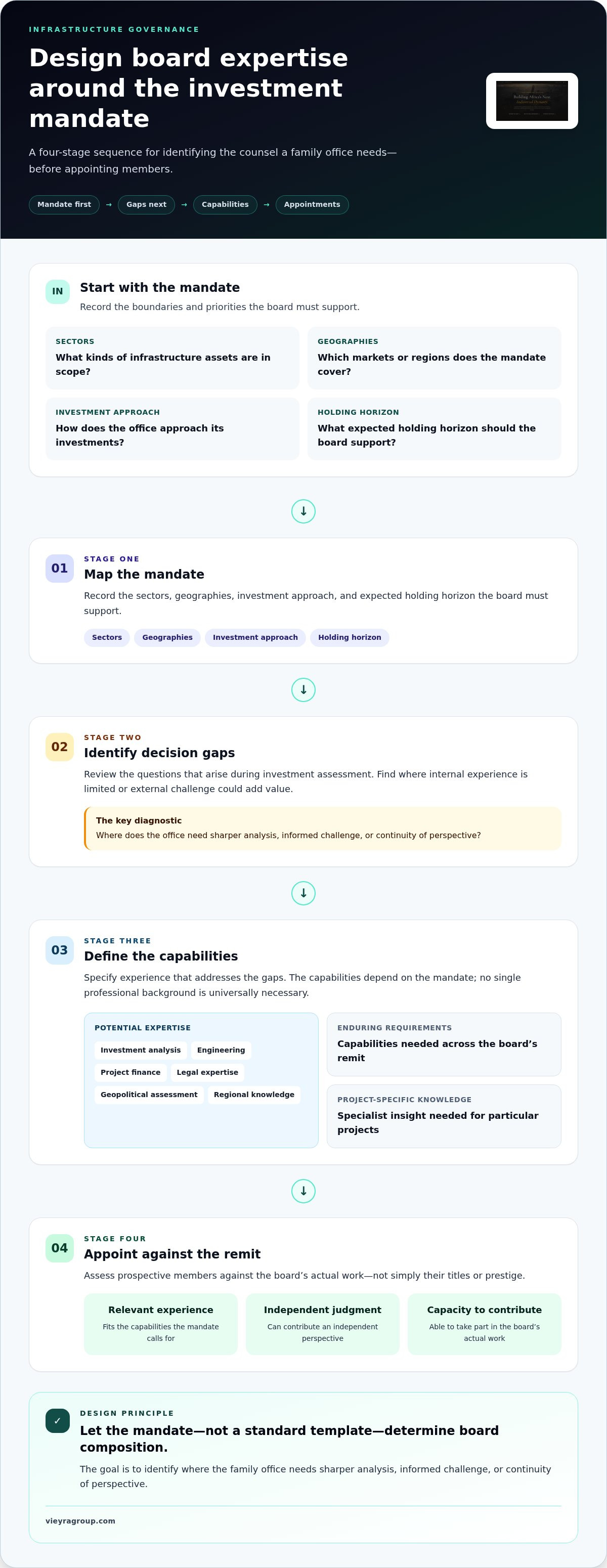
Board composition should follow the investment mandate, not a standard template. A family office infrastructure investment strategy spanning power generation, transport, and industrial assets may need different counsel from one concentrated in a single sector or market. The aim is not to assemble the most impressive titles. It is to identify where the office needs sharper analysis, informed challenge, or continuity of perspective.
A practical design sequence keeps that work focused:
- Map the mandate. Record the sectors, geographies, investment approach, and expected holding horizon the board must support.
- Identify decision gaps. Review the questions that arise during investment assessment and determine where internal experience is limited or external challenge would add value.
- Define capabilities. Specify the experience needed to address those gaps. Distinguish enduring requirements from specialist knowledge needed only for particular projects.
- Appoint against the remit. Assess prospective members for relevant experience, independence of judgment, and capacity to contribute to the board’s actual work.
Depending on the mandate, useful capabilities may include investment analysis, engineering, project finance, legal expertise, geopolitical assessment, or regional knowledge. No single professional background is universally necessary, and no prescribed board size suits every family office. A focused mandate may need a small group with complementary judgment; a broader one may call for specialist input through additional structures, discussed below.
Map expertise to the investment lifecycle
Expertise should reflect how decisions change as an asset advances. Origination may call for sector insight and an ability to assess strategic fit. Diligence can require engineering, market, legal, and geopolitical perspectives. Structuring raises questions about financing, risk allocation, and contractual arrangements. Execution and monitoring require attention to delivery milestones, operating assumptions, and changing exposure. Early assessment may depend on testing a project’s premise, while mature operations call for informed scrutiny of performance and renewal decisions.
For African infrastructure, global investment experience should be complemented by grounded knowledge of the relevant region and its institutional and commercial context. The African Development Bank and International Finance Corporation provide useful contextual reference points for development-finance perspectives on infrastructure. Their mention is not an endorsement or a substitute for project-specific analysis.
Balance family perspective with independent judgement
Family members and long-serving professionals may bring institutional memory about capital priorities, risk tolerance, and prior decisions. External advisers can test inherited assumptions, while local expertise can reveal context that global analysis alone may miss. Selection should consider demonstrated relevant experience, independence and potential conflicts, and the time and attention a candidate can commit. Board composition should reflect the mandate’s unanswered questions, not the prestige of its members.
For families considering global investment perspectives alongside African industrialisation priorities, Vieyra Family Office's investment perspective offers institutional context on long-horizon capital stewardship.
Compare Advisory Board Structures, Authority, and Accountability
The right structure depends on the continuity of advice required and the range of questions the mandate generates. A standing strategic advisory board can maintain context across investment cycles. Specialist panels can address focused questions, and project-specific advisory groups can concentrate on a particular asset or transaction. None is inherently superior. The practical test is whether the arrangement improves the quality and traceability of decisions without creating a second, ambiguous approval process.
An advisory recommendation is not automatically an investment approval. The family office’s governing documents and delegation framework should identify who receives advice, who decides, and who is accountable for execution and monitoring. The comparison below is a design aid, not a universal prescription.
| Structure | Remit | Continuity | Expertise | Suitable mandate conditions |
|---|---|---|---|---|
| Standing strategic advisory board | Advise on portfolio direction, assumptions, and recurring strategic questions | High, supporting institutional memory over time | Broad, aligned with the enduring mandate | Multiple investments or a long-horizon programme requiring consistent counsel |
| Specialist panels | Address defined technical, financial, legal, or regional questions | Variable, assembled as needs arise | Deep within a particular subject | A continuing strategy with intermittent specialist gaps |
| Project-specific advisory groups | Examine a discrete asset, transaction, or project milestone | Limited to the project or assignment | Selected for the project’s particular requirements | A complex undertaking whose risks or context differ materially from the wider portfolio |
When does a standing board differ from specialist panels?
A standing body can retain the reasoning behind earlier assumptions, monitor how those assumptions evolve, and help the office compare decisions across a portfolio. That continuity is valuable when investments share strategic or regional considerations. A targeted panel is more proportionate when the question is narrow, such as evaluating a technical design or a specific jurisdictional context. A project-specific group provides focused scrutiny without making every specialist a permanent participant in broader deliberations.
How should advice connect to formal investment authority?
Document the decision path in plain terms. The advisory body reviews evidence and records recommendations. The designated investment authority approves, declines, or escalates the proposal. Operational leadership executes an approved decision, while assigned oversight roles monitor delivery and report material changes. The precise allocation depends on the office’s governing arrangements, so titles alone should never be treated as proof of authority.
Set escalation routes for conflicts of interest, material risks, departures from approved assumptions, and proposed changes to the investment mandate. Specify who must be notified, which decisions pause for further review, and where unresolved issues are referred. This makes additional governance purposeful: it clarifies accountability instead of adding meetings without consequence. A family office governance for wealth preservation framework can help place these decision rights within the wider responsibilities of long-term stewardship.
For a family office infrastructure investment strategy, the question is not simply how many advisers to convene, but which structure best connects counsel to accountable action. A clear remit, written decision record, and defined escalation path allow informed challenge to strengthen deliberation while keeping formal authority where it belongs.
Establish an Advisory Board Operating Model for Long-Horizon Investments
A board’s value depends on who participates and how its counsel enters the investment process and remains useful as projects evolve. For a family office infrastructure investment strategy, the operating model should connect advice to the mandate, preserve a record of material judgments, and make clear how concerns reach those with formal authority. It need not require an elaborate calendar. The purpose is to ensure the right questions are considered at the right decision points.
A disciplined setup sequence provides a practical foundation:
- Approve a charter. Define purpose, scope, authority limits, and the relationship between advice and formal decisions.
- Define membership. Set criteria for relevant experience, independence, conflicts, and expected contribution, then appoint members against the board’s remit.
- Establish protocols. Agree on information access, preparation, confidentiality, conflict disclosure, meeting records, and escalation routes, tailoring them to applicable jurisdictions.
- Review effectiveness. Assess whether the board addresses genuine expertise gaps and informs investment decisions as projects and portfolio conditions change.
What belongs in an advisory-board charter?
The charter should identify the board’s purpose, matters within its scope, membership criteria, expected contributions, and explicit limits on authority. It should also specify how recommendations are recorded, who considers them, and how unresolved matters reach formal decision-makers. Confidentiality and conflict protocols need particular care. Explain how members disclose relevant interests, manage restricted information, and handle records in a way suited to the jurisdictions and structures involved. Review these provisions against the office’s actual arrangements rather than treating them as generic legal language.
Agendas can turn the charter into a practical instrument of oversight. Each discussion should connect evidence to a decision, milestone, or change in exposure. Relevant items may include:
- Strategic assumptions: whether demand, financing, or regional conditions still support the investment thesis.
- Project milestones: progress against development or operating objectives, including emerging dependencies.
- Risk exposure: material changes, interdependencies, and matters requiring escalation.
- Capital decisions: upcoming commitments, follow-on funding considerations, or proposed changes requiring approval by the designated authority.
How should the board review its contribution over time?
Review effectiveness by asking whether advice has addressed the mandate’s real decision gaps, not simply whether meetings occurred or papers were produced. Consider whether recommendations informed project-stage judgments and portfolio-level oversight, whether emerging risks reached the appropriate decision-makers, and whether the board’s expertise still matches the investment programme. A changing portfolio may call for a revised remit or different specialist input.
For investments shaped by regional and sovereign considerations, the review can also examine how these exposures enter strategic deliberation. This connects to sovereign investment risk management in Africa as a broader dimension of institutional stewardship. Explore Vieyragroup’s long-horizon investment perspective for context on global investment and African industrialisation.
Apply the Framework to a Family Office Infrastructure Investment Strategy
Test board design against five connected elements: mandate, expertise, authority, operating model, and review. Together, they show whether the board can contribute useful judgment and whether its advice reaches the people accountable for investment decisions. A family office infrastructure investment strategy is not ready for board oversight simply because experienced individuals have been appointed. The structure must fit the investment purpose and remain relevant as the portfolio evolves.
A concise readiness test before forming or revising a board
Use these questions to assess whether the proposed arrangement has a clear institutional purpose:
- Mandate: Is the board’s purpose explicitly connected to the office’s investment objectives, geographic scope, and time horizon?
- Expertise: Do members collectively address the strategy’s material knowledge gaps, with room to bring in targeted expertise as needs change?
- Authority: Are advice, approval, execution, and accountability assigned to distinct roles, with a clear route for escalation?
- Operating model: Do the charter, information protocols, and agenda connect counsel to relevant project and portfolio decisions?
- Review: Is there a process to assess whether the board’s contribution remains useful as the mandate, assets, or risk considerations shift?
A weakness in one element can undermine the others. Expertise without access to relevant information may be ineffective; a detailed charter without clear decision rights can leave recommendations unresolved. Consider the readiness test as a whole and address gaps before expanding the board’s remit.
Connect board design to capital stewardship
Global investment activity and a focus on African industrialisation can generate different but complementary questions. A global perspective may prompt scrutiny of portfolio concentration, comparative opportunities, and how an infrastructure commitment fits across markets. An industrialisation lens may direct attention to regional context, the asset’s role in productive capacity, and the assumptions behind long-term development. These considerations inform deliberation; they do not prescribe a board model or guarantee an investment outcome.
Vieyra Family Office is a multi-generational African family office with global investments and a focus on African industrialisation. That perspective offers institutional context for considering how long-horizon capital stewardship engages with development priorities. A broader discussion of global investment management for sovereign-scale family offices can place board design within the wider discipline of investment oversight.
Long-horizon governance supports disciplined consideration by preserving the rationale for commitments, creating opportunities to revisit assumptions, and keeping strategic intent visible as projects progress. That discipline is especially relevant where infrastructure investment intersects with industrial development, regional conditions, and intergenerational stewardship. The board’s role is to sustain informed scrutiny while keeping formal authority clearly assigned.
To explore the institution’s investment perspective, explore Vieyra Family Office.
Carry Long-Horizon Intent into Future Decisions
A well-designed governance structure is not fixed; it must remain responsive as investment priorities, markets, and generations change. Consider how the family office’s mandate may evolve and whether its advisory arrangements can continue to support clear, accountable judgment. A family office infrastructure investment strategy gains resilience when board design reflects both immediate decision needs and stewardship responsibilities that extend beyond any single project.
Vieyra Family Office brings a multi-generational African perspective to global investment activity, with strategic capital focused on African industrialisation. This context highlights the importance of aligning investment governance with long-term purpose while respecting the distinct authority and responsibilities of each institution.
Explore Vieyra Family Office’s institutional investment perspective to consider how global investment and African industrialisation inform its approach to enduring capital stewardship. Thoughtful governance can help families carry their ambitions forward with clarity.
Frequently Asked Questions
What is the role of an advisory board in a family office?
An advisory board helps a family office examine consequential questions through experienced, structured counsel. Its contribution may include testing whether a proposed infrastructure investment remains consistent with family priorities, identifying information gaps before a decision, or preserving lessons from earlier projects. A written remit helps members understand what they are being asked to consider and how their input will be used. The family office should distinguish that counsel from approval or operational direction.
Should a family office advisory board make investment decisions?
Whether an advisory board has decision authority depends on the family office’s governing documents and delegated arrangements. For example, a board might assess the assumptions behind a proposed follow-on investment, while a designated principal or committee records the final decision. Documenting who advises, decides, and implements reduces the risk of an informal recommendation being mistaken for approval. Consider jurisdiction-specific authority and duties in light of applicable documents and professional guidance.
What expertise should an infrastructure investment advisory board include?
Expertise should match the decisions the board is expected to inform, not a standard list of credentials. For a power project, engineering and project-finance perspectives may help examine construction assumptions and funding structure; a cross-border asset may call for regional and geopolitical knowledge. Compare those needs with capabilities already available internally. In a family office infrastructure investment strategy, the key question is whether the board can illuminate material gaps without duplicating existing expertise.
How many members should a family office advisory board have?
There is no universal membership number for every family office. Begin by listing the questions the board must address, then determine whether the proposed members collectively cover them while leaving room for focused discussion. For instance, a board that needs highly technical input might invite a specialist for a particular agenda item rather than appoint every specialist as a standing member. Confidentiality, conflicts, and the practical demands of participation also shape the appropriate composition.
How is an advisory board different from an investment committee?
An advisory board generally offers counsel, while an investment committee may review or approve proposals if authority has been assigned to it. Since institutions use these labels differently, compare written mandates rather than relying on titles. Record recommendations in advisory minutes and formal decisions in the records of the authorized body. This makes it easier to trace how a proposal moved from analysis to action without implying that the two bodies share the same remit.
How often should a family office advisory board meet?
Meeting cadence should reflect the investment pipeline, decision points, and information members need to provide useful counsel. A family office approaching a major project milestone may need a focused discussion outside its ordinary schedule, while periods without material developments may call for less frequent sessions. The charter can establish a baseline and explain how additional meetings are convened. Review whether each session produces a clear next step instead of treating attendance or meeting count as evidence of value.
How can an advisory board address conflicts of interest?
Set a clear process for members to disclose relevant interests and for the chair or designated authority to determine how to handle them. For example, a member connected to a project counterparty should disclose that relationship before the board discusses the proposal; the record should reflect the disclosure and the agreed response. Tailor the protocol to the board’s remit, information access, and relevant jurisdictions. Confirm jurisdiction-specific obligations against current authoritative guidance.


