
What distinguishes philanthropic capital from investment: the source of the funds, or the discipline surrounding their use? African venture philanthropy models can combine grants, recoverable funding and impact investment, but the term is used inconsistently. For enterprises and funders, understanding the difference matters because each approach carries different expectations for repayment, risk and accountability.
These approaches may share a development purpose while differing in capital structure, governance, non-financial support and time horizon. The key is to match those elements to an organisation’s maturity and intended impact. This article explains the main models, how they differ from conventional grantmaking and investment, and how to assess their fit with long-term development objectives.
At Vieyra Family Office, a multi-generational perspective on African industrialisation places philanthropy within a broader institutional approach to development. Through the Vieyra Foundation, the institution pursues philanthropic initiatives aligned with its investment strategy. With this context in view, the discussion considers how philanthropy can complement enterprise growth and longer-term development priorities without treating distinct models as interchangeable.
Key Takeaways
- Distinguish venture philanthropy from conventional grantmaking by examining how mission alignment, tailored capital and organisational support work together.
- Compare African venture philanthropy models by capital form, return expectations, support intensity and duration, rather than assuming one approach is best for every organisation.
- Assess fit by defining the mission, identifying the organisation’s needs, choosing an appropriate form of capital and agreeing on accountability.
- Account for differences among African markets, sectors and organisations. A structure suited to one context may not transfer unchanged to another.
- Align philanthropic initiatives with long-term development objectives while keeping philanthropic purposes distinct from investment mandates.
What Does African Venture Philanthropy Mean, and What Makes It Distinct?
African venture philanthropy is a mission-led approach to funding social-purpose organisations and enterprises. It combines financial support with tailored assistance intended to strengthen organisational capacity and advance a defined social or development purpose. Unlike a conventional grant focused primarily on financing agreed activities, venture philanthropy may involve a closer, longer-term relationship between funder and recipient. It describes an approach, not a single legal form, funding instrument or model that applies everywhere.
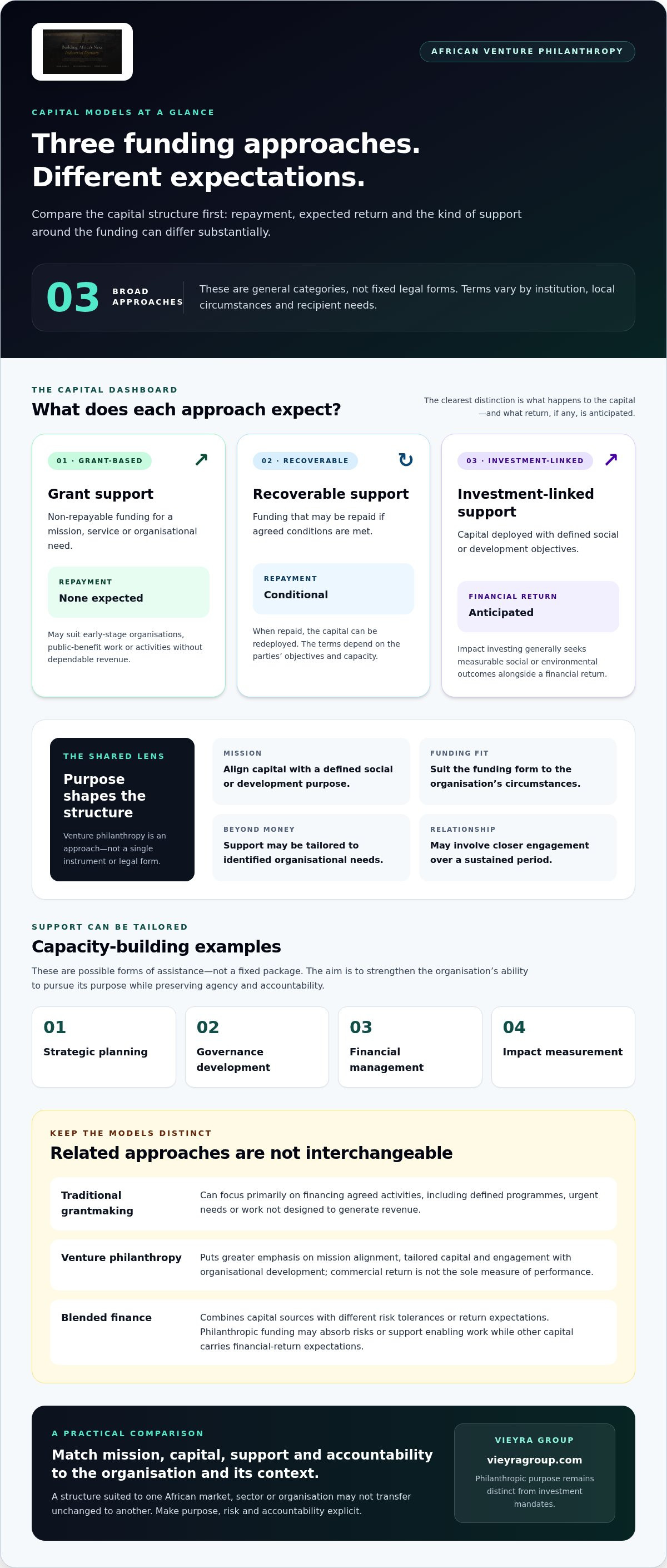
Its distinguishing features are the alignment of capital with mission, funding suited to an organisation’s circumstances, and support that can extend beyond money. Depending on identified needs, that support might include strategic planning, governance development, financial management or impact measurement. These are possible forms of capacity-building, not a fixed package. The central test is whether the relationship strengthens the organisation’s ability to pursue its purpose while preserving its agency and accountability.
How venture philanthropy differs from traditional grantmaking
Traditional grantmaking can suit defined programmes, urgent needs or activities that are not designed to generate revenue. Venture philanthropy does not make grants obsolete or less effective. Rather, it places greater emphasis on the funder’s engagement with the organisation’s development, often over a sustained period and with support tailored to identified needs.
For example, a mission-led enterprise seeking to extend a service may need operating capital as well as stronger governance processes or improved financial controls. A grant can fund the work; a venture-philanthropy relationship may also help build the capabilities needed to sustain it. Accountability should reflect the mission, context and intended outcomes. Commercial return is not the sole measure of performance, and social impact cannot be reduced to revenue growth alone.
Where it sits beside impact investing and blended finance
Venture philanthropy can use philanthropic risk capital in the form of grants, recoverable support or other arrangements, depending on the parties’ objectives and capacity. Its defining purpose is mission advancement. Repayment or financial return may be absent, limited or structured to support continued impact. Impact investing, by contrast, generally seeks measurable social or environmental outcomes alongside a financial return. For a foundational account of investment activity, see Venture Capital, which is distinct from philanthropy even where both may support enterprise growth.
Blended finance combines capital sources with different risk tolerances or return expectations, often to support an activity that may not attract sufficient commercial capital on its own. In some structures, philanthropic funding can absorb risks or support enabling work while other capital is deployed with financial-return expectations. These approaches can intersect, but they are not interchangeable. Sound design makes each contributor’s purpose, risk and accountability explicit. This distinction also informs strategic philanthropy for African industrialisation, where philanthropic initiatives can sit within a wider, long-term development perspective without becoming investment mandates.
Understand African venture philanthropy models through their purpose and operating relationship, not just their labels. Their suitability depends on the organisation’s maturity, the nature of its mission and whether deeper support can advance outcomes that financial capital alone may not deliver.
Which African Venture Philanthropy Models Can Fund Mission-Led Organisations?
No single instrument or legal structure defines venture philanthropy across Africa. Because institutions use the term in different ways, start by comparing repayment expectations and the type of organisation each approach is intended to support. The African Venture Philanthropy Alliance (AVPA) provides regional context for this evolving field. Individual arrangements are shaped by institutional mandates, local circumstances and recipient needs.
Three broad approaches help clarify the choices:
- Grant-based support: non-repayable funding directed toward a mission, service or organisational need.
- Recoverable support: funding that may be repaid if agreed conditions are met, allowing capital to be redeployed.
- Investment-linked support: capital deployed with an expectation of financial return alongside defined social or development objectives.
In brief: grants carry no repayment expectation, recoverable support may be repaid under agreed conditions, and investment-linked capital is structured around an anticipated financial return. These categories describe general approaches. Terms and structures differ among institutions.
Grant-based and capacity-building support
Non-repayable funding may suit early-stage organisations, public-benefit work or activities without dependable revenue. It can support service delivery, experimentation or essential organisational development without creating a repayment obligation. Operational assistance, such as strengthening financial systems or governance, may accompany a grant. That assistance is a separate element of the relationship, not an inherent feature of the funding instrument.
Capacity-building should respond to the organisation’s mission and priorities, rather than assume that every nonprofit should become a revenue-generating enterprise. A community organisation, for example, may need sound stewardship and programme evaluation while remaining focused on grant-funded public services. Measure progress by whether the organisation’s capabilities and resources help it deliver its purpose responsibly.
Recoverable grants, patient capital, and investment-linked support
A recoverable grant is funding that may be returned if specified conditions are met, such as reaching an agreed financial milestone. Set out the recoverable element clearly in advance. Patient capital describes a willingness to accept a longer horizon for results or repayment. It is an investment orientation, not a guaranteed product or promise of return.
Investment-linked support differs from grant funding because it anticipates financial return and ordinarily entails corresponding financial accountability alongside impact objectives. Its suitability depends on whether the organisation’s maturity, cash flow and operating model can support those expectations. Match African venture philanthropy models to the mission, organisational capacity and purpose of the funds, rather than choosing by label alone.
For institutions considering how philanthropy can sit alongside long-term African industrialisation priorities, the Vieyra Family Office’s African industrialisation perspective offers relevant context. Its philanthropic initiatives through the Vieyra Foundation are aligned with its investment strategy. That alignment does not make philanthropic and investment capital interchangeable.
How Should Decision-Makers Compare Venture Philanthropy Models?
No funding structure is inherently superior. Choose by assessing whether its obligations, duration and support match the organisation’s mission, operating maturity and context. The comparison below offers a starting point. An organisation’s public-benefit purpose should remain central, even when a funder also considers financial performance.
| Model | Capital form | Expected return | Support intensity | Typical duration | Potentially suitable use |
|---|---|---|---|---|---|
| Grant-based | Non-repayable funding | No financial return required | May range from limited engagement to tailored capacity support | Set by the grant and purpose | Public-benefit work or activities without dependable repayment capacity |
| Recoverable support | Funding repayable under agreed conditions | Repayment may be conditional; terms vary | Often accompanied by agreed milestones or organisational support | Linked to conditions and the recipient’s capacity | Work with a plausible route to repayment without undue strain |
| Investment-linked | Investment capital | Financial return is anticipated alongside impact objectives | May include strategic engagement and financial accountability | Aligned with the investment horizon and return expectations | Organisations with an operating model capable of supporting investment obligations |
Use the table to frame a decision, not to rank instruments. The suitability of African venture philanthropy models depends on mission alignment, organisational readiness, local conditions and governance. Commercial return expectations must not displace the public-benefit purpose. If repayment or return could divert resources from intended beneficiaries, reconsider the structure.
Match capital structure to mission and organisational maturity
Start with the organisation’s actual operating position. Does it earn revenue, have predictable cash flow, or rely on grants to deliver work that is not designed to generate income? Then assess whether repayment obligations fit its mandate and the needs of its beneficiaries. A revenue-generating enterprise may be able to consider recoverable or investment-linked capital, while a grant-dependent service may need non-repayable support. These are questions of fit, not fixed rules.
Model obligations against realistic income and expenditure, including periods when revenue may be delayed or uncertain. If repayment could reduce service delivery, constrain access for intended beneficiaries or encourage a shift toward more profitable activities, it may create mission drift or operational strain.
Assess governance, risk, and non-financial support
Before agreeing to terms, define who holds decision rights, what reporting is required and where the funder’s role ends. Accountability should provide meaningful oversight without displacing the organisation’s leadership or creating a reporting burden disproportionate to the support. Expertise or networks are valuable when they address a stated need, not simply because they are available.
Local context matters: operating conditions, counterparties and institutional arrangements differ across countries and sectors. A disciplined assessment of these exposures can complement the framework on sovereign investment risk management in Africa. The goal is proportionate stewardship, with capital terms, governance and risk oversight reinforcing the mission rather than competing with it.
How Can Venture Philanthropy Adapt to African Institutional Contexts?
A sound funding approach starts with the institution and place it is meant to serve, not with a preferred financial instrument. African countries, sectors and organisations differ in operating environments, income sources, governance arrangements and development priorities. A structure that supports one organisation may create unnecessary obligations for another. Make the assessment specific to the mission, local ownership and institutional capacity. Consider currency exposure and policy context at the project level rather than making continent-wide assumptions.
A practical sequence for selecting a model
Use these four steps to move from development intent to a considered funding arrangement:
- Define the mission. Specify the intended development outcome, the organisation’s mandate and the beneficiaries the work serves. This gives you a clear purpose against which to judge funding terms.
- Diagnose needs and readiness. Map the use of funds, current operating capacity, income sources and ability to manage additional reporting or repayment obligations. Consider whether local leadership has meaningful authority over priorities and implementation.
- Select capital and support. Choose a funding form and support horizon that fit the work, rather than forcing the work to fit the capital. Assess whether currency exposure or a changing policy environment could affect delivery, costs or financial commitments.
- Agree governance and accountability. Clarify decision rights, reporting responsibilities, review points and the respective roles of funder and recipient. Verify relevant country-level legal, tax or market claims before using them to inform decisions.
The sequence matters: choose capital only after assessing purpose and capacity. If a proposed repayment schedule could divert resources from beneficiaries, or reporting requirements exceed the organisation’s systems, redesign the arrangement. Involve local partners in the assessment, since they can identify operational realities that a general regional framework may miss.
Build accountability around learning and durable outcomes
Accountability is strongest when it distinguishes three levels of evidence. Outputs record what was delivered, such as services or activities. Organisational progress tracks changes in capabilities, systems or governance. Longer-term outcomes consider whether conditions for intended beneficiaries are improving. Each level answers a different question; none substitutes for the others.
Agree on reporting and review processes with local partners so measures are relevant, proportionate and useful for learning, not merely compliance. Reviews can show where implementation assumptions need adjusting and whether the original mission remains well served. This discipline also helps distinguish philanthropic objectives from investment mandates. Development priorities and private capital for African industrialisation are connected, but the two forms of capital should not be conflated.
For institutions assessing how capital, stewardship and local context can work together, explore Vieyra Group’s strategic capital perspective.
How Can Family Offices Align Philanthropy with Long-Term African Development?
For a family office, philanthropy and investment can contribute to related development priorities, but they remain distinct forms of institutional action. Align them by establishing clear purposes, governance and accountability for each, not by blending every mandate. Philanthropic initiatives can support public-benefit objectives, while investment decisions follow their own financial mandates. A shared interest in African development does not make grants and investments interchangeable.
This distinction matters across generations. Without clear objectives, future stewards may inherit an association between philanthropy and investment without understanding how their responsibilities differ. Durable alignment requires an institutional framework that explains why capital is deployed, what outcomes it seeks and how decisions are reviewed over time.
Preserve clear boundaries between philanthropic and investment capital
State charitable purpose, investment mandate and accountability separately, even when they inform one another. Assess philanthropic support against its intended public benefit and stewardship of resources. Assess investment capital against financial expectations appropriate to its mandate. Each requires decision processes and performance measures suited to its purpose. This separation protects mission integrity and prevents commercial return from becoming an implicit test of philanthropic value.
The Vieyra Foundation offers an institutional example: it pursues philanthropic initiatives aligned with the investment strategy of Vieyra Family Office. That alignment is relevant context, but it does not mean the Foundation uses a particular venture philanthropy model or that its philanthropic capital follows investment terms. Clear boundaries make coordination possible without erasing the distinct responsibilities of each.
Place venture philanthropy within an institutional legacy
A multi-generational perspective calls for more than continuity of intent. It requires governance that enables successive stewards to understand objectives, exercise sound judgement and assess whether an approach remains appropriate as institutions and circumstances change. Family offices can support this continuity by recording the rationale for philanthropic priorities, defining oversight responsibilities and reviewing progress against the purpose of each initiative. These measures provide structure without presuming that every generation will make identical decisions.
African industrialisation is the focus of Vieyra Family Office, though no philanthropic or investment activity guarantees a particular outcome. Within that broader orientation, African venture philanthropy models may be one way to align mission-led support with a longer institutional horizon, provided the chosen approach remains accountable to its own purpose. Philanthropy can complement strategic capital while retaining its distinct role.
For a wider view of the institutional principles that inform long-horizon capital allocation, explore global investment management principles in the context of sovereign-scale family offices.
Carry Development Intent into Durable Stewardship
Translate development intent into a durable institutional commitment: state the purpose clearly, define the relationship between philanthropic and investment decisions, and establish a process for reviewing whether that relationship continues to serve its objectives. This discipline gives future stewards a basis for thoughtful continuity while leaving room to adapt as local priorities and organisational needs evolve.
For family offices, this work calls for a long horizon and clear distinctions between mandates. Vieyra Family Office is a multi-generational African family office operating at sovereign scale, and the Vieyra Foundation pursues philanthropic initiatives aligned with its investment strategy. This context shows how philanthropic purpose and investment orientation can inform a broader approach to development without becoming interchangeable.
The value of African venture philanthropy models ultimately rests on the integrity of their design: capital should serve the mission, and governance should protect that purpose over time. Explore Vieyra’s approach to global investment management and strategic capital for African industrialisation to learn more about disciplined stewardship and long-term development.
Frequently Asked Questions
What is venture philanthropy?
Venture philanthropy funds mission-led organisations through sustained, strategically engaged support to advance social or development objectives. A funder might support an organisation delivering a public-benefit service while also helping it strengthen planning or financial oversight. The approach can use different funding instruments; what defines it is how funder and organisation work together toward mission outcomes, not a single contract type.
How is venture philanthropy different from impact investing?
Venture philanthropy prioritises the organisation’s mission and may use capital without requiring a financial return. Impact investing generally combines measurable impact objectives with an expectation of financial return. Consider a service enterprise expanding access to essential services: an impact investor may assess both its outcomes and ability to return capital, while a philanthropic funder may focus on the intended public benefit. The distinction affects which performance measures and financial obligations are appropriate.
What are the main venture philanthropy models?
The main approaches are grant-based support, recoverable funding and investment-linked capital. A grant does not require repayment; recoverable support may be repaid when agreed conditions are met; investment-linked capital anticipates financial returns alongside impact objectives. When comparing African venture philanthropy models, examine the written terms, including repayment triggers, decision rights and reporting duties. Labels alone may not reveal the actual obligations, which vary among institutions and arrangements.
Can venture philanthropy support early-stage African enterprises?
Yes. Venture philanthropy can support early-stage enterprises when the funding structure reflects their development stage and ability to manage its obligations. For an organisation testing whether a service meets a community need, non-repayable support may be more suitable than repayment-dependent capital before reliable income exists. A funder can also help address a defined organisational gap, such as planning or governance, without imposing commercial growth expectations on work whose purpose is public benefit.
Does venture philanthropy always require financial returns?
No. Grant-based philanthropy does not require repayment or an investment return, while some recoverable arrangements provide for repayment only if specified conditions are fulfilled. Investment-linked support is different because financial return is anticipated. Before accepting capital, both parties should understand whether repayment is mandatory, conditional or not expected, and what happens if milestones are missed. Clear terms help prevent an organisation from treating a grant as debt or an investment as a donation.
How should a funder measure venture philanthropy outcomes?
Select measures that reflect the initiative’s intended change and the evidence the organisation can reasonably collect. For a workforce programme, activity counts may show how many people received training, while follow-up evidence can examine whether participants gained relevant skills or employment. Establish a starting point, agree how information will be gathered, and distinguish observed results from changes that cannot confidently be attributed to the funding alone.
How can a family office align philanthropy with investment strategy?
A family office can establish shared long-term priorities while retaining separate objectives, approvals and measures for charitable activity and investment decisions. Written governance principles can clarify the purposes philanthropic capital serves, how investment decisions are assessed and how future generations review each mandate. Vieyra Family Office aligns philanthropic initiatives through the Vieyra Foundation with its investment strategy. That alignment does not make the Foundation’s activities equivalent to a particular investment or venture philanthropy model.


