

What if a sovereign rating captures a country’s broad credit profile but misses the exposure that matters most to a particular investment? Evaluating sovereign risk for investors requires more than reading a rating or reacting to political headlines. Fiscal pressure, currency constraints, policy choices, and institutional capacity can reinforce one another. Their effects depend on where an investment sits, how it is structured, and how long capital is committed.
These signals can be difficult to interpret together. A national risk indicator provides important context, but it cannot determine whether a project can withstand a policy change, restricted currency convertibility, or pressure on public finances. The practical question is not simply whether a country carries risk. It is how that risk could reach a specific investment over its intended horizon.
This article sets out a repeatable framework for assessing sovereign exposure before committing capital. It connects repayment capacity, policy, institutions, and investment structure to scenario analysis, diligence, and ongoing oversight. The aim is to distinguish material exposure from general uncertainty and make more disciplined decisions about long-horizon capital allocation, without attempting to predict political outcomes.
Key Takeaways
- Distinguish sovereign risk from broader country uncertainty by tracing how public finances, currency, regulation, contracts, and counterparties affect a specific investment.
- Make evaluating sovereign risk for investors a structured exercise: interpret fiscal, external, policy, institutional, and contingent-liability signals together rather than relying on one indicator.
- Compare risk channels against the evidence that matters, the investment exposure affected, and the diligence questions that can inform a decision.
- Use a sequenced assessment process to connect exposure mapping and scenario analysis with investment assumptions, structure, monitoring, and review.
- Apply a long-horizon stewardship perspective to country analysis, including when allocating capital toward African industrialisation, without treating strategic purpose as protection from risk.
What Evaluating Sovereign Risk Means for an Investor
Sovereign risk is the possibility that a government’s capacity, incentives, or actions will impair an investment’s expected cash flows, enforceability, or value. It can arise through missed or restructured public obligations, but it can also affect private assets through currency restrictions, regulatory changes, public infrastructure dependencies, or government-linked contracts. For an investor, sovereign risk is the exposure created when a government’s financial position or decisions can alter an asset’s expected returns, rights, or ability to operate.
This exposure varies across economies and asset classes. A government bond depends directly on the state’s repayment capacity and willingness to meet its obligations. An industrial project may instead depend on imported inputs, reliable public infrastructure, stable operating permissions, and payment from a public-sector counterparty. Sovereign Credit Risk Explained provides a foundation for understanding government credit exposure. An investment assessment should also account for the channels beyond direct borrowing.
Sovereign risk, country risk, and political risk: how they differ
Sovereign risk concerns how a government’s ability and willingness to act affect obligations and investments. Country risk is broader: it includes the full operating and financial setting, including conditions outside government, such as disruption to private-sector supply chains. Political risk is one possible channel, encompassing changes in policy or political conditions that affect an investment. It is not a synonym for every sovereign exposure. Fiscal weakness, currency pressure, and institutional capacity can matter without a dramatic political event.
These distinctions help investors avoid treating a single country label as a substitute for analysis. A policy change may directly affect a concession. Currency depreciation, meanwhile, may reduce the value of local-currency revenue against foreign-currency liabilities, even if the contract remains intact.
Where sovereign exposure appears in an investment
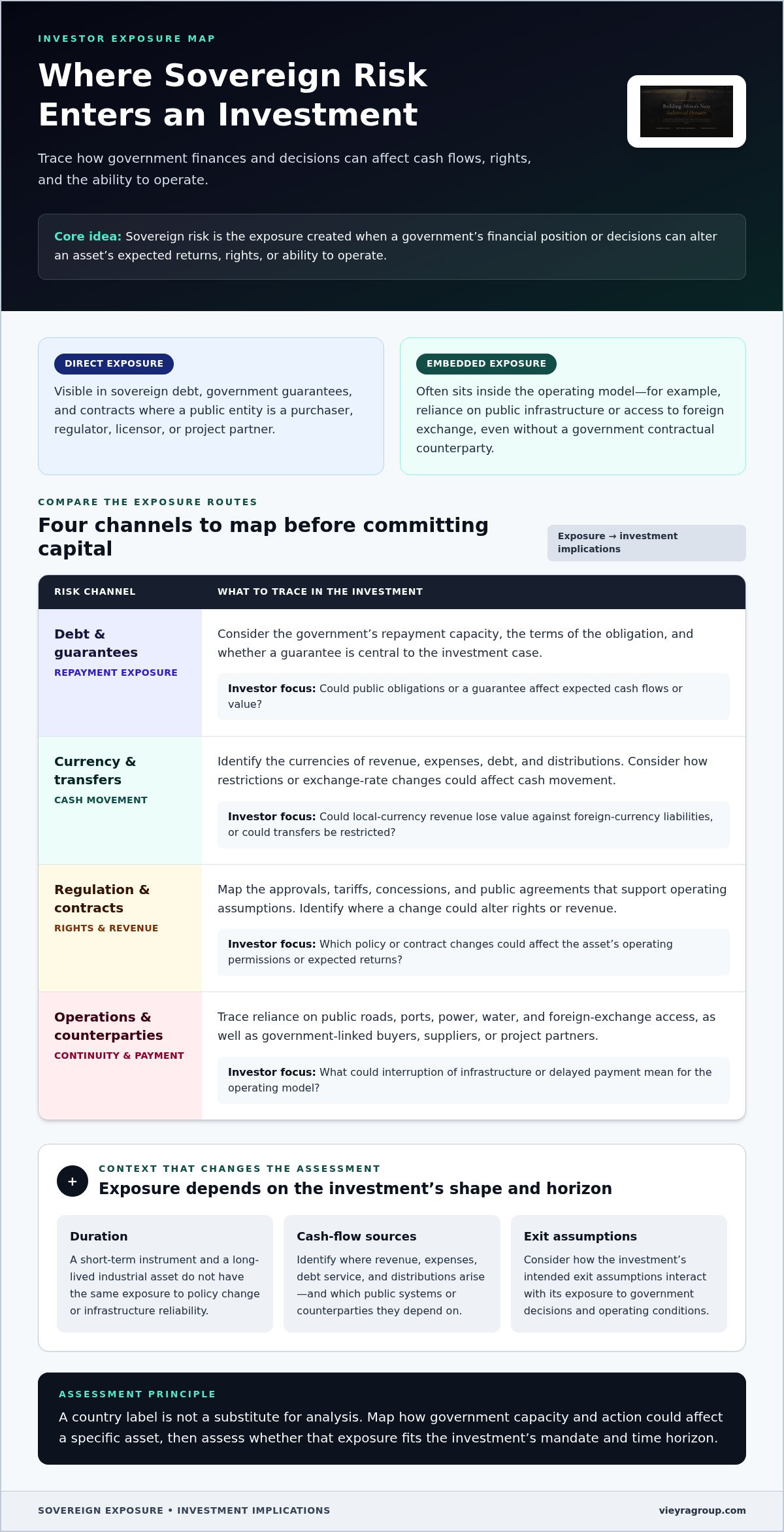
Direct exposure is visible in sovereign debt, government guarantees, and contracts in which a public entity is a purchaser, regulator, licensor, or project partner. Indirect exposure is often embedded in the operating model. A private company may depend on public roads, ports, power, water, or foreign-exchange access even when it has no government as a contractual counterparty.
- Debt and guarantees: Consider repayment capacity, the terms of the obligation, and whether a guarantee is central to the investment case.
- Currency and transfers: Identify the currencies in which revenue, expenses, debt, and distributions arise. Consider how restrictions or exchange-rate changes could affect cash movement.
- Regulation and contracts: Map the approvals, tariffs, concessions, or public agreements that support operating assumptions, and identify where a change could alter rights or revenue.
- Operations and counterparties: Trace dependencies on infrastructure and government-linked buyers, suppliers, or project partners. Consider the consequences of interruption or delayed payment.
Duration, cash-flow sources, and exit assumptions shape the assessment of each channel. A short-term instrument and a long-lived industrial asset do not have the same exposure to policy change or infrastructure reliability. Evaluating sovereign risk for investors therefore helps inform assumptions, diligence, and investment structure; it does not predict political outcomes. The objective is to identify how government capacity and action could affect a particular asset, then decide whether that exposure fits the investment’s mandate and time horizon.
How to Assess Sovereign Risk Across Fiscal, External, and Institutional Signals
A robust assessment brings together five connected areas: fiscal capacity, external resilience, institutional quality, policy direction, and contingent liabilities. The aim is not to compile indicators indiscriminately, but to understand how evidence in one area may amplify or moderate pressure elsewhere. Rising refinancing needs, for example, may become more consequential when foreign-currency earnings are constrained or public revenue is inflexible.
Sovereign-risk indicators are signals to interpret in combination, not standalone verdicts on an investment. Separate what is observed from what is inferred and what remains an assumption. A published debt measure is evidence; an assessment of its sustainability is interpretation; a forecast that future policy will remain unchanged is an assumption that requires scrutiny.
Fiscal and external indicators that inform repayment capacity
Start with the government’s obligations, revenue base, refinancing schedule, and budget flexibility. Debt levels alone may not show whether near-term obligations can be met without disrupting essential spending or requiring additional borrowing. Review the composition and maturity of liabilities alongside the durability of revenues, the cost of servicing debt, and the government’s capacity to respond to economic shocks.
Next, assess external resilience. Compare foreign-currency obligations with available reserves, export and other foreign-currency receipts, external financing needs, and balance-of-payments pressures. Consult current IMF country publications and World Bank reports where relevant, checking release dates, coverage periods, and definitions before comparing figures. Measures with similar labels may use different scopes or reporting periods. Reconcile those differences before relying on apparent changes in an investment assumption.
Institutional and contingent risks beyond headline indicators
Debt and external accounts do not show how consistently policy is implemented or how reliably public institutions administer approvals, uphold contracts, and maintain continuity. Examine documented policy decisions and implementation, the capacity of relevant agencies, and evidence about contractual enforcement. Treat forward-looking judgments cautiously: institutional strength can influence investment conditions, but it cannot guarantee that future decisions will be predictable.
Contingent liabilities may also shift pressure onto public finances. Where evidence exists, review government guarantees, state-owned enterprise obligations, and commitments that could require public support. Disaster and climate exposure also belong in the assessment. Potential damage to infrastructure, revenue, or public spending may create fiscal pressure, but this is one channel among several, not a complete account of sovereign risk.
- Evidence: Record the source, publication date, period covered, and definition for each material indicator.
- Interpretation: Explain how signals interact, including whether external pressures could constrain fiscal choices or whether institutional capacity could affect mitigation.
- Assumptions: Identify what the investment case presumes about policy, financing, and continuity, then define what evidence would challenge those premises.
This discipline turns country analysis into explicit investment assumptions rather than broad judgments. For long-horizon capital allocation, Vieyra Family Office’s investment perspective reflects the importance of considering exposure alongside strategic purpose and institutional stewardship.
Comparing Sovereign Risk Channels and Their Investment Implications
A country-level development does not affect every investment in the same way. Higher public financing pressure, for example, may coincide with tighter foreign-exchange conditions or changes in public spending, but none of these outcomes follows automatically. The relevant question is how a potential change could affect an asset’s cash flows, operating continuity, contractual rights, or ability to return capital.
Use the comparison below to connect each risk channel to observable evidence and a diligence question. Focus on evidence specific to the investment, not just a general signal about the country.
| Risk channel | Evidence to examine | Potentially affected exposure | Diligence question |
|---|---|---|---|
| Fiscal | Debt-service pressure, budget flexibility, refinancing needs | Sovereign obligations, public payments, guarantees | How dependent are expected returns on public funding or timely payment? |
| Currency and transfer | Currency of revenues and liabilities, access to foreign exchange, transfer arrangements | Debt service, imported inputs, distributions, repatriation | Could local-currency receipts fall short of foreign-currency obligations? |
| Policy | Documented policy changes, implementation, sector decisions | Regulated revenues, operating permissions, project economics | Which assumptions rely on policy continuity? |
| Institutional | Administrative capacity, continuity, evidence of contract enforcement | Approvals, dispute resolution, operating processes | Which institutions must act for the project to function? |
| Contract | Counterparty obligations, payment history, contractual protections | Concessions, procurement, public-private arrangements | What happens to cash flow if a government-linked counterparty delays performance? |
| Disaster-related | Asset location, infrastructure dependencies, documented fiscal exposure | Physical operations, public services, repair and recovery assumptions | How could disruption affect operations or public capacity to meet commitments? |
How the same country risk reaches different assets
A sovereign bond is directly exposed to the government’s ability and willingness to service debt. An infrastructure project may instead rely on regulated tariffs, a public-sector purchaser, or imported equipment. An operating business may have no government contract but still be vulnerable if it depends on public power, transport, or foreign-currency access. Currency mismatch can impair returns without sovereign default: local-currency revenue may lose value against foreign-currency debt or imported inputs.
A credit rating offers an external view of sovereign creditworthiness, not a verdict on every asset in that country. Evaluating sovereign risk for investors requires a separate assessment of the asset’s revenue sources, counterparties, costs, and contractual protections.
Why time horizon and scenario assumptions change the comparison
Near-term liquidity pressure may matter most to an investment facing imminent refinancing or payment obligations. Institutional continuity and structural policy change may carry greater weight for a long-lived project. Test base, adverse, and severe scenarios as disciplined cases, not precise predictions. State what each assumes about financing, currency access, policy, and operations, then identify observable evidence that would warrant revising the analysis.
A Practical Sovereign-Risk Evaluation Process for Investment Decisions
A disciplined process turns country analysis into investment decisions by tracing exposure, testing assumptions, and assigning responsibility for review. Begin before capital is committed and continue for as long as the investment depends on government decisions, public infrastructure, or country-specific operating conditions. For a deeper Africa-focused perspective on institutional stewardship, see this sovereign investment risk management framework.
From country screening to investment-specific diligence
Start with the asset’s cash-flow architecture: where revenue originates, which counterparties must perform, what currencies govern receipts and obligations, and how long capital is expected to remain invested. Screen for country indicators only when they bear on those dependencies. Record each source, its publication date, and the period it covers so decisions can be traced to evidence later.
- Map exposure. Identify direct government obligations and indirect dependencies, including regulated revenue, public infrastructure, foreign-currency inputs, or a government-linked purchaser. This map shows which risk channels merit detailed review.
- Select relevant evidence. Match fiscal, external, policy, and institutional indicators to the exposure map. A project with imported equipment may require closer attention to currency access; a public contract may warrant deeper review of counterparty performance and payment assumptions.
- Test critical assumptions. List the legal, operational, financing, and exit premises that underpin expected returns. For each, ask what evidence supports it, who is responsible for verifying it, and what decision would change if it proved unsound.
- Translate findings into a decision. Determine whether the exposure fits the investment mandate, requires a different structure or allocation, or calls for further diligence before commitment. Document the reasoning and any unresolved questions.
Turn scenarios into governance, structure, and monitoring
Build base, adverse, and severe scenarios around plausible changes to the investment’s key assumptions, without presenting any case as a prediction. Define observable triggers, such as a material change in payment performance, currency access, policy implementation, or infrastructure availability. Set review intervals suited to the asset’s duration and mandate, with additional review when a trigger occurs.
Scenario analysis can inform contractual terms, financing choices, operational contingencies, and portfolio allocation, but none of these measures guarantees protection. Match each response to the exposure: alternative sourcing may address an input dependency, while financing more closely aligned with the cash-flow currency may reduce a mismatch. Record the limits of each response and the conditions under which it may no longer be adequate.
Assign an accountable owner for monitoring, specify who receives material updates, and preserve a record of changed evidence and decisions. Clear responsibilities help keep oversight active after approval. For long-horizon capital, review should reflect both investment assumptions and institutional priorities. The principles of family office governance for wealth preservation provide relevant context for assigning that stewardship.
Vieyra Family Office’s investment perspective connects country assessment with long-term capital allocation. Read more about Vieyra’s investment perspective.
Long-Horizon Sovereign Risk Stewardship at Vieyra Family Office
For a multi-generational investor, sovereign-risk assessment is an ongoing discipline, not a one-time screening exercise. Country conditions can shape an asset’s operating life, cash flows, financing, and eventual transfer or exit. Analysis should therefore remain connected to the investment mandate and the period for which capital is committed. Vieyra Family Office manages global investments across asset classes while focusing on African industrialisation. That context makes it important to assess strategic purpose alongside uncertainty, not to treat purpose as protection from risk.
Aligning country analysis with multi-generational investment horizons
Stewardship begins by making exposure explicit: which government decisions, institutions, public services, or currency conditions could affect the asset, and how those dependencies fit the portfolio’s objectives. The investment horizon matters. A long-duration holding may face several cycles of policy and institutional change, while a shorter holding may be more sensitive to immediate financing or liquidity conditions.
Patient capital can support development over time, but patience is not a substitute for evidence or governance. Record the assumptions that underpin the investment case, assign responsibility for reviewing them, and establish how material changes will be escalated. This creates continuity between initial diligence, ongoing oversight, and decisions about whether the investment remains consistent with its mandate. Evaluating sovereign risk for investors is therefore an exercise in disciplined stewardship, not an attempt to forecast political outcomes.
Applying an African industrialisation lens without overlooking risk
Industrial projects may depend on reliable infrastructure, policy conditions, foreign-currency access, functioning institutions, and counterparties capable of meeting their obligations. Those dependencies vary by project and location. Begin with the specific project’s inputs, customers, operating requirements, revenue arrangements, and financing, rather than treating African markets as a single risk category.
A global portfolio perspective helps put country exposure in context. Consider an asset’s role in the wider allocation, including its return drivers and dependencies across jurisdictions and currencies. This does not replace local, project-level diligence. It helps decision-makers ask whether potential development value rests on credible assumptions and whether the portfolio can accommodate the uncertainties identified.
Strategic capital allocation is most considered when opportunity and uncertainty are assessed together. For investors with long horizons, that means linking purpose to practical oversight: maintaining clear assumptions, reviewing evidence as conditions evolve, and ensuring decisions remain aligned with institutional priorities. Vieyra Family Office’s global investment management and capital allocation work provides broader context for considering country exposure within a global allocation.
Learn more about Vieyra Family Office and its focus on global investment management and African industrialisation.
Carry Sovereign-Risk Discipline Into the Next Investment Decision
Make country exposure visible in the investment record: preserve the assumptions behind the decision, identify what evidence could change them, and assign responsibility for revisiting those judgments. This turns sovereign-risk analysis into an ongoing practice of institutional stewardship, rather than a document completed only when capital is committed.
For long-horizon capital, evaluating sovereign risk for investors is not an exercise in eliminating uncertainty. It is a way to understand where uncertainty may affect an investment, decide whether that exposure is consistent with its purpose, and remain prepared to reassess as conditions evolve. A considered process can support ambitious investment objectives while maintaining discipline about the risks attached to each asset.
Vieyra Family Office brings a multi-generational African perspective to global investment management and strategic capital focused on African industrialisation. Explore Vieyra Family Office’s investment perspective to learn more about its approach to long-term capital stewardship.
Frequently Asked Questions
What does sovereign risk mean for an investor?
Sovereign risk is the possibility that a government’s financial capacity or actions could affect an investment’s value, cash flows, or ability to operate as expected. The impact may appear as a missed payment, a change in the timing of a project’s revenue, or a constraint that alters how capital can be used. Its importance depends on the investment’s reliance on public obligations, decisions, or systems.
Is sovereign risk the same as country risk?
No. Sovereign risk concerns exposure to a government’s obligations and actions, while country risk covers a broader range of conditions that may affect investments within a country. For example, a private-sector supply disruption could affect a company’s production without being caused by the government. The distinction helps investors identify whether a potential loss arises from sovereign decisions, wider operating conditions, or an interaction between them.
How do investors assess sovereign risk?
Investors assess sovereign risk by connecting country evidence to a specific investment’s revenue, costs, counterparties, financing, and time horizon. Ask what happens if a major public customer pays late, an essential imported input becomes harder to obtain, or expected project approvals are delayed. Evaluating sovereign risk for investors also involves recording assumptions, testing how changed conditions affect returns, and deciding what evidence should trigger a review.
Can a sovereign credit rating fully measure investment risk?
No. A sovereign rating assesses government creditworthiness, but it cannot capture every feature of an individual asset or transaction. Two investments in the same country may differ in their customers, currencies, operating dependencies, contractual arrangements, and ability to adjust when conditions change. Use the rating as one reference point, then examine whether the specific investment depends on factors the country-level assessment does not measure.
What happens if a government imposes currency or transfer restrictions?
Restrictions may affect an investor’s ability to convert local receipts, make certain foreign-currency payments, or transfer funds across borders. The practical consequence depends on the measure and the investment’s cash-flow arrangements. For example, a project earning local currency but owing payments in another currency could have difficulty meeting its obligations if conversion or transfer is constrained. Assess this exposure in financing and cash-flow scenarios.
Do sovereign risk assessments include climate and disaster exposure?
Yes. An assessment can consider how a climate-related event or disaster may affect an asset directly and place pressure on public finances or essential services. For example, damage to a transport link could interrupt a facility’s access to suppliers or customers, while recovery demands may affect public capacity elsewhere. Examine the location, operational dependencies, and resilience assumptions built into the project, alongside other sovereign-risk channels.


