
Capital alone does not industrialize an economy. Durable growth depends on whether investment is matched by capable institutions, viable enterprises and the productive priorities of each market. The phrase “strategic capital Africa” is used inconsistently across investment and development discussions, and broad continental narratives can obscure the distinct conditions shaping opportunity from one country to another.
That distinction matters. Capital deployed for a short-term return may support an individual transaction, but lasting industrial development calls for a longer horizon and a considered relationship between financing and execution. Understanding what makes capital strategic helps investors assess Africa’s industrial potential with discipline rather than generalization.
This article examines how strategic capital differs from financing treated solely as a transaction, and how institutional capacity, commercial viability and productive priorities shape investment decisions. It also sets out a framework for evaluating long-term allocation across varied African markets. From an institutional, long-horizon perspective, it considers how global investment management can connect with African industrialization, with philanthropy as a complementary activity rather than a substitute for investment.
Key Takeaways
- Distinguish strategic capital from transaction-focused financing by examining the long-term economic and institutional objectives behind an allocation.
- Assess how project maturity, financing needs and investment horizons shape the potential roles of equity, debt and blended structures.
- Evaluate country, currency, regulatory, execution and market risks separately to clarify uncertainty and accountability.
- Use a disciplined sequence to test strategic fit, local context, project readiness, governance and long-term viability before allocating capital.
- See how strategic capital Africa can connect a multi-generational investment perspective with industrialization priorities, while recognizing philanthropy as complementary to investment.
What Does Strategic Capital Mean in the African Context?
Strategic capital is investment guided by long-term economic and institutional objectives, rather than by the terms of a funding transaction alone. Its mandate considers not only how much capital is required, but also the productive capacity an investment may help develop, the institutions needed to support it and the time horizon over which value could be created. In this sense, strategic capital Africa is an approach to allocation, not a single financing instrument or uniform investment model.
State-directed investment funds offer one point of reference, although strategic capital is broader than any one institutional form. A Sovereign wealth fund (SWF), for example, invests assets on behalf of a state under a defined mandate. Other investors, including family offices and long-horizon institutions, may also direct capital toward wider economic objectives while retaining distinct governance structures and investment responsibilities.
How Is Strategic Capital Different from Capital Alone?
Capital alone describes the financial resources committed; strategy describes the purpose, conditions and intended contribution of that commitment. A funding decision may focus primarily on price, repayment or ownership terms. A strategic allocation also tests whether the mandate, time horizon and investee’s execution capacity align with the investment’s productive objectives.
That broader perspective does not guarantee commercial returns or development outcomes. It gives decision-makers a more complete basis for assessing opportunity, capability and risk alongside financial objectives.
Why Industrialization Gives Capital a Wider Role
Industrialization involves more than establishing a factory or financing an enterprise. Productive activity depends on an operating environment that may include infrastructure, skilled labour, reliable suppliers, logistics, relevant institutions and access to durable markets. Investment analysis can examine how an enterprise connects with these supporting capabilities, and whether those connections are developed enough to sustain operations.
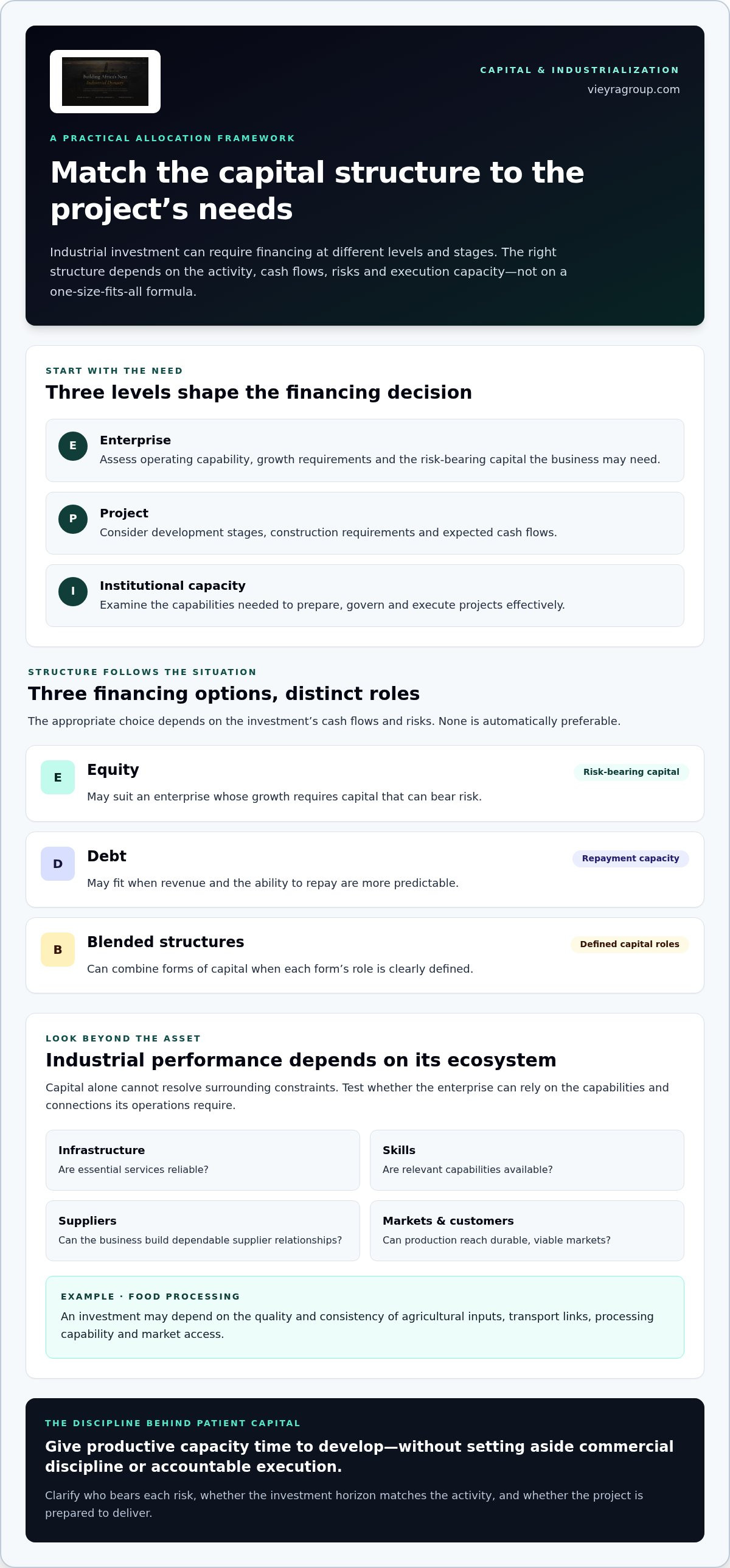
For instance, a food-processing investment may depend on the quality and consistency of agricultural inputs, transport links, processing capability and market access. The appropriate capital structure and sequencing depend on the project and its context; there is no universal pathway or financing mix.
Africa is not a single market with one industrial trajectory. National institutions, regional connections, sector conditions and enterprise capabilities differ, shaping both investment requirements and the feasibility of particular plans. A disciplined strategic mandate starts with that diversity: it tests an opportunity against its specific setting rather than assuming an approach suited to one market can be transferred unchanged to another.
How Strategic Capital Can Support African Industrialization
Industrial investment rarely follows a single financing timetable. An enterprise may need capital to strengthen operations, a project may require funding across development and construction, and institutional capacity can determine whether investment is prepared and governed effectively. Strategic capital can support industrialization when its structure and duration reflect these different needs, rather than treating every opportunity as a request for funds on identical terms.
Patient capital can give productive capacity time to develop without removing the need for commercial discipline or accountable execution.
Matching Capital Structures to Project Needs
The appropriate structure depends on the level of investment and the nature of its cash flows and risks. Equity may suit an enterprise whose growth requires risk-bearing capital; debt may fit more predictable revenue and repayment capacity; blended structures can combine forms of capital when their respective roles are clearly defined. None is automatically preferable.
At the enterprise level, analysis may focus on operating capability and growth requirements. Project-level financing calls for attention to development stages, construction and expected cash flows. Broader institutional needs concern the capabilities that enable projects to be prepared, governed and executed. At each level, clarify who bears particular risks and whether the investment horizon matches the underlying activity.
Connecting Investment to the Wider Industrial Ecosystem
Capital cannot, by itself, resolve constraints in infrastructure, skills, supplier relationships or access to customers. These conditions influence operating costs, production continuity and an enterprise’s ability to reach viable markets. Investors can assess not only the asset or company, but also its dependencies: the reliability of essential services, the availability of relevant capabilities and the strength of connections with suppliers and buyers.
Regional trade frameworks may inform this analysis, but they do not establish market access on their own. As of March 2026, 25 countries had gazetted tariff schedules required to begin preferential trading under the African Continental Free Trade Area, while broader implementation remained phased. For investors, this makes country-level readiness, applicable rules and practical logistics important considerations, rather than assumptions of seamless regional trade.
For a focused examination of private capital’s role in this wider system, see the mandate for private capital in African industrialization. This perspective is central to Vieyra Family Office’s long-horizon approach to investment, which connects global investment management with a focus on African industrialization and long-term economic development.
Which Risks and Governance Questions Shape Strategic Capital in Africa?
Long investment horizons raise a legitimate question: how can institutions remain accountable when conditions may change before an industrial project reaches maturity? The answer is not to treat uncertainty as a single obstacle or assume that patience removes it. Disciplined stewardship requires investors to identify distinct exposures, assign oversight responsibilities and revisit assumptions as implementation proceeds.
When assessing strategic capital Africa, investors need to consider market conditions in their specific national, regional and sectoral context. A continent-wide risk label obscures differences between jurisdictions and projects. A useful assessment identifies the factors that could affect a particular investment and the institution’s capacity to respond.
How Should Investors Think About Risk Across Different Markets?
Risk analysis is more rigorous when exposures are separated rather than compressed into one general judgment. Relevant categories may include:
- Country and political conditions: consider how changes in public priorities or institutional conditions could affect the investment’s assumptions.
- Currency exposure: examine the relationship between the currencies of investment, operating costs, revenues and obligations.
- Regulatory conditions: assess the rules relevant to the activity and how changes could alter its operating context.
- Execution and market factors: evaluate project readiness, delivery capability, input relationships, demand and access to customers.
These categories are not predictions, and their significance varies by jurisdiction and investment structure. Assess them against the project’s expected duration, revenue profile and allocation of responsibilities. Ongoing monitoring tests whether the original assumptions remain credible, allowing decision-makers to respond to material changes through established processes rather than relying on initial diligence alone.
Why Governance Matters to Long-Term Capital
Governance gives a long-term mandate practical form. Clear decision rights establish who approves an allocation, oversees implementation, reviews performance and determines whether material changes need further authorization. Defined accountability also distinguishes investment intent from execution: an institution can set a strategic objective, but progress depends on the quality of decisions and oversight throughout the investment’s life.
For effective stewardship, mandates should specify objectives, boundaries, reporting expectations and escalation procedures. These disciplines do not eliminate uncertainty or assure an outcome. They make responsibility visible and provide a basis for evaluating whether capital continues to serve its intended purpose as circumstances evolve.
For a deeper examination of institutional oversight and risk frameworks, read sovereign investment risk management in Africa. The central principle is consistent: long-term capital requires governance that preserves accountability and remains responsive to context.
How Can Institutions Evaluate a Strategic Capital Opportunity?
A disciplined allocation process translates broad economic intent into decisions that can be assessed, governed and monitored. For strategic capital Africa, the sequence should test both whether an opportunity advances the mandate and whether its commercial foundations and institutional conditions support responsible investment. Development objectives matter, but they do not replace analysis of financial viability.
Assess project readiness and institutional capacity together: a sound proposal depends on the ability to execute, while capable institutions need investable projects through which to act.
A Five-Part Assessment Before Capital Allocation
- 1. Define the mandate. State the long-term objective and intended productive contribution before reviewing proposals. Clarify how the opportunity fits the institution’s priorities and what falls outside its remit.
- 2. Establish the local context. Examine the relevant country, sector and market using available evidence. Consider demand, operating conditions, enabling infrastructure and connections to suppliers and customers. Do not assume that conditions in one jurisdiction apply elsewhere.
- 3. Test project readiness. Assess the project’s stage, execution plan, required capabilities and key dependencies. Identify what is already in place and what remains necessary for implementation, distinguishing documented readiness from aspiration.
- 4. Examine governance and risk allocation. Identify decision rights, accountability, oversight and reporting responsibilities. Determine how participants allocate material risks and whether governance arrangements can support monitoring throughout the investment horizon.
- 5. Evaluate long-term viability. Consider whether the proposed structure, expected cash flows and investment horizon are coherent with the project’s needs. Assess commercial objectives, such as financial performance and operating sustainability, separately from development objectives, such as productive capacity or institutional contribution.
From Investment Thesis to Long-Term Stewardship
This sequence should lead to a clear investment thesis: why the opportunity fits the mandate, what conditions underpin its viability and how oversight will respond if assumptions change. The thesis then informs allocation decisions, governance arrangements and ongoing review. Measurable commercial and development objectives make assessment more rigorous, but institutions should define indicators suited to the opportunity rather than rely on generic targets.
Stewardship continues after capital is committed. Regular review can compare performance with the thesis, examine emerging risks and determine whether the investment remains aligned with its purpose. For related portfolio and stewardship context, see global investment management principles.
Explore Vieyra Family Office’s strategic capital approach to see how a long-horizon investment perspective connects allocation with African industrialization.
How Vieyra Family Office Approaches Strategic Capital for Africa
The principles of strategic allocation become more tangible when viewed through an institution whose investment horizon extends beyond a single transaction. Vieyra Family Office is a multi-generational African family office with a global investment mandate and a focus on allocating strategic capital toward African industrialization and long-term economic development. This perspective connects global investment management with an enduring interest in the continent’s productive potential, while recognizing that each opportunity must be assessed in its own context.
A Multi-Generational Family Office with an African Focus
A multi-generational perspective emphasizes stewardship: how capital is allocated, what objectives guide that allocation and how investment decisions relate to longer-term priorities. It provides a framework for considering opportunities whose development and productive contribution may extend beyond a short investment cycle. A long horizon, however, is not a substitute for disciplined analysis and does not ensure commercial success or a particular development outcome.
For Vieyra Family Office, global investment management and a focus on African industrialization sit within the same institutional perspective. This approach recognizes that industrial growth depends on more than capital provision: project readiness, execution capability, governance and market context remain central to evaluating an opportunity. The strategic capital mandate provides direction, while investment decisions remain grounded in the circumstances of each opportunity.
Capital and Philanthropy Within a Broader Institutional Vision
Institutional stewardship can encompass distinct forms of capital and activity, each with its own purpose. Investment capital is allocated with commercial considerations and an investment mandate in view. Philanthropy can contribute to a broader institutional vision, but it does not replace commercial investment or make the two interchangeable.
The Vieyra Foundation pursues philanthropy aligned with the institution’s investment strategy. Its role is complementary: philanthropic activity and investment allocation can reflect related long-term priorities while retaining distinct purposes. This distinction clarifies how each contributes to the wider vision without implying that either guarantees industrial or economic outcomes.
For readers considering strategic capital Africa through an institutional, long-horizon lens, Vieyra Family Office brings together an African identity, global investment management and a focus on industrialization. Explore Vieyra Family Office to learn more about its institutional perspective and investment approach.
Build Industrial Growth Through Disciplined Capital Stewardship
Lasting industrial growth depends on more than the volume of financing. Strategic capital Africa connects long-term economic priorities with commercially grounded decisions, capable institutions and the conditions required for execution. A disciplined approach distinguishes country, currency, regulatory, market and delivery risks, then evaluates strategic fit, project readiness, governance and long-term viability before allocating capital.
These principles reflect the institutional perspective of Vieyra Family Office, a multi-generational African family office operating at sovereign scale. Its global investment management focuses on African industrialization and long-term economic development, while Vieyra Foundation initiatives align with the investment strategy as a complementary philanthropic activity. This commitment frames an approach to stewardship, not a guarantee of investment or development outcomes.
Industrial capacity is built through considered decisions sustained over time. Explore Vieyra Family Office to learn more about its institutional perspective and investment approach, and consider how disciplined capital allocation can contribute to Africa’s long-term productive potential.
Frequently Asked Questions
What is strategic capital in Africa?
Strategic capital in Africa is investment guided by long-term economic and institutional objectives, rather than treated solely as a funding transaction. A strategic capital Africa framework considers the investment’s mandate, time horizon and intended productive contribution alongside commercial viability, governance and execution capacity. It does not guarantee returns or development outcomes. Its purpose is to bring these considerations into capital allocation while assessing each opportunity within its specific national, regional and sectoral context.
How can strategic capital support industrialization in Africa?
Strategic capital can support industrialization by aligning financing with project maturity, business needs and realistic investment horizons. Equity, debt or blended structures may serve different roles depending on cash flows, risk allocation and project circumstances. Investment decisions can also account for operating requirements, including infrastructure, skills, supplier relationships and access to markets. These factors influence execution, but capital alone cannot resolve them or ensure a project’s success.
What is the difference between strategic capital and private capital?
Private capital describes capital by its source or ownership, while strategic capital describes the broader mandate guiding its allocation. Private investment may be strategic when it considers long-term objectives, productive contribution and institutional context alongside financial discipline. Strategic capital may also come from different types of institutions, including family offices or state-directed funds. The distinction is about purpose and approach, not a single financing instrument or ownership category.
What sectors can strategic capital support in Africa?
Potential areas include manufacturing, agribusiness, energy transition and digital infrastructure, where investment may contribute to productive capacity or enabling systems. These are not universal priorities for every country or investor. Sector selection depends on local market conditions, project readiness, infrastructure, institutional capacity and commercial prospects. Investors should assess the particular opportunity and its dependencies rather than assume a sector’s importance at the continental level makes every project viable.
What risks should investors consider when deploying capital in Africa?
Investors should distinguish country and political conditions, currency exposure, regulatory context, execution capacity and market demand. These risks vary by jurisdiction, sector and investment structure, so broad continent-wide rankings can obscure important differences. Assessment should consider how exposures relate to the project’s expected horizon and allocation of responsibilities. Clear governance, defined decision rights and ongoing monitoring help institutions review assumptions and respond as conditions change.
How can institutions evaluate an African industrial investment opportunity?
Institutions can begin by defining the investment mandate and intended contribution, then assess the local market and enabling conditions. Next, examine project readiness, execution capabilities and dependencies; review governance, oversight and risk allocation; and test long-term commercial viability alongside development objectives. Assess these objectives distinctly rather than treating them as interchangeable. Project readiness and institutional capacity matter together because implementation depends on both a prepared opportunity and the ability to execute responsibly.
How does a family office contribute to strategic capital in Africa?
A family office can bring a long-horizon institutional perspective to investment management and capital allocation, guided by its mandate and governance. Vieyra Family Office is a multi-generational African family office operating at sovereign scale. It manages global investments across a range of asset classes while focusing on African industrialization and long-term economic development. This perspective informs its strategic capital allocation without implying that any investment guarantees commercial performance or development outcomes.
How do philanthropy and strategic investment relate to African industrialization?
Philanthropy and strategic investment can support related long-term institutional priorities while serving distinct purposes. Investment capital is allocated under commercial and investment considerations; philanthropic activity is not a substitute for that capital or a commercial allocation. Through the Vieyra Foundation, Vieyra Family Office pursues philanthropic initiatives aligned with its investment strategy. This alignment reflects a broader institutional vision while preserving the distinction between philanthropic activity and investment decisions.


