
What if the most important result of a philanthropic grant is not what it funds this year, but what an institution can sustain after the funding ends? For institutional philanthropy Africa, grant totals and activity reports are useful records, but they cannot show on their own whether local capabilities have strengthened or whether change will endure.
That measurement challenge is familiar to funders and institutions alike. Outcomes can take years to emerge, and social and economic conditions make it difficult to attribute change to a single grant. Evaluation frameworks developed elsewhere may also miss the priorities and perspectives of the people most affected.
This article explains how to distinguish activities and outputs from outcomes and longer-term institutional effects, then choose proportionate ways to gather evidence, learn, and remain accountable. It covers how local context and intended beneficiaries can shape evaluation, including how funders can assess their contribution without overstating attribution. The Vieyra Foundation offers an example of philanthropy situated within a broader institutional strategy, where long-term development and investment are considered together.
Key Takeaways
- Distinguish inputs, activities, outputs, outcomes, and longer-term effects. Each measure shows something different and has limits.
- Assess institutional philanthropy Africa by tracing the connection between mandate, resources, intended capacity, continuity, and local partnerships.
- Build a proportionate evidence cycle: define the purpose, establish a baseline, select relevant evidence, review progress, learn, and communicate findings.
- Shape evaluation around local context and the priorities of intended beneficiaries, while distinguishing a funder’s contribution from sole attribution.
- Consider how philanthropic initiatives can fit within a broader institutional strategy and complement investment and public-sector action without overstating results.
What institutional philanthropy in Africa measures, and why grant totals are not enough
Institutional philanthropy is organized, sustained philanthropic action guided by a defined mandate, governance arrangements, objectives, and accountability. Unlike a single act of giving, it can provide an ongoing basis for setting priorities, allocating resources, reviewing progress, and learning over time. An institution’s scale and longevity describe how its giving is organized; they do not establish its effectiveness or public value.
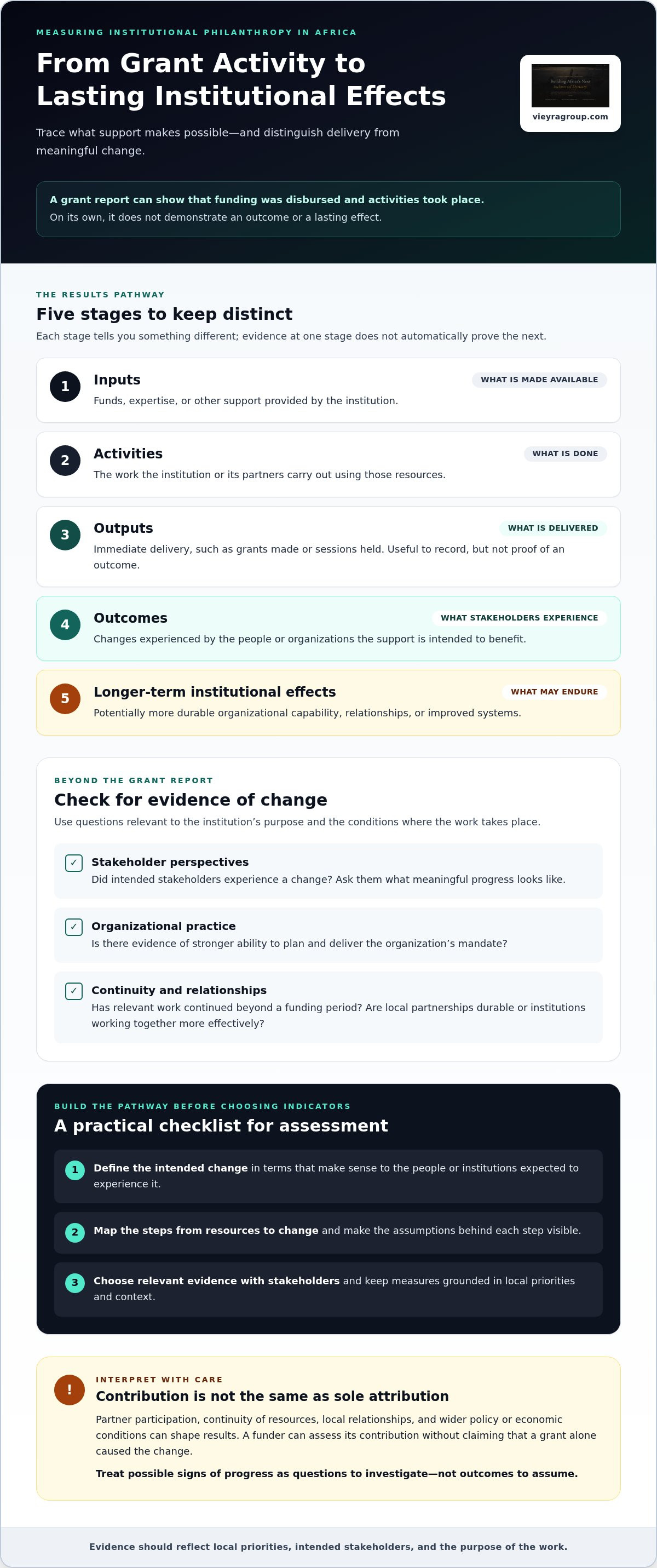
Assessment needs to distinguish the stages between commitment and change. Inputs are the funds, expertise, or other support made available. Activities are what the institution or its partners do with those resources. Outputs record immediate delivery, such as grants made or sessions held. Outcomes are changes experienced by intended stakeholders. Longer-term institutional effects may include stronger organizational capability, more durable relationships, or improved systems. These stages connect, but they are not interchangeable: a record of delivery does not by itself demonstrate an outcome.
How institutional philanthropy differs from individual giving and episodic grants
Individual giving, episodic grants, and institutional philanthropy can each respond to need and reflect considered priorities. Their mandates and decision processes may differ. An institution often works within formal governance and defined objectives, while individual giving may reflect personal judgment or a particular moment. Neither form is inherently superior. A continuing institutional approach can support repeated review, shared responsibility, and accountability across funding decisions, provided that those practices are built into how the institution works.
Continuity creates the possibility of sustained learning, not a guarantee of it. An institution still needs to examine whether its objectives remain relevant, whose perspectives shape decisions, and whether reported activities correspond to meaningful change. For a wider example of an African philanthropic institution, see the overview of TrustAfrica.
What counts as a result beyond the grant report
A grant report can establish that resources were disbursed and agreed activities took place. It may not show whether intended stakeholders experienced a change, whether a partner can continue its work, or whether local institutions are working together more effectively. Answering those questions requires evidence suited to the outcome, such as stakeholder perspectives, records of organizational practice, or evidence that relevant work has continued beyond a funding period.
Useful areas of inquiry might include an organization’s ability to plan and deliver its mandate, the durability of local partnerships, and changes in systems related to the philanthropic objective. Treat these as questions to investigate, not outcomes to assume. The institution’s purpose and the conditions in which its work takes place should determine what evidence is relevant.
Africa does not have a single operating context. Priorities, institutional arrangements, community expectations, and practical constraints vary across and within countries. A measure that is useful in one setting may obscure what matters in another. Credible assessment begins by asking the people and institutions concerned what meaningful change looks like, then selecting evidence that can illuminate progress without treating activity as proof of lasting effect.
How African institutional philanthropy connects resources to lasting capacity
To assess whether philanthropy may strengthen lasting capacity, start with a results pathway rather than a list of indicators. The pathway should show how the institution’s mandate and resources are expected to lead, through specific activities, to a defined change. For example, if support is intended to strengthen a local organization, identify the capability expected to improve, how that improvement could be observed, and why the planned activities are likely to contribute to it.
This approach also makes assumptions visible. Progress may depend on partner participation, continuity of resources, local relationships, or wider policy and economic conditions. These influences can shape results without being within a funder’s control. Research on the enabling environment for giving, including supportive policies for African philanthropy, illustrates why institutional change needs to be understood in its wider setting.
Build a results pathway before selecting indicators
Describe the intended change in terms that make sense to the people or institutions expected to experience it. Then map the steps from resources to that change and note the assumptions behind each step. Ask intended stakeholders what progress would look like in practice and how their views can inform the evidence gathered. This helps keep assessment grounded in local priorities rather than measures chosen mainly for convenience.
For a capacity-building objective, evidence might show whether an organization can carry out core responsibilities more consistently, retain essential knowledge, or sustain productive local partnerships. These are possible signs, not universal indicators. Their relevance depends on the organization’s mandate and starting conditions.
Set a time horizon that reflects the intended institutional change
Delivery is often easier to observe sooner than organizational or system change. Activity and output records can show whether planned work took place. Evidence of stronger capability or more durable collaboration may take longer to emerge and involve several actors. Review intervals should serve different purposes: regular checks can identify implementation issues, while periodic reflection can test whether the original pathway and assumptions still hold.
Keep a record of changes in context, stakeholder perspectives, and the reasoning behind adjustments. If economic conditions shift or a policy change affects a partner’s work, documenting it helps interpret progress fairly. It does not prove that a philanthropic intervention caused or prevented the change. Select measures to fit the programme’s purpose rather than applying a universal template.
Institutional philanthropy Africa is more credibly assessed when evidence follows the intended pathway, recognizes external influences, and distinguishes direct delivery from longer-term contribution. Institutions considering how sustained investment and philanthropic purpose can relate may explore Vieyra Family Office’s long-term perspective.
Outputs, outcomes, and contribution: compare evidence without overstating impact
Evidence is most useful when it answers a defined question. Delivery records can establish what resources were committed and activities completed. On their own, they cannot demonstrate a change in people’s circumstances or institutional capacity. The distinctions below help match each type of evidence to the conclusion it can reasonably support.
| Stage | What it describes | Evidence and question answered |
|---|---|---|
| Inputs | Resources committed, such as funding, expertise, or time. | Budgets and allocation records show what was made available. |
| Activities | Work undertaken with those resources. | Implementation records show whether planned work took place. |
| Outputs | Direct products or services delivered. | Grant records, attendance, or delivery logs indicate what was completed and whom it reached. |
| Outcomes | Changes experienced by intended stakeholders. | Surveys, interviews, or relevant administrative records can help assess changes in experience or practice. |
| Longer-term effects | Broader or more durable changes in institutions or systems. | Repeated observations and stakeholder accounts may indicate whether capacity or relationships have endured. |
No single evidence source answers every question. Quantitative measures can show patterns in reach or change, while qualitative accounts can explain how people experienced an intervention and why results differed. Used together, they can provide a fuller picture. Disaggregating results by relevant characteristics may show whose experiences are represented, but do so only when data collection is reliable, ethical, and appropriate to the purpose.
How to interpret contribution and uncertainty
Credible reporting distinguishes what a funder directly controlled from what it may have influenced. An institution can document its own funding decisions and activities. Outcomes in complex settings, however, often reflect the actions of partners, public institutions, communities, and wider conditions. Sole-credit claims therefore require evidence that may not be available.
Contribution analysis offers a more measured approach: explain how the support was expected to help produce change, examine evidence for each link in that reasoning, and test the assumptions against other plausible influences. This does not prove that the funder alone caused the outcome. It clarifies whether the available evidence supports the institution’s role.
Interpretation should include what did not proceed as planned. Stakeholder perspectives may reveal whether benefits were unevenly distributed, an approach created burdens, or an unexpected effect changed the value of the work. Reporting these findings alongside progress makes uncertainty visible and gives future decisions a stronger evidence base.
A practical framework for measuring institutional philanthropy results in Africa
A useful measurement framework should help an institution make better decisions, not simply produce more reporting. Its design should reflect the mandate, the evidence that can be responsibly gathered, and the priorities of the people and organizations affected. Use a disciplined cycle to keep assessment focused:
- Define the purpose. State the change the philanthropic effort intends to support and whose experience is expected to change.
- Establish a baseline. Record relevant conditions before or at the start of the work, and note where information is incomplete.
- Select evidence. Choose a focused set of measures that can inform decisions about delivery and progress toward intended outcomes.
- Review findings. Compare the evidence with the baseline and consider how context or assumptions have changed.
- Learn and adapt. Decide whether to continue, refine, or reconsider the approach, and record the reasons.
- Communicate responsibly. Share progress, limitations, and unresolved questions with relevant stakeholders.
Choose a proportionate set of measures and evidence sources
Start with the decisions the evidence needs to support. A measure is useful when it connects directly to an intended outcome and can be collected reliably and responsibly. For example, a programme intended to strengthen an organization’s continuity might consider relevant administrative records alongside partner reflections on whether core practices are being sustained. The right measures depend on the mandate and local conditions, rather than a universal scorecard.
Administrative data can clarify what was delivered. Stakeholder feedback can illuminate reach, experience, and perceived relevance. Contextual evidence can help explain changes outside the programme’s control. These sources complement one another, but each has limitations. Define indicators in plain language, record how and when information is collected, identify gaps, and set responsible practices for access, storage, and use. Avoid collecting personal or sensitive information unless there is a clear purpose and suitable safeguards.
Turn evaluation into learning and accountable reporting
Set review points so findings can inform decisions while the work is developing. At each review, consider whether activities remain aligned with the intended change, whether local stakeholders interpret progress similarly, and whether developments in context call for an adjustment. The review schedule should fit the nature and pace of the work. It cannot guarantee that long-term effects will be measurable within a particular period.
Give achievements and limitations equal care in reporting. Explain what the evidence supports, what remains uncertain, how conditions have changed, and which questions are still open. If you use a benchmark or country-specific measure, identify its source and check that it is relevant to the setting rather than presenting it as a universal standard.
Institutions considering how philanthropic purpose can sit alongside long-term investment may explore Vieyra Family Office’s investment perspective.
How the Vieyra Foundation situates philanthropy within long-term institutional strategy
Evidence can distinguish delivery from outcomes and longer-term effects, but the institutional setting also shapes how philanthropic priorities are formed. Vieyra Family Office is a multi-generational African family office that manages global investments and focuses on African industrialisation. Through the Vieyra Foundation, it pursues philanthropic initiatives aligned with its investment strategy. This is an example of philanthropy considered within a broader institutional outlook, without implying particular programmes, beneficiaries, or measured results.
Strategic alignment without conflating philanthropy and investment
Alignment can mean coherence of purpose across distinct forms of institutional action. It does not make a philanthropic grant equivalent to an investment, or require both forms of capital to use the same success criteria. Investment decisions may consider financial and strategic factors. Philanthropic decisions should be assessed against their own mandate, intended public value, and the outcomes they seek to support.
Maintaining this distinction matters. Philanthropic capital can complement investment and public-sector action, but it is not a substitute for either. Clear mandates help preserve accountability: assess each activity against the purpose for which it was undertaken, while still considering how broader institutional commitments relate to long-term development.
Next steps for institutions developing an evidence-led approach
Start by stating the intended outcomes, the decisions evidence should inform, and the learning questions that remain open. Then select measures to address those questions, involving local stakeholders in defining what meaningful progress would look like. This order reduces the risk of collecting data simply because it is easy to count or familiar from another context.
Make the strength and limits of evidence clear in reporting. Describe what has been observed, what remains uncertain, and how changes in context may affect interpretation. If evidence suggests progress, explain the institution’s plausible contribution without claiming exclusive causation. If findings are mixed or incomplete, state that plainly. This supports learning and accountability, particularly when institutional change takes time and depends on multiple actors.
For readers considering how philanthropy can fit within a long-term institutional perspective, explore Vieyra Family Office’s approach to African development and investment.
Build an Evidence Base for Enduring Change
Grant totals and activity records matter, but they describe resources committed and work delivered, not necessarily changes experienced by people or institutions. Stronger assessment distinguishes outputs from outcomes, connects evidence to a clear results pathway, and considers how local context and stakeholder priorities shape the meaning of progress.
For institutional philanthropy Africa, credible measurement also requires care when interpreting contribution. Philanthropic institutions can examine what they controlled, what their support may have influenced, and where uncertainty or the roles of other actors remain. Proportionate evidence, reviewed over a suitable time horizon, can guide learning without overstating attribution or burdening partners with measures that do not serve the mandate.
These principles are especially relevant when philanthropic initiatives sit alongside longer-term investment and development priorities. Vieyra Family Office is a multi-generational African family office focused on African industrialisation. Through the Vieyra Foundation, it pursues philanthropic initiatives aligned with its investment strategy.
Explore Vieyra Family Office and its perspective on long-term African development. With clear purpose, locally meaningful evidence, and a willingness to learn, institutions can build a more thoughtful basis for lasting change.
Frequently Asked Questions
What is institutional philanthropy in Africa?
Institutional philanthropy in Africa is organized philanthropic action guided by a defined purpose, governance, and accountability. It may include grants and other forms of support, but its institutional character lies in how decisions, stewardship, and learning are organized. Priorities should reflect the communities, institutions, and conditions involved. African contexts are diverse, so a mandate that is relevant in one setting should not be assumed to define what matters elsewhere.
How do institutions measure philanthropic impact in Africa?
Institutions measure philanthropic impact by defining the intended change and identifying the people or organizations expected to experience it. They can then distinguish activities and outputs from outcomes, select evidence proportionate to the purpose, and review it over a suitable period. Quantitative information may show patterns in reach, while stakeholder perspectives can illuminate experience and relevance. Findings should make uncertainty and external influences clear, supporting a reasoned account of contribution without claiming that philanthropy alone caused complex change.
What is the difference between philanthropic outputs and outcomes?
Outputs are the direct products of funded activities, such as services delivered or participants reached. Outcomes are changes that follow or accompany those activities, such as improved capability or access, when supported by relevant evidence. Counting delivery can establish what took place, but it does not demonstrate change by itself. A sound assessment explains the connection between outputs and intended outcomes, considers how long change may take to emerge, and acknowledges other factors that can shape results.
Can institutional philanthropy create lasting change without direct attribution?
Yes. Philanthropy can contribute to lasting change even when a single funder cannot establish sole causation. Institutional and social outcomes may reflect the combined influence of organizations, public decisions, communities, and changing conditions. A careful evaluation describes the intended pathway, examines evidence of progress, and considers alternative explanations. It can then explain the funder’s plausible contribution while acknowledging uncertainty. This supports learning and accountability without claiming more than the evidence can establish.
What indicators should African philanthropic institutions use?
African philanthropic institutions should select indicators that connect directly to their mandate, intended outcomes, and decision needs. There is no universal set suitable for every institution or context. Depending on the purpose, measures might include delivery records, stakeholder experience, or evidence of organizational capacity. Define each indicator clearly, consider whether the data are reliable and proportionate to collect, and involve relevant local stakeholders in deciding what meaningful progress looks like.
How often should a foundation evaluate its philanthropic results?
A foundation should set evaluation timing according to the purpose, duration, and expected pace of its work rather than follow a fixed universal schedule. Delivery information can be reviewed regularly, while outcomes may require intervals suited to the change being pursued. Planned review points should support decisions and learning. If evidence is incomplete, report that limitation clearly, distinguish early signs of progress from established results, and note relevant changes in context.


