
What enables wealth to endure across generations without reducing legacy to a balance sheet? Multi-generational wealth preservation depends on treating investment discipline, governance, risk stewardship, and shared purpose as parts of one system. When these decisions are made separately, immediate market pressures can displace long-term priorities, while changing family perspectives can complicate succession and stewardship.
Preserving capital matters, but durability also depends on how it is invested, how decisions are guided, and how responsibility passes forward as generations and priorities change. A lasting legacy is not static. It needs principles strong enough to provide continuity and flexible enough to remain relevant.
This article sets out a connected framework for preserving wealth across generations. It explores investment, governance, and risk, and considers how productive capital allocation and institutional philanthropy can express a family’s purpose. From global investment management to long-term African industrial development, the central question is how wealth can remain both resilient and consequential over time.
Key Takeaways
- Understand why multi-generational wealth preservation means sustaining decision-making capacity and purpose, not merely protecting asset values.
- See how investment policy, governance, risk oversight, and family objectives can reinforce one another over a long horizon.
- Recognize where diversification can help, and why it cannot address succession, liquidity, governance, or alignment of purpose on its own.
- Apply a practical framework that moves from articulating purpose and assessing obligations to aligning capital and reviewing outcomes.
- Explore how Vieyra Family Office connects global investment management with strategic capital for African industrialisation as expressions of long-term stewardship.
What Does Multi-Generational Wealth Preservation Actually Mean?
Multi-generational wealth preservation is the disciplined stewardship of capital, decision-making capacity, and purpose so they can remain productive and relevant across generations. It means looking beyond a portfolio’s stated value. Wealth may be transferred intact on paper yet lose strength in practice if purchasing power declines, assets are concentrated without effective oversight, or successors inherit responsibility without the knowledge and governance to exercise it well.
Preservation is an active institutional discipline, not a mandate to freeze assets or avoid change. It requires clarity about what capital must support, how decisions are made, and whether the structures guiding those decisions can adapt as circumstances evolve. The context of The Great Wealth Transfer underscores why continuity of stewardship matters alongside the movement of assets from one generation to another.
How Is Wealth Preservation Different From Wealth Accumulation?
Accumulation seeks to build capital; preservation seeks to maintain its capacity to serve defined objectives over a longer horizon. A nominal balance can remain stable while its purchasing power falls. Similarly, a portfolio concentrated in one asset or enterprise may expose continuity to risks that its current valuation does not show. These considerations connect investment choices to governance and oversight.
Preservation does not mean eliminating risk or resisting change. It means assessing risk against obligations and time horizons, then making deliberate adjustments when conditions or needs shift. The test is not whether a portfolio stays unchanged, but whether its productive capacity and decision-making framework endure.
Whose Interests Does a Multi-Generational Strategy Serve?
Present stewards must balance current obligations with the interests of future beneficiaries, without treating either as secondary by default. Family legacy may involve continuity of values and responsibility. Institutional continuity concerns the ability to make and carry out decisions over time. Wider economic contribution may reflect how capital supports productive activity beyond the family.
Purpose helps clarify these priorities, but it cannot replace investment discipline. For example, a commitment to long-term development may inform where capital is allocated, while rigorous assessment still guides how that allocation is made and reviewed. Global investment management, strategic capital supporting African industrialisation, and aligned philanthropy can each express legacy in distinct ways, provided their roles remain clear and complementary.
Returns matter, but they cannot secure continuity by themselves. Durable stewardship links capital to capable governance and a purpose that each generation can carry forward, interpret, and responsibly renew.
How Do Investment Strategy, Governance, and Purpose Work Together?
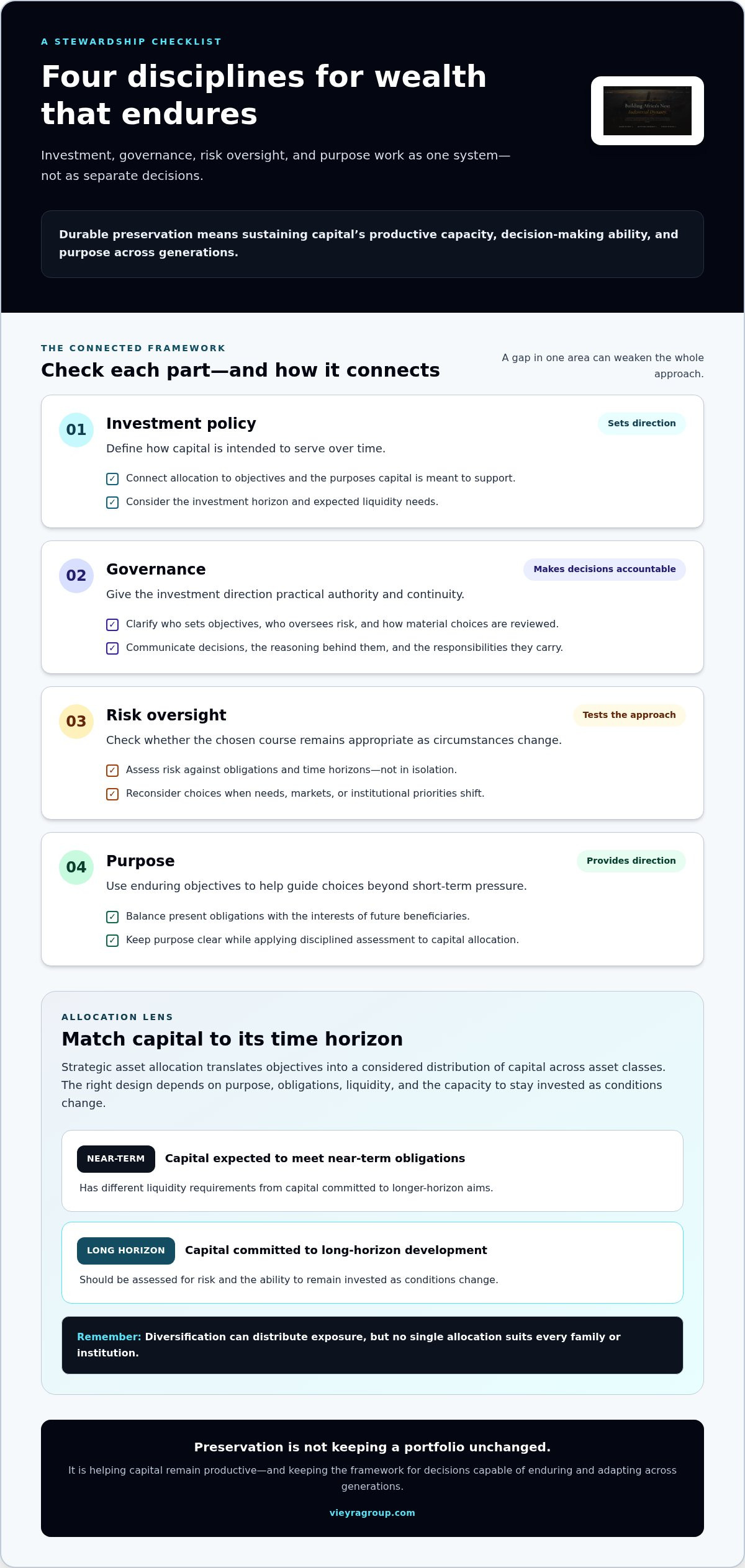
Investment policy establishes how capital is intended to serve over time. Governance determines who may make decisions, how those decisions are reviewed, and when they should be reconsidered. Risk oversight tests whether the chosen course remains appropriate as obligations, markets, and institutional priorities change. Purpose provides direction, helping stewards judge whether capital serves enduring objectives rather than short-term pressure alone.
Investment policy and governance are complementary disciplines: policy sets the direction for capital, while governance makes that direction accountable, coherent, and capable of continuity. Neither is sufficient by itself. A considered allocation can be undermined by unclear authority or inconsistent oversight. Sound governance, in turn, cannot compensate for a strategy disconnected from the institution’s time horizon and commitments. Together, they provide a framework for multi-generational wealth preservation.
What Role Does Strategic Asset Allocation Play?
Strategic asset allocation translates objectives into a considered distribution of capital across asset classes. Its design should reflect how long capital will be invested, expected liquidity needs, and the purposes it is meant to support. Diversification can distribute exposure, but no single allocation suits every family or institution. A related discussion of strategic asset allocation for family offices can deepen this analysis.
For example, capital expected to meet near-term obligations has different liquidity requirements from capital committed to long-horizon development. This distinction does not prescribe specific holdings. It shows why allocation decisions should begin with obligations and purpose, then be assessed for risk and the capacity to remain invested as conditions change.
Why Does Governance Matter to Long-Term Stewardship?
Governance gives investment policy practical authority. Clear decision rights establish who sets objectives, who oversees risk, and how material choices are explained and reviewed. Regular communication can help successive stewards understand not only what decisions were made, but also the reasoning and responsibilities behind them. A related examination of family office governance for wealth preservation can offer further perspective.
Continuity does not require every generation to make identical choices. It requires a reliable process for distinguishing enduring principles from decisions that warrant revision. Succession planning, accountability, and structured dialogue can support that balance without assuming a universal governance model or offering legal advice. Appropriate arrangements depend on an institution’s purpose, complexity, and obligations.
For Vieyra Family Office, global investment management across asset classes and strategic capital supporting African industrialisation show how investment activity can connect broad portfolios with long-term institutional purpose. Aligned philanthropy through the Vieyra Foundation expresses a complementary dimension of legacy, not a substitute for disciplined capital allocation. Explore Vieyra’s approach to long-term stewardship.
Is Diversification Enough to Preserve Wealth Across Generations?
No. Diversification can help manage certain portfolio risks, including excessive concentration in a single asset, sector, or market, but it cannot secure every dimension of a legacy. A portfolio may be diversified while decision-making authority remains unclear, liquidity is insufficient for obligations, or successors lack a shared understanding of the institution’s purpose. Multi-generational wealth preservation therefore requires attention to both the portfolio and the systems responsible for its stewardship.
This distinction matters because risks differ in character. Market exposure and concentration can be assessed through portfolio analysis, while succession, governance, and purpose alignment require ongoing institutional attention. Some risks can be measured and monitored; others involve uncertainty about future conditions, priorities, or decisions. Diversification alone cannot address either category in full.
Which Risks Can a Diversified Portfolio Address, and Which Remain?
Holding assets across different classes, sectors, or regions may reduce reliance on any single source of exposure. It does not eliminate the possibility of loss, ensure that investments will behave independently, or guarantee preservation. Diversification is a tool for shaping portfolio risk, not a promise of a particular outcome.
Other vulnerabilities sit outside portfolio construction. Unclear authority can delay decisions; weak succession processes can interrupt continuity; inadequate liquidity planning can put pressure on long-term commitments. These risks call for governance, communication, and review alongside investment oversight. A useful assessment asks not only what the portfolio owns, but also who can act, which obligations capital must meet, and how decisions remain accountable over time.
How Can Global and African Priorities Be Held in Balance?
Global investments and strategic capital for African industrialisation can serve distinct, complementary objectives within a broader institutional mandate. Global investment management can provide exposure across asset classes and geographies, while regional capital allocation can express a long-term commitment to productive development. The balance should follow the institution’s purpose, obligations, risk capacity, and investment horizon, rather than an assumption that any region or theme will deliver superior returns.
Geography brings its own considerations, including differences in market conditions, operating environments, and the time required for capital to support development. These factors warrant deliberate assessment and continuing oversight, not alarm or generalisation. For a closer examination of global investment management for sovereign-scale family offices, readers can explore how broad investment mandates may be structured around enduring institutional objectives.
The central principle is measured coordination: diversify where it supports the mandate, preserve adequate capacity to meet obligations, and maintain governance capable of responding to changing conditions. A resilient legacy is not defined by a portfolio without risk, but by the discipline to understand and steward risk across the institution.
What Practical Framework Can Families Use to Steward Wealth Over Time?
A practical framework gives stewards a repeatable way to connect legacy intentions with capital decisions, without imposing a universal governance structure or investment model. For multi-generational wealth preservation, use this sequence: articulate purpose, assess obligations, define governance, align capital, and review outcomes. It turns broad intentions into decisions that can be explained, monitored, and revised as circumstances change.
- Articulate purpose: Identify the enduring principles the wealth is meant to serve.
- Assess obligations: Clarify present and anticipated commitments, including liquidity needs and long-term objectives.
- Define governance: Establish who holds decision authority, how accountability works, and how responsibilities are transferred.
- Align capital: Connect investment horizons, risk capacity, and asset allocation to the stated purpose and obligations.
- Review outcomes: Assess whether decisions remain consistent with the mandate, and revise assumptions when conditions warrant.
Make the sequence tangible with a simple decision matrix. These entries are illustrative, not prescribed. Families can adapt the decision owners and review cadence to their responsibilities and circumstances.
- Long-horizon development objective: Time horizon, long term; decision owner, designated investment authority; objective, support the stated institutional mandate; review cadence, at scheduled strategy reviews.
- Near-term liquidity obligation: Time horizon, near term; decision owner, assigned financial steward; objective, maintain capacity to meet planned commitments; review cadence, in line with the obligation schedule.
- Legacy and governance priorities: Time horizon, ongoing; decision owner, relevant family or institutional governance body; objective, sustain clarity of purpose and accountability; review cadence, at established governance reviews.
This is a repeatable stewardship cycle, not a one-time plan: purpose guides decisions, review tests their continued relevance, and adaptation renews the framework without abandoning its principles.
How Should a Family Translate Legacy Into Investment Principles?
Separate enduring principles, such as responsible stewardship or a commitment to productive development, from assumptions that may change, such as a particular liquidity need or investment horizon. Then translate objectives into investment considerations: capacity to bear risk, the timing of obligations, and the period over which capital can remain committed. A purpose statement should inform disciplined decisions, not predetermine an investment outcome.
How Can Stewardship Adapt as Generations and Markets Change?
Scheduled reviews of mandates, governance arrangements, and underlying assumptions create room for measured adaptation. A commitment to development may endure while the opportunities, risks, and time horizons associated with it evolve. Families examining this changing context can also consider the evolution of private capital markets in Africa.
To explore how global investment management and strategic capital can serve long-term institutional objectives, learn about Vieyra’s approach to investment stewardship.
How Does Vieyra Family Office Approach Multi-Generational Stewardship?
Vieyra Family Office is a multi-generational African family office operating at sovereign scale, connecting capital stewardship with long-term development. Its approach brings together global investment management across asset classes, strategic capital allocation supporting African industrialisation, and aligned philanthropic initiatives through the Vieyra Foundation. These activities express different dimensions of legacy while retaining distinct roles within a broader framework of purpose and disciplined decision-making.
This perspective treats multi-generational wealth preservation as active stewardship: capital is managed not only for continuity, but also in relation to the productive objectives it is intended to serve. Global investment management and African industrialisation capital are complementary, not interchangeable. The former spans investments across asset classes; the latter directs strategic capital toward industrial development. Each requires decisions grounded in its own objectives and risks, and neither implies a guaranteed outcome.
How Can Global Investment Management Support a Long-Term African Legacy?
A global investment mandate can provide a broad foundation for managing capital across asset classes, while strategic allocation to African industrialisation reflects a specific institutional commitment to the region’s productive development. The relationship is one of considered alignment: global investments and regional priorities can coexist within a long-term mandate, with allocation decisions shaped by purpose, horizon, and risk oversight rather than assumptions of certain returns.
Vieyra’s strategic capital allocation is distinct from retail banking or public brokerage. Its role is institutional: capital is directed in support of African industrialisation as part of a broader approach to investment stewardship and long-term development.
Where Does Philanthropy Fit Within a Stewardship Framework?
The Vieyra Foundation pursues philanthropic initiatives as a complementary expression of institutional purpose. Philanthropy can give practical form to a legacy’s commitments, while investment management and strategic capital allocation remain essential disciplines in their own right. Clear distinctions among these roles support accountability and help ensure that purpose informs capital decisions without displacing investment analysis or governance.
Together, global investment management, strategic capital for African industrialisation, and aligned philanthropy illustrate a view of legacy that extends beyond capital retention. Each can contribute to continuity in a different way: through managed investment, productive allocation, or philanthropic purpose. Their coordination rests on deliberate stewardship and a long-term institutional perspective.
For a fuller view of this institutional perspective and its work, Explore Vieyra Family Office.
Build a Legacy Through Deliberate Stewardship
Enduring wealth depends on more than investment returns. It requires a connection between capital strategy, clear governance, thoughtful risk oversight, and a purpose that can be carried forward as generations and circumstances change. Diversification can help manage portfolio exposures, but continuity also calls for attention to liquidity, decision-making, and succession.
A practical stewardship framework begins with purpose, assesses obligations, clarifies authority, aligns capital, and reviews outcomes over time. This disciplined cycle gives families a basis for adapting without losing sight of the principles that guide their legacy. That is the broader promise of multi-generational wealth preservation: sustaining not only capital, but also the capacity to use it responsibly and productively.
Vieyra Family Office brings this institutional perspective as a multi-generational African family office operating at sovereign scale, connecting global investment management with strategic capital allocation for African industrialisation. Through the Vieyra Foundation, aligned philanthropic initiatives offer a complementary expression of purpose.
Explore how these priorities inform Vieyra’s work and perspective. Explore Vieyra Family Office to learn about its approach to investment stewardship and long-term development.
Frequently Asked Questions
What is multi-generational wealth preservation?
Multi-generational wealth preservation is the stewardship of capital, decision-making capacity, and purpose so they can remain productive and relevant across generations. It involves more than maintaining an asset’s nominal value: stewards also consider purchasing power, investment risk, governance, liquidity, and continuity of responsibility. In practice, families clarify what their wealth is intended to support, establish how decisions are made, and review whether their investment approach remains aligned with those objectives.
How can families balance current needs with future generations’ interests?
Families can begin by identifying present obligations and future objectives, then consider how much capital must remain accessible and what can be invested over a longer horizon. Clear priorities help stewards weigh current distributions against continued productive capacity, rather than treating either as an automatic priority. Regular discussion among decision-makers can make trade-offs explicit and help ensure that choices reflect both the family’s responsibilities today and its intended legacy.
What role does governance play in preserving family wealth?
Governance establishes who has authority to make decisions, how those decisions are reviewed, and how responsibility is carried forward. Clear roles and accountability can support consistency while allowing considered adaptation as circumstances change. Communication also matters: future stewards benefit from understanding the principles behind investment and distribution decisions, not simply inheriting their outcomes. Governance arrangements should reflect the family’s needs and circumstances rather than assume a single structure suits every family.
Can wealth preservation include investment in economic development?
Yes. Wealth preservation can include productive investment aligned with a family or institution’s long-term objectives, including capital allocation that supports economic development. Vieyra Family Office, a multi-generational African family office operating at sovereign scale, combines global investment management with strategic capital allocation for African industrialisation. Such investment remains subject to disciplined assessment and oversight; a development purpose can guide capital decisions, but does not guarantee financial or economic outcomes.
How should a multi-generational investment strategy adapt over time?
A multi-generational investment strategy should be reviewed as obligations, liquidity needs, market conditions, and institutional priorities evolve. Scheduled reviews can test whether the investment mandate, allocation, and risk assumptions remain appropriate, while governance processes clarify who evaluates potential changes. Adaptation need not mean abandoning enduring principles. It can mean revising the means of pursuing them as circumstances shift, with decisions assessed against the long-term purpose and capacity of the capital.
What happens if family priorities change between generations?
Changing priorities call for structured discussion, not an assumption that the legacy must remain fixed or be discarded. Families can distinguish enduring principles from objectives that may reasonably evolve, then review how investment policy and governance reflect the distinction. Clear decision processes help stewards explain changes and assess their implications for beneficiaries and obligations. Where priorities diverge, shared information and accountable deliberation can support decisions that respect continuity while recognizing new perspectives.


