
What distinguishes capital that enters an economy from capital that helps shape its productive future? For an African institutional investor, the answer depends not only on how much capital it deploys, but also on its mandate, governance, risk framework and investment horizon. Those factors influence whether capital goes toward liquid securities, long-term infrastructure or enterprises that can deepen regional value chains.
Pension funds, insurers, sovereign wealth funds, development finance institutions and family offices may all mobilise capital, but they do so under different obligations and objectives. Knowing those differences helps investors, project leaders and partners assess whether a source of capital fits a proposed investment and whether claims about development are supported by evidence.
This article explains the main institutional investor categories and how their mandates shape allocation decisions. It also offers a practical framework for assessing governance, risk, time horizon and alignment with African industrialisation. Vieyra Family Office brings a distinct perspective to this discussion through global investment management and a long-term focus on African industrialisation and strategic capital for economic development.
Key Takeaways
- Assess an African institutional investor by its mandate, governance and investment horizon, not by geographic focus or legal form alone.
- Trace how capital is allocated to enterprises, infrastructure and productive capacity, and distinguish development intentions from outcomes supported by evidence.
- Compare pensions, sovereign wealth funds, development finance institutions and family offices by their responsibilities and objectives, rather than treating them as interchangeable sources of capital.
- Use a structured review of purpose, governance, time horizon, risk oversight and outcome accountability to assess mandates and strategic partnerships.
- Vieyra Family Office connects global investment management with a long-term focus on African industrialisation.
What Is an African Institutional Investor? Defining Its Mandate and Role
An African institutional investor is an organisation that pools, manages or deploys capital under an established investment purpose, with a connection to African markets, assets or economic priorities. The term covers different kinds of capital allocators, not a single investment model. To understand what an institution may do, separate four dimensions: its mandate, geographic focus, asset classes and legal form.
An investor’s identity describes what kind of institution it is; its mandate describes what it is authorised or committed to achieve. Geographic focus indicates where it invests, while asset classes identify the instruments or businesses in which it may place capital. Legal form concerns how the institution is constituted. These dimensions can overlap, but should not be confused: an African focus alone does not establish an investor’s objectives, governance or investment horizon.
Which institutions may fall under this definition?
The category includes institutions with materially different sources of capital and responsibilities:
- Pension funds invest retirement savings and operate within responsibilities to beneficiaries.
- Insurers manage capital in relation to policyholder and balance-sheet obligations.
- Sovereign wealth funds invest public wealth according to state-defined objectives.
- Development finance institutions combine financing activity with development-related mandates. The Africa Finance Corporation, for example, provides a reference point for an institution associated with infrastructure development across the continent.
- Family offices steward family capital, with governance and investment priorities shaped by the family’s structure and objectives.
Institutional status does not mean identical ownership, accountability or risk tolerance. A pension fund’s obligations to members differ from a sovereign fund’s public purpose, while a development finance institution’s objectives differ from those of a family office. Their horizons may also vary, even when they consider similar sectors or opportunities.
What makes the African context relevant?
African markets are not one uniform investment environment. Countries and regions differ in economic structure, financial-market depth, infrastructure, currencies and institutional conditions. Investors assessing opportunities across the continent need to account for local context rather than treating a regional focus as evidence of uniform risk or opportunity.
Context matters because investment decisions influence how capital is formed and whether it can support productive activity, including enterprises, infrastructure and industrial capacity. But a stated development purpose does not prove that those outcomes have occurred. The mandate indicates intent and direction; evidence of allocations and results is needed to assess contribution. This distinction is a sound starting point for comparing institutions and considering their potential role in African economic development.
How African Institutional Investors Connect Capital to Long-Term Development
Capital contributes to development through a chain of decisions, not through its stated purpose alone. An institution’s mandate guides how it selects investments. Allocation then directs capital toward companies, infrastructure or financial instruments. If financing supports a viable enterprise or project, it may help expand operations, strengthen supply networks or build productive capacity. Whether those effects endure depends on execution, market conditions and ongoing oversight.
For example, investment in a processing facility may support more local value creation if the business can secure reliable inputs, reach customers and operate sustainably. Infrastructure can play a similar role by improving the conditions in which firms produce and trade. These are possible pathways, not guaranteed outcomes. The African Development Bank Group Working Paper on Institutional Investors offers further context on the opportunities and challenges shaping institutional investment in Africa.
How can long-horizon capital support industrialisation?
Some industrial and infrastructure projects need sustained financing through planning, construction and the development of commercial operations. Patient capital can accommodate longer timelines when the mandate, expected return and risk controls support them. Its potential value lies not simply in staying invested, but in helping viable projects develop capabilities, deepen value creation and sustain productive activity over time.
That distinction is central to the private capital mandate for African industrialisation, which examines how investment purpose can align with industrial development. An African institutional investor’s horizon must still reflect its own obligations. A long duration is appropriate only when governance, liquidity needs and project risks are understood.
Why do stewardship and accountability matter?
Time alone does not make capital responsible or effective. Strong stewardship connects investment decisions to oversight throughout an asset’s life: evaluating assumptions before commitment, monitoring performance and responding when risks or conditions change. Governance clarifies who makes decisions, how conflicts are managed and what information is reported.
A development objective states what an investment seeks to achieve; a measured result shows what it has achieved and how that conclusion was reached. Assessing outcomes therefore requires relevant evidence, such as whether a project reached operational milestones, strengthened productive capacity or delivered its intended service. Measurement should be proportionate to the investment and transparent about limitations, rather than relying on broad claims that cannot be tested.
Vieyra Family Office connects global investment management with a focus on African industrialisation and strategic capital for long-term growth. Explore Vieyra’s approach to strategic capital and industrialisation.
African Institutional Investors Compared: Mandates, Horizons, and Responsibilities
Investor categories are a useful starting point, but do not determine how every institution allocates capital. An organisation’s mandate, governance, funding obligations and investment strategy shape its decisions. The table describes general tendencies, not rules that apply uniformly across African markets.
| Institutional type | Typical mandate | Investment horizon | Accountability |
|---|---|---|---|
| Pension funds | Invest retirement assets in line with obligations to members and beneficiaries. | Often considers long-term liabilities, while maintaining attention to liquidity and portfolio needs. | Accountable through governance structures and responsibilities to beneficiaries. |
| Sovereign wealth funds | Manage public wealth according to objectives established by the relevant state. | Can be long-term, although objectives and liquidity requirements differ by fund. | Subject to public mandates and the fund’s governance and oversight arrangements. |
| Development finance institutions | Provide or mobilise finance in support of development-related objectives. | Varies with the financing instrument, project and institutional mandate. | Accountable for financial discipline and delivery against stated development objectives. |
| Family offices | Steward family capital in accordance with the family’s priorities and governance. | May reflect multi-generational considerations, but varies among offices. | Accountability is shaped by ownership, governance and the family’s stated objectives. |
How do family offices differ from public investment institutions?
The distinction begins with ownership and governance, not an assumption about investment quality or performance. A family office is organised around stewardship of family capital; a sovereign wealth fund or development finance institution may operate under public objectives and associated oversight. Arrangements vary within each category. A family office may connect global investment management with a regional industrial focus, as Vieyra Family Office does, while public institutions work within their own mandates and responsibilities.
When do mandates overlap in African investment?
Several institutions may support the same industrial or infrastructure objective while contributing different forms of capital and operating under distinct accountabilities. A pension fund might invest for its beneficiaries, a development finance institution might finance a project under a development mandate, and a family office might allocate strategic capital. Public policy can shape the enabling environment, but is not itself an investment allocation. Philanthropic activity is also distinct: the Vieyra Foundation pursues initiatives aligned with the investment strategy, rather than functioning as an investment product.
These roles can complement one another, but shared objectives do not erase differences in risk responsibility, decision rights or measures of success. Global investment management principles provide a wider portfolio context. Comparison is most useful when it examines an African institutional investor’s actual mandate and accountability, rather than relying on its category label alone.
How to Evaluate an African Institutional Investor’s Mandate and Alignment
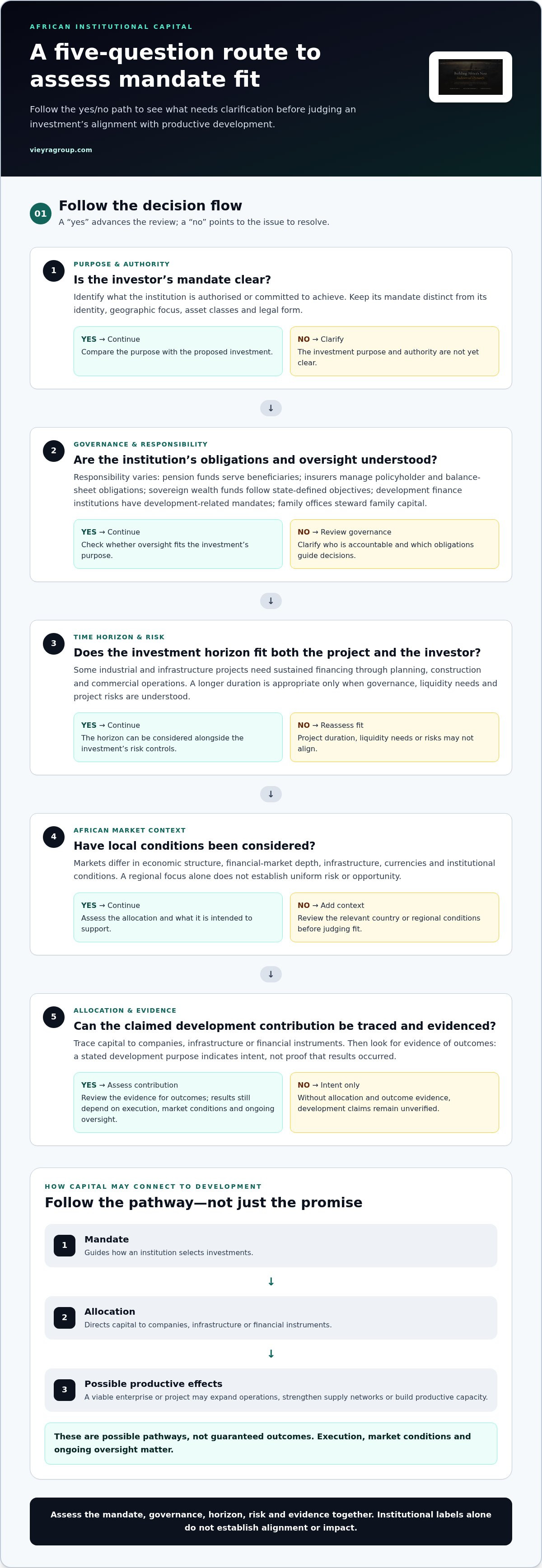
A sound assessment looks beyond an institution’s stated ambitions. Its mandate, governance, investment horizon, risk oversight and approach to measuring outcomes should form a coherent whole. Use the following framework to examine an African institutional investor or assess alignment in a strategic partnership. Context-specific diligence should complement, not replace, sound institutional governance.
- 1. Clarify the investment purpose. Identify the institution’s stated objectives and the activities its mandate is designed to support. Then ask whether a proposed investment has a clear connection to those objectives, rather than relying on broad language about development or impact.
- 2. Examine governance and decision rights. Establish how investment decisions are authorised, who oversees them, and how performance and conflicts are addressed. Consider whether responsibilities are clear enough to support continuity through leadership transitions. The family office governance principles offer related context on stewardship and institutional continuity.
- 3. Test the time horizon against the purpose. Compare the expected duration of an investment with the institution’s obligations, liquidity needs and stated objectives. A long-term project may require patient capital, but duration alone does not establish suitability. Consider the investment rationale and the institution’s capacity to remain committed.
- 4. Assess risk within the relevant context. Consider the project, market, currency, operating environment and investment period together with the institution’s risk mandate. Context-specific diligence helps identify material uncertainties and inform decisions; it is not a substitute for governance. A dedicated sovereign investment risk management framework provides further perspective.
- 5. Define outcome accountability. Specify what evidence would indicate progress toward the investment’s objectives, who will assess it and how limitations will be reported. Separate financial performance from development outcomes, then examine how each relates to the institution’s mandate.
Which mandate and governance questions deserve attention?
Ask how the institution connects its objectives to investment decisions and whether oversight responsibilities are clear and consistent. A mission statement alone does not establish alignment. Look for decision-making, monitoring and accountability that reflect the stated purpose.
How should risk and development objectives be considered together?
Development objectives should inform assessment of an opportunity, not obscure its risks. Risk management supports disciplined decisions and adaptation as conditions change; it cannot promise a particular return or development result. To explore how strategic capital can connect investment purpose with African industrialisation, review Vieyra’s approach to strategic capital.
Vieyra Family Office: Connecting Global Investment Management with African Industrialisation
Vieyra Family Office offers an institution-specific perspective on the relationship between global investment management and African industrialisation. It is a multi-generational African family office operating at sovereign scale, with an investment focus that brings these areas together. This approach illustrates how a family office can steward capital in a global investment context while directing strategic attention toward long-term growth projects and economic development in Africa.
This perspective relates to the broader institutional framework explored in this article. Understand an African institutional investor not by its category alone, but by the objectives that shape capital allocation, the horizon over which it can act, and the governance and accountability guiding its decisions. Vieyra connects strategic capital with long-term growth projects and economic development. That describes an investment orientation, not a claim that a particular project or outcome has been achieved.
How does Vieyra’s institutional perspective connect global capital and Africa?
Global investment management and African industrialisation are complementary dimensions of Vieyra’s focus. The first describes the broad investment-management context; the second identifies a regional productive-development priority. Together, they frame a long-term stewardship perspective that considers capital allocation alongside industrial capacity and economic growth, without implying a particular portfolio composition, transaction or geographic allocation.
This orientation also highlights a useful principle for institutional dialogue: strategic capital is best understood through its purpose, time horizon and governance, rather than broad claims about scale or impact. Consider how an investment objective is defined, how risk is addressed over time and what evidence would demonstrate progress. These questions apply across institutions, even though each investor’s mandate and responsibilities remain distinct.
What are the next steps for institutional dialogue?
Productive dialogue begins with a disciplined reading of the mandate. Consider whether the stated purpose aligns with the proposed investment, whether the horizon suits the undertaking, how decision-making and oversight are structured, and how risks and outcomes will be assessed. This framework helps partners distinguish investment intention from demonstrated results and identify where expectations, responsibilities or measures of success need greater clarity.
The Vieyra Foundation is a distinct philanthropic initiative aligned with the investment strategy. It is associated with that strategy, but is not investment management or an investment product. This distinction separates capital deployed through investment activity from philanthropic initiatives pursued in alignment with broader priorities.
For a closer understanding of Vieyra’s institutional perspective on global investment management and African industrialisation, explore Vieyra Family Office.
Build a Clearer View of Long-Term Capital
The role of an African institutional investor is best understood through the relationship between mandate, governance, risk and investment horizon. These factors distinguish institutions that may share a development objective but carry different responsibilities. Assessing capital’s contribution also means separating stated intent from outcomes supported by evidence.
For industrialisation, the quality of investment alignment matters as much as duration. A credible assessment considers what the institution seeks to achieve, how decisions are overseen, whether risks are addressed over time and how progress will be measured.
Vieyra Family Office brings a distinct perspective as a multi-generational African family office operating at sovereign scale, with global investment management and a focus on African industrialisation. Its strategic capital supports long-term growth projects and economic development, while the Vieyra Foundation pursues philanthropic initiatives aligned with the investment strategy and distinct from investment management.
Explore how this institutional perspective connects stewardship and African industrialisation through Explore Vieyra Family Office. Clear mandates and accountable capital can help advance a more durable vision for productive growth.
Frequently Asked Questions
What is an African institutional investor?
An African institutional investor is an organisation that allocates or manages capital under an institutional mandate connected to African markets, assets or development priorities. The term can describe different kinds of capital owners and managers; it does not imply a single investment strategy. To understand a particular institution, examine its objectives, governance, investment horizon and accountability rather than relying on its label or regional focus alone.
Which institutions are considered African institutional investors?
The category may include pension funds, insurers, sovereign wealth funds, development finance institutions and family offices investing in or from African markets. These institutions differ in ownership, governance, objectives and constraints. A pension fund’s responsibilities to beneficiaries, for example, differ from a family office’s stewardship of family capital. The category is a broad description, not proof of shared responsibilities, risk tolerance or development outcomes.
How do African institutional investors support industrialisation?
An African institutional investor may allocate capital to businesses or projects that support productive capacity, infrastructure or industrial development. The contribution depends on the mandate, financing structure, governance, project conditions and investment horizon. For example, investment in an enterprise may help it expand production, but allocation alone does not establish that result. Assessing development contribution requires appropriate evidence and recognition that markets and investment effects differ across African countries.
What is the difference between a family office and a sovereign wealth fund?
A family office stewards wealth associated with a family, while a sovereign wealth fund generally manages public or state-associated capital under objectives set for that fund. Their ownership, governance and accountability may therefore differ. Both may invest across markets and asset classes, but neither label alone establishes a particular strategy, time horizon or development commitment. Assess the institution’s actual mandate and governance arrangements to understand its investment role.
How can an institution assess an African investor’s mandate?
Begin by identifying the institution’s objectives, governance, investment horizon, risk oversight and approach to accountability. Then examine whether its capital-allocation decisions align with those objectives and suit the relevant market or project context. Consider what evidence would demonstrate progress and who is responsible for assessing it. This institution-specific approach helps distinguish intended contribution from measured outcomes without relying on broad assumptions about African markets.
Can institutional investment and development objectives align?
Yes. Institutional investment and development objectives can align when the mandate, investment decisions, governance and accountability are coherent. Alignment is not automatic, nor does it guarantee financial performance or development outcomes. Ask whether objectives are clearly stated, risks are appropriately overseen and results are evaluated using credible evidence. Different institutions may contribute to related long-term priorities while retaining distinct responsibilities and investment approaches.
Why does governance matter for African institutional investors?
Governance clarifies how an institution makes decisions, oversees capital, manages conflicts and remains accountable to its mandate. These arrangements matter when investments involve long horizons, multiple stakeholders or changing market conditions. Strong governance cannot eliminate investment risk, but it can support disciplined stewardship and continuity. Examine the institution’s decision rights and oversight processes rather than inferring them from its category or public statements.


