
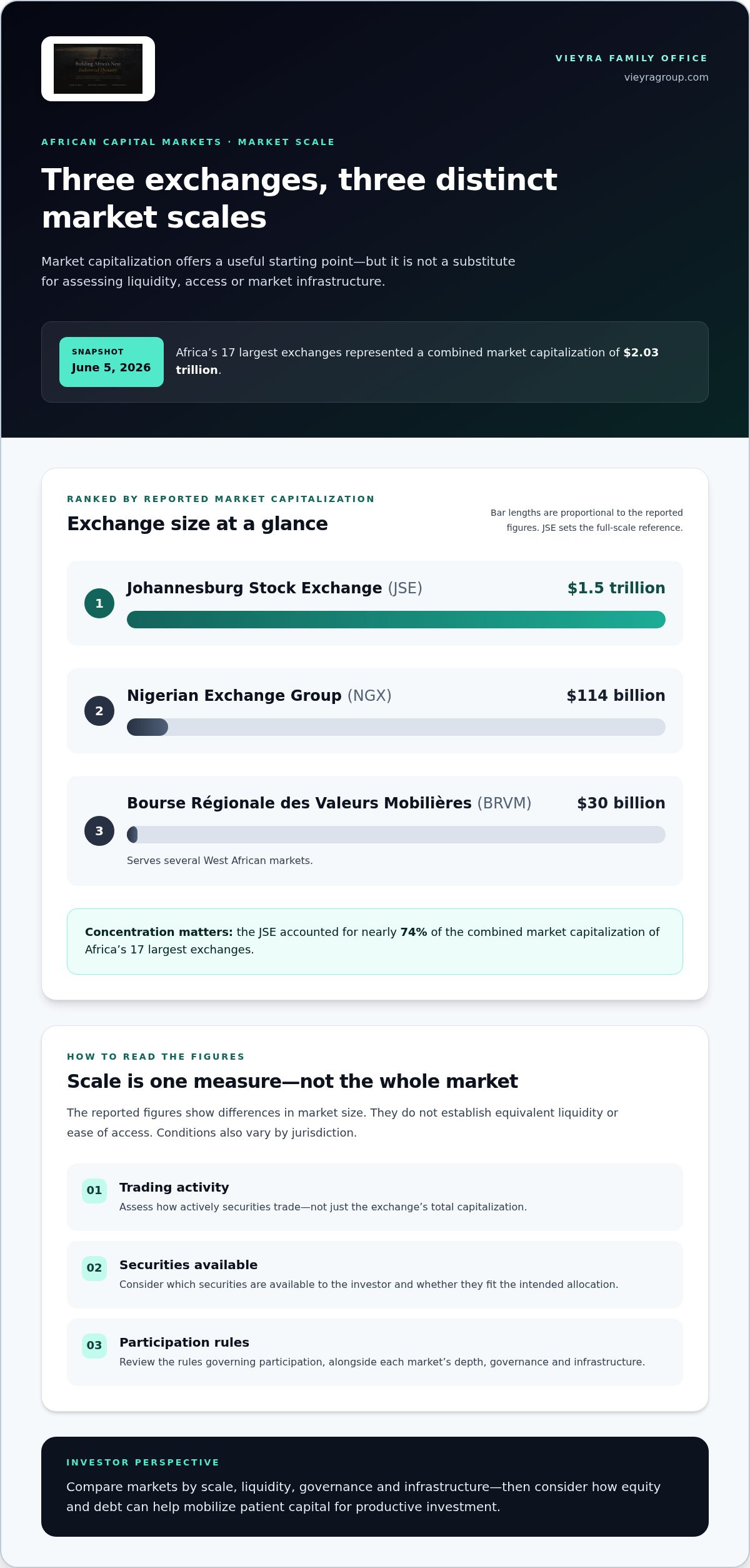
What if the defining opportunity in African capital markets lies not in the absence of risk, but in the institutional capacity taking shape to convert long-term capital into industrial growth? For investors weighing liquidity constraints, regulatory fragmentation and short-term volatility, that distinction matters. Markets remain uneven, yet their scale is increasingly difficult to dismiss: as of June 5, 2026, Africa’s 17 largest exchanges represented a combined market capitalization of $2.03 trillion, with the Johannesburg Stock Exchange accounting for nearly 74%.
Volatility and concentration are real considerations, but they do not capture the full structural transition. Regulatory modernization, cross-border investment and domestic capital mobilization are changing how African economies can finance productive capacity. For institutional investors, the challenge is to assess these developments with a framework suited to sovereign-scale opportunities and multi-generational horizons.
This examination considers how market maturation intersects with industrialization, where fragmentation and liquidity call for disciplined analysis, and how evolving capital channels may support durable value creation. Vieyra Family Office focuses on long-term strategic capital allocation in service of African industrialization and enduring economic development.
Key Takeaways
- Assess African capital markets through institutional maturity, infrastructure and industrial financing potential, rather than short-term volatility alone.
- Examine how transparency practices and regional regulatory coordination may affect market access and capital allocation.
- Compare sovereign and corporate bonds, including sustainability-linked instruments, by considering both risk and return and their potential role in productive investment.
- Distinguish short-term speculation from multi-generational stewardship, and assess currency exposure across local and global allocations.
- Consider how sovereign-scale strategic capital and philanthropic alignment can contribute to enduring industrial development.
Defining the Contemporary Landscape of African Capital Markets
Describing African exchanges simply as “frontier markets” can obscure the institutional capabilities taking shape across the continent. A more useful assessment compares markets by depth, liquidity, governance and infrastructure, while recognizing that conditions vary substantially between jurisdictions. The Johannesburg Stock Exchange (JSE), Nigerian Exchange Group (NGX) and Bourse Régionale des Valeurs Mobilières (BRVM), which serves several West African markets, illustrate this diversity rather than a single continental profile.
Market size is one part of the picture. As of June 5, 2026, the JSE’s market capitalization was approximately $1.5 trillion, compared with $114 billion for NGX and $30 billion for the BRVM. These figures show the difference in market scale, not equivalent levels of liquidity or ease of access. Investors should also assess trading activity, the securities available to them and the rules that govern participation. For a broader view of the exchanges and their histories, the List of African Stock Exchanges offers useful context.
For industrial development, the strategic question is how markets can mobilize patient capital for productive assets. Equity can provide risk-bearing capital, while debt can support infrastructure and corporate investment when issuers, investors and market frameworks are aligned. This lens also corrects an overly narrow account of African growth as dependent primarily on external aid: domestic institutional investors and local markets are important parts of the capital formation picture.
The Maturation of Continental Exchanges
Market development is not simply a move from equities to a uniform catalogue of debt and derivatives. Deeper fixed-income markets and suitable risk-management instruments can broaden the ways investors and issuers structure financing, although availability and liquidity differ by exchange. Cross-listing protocols may widen an issuer’s investor base and improve visibility across borders. Their practical value, however, depends on compatible disclosure, settlement and regulatory arrangements.
Technology is also changing market infrastructure. Nigeria’s T+1 settlement cycle for equities and commodities transactions took effect on June 1, 2026, providing a concrete example of operational modernization. Digitized trading and settlement can support more efficient participation, but they do not eliminate currency, liquidity or regulatory risk. AfCFTA, with its ambition of a single market of 1.4 billion consumers, provides a long-term rationale for deeper regional connections. Integration will depend on implementation, not aspiration alone.
Sovereign Capital as a Market Catalyst
Public capital can help establish investment conditions in sectors where long development horizons or infrastructure requirements exceed the capacity of individual private investors. Sovereign wealth funds, where established and appropriately mandated, may act as anchor investors. Public-private partnerships can combine public objectives with private financing and expertise in market-enabling infrastructure. Their effectiveness depends on governance, transparent allocation and credible project economics.
In 2026, sovereign-scale investment means aligning substantial, long-horizon capital with national and regional priorities to build productive capacity and durable economic value. For institutional investors, this shifts attention from short-term market movements to the quality of institutions, financing structures and industrial outcomes.
The Institutionalization of Market Infrastructure and Regulatory Frameworks
For long-horizon investors, regulation is not merely a constraint to monitor. It is part of the architecture that makes capital allocation possible. Predictable disclosure, enforceable investor rights and credible oversight reduce uncertainty about how capital is raised, governed and protected. In African capital markets, these foundations can matter as much as near-term performance, particularly when financing industrial projects whose returns develop over extended periods.
Reporting frameworks such as IFRS S1 and IFRS S2 provide a common structure for communicating sustainability-related risks and climate-related information. Their value depends on consistent application, reliable underlying data and meaningful assurance, rather than adoption as a formal label alone. The OECD Africa Capital Markets Report offers a broader policy perspective on market development, economic transformation and climate finance, themes that increasingly connect investor transparency with productive investment.
Regional Regulatory Convergence
West African Capital Markets Integration (WACMI) illustrates the ambition to make regional investment more coherent by connecting participating markets and reducing avoidable barriers to cross-border activity. Its institutional significance lies in the practical work required: compatible rules, dependable information flows and processes that help investors understand their rights and obligations across jurisdictions. Assess integration by practical access and investor protections, not by the existence of an initiative alone.
For industrial conglomerates seeking capital across borders, greater consistency in listing, disclosure and ongoing reporting requirements can reduce duplication and broaden the potential investor base. Harmonization need not erase national legal distinctions. Effective convergence makes those distinctions more legible, while credible dispute-resolution mechanisms give institutional investors a clearer route to address disagreements through established legal and regulatory channels.
Transparency and Global Compliance
Alignment with OECD and G20 principles is best understood as a reference point for sound governance, disclosure and responsible investment, not as evidence of uniform adoption across African jurisdictions. Anti-money laundering frameworks also support market confidence. Robust due diligence and clear beneficial-ownership information can help protect the integrity of capital flows, while inconsistent implementation may create friction for legitimate investors. The institutional task is to combine rigorous controls with proportionate, predictable procedures.
Central banks contribute to this architecture through monetary policy, financial-system oversight and measures that affect liquidity and currency stability. Their decisions shape the conditions in which issuers refinance obligations and investors assess local-currency exposure. Nigeria’s Investments and Securities Act 2025, now the principal legislation for its capital market, and the country’s T+1 settlement cycle, effective June 1, 2026, illustrate how statutory and operational reforms can strengthen market infrastructure. Each remains specific to its jurisdiction.
For multi-generational capital, trust is built through the cumulative discipline of transparent reporting, enforceable protections and stable institutions. Investors can include governance quality, disclosure practices, and the reliability of settlement and oversight arrangements in due diligence alongside financial returns. This institutional lens also informs Vieyra Family Office’s commitment to strategic capital allocation for long-term African industrialization. Its approach to African industrialization places enduring economic development at the center of its investment perspective.
Strategic Asset Classes: Balancing Liquidity with Industrial Transformation
Asset allocation across African capital markets requires more than choosing between public equities and private investments. Institutions need to match an investment’s liquidity, currency exposure, duration and governance profile to the economic role it is intended to serve. A listed share may offer a route to periodic trading; an infrastructure holding may require patient capital and a longer realization horizon. Neither structure is inherently superior. Suitability depends on mandate, valuation discipline and the capacity to withstand volatility.
Sovereign bonds are shaped by fiscal capacity, debt-management credibility, currency denomination and refinancing needs. Corporate bonds add issuer-specific considerations, including cash-flow durability, leverage and the commercial environment in which a company operates. Investors should distinguish nominal yield from risk-adjusted return: higher rates do not, by themselves, compensate for inflation, currency depreciation, default exposure or limited secondary-market liquidity. Reviewing maturity and repayment sources is therefore central to long-term allocation.
Debt Markets and Infrastructure Finance
Infrastructure funds can connect long-duration projects with investors seeking structured exposure, while debt can finance defined stages of development where repayment capacity is credible. A sovereign-backed industrial bond may rely on a government guarantee or other explicit public support. Investors should examine the precise legal obligation, budgetary exposure and source of repayment. Debt serves a multi-generational industrial legacy by financing productive assets over time while assigning repayment obligations to clearly defined future cash flows.
Green bonds generally direct proceeds toward eligible environmental projects; sustainability-linked bonds instead connect financing terms to specified performance objectives. Both require credible criteria, transparent reporting and oversight if their stated purpose is to carry weight with institutional investors. For industrial finance, these instruments can align capital formation with energy transition or resource efficiency, but their labels do not replace analysis of issuer creditworthiness, project execution and repayment capacity.
Equity Markets and Value Creation
Public equities provide participation in company growth and, in markets with sufficient trading activity, a potential route to liquidity. The JSE’s scale generally offers a deeper setting than smaller regional hubs, but liquidity still depends on the specific security, free float and trading conditions. Private equity can support operational change and long-horizon expansion, though capital is less readily realized and valuation may rely on less frequent transactions. A disciplined portfolio treats these as complementary exposures, not substitutes.
Identifying an undervalued industrial asset requires more than comparing headline multiples. Investors can examine replacement costs, earnings quality, access to inputs, governance and a company’s capacity to expand into regional supply chains. Sectoral diversification may help reduce reliance on any single earnings driver, while infrastructure funds can provide exposure to assets that underpin multiple industries.
- Use public markets where transparency, trading depth and portfolio liquidity are priorities.
- Consider private capital where active ownership and patient expansion are central to the thesis.
- Evaluate infrastructure exposure against project cash flows, currency structure and risk allocation.
For a sovereign-scale allocation, the objective is not to maximize liquidity in every holding. It is to balance liquid assets with carefully governed commitments capable of supporting industrial transformation across investment cycles.
Navigating Volatility through Multi-Generational Stewardship
Volatility is a feature of investment, not a complete measure of an asset’s long-term worth. For institutions allocating across African capital markets, stewardship means distinguishing temporary repricing from lasting changes in an investment’s productive capacity, governance or ability to generate cash flow. Speculation prioritizes near-term price movements; long-term stewardship asks whether capital can preserve and build value through changing market and political conditions.
This distinction does not make risk immaterial. Currency depreciation, shifting policy, changing financing conditions and geopolitical developments can affect valuations and project economics. Nor are industrial assets inherently resilient: essential infrastructure or productive capacity may support durable demand, but operational weakness, poor governance or excessive leverage can still impair value. Assess the underlying asset rather than assuming its strategic importance guarantees performance.
The Multi-Generational Investment Horizon
A 50-year perspective does not mean ignoring five-year market cycles; it means resisting the assumption that each cycle defines an asset’s full investment case. A long horizon can allow time for industrial capacity, supply chains and supporting infrastructure to mature, while periodic reviews identify when the original thesis no longer holds. Patience becomes an advantage only when paired with active oversight, realistic valuation and clear conditions for reassessing capital commitments.
Wealth preservation in a developing economy calls for an architecture that distinguishes capital by purpose and time horizon. A portfolio can maintain liquid reserves for obligations and market dislocations while allocating a separate portion to long-duration investments whose returns depend on sustained development. Written investment principles, decision rights and succession arrangements can help preserve continuity without preventing future generations from responding to changed circumstances.
Risk Mitigation and Capital Preservation
Currency risk deserves explicit treatment because an asset’s revenue currency may differ from its financing, operating costs or eventual distributions. Investors can map these exposures before selecting responses, which may include balancing local-currency holdings with global assets, matching financing to expected cash flows, or using hedging instruments where suitable and accessible. Hedging has costs and limitations; it should address a defined exposure rather than substitute for understanding it.
Global diversification can reduce reliance on a single market or currency, while local allocations retain a connection to African productive growth. The balance should reflect an institution’s obligations, liquidity needs and tolerance for loss, not a fixed formula. Geopolitical analysis and institutional memory also matter: a record of past assumptions, decisions and outcomes can help investment committees distinguish enduring structural change from temporary uncertainty.
For a family office, governance makes this horizon operational. A documented mandate, disciplined approval processes, independent review and transparent reporting can support accountability across generations, while regular scenario analysis tests how portfolios might respond to currency, liquidity and policy shocks. Vieyra Family Office’s multi-generational perspective and focus on strategic capital allocation place stewardship in service of long-term African industrialization. Vieyra’s strategic investment approach connects long-term capital with enduring economic development.
Sovereign-Scale Capital Allocation: The Vieyra Framework for Industrial Growth
Capital markets become more consequential when their resources finance productive capacity, rather than circulate solely among financial assets. Vieyra Family Office’s institutional perspective centers on strategic capital allocation and African industrialization, with global investment management supporting a long-term view of opportunity and risk. This approach connects investment decisions to durable foundations of economic growth: industrial capability, enabling infrastructure and the conditions that allow enterprises and communities to participate in development.
For African capital markets, the implication is significant. The quality of an investment thesis depends not only on expected financial returns, but also on whether a project addresses a lasting economic need, can be governed responsibly and fits a viable financing structure. Sovereign partnerships may help align public priorities, private capital and regional development objectives, provided responsibilities, accountability and risk allocation are clearly established.
The Architecture of Industrialization
Evaluating an industrial project begins with its place in a wider productive system. Investors can consider whether essential infrastructure, skilled capacity, reliable inputs and credible demand support its long-term viability. They should also examine the governance structure, financing assumptions and principal execution risks. This disciplined assessment helps distinguish projects with strategic importance from those whose commercial foundations remain insufficiently established.
Capital allocation and social development are related, but they are not interchangeable. Industrial investment can create conditions for broader economic participation when development objectives are integrated into project planning and assessed alongside financial performance. Philanthropic initiatives, including work aligned with the Vieyrа Foundation, can complement this wider vision without substituting for commercially sound investment. Over time, sustainable infrastructure may strengthen productive capacity and leave value that extends beyond an individual investment cycle.
A Vision for Global African Stewardship
A durable investment architecture requires coordination among long-term capital, public institutions and strategic partners. Sovereign partnerships can contribute to regional growth where objectives are shared and governance is transparent; they are not a substitute for rigorous project assessment. For prospective partners, the central questions concern the development need, the proposed allocation of risk, the standards of oversight and the intended economic contribution.
Looking toward 2030, Vieyrа Family Office’s role reflects its commitment to sovereign-scale operations, multi-generational stewardship and large-scale industrialization. The Vieyra Foundation’s philanthropic alignment adds a dimension of social purpose to this institutional outlook, while investment discipline remains essential to lasting economic development. Together, these principles offer a considered basis for engaging with the continent’s long-term transformation.
Learn more about the Vieyra approach to sovereign-scale investment.
Position Capital for Enduring African Growth
The next strategic decision is not simply where to allocate capital, but what enduring capacity that capital should help create. For institutional investors, this means defining a mandate that connects return expectations with time horizon, governance, risk tolerance and a clear view of the economic value an investment is intended to sustain. That discipline can help translate the evolving potential of African capital markets into considered commitments rather than transient responses to market sentiment.
Vieyra Family Office brings a sovereign-scale institutional perspective, a multi-generational investment horizon and a focus on African industrialization. Its approach places strategic capital allocation within a wider vision of lasting economic development, creating common ground for partners whose ambitions align with Africa’s long-term productive growth.
Engage with Vieyra Family Office about strategic capital solutions and how a carefully structured investment perspective can serve enduring value and industrial progress. Patient capital and purposeful partnership can strengthen the foundations of a more prosperous future across generations.
Frequently Asked Questions
What is the current state of liquidity in African capital markets in 2026?
Liquidity in 2026 remains uneven across exchanges, securities and investor groups; a large market capitalization does not ensure that an investor can trade a particular holding readily. The Johannesburg Stock Exchange is dominant, while smaller exchanges may have thinner trading. African institutional investors manage an estimated $4 trillion in assets, yet foreign allocation to African equities remains below 1% of global assets under management. This indicates room for broader participation, not guaranteed liquidity.
How does the AfCFTA influence institutional investment in African stock exchanges?
The AfCFTA can support institutional investment by encouraging a wider regional economic outlook, but it does not automatically unify exchange rules or make securities freely interchangeable. Investors can assess whether cross-border trade growth creates demand for companies they hold, then examine market access, currency exposure and applicable jurisdictional requirements. For portfolio construction, treat the agreement as a long-term catalyst whose investment effects depend on implementation and supporting market infrastructure.
What are the primary risks for sovereign-scale investors in African debt markets?
Key risks include sovereign or corporate repayment stress, currency depreciation, inflation, refinancing pressure and limited secondary-market trading. Before allocating, review the issuer’s debt profile, repayment sources, maturity schedule and exposure to foreign-currency obligations. Also consider how changes in fiscal policy or commodity revenues could affect repayment capacity. A higher yield alone does not establish adequate compensation for these risks.
Can multi-generational wealth preservation be achieved through African industrial assets?
African industrial assets can contribute to multi-generational wealth preservation, but they cannot guarantee it. Their suitability depends on durable demand, competent governance, manageable leverage and the ability to maintain or renew productive capacity. A family or institution should also plan for illiquidity, succession and the possibility that future owners may need to restructure or exit an investment. Preservation requires oversight across generations, not simply long holding periods.
How do African regulatory frameworks compare to global standards for transparency?
Comparison must be made jurisdiction by jurisdiction: African markets do not operate under one regulatory framework, and adoption of international standards varies. Investors can examine reporting against IFRS requirements, including IFRS S1 and S2 where applicable, alongside audit quality, beneficial-ownership disclosures and enforcement practice. Alignment with global standards can improve comparability, but implementation and supervisory capacity determine how much confidence disclosures provide in practice.
What is the role of green bonds in financing African industrialization?
Green bonds can direct financing toward eligible environmental projects that support industrial development, such as renewable energy or more efficient infrastructure. Their credibility depends on clear use-of-proceeds criteria, transparent reporting and evidence that funded activities meet the stated objectives. Distinguish them from sustainability-linked bonds, whose terms are tied to performance targets rather than exclusively to funding specified projects. Neither instrument removes issuer or execution risk.
How does a family office manage currency volatility in frontier markets?
A family office can begin by mapping the currency of each asset’s income, costs, financing and eventual distributions, then comparing those exposures with future obligations. Potential approaches include balancing local holdings with global assets, matching debt currency to expected cash flows, and using suitable hedges where available. These measures involve trade-offs; governance should define acceptable exposure and establish review points rather than rely on a single forecast.
What defines a sovereign-scale investment in the African context?
A sovereign-scale investment is defined less by a single monetary threshold than by its ambition, time horizon and economic significance. It may involve strategic capital directed toward industrial capacity or enabling infrastructure, with assessment of governance, public priorities and long-term development effects. The phrase does not necessarily mean a government is the investor. Vieyra Family Office, for example, is a multi-generational African family office operating at sovereign scale.


