

What determines whether an investment decision serves a family’s long-term mandate: the conviction behind it, or the discipline used to test it? For family offices, family office investment committee best practices begin with a clear answer: sound stewardship depends on defined authority, rigorous evidence and accountability that continues after capital is deployed.
Investment discussions can be shaped by personal conviction, incomplete information or differing views of risk. A committee framework gives participants a consistent way to weigh those perspectives against portfolio objectives, liquidity needs and the family’s priorities. It also makes it easier to distinguish a promising idea from a proposal that is ready for a decision.
This 2026 checklist covers committee authority and delegated decision rights, proposal preparation, due diligence, meeting records and post-approval oversight. It also addresses conflicts and accountability. Use it to build a repeatable process, then tailor that process to the office’s investment mandate, scale and time horizon, whether the portfolio focuses on global stewardship, strategic investment in African industrialisation or both.
Key Takeaways
- Define the committee’s mandate around the family’s objectives, time horizon, liquidity requirements and tolerance for risk.
- Clarify decision rights, responsibilities and meeting records so each investment proposal has a clear path from review to approval.
- Use family office investment committee best practices to compare opportunities against consistent criteria, rather than narrative appeal or isolated return projections.
- After approval, assign oversight responsibilities and review the investment thesis and risk indicators without treating any single signal as an automatic buy, hold or exit decision.
- Adapt committee design to the office’s scale, geography and long-term mandate, preserving a clear connection between capital allocation and family priorities.
Why family office investment committees need a clear decision mandate
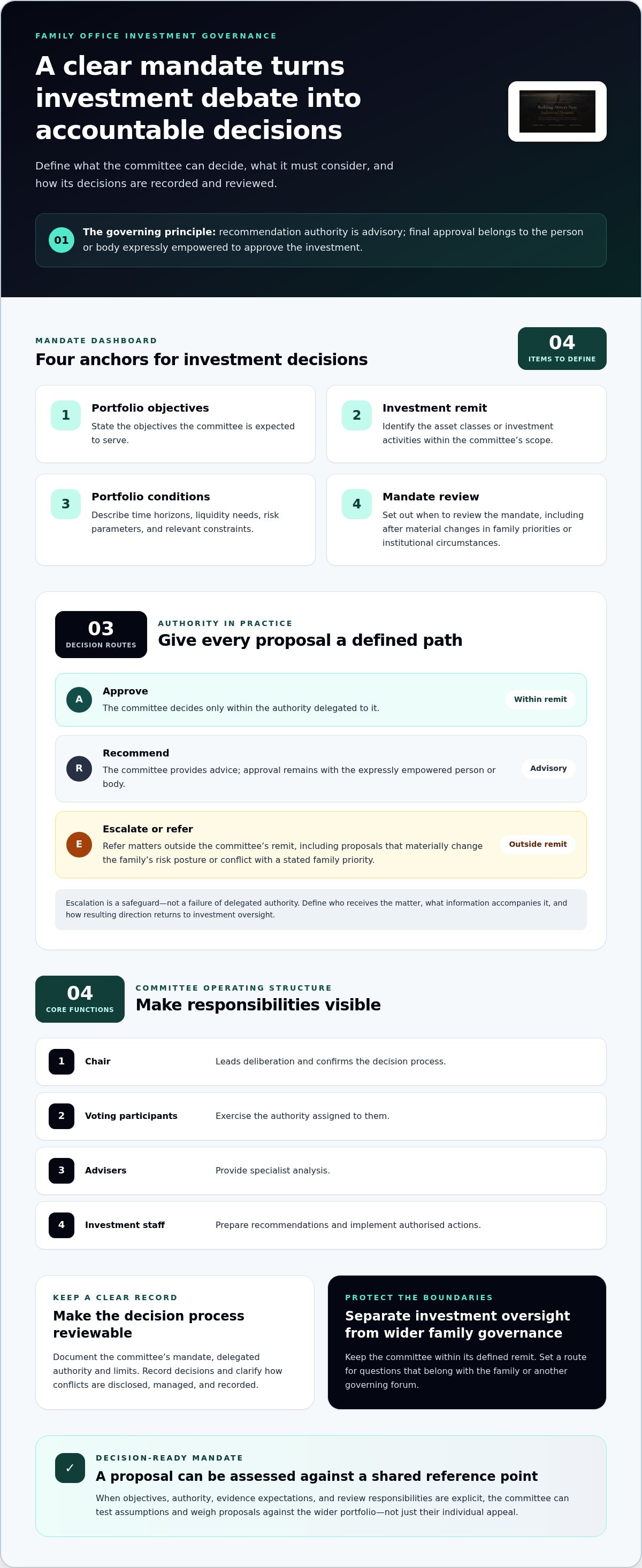
An investment committee is a delegated forum that evaluates proposals, tests assumptions and makes or recommends decisions within authority granted by the family office. Its mandate states what the committee may decide, what evidence it should consider and how decisions will be recorded and reviewed. This distinction matters because a Family office may oversee investments alongside other responsibilities. The investment committee should stay within its defined remit rather than assume authority over every family matter.
A clear mandate connects investment objectives to the practical conditions that shape capital allocation: time horizon, liquidity needs, risk tolerance and constraints. Without that connection, a compelling opportunity can be assessed on its own merits without considering its role in the wider portfolio. Family office investment committee best practices therefore start with an agreed reference point for assessing proposals and making disagreements productive.
The committee’s oversight role should also be distinct from operational portfolio management. Investment professionals may source opportunities, conduct analysis and implement authorised decisions; the committee challenges and decides within its delegated scope. Family-level governance addresses broader questions, such as shared priorities or stewardship expectations. Clear boundaries help each forum focus on its responsibilities and establish a route for matters that cross those boundaries.
What belongs in an investment committee mandate?
The mandate should be specific enough to guide decisions and tailored to the family office’s circumstances. It can identify the objectives, asset classes, investment horizon and material constraints that shape the committee’s remit. For a globally invested office, for example, public and private holdings may have different liquidity profiles that affect allocation decisions. Another office may give greater weight to a regional or strategic investment priority.
- State the portfolio objectives the committee is expected to serve.
- Identify the asset classes or investment activities within its remit.
- Describe relevant time horizons, liquidity needs, risk parameters and constraints.
- Set out how and when the mandate will be reviewed, including after material changes in family priorities or institutional circumstances.
How should committee authority relate to family office governance?
Separate matters the committee may approve from those it may recommend or must refer elsewhere. An allocation within an agreed portfolio framework might sit within the committee’s authority, while a proposal that materially changes the family’s risk posture or conflicts with a stated family priority may require escalation. Governing documents and decision records should make these boundaries clear to participants.
Escalation is not a failure of delegated authority. It is a safeguard for questions that exceed the committee’s remit. A family office can define who receives such matters, what information accompanies them and how the resulting direction returns to investment oversight. These boundaries sit within wider structures for stewardship and continuity, as discussed in family office governance for wealth preservation. A mandate designed for the office’s scale, geography and long-term objectives gives investment deliberation a stable institutional foundation.
Set investment committee roles, decision rights and meeting standards
A sound mandate needs an operating structure that makes authority visible in practice. Participants should know who may bring a proposal, who challenges its assumptions, who votes and who is accountable for carrying out an approved decision. These distinctions reduce ambiguity without making deliberation mechanical. Members can debate freely while understanding when discussion becomes a formal decision.
Recommendation authority is advisory; final approval authority rests with the person or body expressly empowered to approve the investment. Record that distinction alongside any delegation, including its limits and the matters reserved for escalation. The SEC’s guidance on Family Offices describes conditions for a family-office exclusion from certain investment adviser regulation. Because legal obligations depend on the office’s circumstances and jurisdiction, governance documents and delegated authority merit appropriate legal review.
Which roles and decision rights should be explicit?
Document responsibilities by function rather than relying on titles alone. A chair leads deliberation and confirms the decision process; voting participants exercise their assigned authority; advisers provide specialist analysis; and investment staff prepare recommendations and implement authorised actions. The written framework should also state how conflicts are disclosed, managed and recorded, and how confidentiality applies to materials and discussion.
- Identify the chair, voting participants, advisers and responsible investment staff, including each role’s limits.
- Set delegated thresholds and identify decisions requiring escalation, with jurisdiction-specific review where relevant.
- Record conflict disclosures, any participation restrictions and the rationale for the committee’s treatment of the matter.
- Provide a method for registering dissent so material differences of view remain part of the decision record.
These are core family office investment committee best practices because they preserve a clear line from authority to accountability, even when a proposal attracts strong individual conviction.
What makes committee meetings disciplined and useful?
Prepare participants with a shared evidentiary foundation before discussion begins. Circulate materials in advance, separate established facts from assumptions, and identify the proposal’s main risks and relevant alternatives. An agenda can distinguish informational updates from substantive deliberation and formal decisions, helping the chair avoid confusing awareness of an issue with approval to act.
- Provide the proposal, supporting analysis, material risks and alternatives before the meeting.
- Use the agenda to identify which items require discussion, a recommendation or a formal decision.
- Maintain minutes that record the decision, its conditions, material dissent and assigned actions.
- Track follow-up responsibilities so approval does not leave implementation ownership unclear.
Minutes need not reproduce every exchange. They should capture the reasoning and authority relevant to the outcome, including recusals or unresolved conditions, so the record can inform later oversight. For offices considering how capital allocation relates to global stewardship, Vieyra’s global investment management provides a relevant institutional perspective.
Use a consistent investment decision checklist to compare opportunities
A repeatable assessment gives the committee a common basis for comparing investments with different structures, time horizons and return profiles. It also separates an opportunity’s appeal from the evidence supporting it. Family office investment committee best practices call for every proposal to be tested against the office’s stated objectives, the portfolio’s current exposures and the conditions under which the investment thesis could fail.
Ask the same core questions for every proposal, then record the evidence, decision implications and unresolved issues beside each criterion. This makes gaps visible before approval and allows members to compare alternatives without treating a single return projection as decisive.
How should an opportunity demonstrate portfolio fit?
Start by identifying the investment’s intended role: which objective it serves, how it may affect concentration or existing exposures, and how much capital it requires over time. Consider whether its expected holding period is compatible with liquidity needs and whether it complements or duplicates current portfolio positions. Strategic alignment matters, but it does not establish that assumptions are complete or risks acceptable.
- Mandate fit: What objective does the opportunity advance, and is it within the committee’s authority?
- Portfolio role: How does it affect diversification, concentration and existing exposures?
- Capital profile: What liquidity, follow-on capital and time horizon does it require?
- Evidence quality: Which claims are verified, which are assumptions, and what remains unresolved?
What should due diligence and risk review establish?
Test the investment thesis by examining its dependencies: what must be true for it to succeed, who must execute, and which external conditions could change the outcome. Review governance, operational capacity and relevant legal, regulatory or geopolitical considerations. For investments connected to African institutions or markets, the analysis may also draw on sovereign investment risk management in Africa.
Downside analysis should describe plausible adverse scenarios and their portfolio consequences, not simply assign a lower return estimate. Define review conditions in advance, such as a material change to a core assumption, a missed execution dependency or a shift in the investment’s liquidity profile. These conditions prompt reassessment; they do not dictate an automatic decision to buy, hold or exit. Strengthening Governance in Family Offices also discusses how committee frameworks can align investment decisions with family objectives.
- Criterion: mandate fit. Evidence: stated objective and supporting rationale. Implication: proceed only within the authorised remit. Open question: does the proposal advance a defined priority?
- Criterion: downside and dependencies. Evidence: scenario analysis, key assumptions and execution requirements. Implication: identify conditions for further review. Open question: what could invalidate the thesis?
- Criterion: liquidity and portfolio impact. Evidence: capital schedule, holding horizon and exposure analysis. Implication: assess compatibility with portfolio needs. Open question: what constraints emerge under stress?
This compact assessment makes comparison more disciplined while preserving room for informed judgment. A proposal with strong strategic alignment but material unanswered questions can be distinguished from one with evidence mature enough to support a decision.
Turn investment committee approvals into accountable portfolio oversight
Approval begins an investment’s governance record; it does not end the committee’s responsibility. A disciplined post-approval process turns the decision into assigned actions, clear monitoring responsibilities and scheduled opportunities to test whether the original thesis remains credible. Without an accountable owner, material developments may surface without a clear route back to the committee.
Family office investment committee best practices distinguish monitoring indicators from decisions. A change in operating performance, a delayed milestone or a shift in market conditions may warrant analysis, but none should automatically trigger a buy, hold or exit. The committee should consider developments against the investment’s original assumptions, portfolio role and relevant constraints.
What should the committee monitor after approval?
Start with the conditions recorded at approval. Track the investment thesis, agreed milestones, material risks and unresolved conditions. Assign an owner to provide updates and raise significant developments. Review frequency should reflect the nature of the asset and the risks identified, rather than apply one schedule to every holding. This keeps oversight proportionate while ensuring changes in assumptions, governance or portfolio exposure receive attention.
Compare actual developments with the evidence and expectations available at approval. A short-term variance may be informative, but it is not conclusive on its own. Assess whether it affects the underlying thesis, the investment’s risk profile or its fit within the wider portfolio. Global investment management principles place this review within a wider stewardship perspective, particularly for portfolios spanning asset classes and jurisdictions.
How should committees learn from decisions over time?
Periodic review should examine both investment outcomes and the quality of the decision process. Ask whether the original assumptions were reasonable given the available information, whether important dependencies were understood and whether developments were escalated in a timely manner. The aim is not to claim certainty in hindsight, but to refine due diligence and clarify how the mandate applies to future opportunities.
Record lessons in a way that informs subsequent reviews. Distinguish outcomes driven by changed external conditions from those that reveal a missed assumption, unclear ownership or insufficient evidence. That distinction helps the committee improve its judgment without allowing a single result to distort future decisions.
A practical sequence keeps accountability visible:
- Translate approval conditions into specific actions and monitoring indicators.
- Assign an owner for implementation, updates and escalation.
- Review milestones, thesis assumptions, risks and portfolio exposure at an appropriate interval.
- Refer material changes to the committee for deliberation, rather than treating indicators as automatic instructions.
- Record the review, any revised conditions and lessons for future decisions.
These family office investment committee best practices connect approval to continuing stewardship, while preserving the committee’s role as a forum for judgment rather than a mechanical response to individual signals. To explore Vieyra’s perspective on global investment management, visit the firm’s website.
Adapt family office investment committee best practices to long-term capital
No single committee design suits every family office. Authority, meeting practices and oversight should reflect the office’s mandate, geographic reach, scale and investment horizon. A portfolio with global holdings across asset classes may require attention to different liquidity and execution considerations than a portfolio focused on a narrower set of strategies. The governing principle is fit: committee arrangements should support the capital’s purpose and make accountability clear.
Long-horizon capital can support consideration of durable value creation, but patience is not a substitute for disciplined analysis. Deliberation should weigh potential contribution over time alongside liquidity requirements, execution risk and portfolio resilience. Strategic conviction can help a committee identify opportunities aligned with its mandate; it cannot replace credible evidence, sound governance or an assessment of how the investment could perform under adverse conditions.
How does long-horizon capital change committee deliberation?
A multi-generational perspective may extend the period over which an investment’s contribution is assessed, while keeping the thesis subject to review. For example, an office with a strategic interest in African industrialisation may consider how a proposed investment could support long-term productive capacity. That context reflects the office’s priorities, not a universal objective for family offices, and it does not reduce the need to test execution assumptions, risks and portfolio fit.
Vieyra Family Office manages global investments and deploys strategic capital with a focus on African industrialisation. Its work illustrates how a clear mandate and investment horizon can shape capital allocation across global and African-centric assets.
What should a committee review before adopting this checklist?
Use the following review to confirm that committee arrangements are workable, understood and connected to ongoing oversight. It can help identify gaps without prescribing a uniform template:
- Mandate: Confirm that objectives, investment scope, horizon, liquidity needs and material constraints are documented and current.
- Authority: Verify that responsibilities, delegated decision rights and escalation paths are clear to participants.
- Evidence: Check that material proposals distinguish supporting information from assumptions and identify important risks and unresolved questions.
- Decision record: Ensure that each material decision captures its rationale, conditions, dissent where relevant and accountable owner.
- Oversight: Confirm that monitoring responsibilities and review triggers are assigned, with a path for significant developments to return to the committee.
Applying family office investment committee best practices this way connects strategic intent to deliberation and continuing accountability, while allowing the framework to evolve as the office’s mandate or circumstances change. Vieyra’s global investment management offers a perspective on long-horizon stewardship across markets and asset classes.
Keep the committee’s mandate responsive to the future
A committee framework should be durable enough to guide decisions through changing conditions, yet flexible enough to evolve as family priorities and institutional circumstances shift. Treat periodic review as an act of stewardship: consider whether the mandate still reflects the capital’s purpose, whether authority remains clear and whether the committee continues to learn from its decisions. This keeps family office investment committee best practices focused on the future the family intends to shape, rather than preserving process for its own sake.
Vieyra Family Office is a multi-generational African family office operating at sovereign scale. It manages global investments and deploys strategic capital with a focus on African industrialisation. Through the Vieyra Foundation, it also pursues philanthropic initiatives aligned with its investment strategy. Together, these activities reflect an institutional approach to long-term capital allocation and stewardship.
Consider how a disciplined approach to capital allocation can serve your office’s particular horizon and priorities. Explore Vieyra Family Office’s perspective on global investment management.
Frequently Asked Questions
What is an investment committee in a family office?
An investment committee is a delegated forum that reviews investment proposals and oversees decisions within an agreed mandate. Its remit and authority vary by office, so the governing framework should identify which matters it can decide and which it refers elsewhere. This prevents discussion from being mistaken for approval. Strong family office investment committee best practices also connect each decision to its rationale and the person responsible for subsequent action.
Who should sit on a family office investment committee?
Membership should provide the knowledge and perspectives needed to assess the office’s investments, rather than follow a standard roster. A family principal may contribute context about priorities, while investment professionals assess portfolio implications and advisers offer relevant specialist judgment. A skills matrix can reveal gaps, such as limited experience with a particular asset class or geography. The committee’s written framework should clarify participation, voting rights, conflicts and how expertise informs, but does not replace, decision authority.
How often should a family office investment committee meet?
The appropriate meeting cadence depends on the portfolio’s complexity and the pace of decisions requiring committee attention. A regular calendar provides a predictable forum for planned reviews, while a separate escalation protocol addresses material developments between meetings. For example, a significant change to an investment’s assumptions may warrant review outside the routine schedule. Distinguish event-driven consideration from ordinary updates so urgent matters are not left waiting for the next scheduled discussion.
What should investment committee minutes include?
Minutes should create a reliable record of what the committee considered and what followed from its decision, rather than reproduce the meeting word for word. Record the proposal, material evidence, risks, rationale and outcome, along with relevant conditions, dissent, participant conflicts and assigned actions. Link each action to an owner and track its status at the next review. Retention and access should follow the office’s applicable policies, especially where materials are sensitive.
How should a family office handle disagreement over an investment?
Examine disagreement before trying to resolve it. Clarify whether participants differ over the evidence, the investment’s assumptions, its fit with family objectives or the level of risk the office is prepared to accept. If a material question remains unanswered, the committee can request further analysis and defer its decision under the procedures in its mandate. Record significant dissent and the basis for the eventual outcome, preserving useful challenge for future reviews.
Does every family office investment decision require committee approval?
No. The office’s delegated authority should specify which matters require committee approval, which may be handled within previously authorised limits and which need escalation. For example, an investment professional might implement a decision already approved within a defined allocation, while a proposal outside that scope returns for review. Clear boundaries enable action without implying that all decisions belong to the committee. Reassess those boundaries when the office’s mandate, portfolio or operating arrangements materially change.


