
Does the traditional model of passive wealth management suffice when the objective is the enduring security of a multi-generational legacy within a complex economic frontier? The strategic pursuit of long-term capital preservation Africa demands a departure from conventional defensive postures in favor of a sophisticated integration with the continent’s industrial trajectory. Persistent volatility in local currencies and the presence of structural risks often erode liquid wealth, leaving many established families and institutions without a clear path toward permanent stability.
We recognize that the safeguarding of significant capital requires more than mere risk mitigation; it demands a visionary architecture that aligns private interest with systemic progress. This article provides a comprehensive exploration of the strategic frameworks necessary to secure and grow assets amidst macro-economic shifts. You will gain insight into the principles of sovereign-scale deployment, the role of industrialization as a hedge against volatility, and the institutional structures required to maintain a cohesive legacy for generations to come.
Key Takeaways
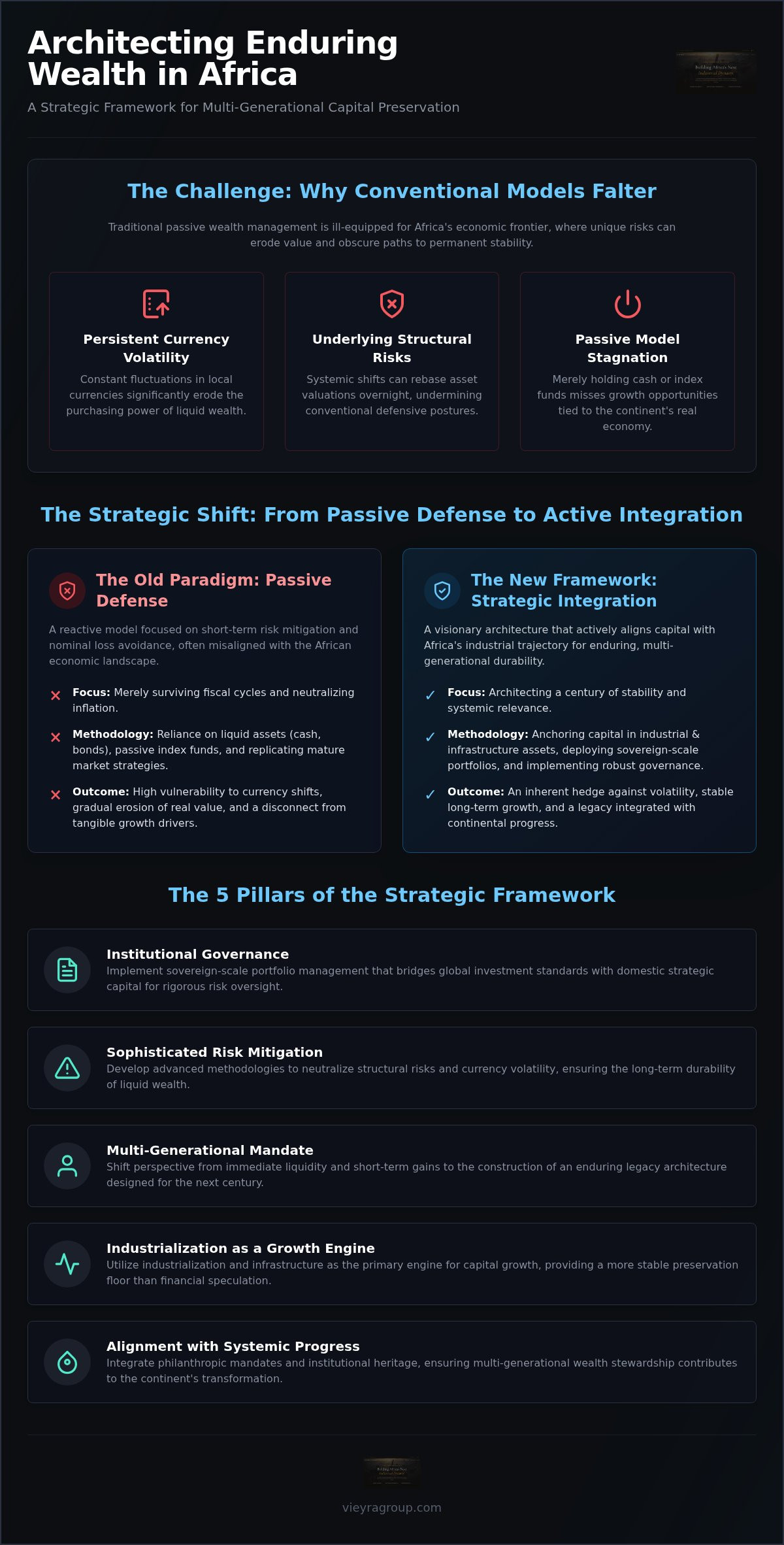
- Recognize the essential transition from passive asset protection to a strategic framework for long-term capital preservation Africa aligned with the continent’s industrial transformation.
- Implement the institutional governance structures required to manage sovereign-scale portfolios that bridge global investment standards with domestic strategic capital.
- Develop sophisticated methodologies to mitigate structural risks and currency volatility, ensuring the durability of liquid wealth within evolving economic landscapes.
- Utilize industrialization as a primary engine for capital growth, providing a more stable preservation floor than conventional financial speculation.
- Align multi-generational wealth stewardship with systemic progress through the integration of philanthropic mandates and institutional heritage.
The Strategic Imperative of Long-Term Capital Preservation in Africa
The concept of capital preservation within the African context transcends the simplistic avoidance of nominal loss. It represents a profound commitment to maintaining purchasing power and societal influence across vast economic cycles. Unlike standard inflationary protection, which merely seeks to neutralize the corrosive effects of consumer price indices, multi-generational durability requires a more robust engagement with the underlying drivers of continental growth. True long-term capital preservation Africa necessitates an understanding that wealth isn't a static reserve but a living legacy that must be integrated into the very fabric of emerging industrial systems. It's the difference between merely surviving a fiscal year and architecting a century of stability.
Traditional Western preservation models frequently rely on the deep liquidity of bond markets and the predictability of mature legal systems. In contrast, the African landscape demands a more active and institutionalized posture. One can't simply hold cash or passive index funds when currency fluctuations and structural shifts can rebase valuations overnight. Instead, the strategic imperative is to anchor capital in assets that possess inherent utility and systemic importance. This institutional gravity allows a family office or a sovereign-scale entity to remain unmoved by the erratic rhythms of emerging market cycles, focusing instead on the steady progress of the continent's transformation.
The Multi-Generational Mandate
Stewardship at this scale demands a psychological pivot from the pursuit of immediate liquidity to the construction of enduring legacy architecture. When horizons extend into the next century, the volatility of a single decade becomes a manageable variable rather than a terminal threat. Multi-generational capital is the intersection of family heritage and institutional permanence. This shift in perspective allows for the deployment of strategic capital into projects that require the patience of a sovereign entity. It ensures that the core of the estate remains resilient against the transient shocks of global markets, favoring the slow, certain growth of industrial foundations over the ephemeral gains of speculation.
Africa as a Global Investment Frontier
High-potential markets often present a paradox where rapid growth is accompanied by significant structural instability. Conventional models often fail to account for the unique History of Industrialization in Africa and its impact on long-term asset valuation. To safeguard capital here, one must look beyond public equities toward permanent asset classes like large-scale infrastructure and industrial development. Global investment management in this region isn't about replicating overseas strategies. It's about localized precision and the foresight to recognize which sectors will underpin the continent's future. By identifying these permanent pillars, stewards can achieve a level of long-term capital preservation Africa that remains decoupled from the noise of international financial headlines.
The Architecture of Multi-Generational Capital Management
The establishment of a resilient estate within the continent requires more than mere portfolio diversification; it necessitates the construction of a robust institutional architecture capable of withstanding profound systemic shifts. This structural foundation is the cornerstone of effective long-term capital preservation Africa, where the primary objective is to ensure that wealth remains both productive and protected across successive generations. Such a framework demands the implementation of rigorous governance protocols that mirror the sophistication of global financial centers while remaining deeply attuned to the nuances of the African economic landscape. By establishing institutional rigor in capital allocation and risk oversight, stewards can navigate the complexities of emerging markets with the same precision applied to mature economies.
Integrating Global Investment Management with African-centric Strategic Capital Solutions creates a dual-layered defense against volatility. This methodology allows for the seamless coordination of assets across multiple jurisdictions, ensuring that the legacy is not overly dependent on the performance of a single market or currency. The architecture of such a system must prioritize the interconnectedness of various initiatives, moving beyond fragmented asset management toward a unified strategy that accounts for geopolitical shifts and long-term industrial trends. This level of oversight ensures that capital is not merely held but is actively managed to serve the enduring vision of the family or institution.
Sovereign-Scale Stewardship
When a private entity adopts a sovereign-level perspective, it moves beyond the pursuit of standard benchmarks to engage in the deliberate planning of regional development. This approach involves identifying partnerships that align private capital with the broader goals of continental transformation, particularly through large-scale infrastructure projects that provide essential services. These initiatives require a level of institutional deliberation that considers the long-term impact on the economic ecosystem, ensuring that every deployment of capital strengthens the underlying environment. By operating with the poise of a significant global actor, an institution can secure a position of influence that transcends traditional investment cycles.
Asset Allocation for Longevity
Achieving stability in high-growth environments involves a precise calibration between liquid global assets and illiquid industrial holdings. While global portfolios provide the necessary liquidity to navigate immediate requirements, African Industrialization Capital offers an anchor against the volatility of international markets. By deploying Strategic Capital Solutions, institutions can secure a permanent presence in essential sectors, effectively turning structural risks into long-term advantages. This methodical approach to asset management ensures that the core legacy remains untouched by the transient fluctuations of the global economy, providing a stable floor for multi-generational growth.
Mitigating Structural Risks to African Wealth Legacies
Securing a legacy against the backdrop of emerging market volatility involves more than the mitigation of standard market fluctuations. It requires a profound understanding of structural risks that can fundamentally rebase the valuation of an entire estate. Within this context, long-term capital preservation Africa is achieved not through defensive retreat, but through the application of strategic depth. The primary threats to multi-generational wealth often stem from systemic shifts, including abrupt regulatory changes and the erosion of liquid assets due to local currency devaluation. To counter these forces, an institution must operate with a degree of permanence that transcends political cycles, establishing a position of institutional neutrality that allows for the continued stewardship of assets regardless of the prevailing geopolitical climate.
Managing risk at a sovereign scale demands an approach that integrates localized intelligence with global oversight. This strategic posture prioritizes the creation of a resilient capital base anchored in essential industrial sectors that remain vital to the continent's progress. By focusing on sectors with high barriers to entry and systemic importance, a family office can insulate its core holdings from the erratic rhythms of speculative markets. This method ensures that capital isn't merely surviving but is actively contributing to the structural integrity of the economies in which it operates, thereby creating a self-reinforcing cycle of stability and growth.
Currency and Inflationary Resilience
Traditional cash holdings often prove inadequate for preserving value in environments characterized by high inflation and currency instability. A more effective strategy involves the deployment of wealth into hard-asset industrialization, where the value of the investment is tied to tangible production and essential infrastructure. Global diversification remains a critical component for African-based institutions, providing a necessary hedge against domestic shocks while allowing for participation in more mature financial ecosystems. The consistent expansion of domestic industrial output serves as a primary stabilizer for local currency valuations by reducing import dependency and enhancing trade balances. This focus on industrialization transforms the nature of the risk, moving from passive exposure to active participation in the continent's economic strengthening.
Governance and Succession Planning
The human element of capital stewardship often presents the greatest risk to long-term durability. Establishing a rigorous family constitution is essential for maintaining institutional focus across generations, providing a clear framework for decision-making and conflict resolution. This governance structure must include robust mentorship programs designed to prepare the next generation of leaders for the complexities of sovereign-scale management. By institutionalizing these processes, families can effectively mitigate the common 'third-generation curse' that often sees the dissipation of wealth. Success isn't just about the preservation of capital; it's about the cultivation of a shared vision that ensures the legacy remains a significant global actor for centuries to come.
Industrialization as a Mechanism for Wealth Durability
The pursuit of long-term capital preservation Africa requires a fundamental re-evaluation of what constitutes a "safe haven" within the continent’s unique economic landscape. While conventional wisdom often favors the perceived safety of liquid financial instruments, these assets frequently lack the structural resilience needed to withstand profound regional transformations. True durability is found in the alignment of capital with the continent’s industrialization. By shifting focus from ephemeral financial speculation to the establishment of manufacturing and infrastructure, institutions create a preservation floor that's anchored in tangible production. This strategic engagement ensures that the wealth remains vital to the economic ecosystem, providing a level of security that passive holding can't replicate.
Economic transformation is the most reliable guarantor of institutional influence. When an estate is integrated into the essential industrial fabric of a nation, its preservation becomes a matter of systemic importance. This alignment creates a natural defense against the volatility that often characterizes emerging markets. It moves the legacy from the periphery of the economy to its core, where the stability of the investment is reinforced by the growth of the region itself. This isn't merely an investment strategy; it's the architecture of a permanent presence.
Strategic Capital for African Development
The transition from rent-seeking behaviors to institutionalized value-creation represents a critical evolution in the stewardship of multi-generational wealth. Financing the primary engines of economic growth ensures asset longevity by creating systemic moats around the capital base. Industrial projects, particularly those involved in manufacturing and large-scale infrastructure, possess inherent utility that remains consistent regardless of market sentiment. By deploying African Industrialization Capital, stewards can transform their holdings into structural pillars of the regional economy, securing a legacy that's both protected and productive. This approach prioritizes long-term stability over short-term liquidity, recognizing that the most secure assets are those that underpin the continent’s future.
The Role of Global Investment Management
Leveraging global expertise through sophisticated Global Investment Management allows for the optimization of these industrial projects, ensuring they meet international standards of efficiency and governance. This creates a powerful feedback loop where global market returns are strategically channeled back into continental reinvestment. Such a methodology ensures that the capital remains at the forefront of the continent’s progress, participating in sovereign-level initiatives that drive large-scale development. To align your institutional objectives with the continent’s industrial trajectory, explore our frameworks for African Industrialization Capital and strategic growth.
Institutional Stewardship and the Multi-Generational Mandate
The Vieyra Family Office serves as a stately guardian of this vision, operating with a level of deliberation that mirrors the sovereign entities with which it aligns. True long-term capital preservation Africa isn't merely a matter of financial management; it's an exercise in institutional permanence. By adopting a century-long stewardship horizon, families can ensure that their legacy remains a significant global actor, untouched by the transient rhythms of market cycles. This sovereign-scale posture allows for the steady, methodical deployment of capital into the very foundations of the continent’s progress, ensuring that the estate grows in tandem with the region’s industrial transformation. The philosophy of Global Stewardship in the 21st century demands that significant capital actors move beyond the pursuit of isolated returns to consider their role as visionary architects of a more stable, industrialized future.
The Role of Institutional Philanthropy
Strategic philanthropy, managed through the Vieyra Foundation, acts as a critical tool for ensuring social stability and brand permanence. Foundation initiatives shouldn't be viewed as separate from the core mandate but as an essential component of long-term capital preservation Africa. By aligning philanthropic efforts with key investment themes, such as industrial development and education, institutions can measure legacy impact through the lens of systemic improvement. This alignment ensures that the family’s influence remains deeply rooted in the social and economic fabric of the continent, creating a self-reinforcing cycle of growth and security. Measuring the legacy impact of institutional giving requires a focus on long-term outcomes that strengthen the underlying environment in which the estate operates.
Constructing the Legacy Architecture
Constructing a resilient legacy architecture requires the synthesis of global investment management and localized strategic capital solutions. As African capital markets continue to evolve, the distinction between passive asset protection and active institutional stewardship will become increasingly pronounced. The future belongs to those who view their wealth as a visionary architect of progress, blending traditional values of heritage with a forward-looking commitment to large-scale development. Establishing a sovereign-scale investment posture is the final step in securing a multi-generational mandate that will endure for centuries. This process involves the rigorous implementation of governance protocols, the preparation of next-generation stewards, and the continuous alignment of capital with the continent’s most vital sectors. It's through this methodical approach that a family’s heritage is transformed into a permanent global influence. Discover the Architecture of Multi-Generational Wealth to begin architecting your permanent legacy.
Architecting a Permanent Legacy in the African Century
The transition from passive wealth maintenance to the active construction of a multi-generational estate requires a fundamental realignment of strategic priorities. We've explored how the integration of global investment standards with domestic industrialization provides the only robust framework for long-term capital preservation Africa. By establishing institutional governance and anchoring capital in essential infrastructure, stewards can effectively insulate their legacies from the transient volatility of emerging market cycles. This sovereign-scale perspective ensures that wealth remains a productive force for generations, transcending mere fiscal survival to become a cornerstone of continental progress.
Drawing upon a multi-generational institutional heritage and sovereign-scale investment expertise, we remain dedicated to the realization of African industrial transformation. The path to enduring stability is paved with deliberate, strategic choices that favor systemic impact over short-term liquidity. We invite you to Engage with Vieyra Family Office for Strategic Capital Stewardship to secure your family's heritage within this evolving landscape. The future of African wealth isn't merely to be held; it's to be architected with the foresight and poise of a global institution certain of its trajectory.
Frequently Asked Questions
What is the primary difference between wealth management and multi-generational capital preservation?
Wealth management typically addresses short-term liquidity and periodic returns, while long-term capital preservation Africa demands a focus on the enduring durability of a legacy across multiple generations. This distinction requires a transition from simple asset accumulation to the construction of a robust institutional architecture. Such a framework prioritizes the safeguarding of purchasing power against systemic shifts, ensuring that the estate remains a significant global actor for centuries.
How does African industrialization contribute to long-term capital preservation?
Industrialization serves as a primary engine for wealth durability by anchoring capital in tangible manufacturing and essential infrastructure. These assets provide a more stable preservation floor than financial speculation. By financing the engines of growth, stewards create systemic moats that protect the capital base from the transient rhythms of speculative markets. This alignment ensures that the legacy remains integrated into the continent's fundamental economic transformation.
What role does currency volatility play in African capital preservation strategies?
Currency volatility necessitates a strategic shift from liquid cash reserves into hard assets that maintain value through productive utility. In the context of long-term capital preservation Africa, linking wealth to industrial output provides a natural hedge against devaluation. This approach ensures that the legacy retains its global influence by focusing on sectors that underpin the structural integrity of the regional economy. It turns a macro-economic risk into a driver of stability.
Why is a sovereign-scale approach necessary for private family offices in Africa?
Private family offices require a sovereign-scale approach to operate with the deliberation and foresight necessary for large-scale development. This posture allows an institution to align its capital with regional goals, establishing a position of institutional neutrality that transcends political cycles. It provides the strategic depth needed to manage risks that operate at a systemic level. This level of operation is far beyond the scope of traditional retail banking.
How can global investment management be balanced with African-centric goals?
Global investment management provides the necessary liquidity and diversification to balance the illiquid nature of continental industrial projects. By leveraging international expertise, stewards can optimize their African portfolios to meet rigorous global standards of governance and efficiency. This dual-layered strategy ensures that returns from global markets are strategically channeled back into the continent's industrial trajectory. It creates a self-reinforcing cycle of growth and security.
What are the essential governance pillars for preserving a multi-generational legacy?
The essential pillars of multi-generational governance include a formal family constitution and an institutionalized decision-making framework. These structures provide the clarity needed to navigate complex successions and prevent the dissipation of wealth across generations. Mentorship of the next generation remains critical. It ensures that future stewards possess the intellectual rigor and strategic vision required to manage sovereign-scale capital with composure.
How does the Vieyra Foundation align with the family office's investment strategy?
The Vieyra Foundation aligns with the broader investment strategy by focusing on philanthropic initiatives that enhance social stability and long-term economic themes. This alignment ensures that the family office's impact extends beyond financial returns to include systemic improvements in the regions where it operates. By integrating foundation mandates into the preservation framework, the institution secures its brand permanence and societal influence. Philanthropy becomes a tool for institutional resilience.
Can capital preservation be achieved through impact investing in Africa?
Capital preservation is most effectively achieved through strategic industrialization rather than conventional impact investing, which often prioritizes social returns over structural durability. While social impact is a natural byproduct of industrial growth, the primary focus remains on the establishment of resilient manufacturing and infrastructure. This ensures that the capital base remains protected. It allows the institution to contribute meaningfully to the continent's large-scale economic transformation.


