
About 12 million young Africans enter the workforce each year, while only 3 million new formal wage jobs are created. For Sub-Saharan Africa, the next stage is to align investment in Africa’s workforce development with the capabilities employers need and the industries capable of generating productive work. Education, digital skills and industrial growth must therefore advance in concert.
Education must prepare people not only to enter employment, but also to adapt as technology and economic structures change. That means connecting learning with practical skills, workplace needs and pathways into productive sectors, rather than treating education and job creation as separate priorities.
This article examines how education investment can strengthen workforce readiness, why digital skills matter to employers and workers, and how industrial development can create more pathways from training to jobs. It also considers investment choices that connect these priorities and support individual opportunity and durable growth across Sub-Saharan African economies.
Key Takeaways
- Understand how digital skills initiatives in Nigeria and Zimbabwe respond to employer demand, and why access to training matters alongside connectivity.
- See how education investment can connect learning with practical capabilities and clearer pathways into productive work.
- Assess how population growth, employment needs and manufacturing potential shape the region’s workforce development outlook.
- Consider how long-term capital can support African industrialisation and the wider conditions that make workforce readiness possible.
Digital skills initiatives in Nigeria and Zimbabwe
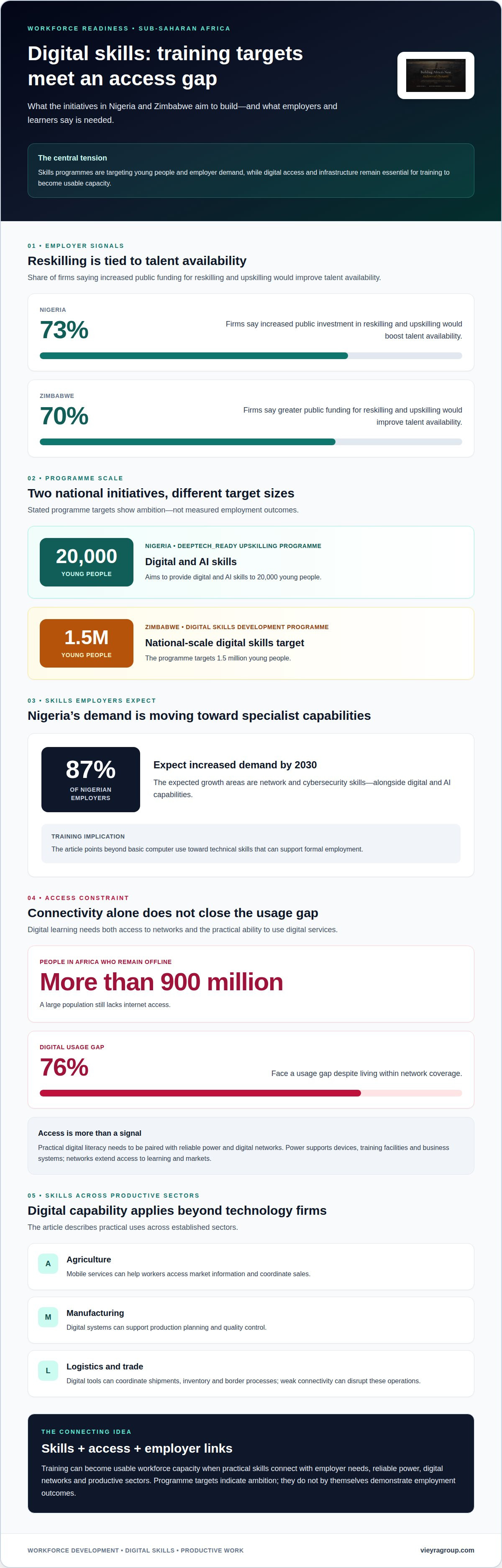
Digital skills investment links training to capabilities employers need. In Nigeria, 73% of firms say increased public funding for reskilling and upskilling would boost talent availability. The DeepTech_Ready Upskilling Programme aims to provide digital and AI skills to 20,000 young people. Meanwhile, 87% of Nigerian employers expect demand for network and cybersecurity skills to increase by 2030. These priorities point beyond basic computer use toward technical skills that can support formal employment. Workforce development investment in Africa can connect such training with employers’ evolving needs.
Zimbabwe’s Digital Skills Development Programme targets 1.5 million young people, while 70% of firms say greater public funding for reskilling and upskilling would improve talent availability. Yet training cannot unlock opportunity without access: more than 900 million people in Africa remain offline, and 76% face a digital usage gap despite living within network coverage. Digital literacy programmes therefore need to build practical ability to use services, not merely awareness of technology.
Connectivity also depends on infrastructure. Reliable power keeps devices, training facilities and business systems running, while digital networks extend access to learning and markets. In trade logistics, digital tools can help coordinate shipments, inventory and border processes, while weak connectivity can disrupt these operations. Workforce development investment in Africa should therefore consider skills alongside power and network access, not treat digital training as a standalone intervention.
Digital capability can raise productivity in traditional sectors. In agriculture, mobile services can help workers access market information and coordinate sales; in manufacturing, digital systems can support production planning and quality control. Logistics businesses can use digital records to manage deliveries and stock. These examples show how digital skills apply across the continent, creating potential employment pathways beyond technology firms.
Examples with defined scale include Nigeria’s DeepTech_Ready Upskilling Programme and Zimbabwe’s Digital Skills Development Programme. Their stated targets indicate ambition, not measured employment outcomes. Vocational accreditation in Nigeria and Zimbabwe is country-specific, with requirements shaped by the qualification and applicable national framework. Nigerian employers increasingly identify network and cybersecurity skills as growth areas, alongside digital and AI capabilities. Workforce development investment in Africa should connect these skills with power, connectivity and productive sectors to turn training into usable capacity.
Education investment and workforce readiness
Education investment strengthens workforce readiness when learning reflects employer demand and access to productive work. In Sub-Saharan Africa, aligning education with infrastructure and technology can help workers adapt as economies change.
Programs and Funding Sources
Workforce development programmes connect education and practical training with employment skills. Funding can combine public investment, development-bank support and private-sector contributions, each serving different needs. Governments can direct resources to education and training; development banks can support broader development priorities; and employers and investors can help align learning with workplace requirements. When assessing a programme, consider how its funding model shapes participation, the capabilities taught and the link between training and real work.
There is no single cost per participant across Africa. Expenses depend on programme duration, teaching resources, equipment, technology and the skills taught. A digital course, for example, has different infrastructure needs from practical vocational instruction that uses specialist equipment.
Program Impact and Returns
Program impact measures whether training improves participants’ employment outcomes and equips businesses with relevant capabilities. It matters because enrolment alone cannot show whether education investment supports workers or the wider economy. Cited apprenticeship programs increased employment rates from 47% to 80%, illustrating the value of assessing outcomes beyond course attendance. The result is evidence from those programs, not a universal forecast for every training model.
Evaluation can track completion, job placement and continued employment, alongside whether taught skills match employer needs. A survey found that 45% of African youth felt their skills did not match local labour markets, while 40% to 60% of African firms cite skills shortages as a top growth constraint. These figures show why alignment belongs in program design and evaluation.
Funding effectiveness also depends on the connection between training and hiring. In South Africa, 34% of businesses are considering removing degree requirements to find candidates with skills for emerging jobs. That example points to a practical reform: employers can recognize demonstrated capabilities, while education providers shape learning around relevant technologies and workplace tasks. Tracking those connections helps investors distinguish participation from workforce readiness.
What is the current size and growth outlook of Africa’s workforce development market?
Africa’s workforce development market is best understood through the scale of its working-age population and demand for employment, rather than a single market-value figure. The continent is projected to have more than 1.2 billion people of working age by 2050. According to the World Bank, its working-age population will increase by roughly 740 million people by then. This demographic expansion makes workforce development investment in Africa a long-range economic consideration.
The nearer-term outlook also points to sustained expansion. Africa’s working-age population is expected to reach about 450 million by 2035, while half of all new entrants to the global labour force are projected to come from Sub-Saharan Africa by 2030. These shifts increase the importance of education, vocational pathways and employer-linked training across national economies. Investment planning must consider how those pathways can serve workers entering different industries.
Population growth alone does not create workforce readiness or enough employment. Africa needs up to 15 million new jobs annually by 2030 to absorb its growing youth population. Current economic structures risk creating only around 100 million jobs, a constraint that makes the relationship between training and productive sectors central to investment decisions. The challenge is to grow the capacity to employ people as well as prepare them for work.
Investors and policymakers can assess workforce initiatives alongside the industries expected to employ trained people. Training can address skill gaps, but lasting outcomes also depend on whether firms expand, adopt technology and create suitable roles. Manufacturing, agriculture and digital activity each require distinct capabilities, so a uniform programme may not suit every economy. Workforce development investment in Africa should reflect these sector differences.
The scale of future labour supply makes effective delivery and alignment important. Countries experiencing population growth are expected to supply nearly two-thirds of new workforce entrants globally in the coming years. Capital must support relevant learning as productive capacity develops. The central measure is not population alone, but whether education and employment opportunities advance together across the continent.
Which African countries and sectors have the greatest workforce development investment needs?
Investment needs differ by population structure, employment patterns and productive capacity. In Nigeria, about 70% of the population is under 30, creating substantial demand for education linked to practical work. The most useful workforce strategies connect training with employers and expanding sectors, rather than treating skills development as separate from economic planning. Each country’s priorities depend on the industries it can grow and the capabilities those industries require.
Across Africa, private firms generate roughly 90% of all jobs, while informal employment accounts for roughly 85% of the labour force. Sub-Saharan African MSMEs also have an unmet financing need of $331 billion per annum. These conditions make smaller businesses important to workforce planning: training that strengthens business capabilities can support productivity, while formal pathways can help workers access more stable employment. Investment must account for both realities.
Agriculture presents a distinct skills and productivity opportunity. Africa holds 60% of the world’s uncultivated arable land, yet applies an average of 22 kilograms of fertilizer per hectare, compared with a global average of 146 kilograms per hectare. Training in soil management, equipment use and agricultural processing can connect workers to higher-value activity. Its effectiveness depends on complementary infrastructure, reliable access to inputs and routes to market.
Manufacturing can create demand for technical, operational and logistics capabilities. Africa’s manufacturing sector was estimated to have potential to create an additional 14 million stable, well-paid jobs if the African Continental Free Trade Area succeeds. AfCFTA implementation was also estimated to increase employment in energy-intensive steel and aluminum manufacturing by 2.4 million jobs. These opportunities make production skills and cross-border trade capacity relevant investment priorities.
AfCFTA comprises 55 member states and covers more than 1.3 billion people, creating a continental context for industrial growth. Capital allocation can therefore consider skills alongside infrastructure, business finance and sector-specific hiring needs. To explore how strategic investment can support these priorities, review investment perspectives.
Vieyra Family Office: Global Investment Management
Vieyra Family Office’s Global Investment Management and African Industrialization Capital support long-term investment in African economic development. This work is relevant when workforce readiness forms part of a broader strategy involving productive sectors, industrial capacity and durable growth.
Strategic Capital Solutions supports long-term growth projects. These offerings connect investment priorities with wider conditions that support employment, including the development of industries able to use workers’ skills. They are most relevant to institutional investors considering workforce development alongside African industrialization, rather than seeking a standalone training programme.
For a discussion of investment priorities and their relationship to African industrial growth, contact Vieyra Family Office.
Shape the next phase of workforce readiness
The next phase calls for investment decisions that connect learning with the productive capacity of African economies. Workforce development investment in Africa can be approached as part of a broader commitment to durable growth, where education, industry and employment reinforce one another. The central question is how capital can support conditions in which skills translate into meaningful economic participation.
For institutional investors considering this relationship, Vieyra Family Office’s Global Investment Management, African Industrialization Capital and Strategic Capital Solutions provide relevant areas of engagement. These offerings align with long-term investment priorities across African industrial development and economic growth. They are most relevant when workforce readiness forms part of a wider strategic investment perspective, rather than a standalone training objective.
To discuss how these priorities relate to your investment objectives, Contact Vieyra Family Office. Deliberate, long-term commitments can help create stronger foundations for opportunity and sustainable prosperity.
Frequently Asked Questions
What’s next for Sub-Saharan Africa?
The priority is to connect workforce preparation more closely with the jobs emerging economies can sustain. Institutions can start by identifying the roles employers need, translating those requirements into teachable competencies and incorporating employer feedback into course design. Training plans should also account for learners’ reliable access to instruction and tools. This makes employment pathways, rather than enrolment alone, the central measure of progress.
What are the risks and barriers to investing in workforce development in Africa?
Key barriers include a mismatch between training and hiring needs, unreliable access to power or digital infrastructure, and limited coordination among educators, employers and investors. Programmes can also falter when learners lack the equipment or practical experience their training requires. Investors can address these risks by linking funding to clearly defined competencies, employer participation and follow-up measures that assess whether participants use their skills at work.
Which African workforce development investment models and providers have succeeded?
The cited apprenticeship programs increased employment rates from 47% to 80%, showing positive outcomes for apprenticeship-based training.


