

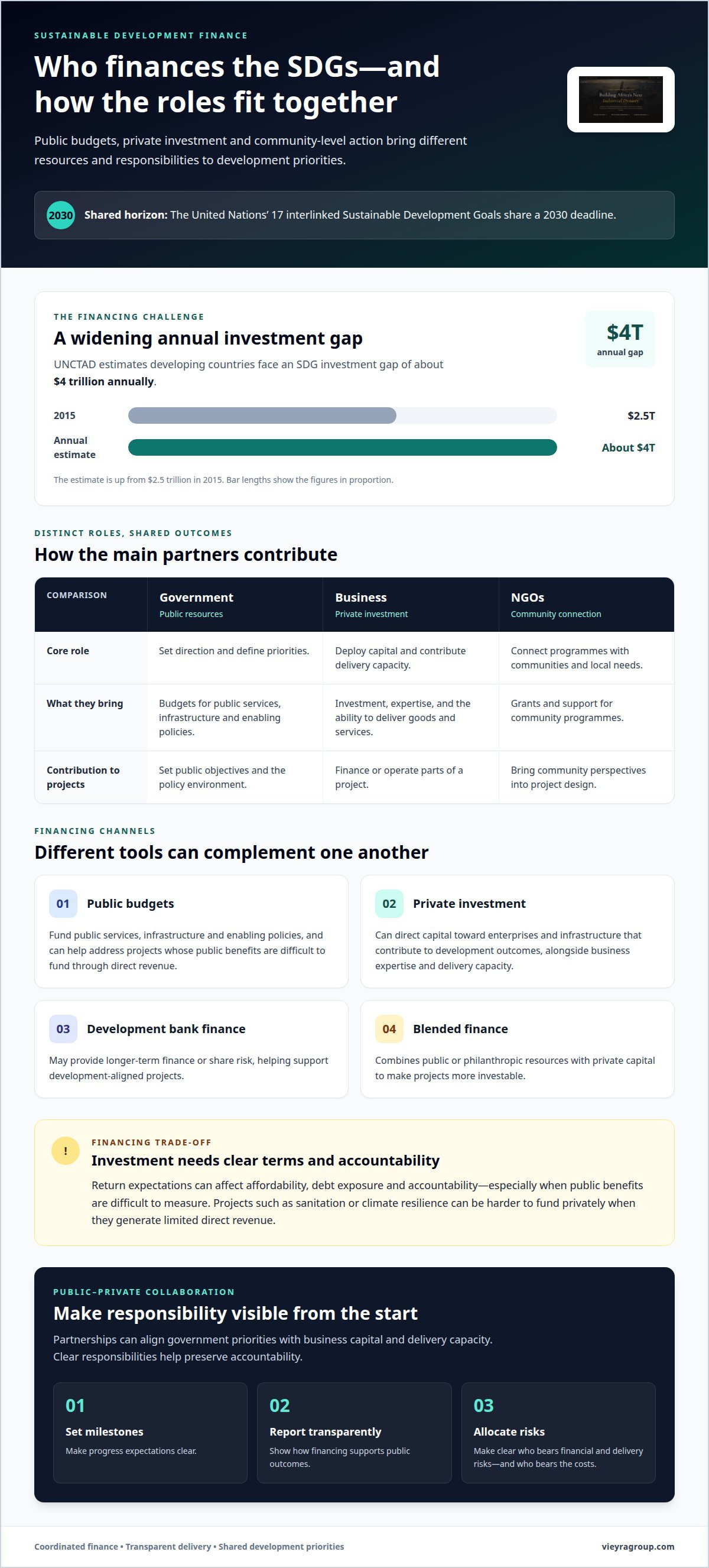
Developing countries face an annual SDG investment gap of $4 trillion, according to UNCTAD. Closing it calls for coordinated public and private finance, stronger domestic revenue, transparent reporting, and international cooperation rather than reliance on a single funding channel.
The scale of the challenge is clear, but its response is best understood as a connected system. Finance for sustainable development goals draws on public budgets and private investment, while domestic tax revenue, transparent reporting, and international forums help shape how resources are raised, directed, and assessed. The United Nations’ 17 interlinked Sustainable Development Goals share a 2030 deadline.
This article explains how financing channels complement one another, why public and private investment must work together, and how the Financing for Development Forum can advance coordination and accountability. It also considers how long-term strategic capital can support development priorities. The distinction matters because financing must reflect national priorities, sector needs, and the capacity to sustain results over time.
Key Takeaways
- See how public resources and private investment can complement one another in financing development priorities.
- Understand how domestic tax revenue can strengthen a country’s capacity to fund its own development.
- Learn why transparent reporting helps make financing decisions and development progress more accountable.
- Explore how the Financing for Development Forum can bring financing priorities and international cooperation together.
Public and private finance for sustainable development
Finance for sustainable development goals combines public resources, private investment, and community-level action. The United Nations sets a 2030 deadline for achieving the Sustainable Development Goals.
Government, Business, and NGO Roles
Government budgets set priorities and fund public services, infrastructure, and enabling policies. Private businesses contribute investment, expertise, and the ability to deliver goods and services. NGOs can provide grants, support community programmes, and bring local needs into project design. Each plays a distinct role: governments set direction, businesses deploy capital, and NGOs connect programmes with communities.
Private Investment for the SDGs
Private investment can direct capital toward enterprises and infrastructure that contribute to development outcomes. Development banks may provide longer-term finance or share risk, while blended finance combines public or philanthropic resources with private capital to make projects more investable. These structures involve trade-offs: return expectations can affect affordability, debt exposure, and accountability, especially when public benefits are difficult to measure. In the United States, the U.S. International Development Finance Corporation and USAID are examples of institutions with programmes that can support development-aligned projects.
Public-Private Collaboration
Public-private collaboration brings government priorities together with business capital and delivery capacity. A partnership can assign public actors responsibility for policy and public objectives, while private participants finance or operate parts of a project. Clear milestones, transparent reporting, and explicit allocation of financial and delivery risks help preserve accountability. When assessing a proposal, ask whether its financing supports a public outcome and makes clear who bears the costs and risks.
SDG Financing Needs and Gaps
UNCTAD estimates that developing countries face an investment gap of about $4 trillion annually, up from $2.5 trillion in 2015. No single SDG is least financed everywhere; projects with diffuse public benefits, such as sanitation or climate resilience, can be harder to fund privately because they generate limited direct revenue. Public budgets and concessional capital can help address that mismatch.
Domestic tax revenue mobilisation
Domestic tax revenue mobilisation means raising public income through a country’s tax system to fund services and development priorities. Compared with external financing, revenue collected domestically can give governments greater continuity in planning. Its effectiveness depends not only on tax rates, but also on administration, compliance, economic activity, and public confidence. Well-designed systems connect revenue collection to visible public value, including health services, education, transport, and resilient infrastructure.
The United Nations Development Programme launched its Tax for SDGs initiative in 2021 to help countries mobilise domestic resources. In 2019, members of the development community discussed domestic revenue mobilisation for the Sustainable Development Goals in Addis Ababa. These efforts reflect a practical challenge: a tax system needs capable institutions, clear rules, and reliable processes to convert economic activity into funds for national priorities.
Effective mobilisation starts with understanding the existing revenue base. Governments can assess the contributions of income, consumption, property, and business activity, then identify gaps linked to weak administration or informal economic activity. Better taxpayer registration, accessible filing processes, accurate records, and consistent enforcement can support collection without relying solely on higher rates. Each measure should consider who bears the burden and whether collection is practical across sectors and communities.
Revenue decisions also need a credible link between collection and public spending. Transparent budgets help residents and businesses understand how funds support services, while expenditure reviews can show whether programmes advance stated development priorities. Governments can strengthen this link by publishing clear budget information, monitoring revenue and spending, and building administrative capacity over time. For investors, predictable revenue institutions can signal whether public commitments rest on durable fiscal foundations.
Tax mobilisation cannot replace grants, concessional resources, or private capital. It can complement them and support public priorities with limited commercial returns. The central policy task is to balance revenue adequacy, fairness, and administrative practicality. For development finance, that balance matters: domestic resources can sustain programmes, while credible institutions and transparent allocation help maintain public trust and make financing decisions more accountable.
Reporting standards and transparency
Transparent reporting makes development finance traceable from commitment to outcome. A project record should identify its funding source, instrument, recipient, purpose, disbursement schedule, and responsible institution. For example, a clean-energy project might separate public grants from private loans and show which milestones each supports. This distinction helps readers tell whether reported capital is a pledge, an approved allocation, or money actually disbursed.
Consistent reporting connects financial data with results. Project teams can define indicators before implementation, document how they are calculated, and report progress against the same measures over time. For a health programme, this could mean separating expenditure on facilities from service-delivery results. Clear definitions are essential: without them, reports may use similar labels to measure different activities, making comparisons unreliable.
The UN Secretary-General’s Inter-Agency Task Force on Financing for Development issues the Financing for Sustainable Development Report annually; its 2024 edition provides a reference point for examining financing challenges. Such reporting can help public institutions, investors, and development partners understand how financing conditions relate to sustainable development priorities. It does not replace project-level disclosure, which must explain the specific commitments, flows, and outcomes under review.
For private investment, disclosures can explain how a project addresses environmental and social effects, financial exposure, and intended public benefits. Reporting should distinguish measured outcomes from projections and explain the assumptions behind forecasts. If a project changes its scope or timetable, an update should identify the change and its implications. This preserves an audit trail and helps stakeholders assess performance without mistaking estimates for achieved results.
Practical transparency relies on accessible records, clear responsibility, and regular reconciliation. Institutions can assign data owners, preserve supporting documents, and compare reported disbursements with project accounts. They can also explain data limitations and correct inconsistencies openly. These practices give decision-makers a stronger basis for allocating capital, identifying delivery problems, and assessing whether financing remains aligned with stated development objectives.
Financing for Development Forum
The annual Financing for Development Forum provides a setting to review international financing commitments and consider their implementation. Operating under the auspices of the United Nations Economic and Social Council, it reviews the Addis Ababa Action Agenda and other financing outcomes. Its practical value lies in connecting policy commitments with issues that affect countries’ ability to fund development.
Debt conditions are central to that discussion. Developing countries pay around twice as much on average in interest on their total sovereign debt stock as developed countries. Almost 40 per cent of developing countries face severe debt problems. These pressures can constrain public investment, making debt sustainability and access to affordable long-term finance important subjects for international coordination.
The Forum’s work sits alongside broader negotiations. The Fourth International Conference on Financing for Development was held from 30 June to 3 July, 2025, and was described as a once-in-80-year opportunity. Its significance is not simply the meeting itself, but the chance to address how domestic resources, international cooperation, and private capital can support development priorities together.
Earlier milestones show how the agenda has evolved. The development financing landscape changed during the 2008 financial crisis, while the High-level Dialogue on Financing for Development took place at the United Nations on 20 September 2023. Member States adopted the Pact for the Future in September 2024, adding another international outcome for financing discussions to consider.
For readers, the Forum is best understood as a coordination and review mechanism, not a project fund. It does not itself guarantee finance for an individual initiative. Instead, discussions can identify shared constraints, compare policy approaches, and keep attention on commitments over time. Assess development finance by considering both its funding sources and the conditions that shape countries’ ability to deploy resources sustainably. Debt costs, public revenue capacity, and reporting quality all matter.
Vieyra Family Office
Vieyra Family Office brings a long-term investment perspective to development priorities, linking capital allocation with durable economic growth. Its global investment management and strategic capital solutions address investment and capital needs, while its African industrialization capital supports industrial development. The Vieyra Foundation advances philanthropic initiatives focused on education, maternal health, AI literacy, infrastructure access, scholarships, industrial education, and food security.
This perspective is relevant when a project or investment strategy calls for patient capital, a clear development rationale, and alignment between financial objectives and lasting economic outcomes. The right approach depends on the project’s purpose, structure, and financing needs. The key consideration is how capital can support sustainable progress over time.
For a discussion about development-focused investment and capital solutions, contact Vieyra Family Office.
Shape the Next Stage of Development Finance
The next step is to apply financing principles with discipline: define the development outcome, clarify how it can endure, and align capital decisions with the project’s long-term purpose. This is where finance for sustainable development goals becomes a practical framework for assessing whether financial objectives and lasting public value can advance together.
For decision-makers, the key consideration is not simply where capital comes from, but how investment choices support durable economic development. A clear account of purpose, governance, and intended outcomes provides a stronger basis for evaluating opportunities and directing capital thoughtfully.
Vieyra Family Office brings a long-term perspective to investment and development priorities. To discuss how your priorities may align with strategic capital, begin a conversation with Vieyra Family Office. Thoughtful alignment can help lay the foundation for enduring progress.
Frequently Asked Questions
What are the solutions?
Solutions combine financing sources and match each instrument to a project’s purpose and revenue profile. Public budgets and grants can support essential services without direct income, while private investment may suit projects with viable commercial returns. Development assistance, domestic revenue, and international investment can complement these channels. Start by defining the public outcome, identifying who can finance it, and clarifying how delivery will be assessed.
What is finance for the Sustainable Development Goals (SDGs)?
Finance for sustainable development goals refers to the money and financing arrangements used to advance programmes, infrastructure, and enterprises that contribute to the Sustainable Development Goals. It covers both mobilising capital and directing it toward development priorities. For example, a clean-energy project may need public planning, private investment, and financing for construction. The key test is whether the funding structure supports the intended development purpose and makes responsibilities clear.
What are the main public and private sources of SDG financing?
Public sources include domestic tax revenue, government budgets, official development assistance, and public borrowing. Private sources include foreign direct investment, business investment, and lending from financial institutions. Philanthropic funding and NGO-supported programmes can also contribute to specific initiatives. Sources differ in purpose and terms: a grant does not create the same repayment obligation as a loan, while equity investment ties capital to an enterprise’s performance.
How do governments use taxes, budgets, and public debt to finance the SDGs?
Governments collect taxes as domestic revenue and allocate available funds through budgets to public priorities such as infrastructure and services. Public debt can finance investment, but it creates future repayment obligations that must be weighed against other spending needs. In practice, a budget connects a policy objective to an allocation, while expenditure records show where funds went and whether implementation matched the stated purpose.
How can impact investing and sustainable bonds support the SDGs?
Impact investing directs capital toward enterprises or projects seeking both a financial return and defined social or environmental benefits. Sustainable bonds can raise funds for specified eligible activities, with bond terms and reporting explaining how proceeds are allocated. For example, an issuer might designate proceeds for renewable energy infrastructure. Investors can assess the stated use of funds, the measures for reporting progress, and whether results are distinguished from targets.
How is SDG financing tracked and measured?
Tracking combines financial records with indicators of project delivery and development results. A project can record commitments separately from actual disbursements, then connect spending to outputs, such as completed infrastructure, and outcomes, such as improved access. Clear definitions and consistent reporting periods make comparisons more meaningful. Assigning responsibility for maintaining records also helps explain changes, identify gaps, and distinguish measured results from projections.


