

The headline valuation is only one part of an investment agreement negotiation. The key distinction is how an angel investor or venture capital firm expects to participate in the company’s future. Angel discussions often focus on the individual investor’s contribution and agreed rights, while venture capital negotiations may place greater weight on formal governance and provisions affecting later financing and decision-making.
It is reasonable to focus first on the amount invested and the ownership offered, but those figures do not show how proceeds might be distributed in a sale or who can influence significant company decisions. Read the agreement as a connected set of economic and governance terms.
This guide explains how to prepare for discussions with angel investors and venture capital firms, compare their negotiation priorities, and assess liquidation preferences, board control, and protective provisions. It also outlines how to move from a term sheet to definitive documents while considering the rights, obligations, and long-term implications of each term.
Key Takeaways
- Distinguish a term sheet’s headline points from the detailed rights and obligations in the final investment agreement.
- Assess liquidation preferences by considering how they affect the distribution of proceeds across different exit outcomes.
- Negotiate board representation and protective provisions in light of how they shape company decisions and future financing.
- Adapt your approach to angel investors and venture capital firms by clarifying priorities, responsibilities, and the terms that matter most to each party.
Investment agreements versus term sheets
Use the term sheet to establish the principal commercial terms, then treat the investment agreement as the detailed contract. Review both against the proposed equity, governance rights, and transaction structure.
-
Research and Review Term Sheets
Review the term sheet alongside the company’s financial, operational, and legal information. Check that the proposed investment value, pricing mechanisms, governance rights, and exit conditions align across the documents. Include the startup’s intellectual property, customer relationships, and team in due diligence. Complete this review before finalizing legal documents so unresolved issues do not carry into the definitive agreements.
-
Identify Non-Negotiable Terms
Set out your essential terms before responding to an investor’s proposal. Identify which points concern investment value, board seat rights, decision-making, or future financing, and distinguish them from terms open to adjustment. Do not assume every term-sheet provision is binding: term sheets are generally non-binding summaries, though confidentiality and exclusivity provisions are exceptions. Record agreed conditions clearly before either party relies on them.
-
Compare Equity Structures and Agreements
Compare the proposed equity structure with the rights attached to the investment instead of judging the offer by valuation alone. A term sheet presents high-level business points; the investment agreement sets out detailed rights and obligations, including minority protections, corporate governance, pricing mechanisms, and exit conditions. Check that the final documents reflect the negotiated structure. Representations and warranties provide detailed assurances, while indemnification terms address specified consequences of breaches.
- For a U.S. offering, account for federal and state securities rules: according to the U.S. Securities and Exchange Commission and state securities regulators, offerings must comply with SEC and state Blue Sky laws. Rule 506(b) or Rule 504 are typical exemptions for taking money from non-accredited investors.
Unlike a term sheet’s high-level business points, an investment agreement typically contains detailed representations, warranties, and indemnification terms. Review how these assurances and remedies are drafted alongside the transaction’s other obligations.
What is a "Liquidation Preference"?
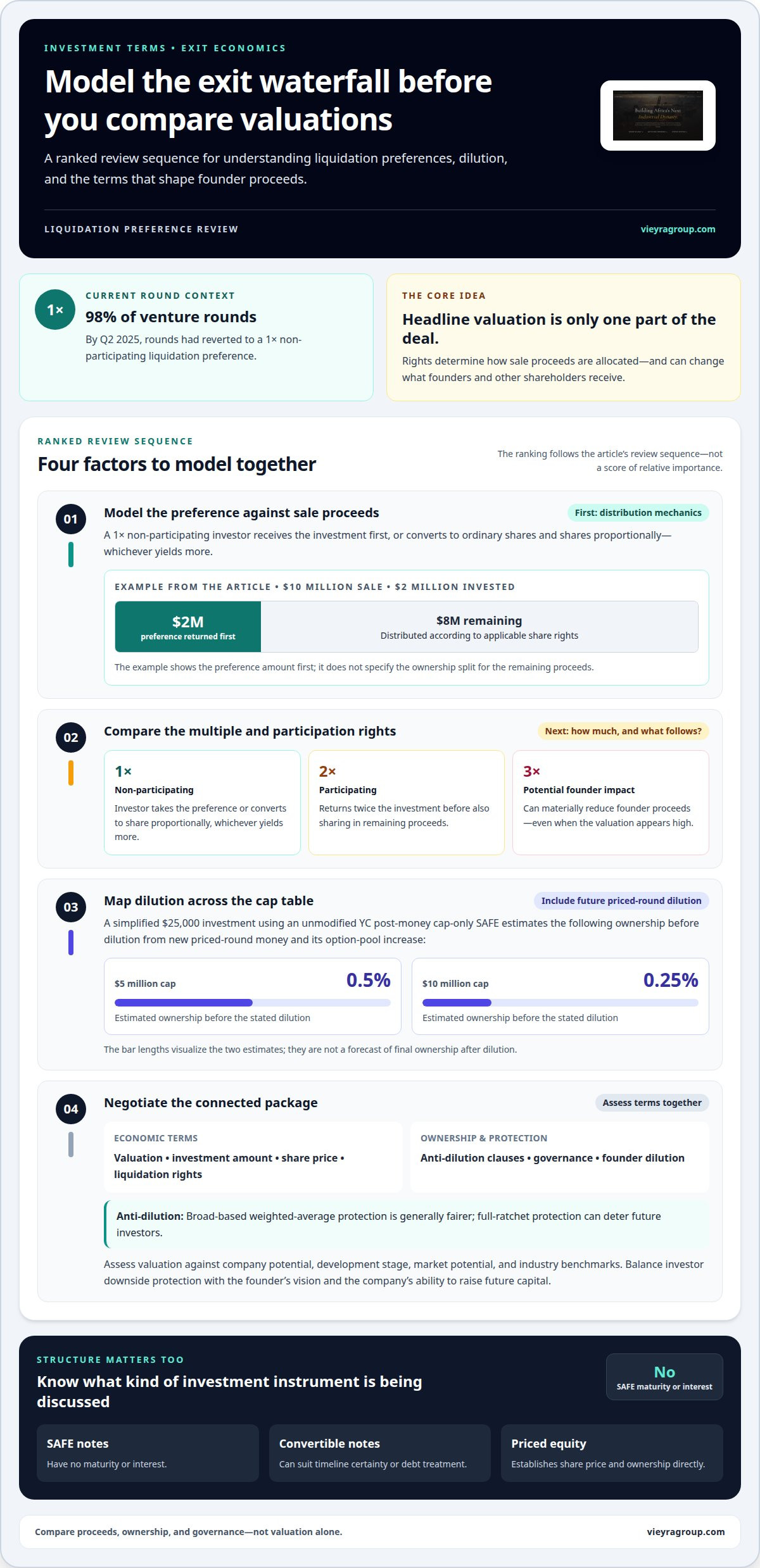
- Model how a liquidation preference changes proceeds before comparing headline valuations. A 1x non-participating preference returns an investor’s investment first, or lets the investor convert to ordinary shares and share proceeds proportionally, whichever yields more. In a $10 million sale after $2 million invested, the preference returns $2 million first; the remaining proceeds are distributed according to the applicable share rights.
- Compare the preference multiple and participation rights in each offer. A 2x participating preference returns twice the investment before the investor also shares in remaining proceeds. A liquidation preference can affect how sale proceeds are allocated between investors and other shareholders. A 3x preference can materially reduce founder proceeds, even when the valuation appears high. By Q2 2025, 98% of venture rounds had reverted to a 1× non participating liquidation preference.
- Map dilution across the cap table, including any option pool increase. A simplified $25,000 investment using an unmodified YC post-money cap-only SAFE with a $5 million cap estimates 0.5% ownership before dilution from new priced-round money and its option-pool increase; with a $10 million cap, the estimate is 0.25%. SAFE notes have no maturity or interest, while convertible notes can suit timeline certainty or debt treatment. Priced equity rounds establish share price and ownership directly.
- Negotiate valuation, investment amount, share price, liquidation rights, anti-dilution clauses, and governance together. Assess valuation against the company’s potential, development stage, market potential, and industry benchmarks; then model the resulting shares and founder dilution. Broad-based weighted-average anti-dilution protection is generally fairer, while full-ratchet protection can deter future investors. A balanced agreement aligns investor downside protection with the founder’s vision and the company’s capacity to raise future capital. For wider context, review long-term investment considerations.
Board control and protective provisions
Define decision rights alongside ownership, so investor protections support oversight without obscuring who can direct the company.
-
Define Board Control and Voting Rights
Specify board composition, appointment rights, voting thresholds, and the decisions requiring investor consent. A board seat gives an investor formal participation in board deliberations, while voting rights determine influence over shareholder decisions. Clarify how these rights interact with the startup’s governance documents and future financing. Consider whether consent applies to fundamental changes or extends to ordinary operations, where broader control could constrain management.
-
Review Protective Provisions
List each protective provision and the action it governs, such as issuing senior securities, changing share rights, or approving a sale. Assess how consent works alongside the liquidation preference and ownership structure. A provision can protect investor interests without granting control over daily management. Review whether participating rights or approval requirements could affect future financing, restructuring, or an exit.
- Keep a negotiation record linking each proposed right to its commercial purpose. Set out the parties’ objectives, available information, and areas where compromise may be possible. The IISD Guide to Negotiating Investment Contracts for Farmland and Water includes a preparation section and a model contract section. Its structure offers a useful reference for organizing diligence and drafting, while startup board rights require terms suited to corporate governance.
- Use contract examples to understand how obligations and decision rights are expressed in long-term projects. ResourceContracts.org is a searchable database of publicly available oil, gas, and mining contracts, developed by CCSI, the World Bank, and the Natural Resource Governance Institute. The International Bar Association’s Model Mining Development Agreement is a draft contract of more than 200 pages for mining projects in developing countries. These models concern distinct transactions, but illustrate the importance of precise provisions.
Negotiating with angel investors and venture capital firms
- Begin by matching the investor’s scale and process to the company’s funding requirements. Angel investors typically invest $25,000 to $100,000 per deal, while venture capital firms usually start at $1 million or more. An angel discussion may involve an individual investor’s priorities; a VC negotiation may include a firm’s investment team and formal governance expectations. A disciplined investment agreement negotiation starts by establishing the capital required and its intended use before discussing ownership.
- Ask each investor to explain the value they bring beyond capital, then reflect those expectations in the proposed relationship. Clarify involvement, information rights, decision-making responsibilities, and the growth time horizon. An investor seeking a board seat may have different governance priorities from one seeking periodic updates. In an investment agreement negotiation, make these distinctions explicit instead of assuming that angels or venture capital firms follow a uniform model.
- Evaluate valuation and ownership together. For example, a $2 million investment at an $8 million pre-money valuation produces a $10 million post-money valuation and gives the investor a 20% stake. Apply the same calculation when comparing proposals, then assess how preferences, future dilution, and option-pool changes affect the founder’s position. A higher valuation alone does not establish which offer best supports the company’s next funding stage.
- Negotiate the clauses that shape the partnership after signing, including liquidation preferences, board rights, protective provisions, and future financing participation. Address founder vesting within the overall structure: a standard schedule spans four years with a one-year cliff. Under that schedule, founders earn 25% of their equity after completing the cliff. Ensure the documents express the agreed terms consistently.
- Use counsel to examine how the term sheet translates into binding documents, including representations, warranties, and indemnification. Compare each investor’s economic terms with governance rights and obligations, then record agreed changes before finalizing. For founders considering capital aligned with long-term industrial development, explore strategic capital perspectives as part of the wider investment discussion.
Vieyra Family Office: Global Investment Management
Vieyra Family Office provides Global Investment Management across asset classes, with a focus on long-term investment and African industrialisation. Its focus may be relevant when an opportunity involves regional productive capacity, durable growth, or broader economic development.
For founders and investors assessing whether capital aligns with a company’s strategic direction, consider how financing terms relate to the project’s long-term objectives. Vieyra Family Office also provides African Industrialization Capital and Strategic Capital Solutions, connecting investment decisions with industrial development and strategic capital needs.
If you are considering a long-term investment or strategic capital opportunity, contact Vieyra Family Office to begin a discussion.
Make the Next Investment Decision Deliberately
Define the investment mandate before a new opportunity shapes it for you. Clarify the strategic purpose of the capital, the company’s decision-making needs, and the partnership required to advance its long-term direction. This framework can make an investment agreement negotiation more disciplined, allowing each proposed term to be assessed against the enterprise’s priorities rather than in isolation.
Vieyra Family Office provides Global Investment Management, African Industrialization Capital, and Strategic Capital Solutions. These offerings are relevant to investors considering global portfolios, African industrial development, or capital aligned with strategic growth. Start with a clear account of the opportunity and the objectives it is intended to serve. Institutional inquiries are Access by Invitation.
To discuss a potential investment aligned with these priorities, contact Vieyra Family Office. A considered next step can help bring long-term ambition and capital strategy into closer alignment.
Frequently Asked Questions
What’s the difference between negotiating with angel investors and venture capital firms?
Angel negotiations often involve direct discussion with an individual investor, while venture capital discussions may involve a firm’s investment process and several decision-makers. This can affect how proposals are evaluated and approved. Establish who has authority to settle terms, how the investor expects to participate after closing, and what information will support the decision.
What Are Investment Agreements?
Investment agreements record the terms under which an investor provides capital to a company. They translate the parties’ understanding into documented rights, responsibilities, and transaction mechanics. For example, an agreement can establish what an investor receives in exchange for funding and how agreed protections apply if the company later raises capital or is sold.
What does the negotiation process look like?
The process generally moves from preparation to preliminary terms, negotiation of detailed provisions, and execution of final documents. Identify the company’s financing needs, review the proposed terms, resolve differences on economic and governance points, and ensure the final documents reflect the agreed position. Due diligence should inform negotiations before the parties finalize legal documents.
What is an investment agreement and what terms does it cover?
An investment agreement formalizes the conditions of an investment and the parties’ relationship after funding. Its terms can address the amount invested, equity issued, price mechanisms, investor rights, company governance, exit conditions, and detailed representations, warranties, and indemnification. Founders should read these provisions together: a change to one term can affect ownership, decision-making, or the distribution of future proceeds.
What are common liquidation preference terms and how do they affect payouts?
A liquidation preference sets the order or amount an investor receives from certain company-sale proceeds before other shareholders receive distributions. A 1x non-participating preference allows an investor to choose between receiving the initial investment first or converting to ordinary shares. A participating preference can add a share of remaining proceeds after the preference payment, affecting how much is left for founders and other shareholders.
How are board seats, voting rights, and investor consent rights negotiated?
Negotiate these rights by defining who appoints directors, which matters require shareholder votes, and which actions need investor consent. Distinguish significant decisions, such as issuing securities with superior rights, from routine operating choices. For example, consent over a major restructuring may protect an investor’s interests, while consent over ordinary hiring could restrict management. Draft each right clearly across the governing documents.


