
Capital is only one part of what family office venture capital in Africa can mean for an early-stage technology company. Alongside financing, its value may include a long-term investment perspective, attention to regional markets, and connections to private capital events. For founders, these forms of support can matter as much as the funding itself.
It is reasonable to look beyond the size of an investment: a company also needs capital aligned with its stage, sector, and plans for growth. Across Africa’s varied markets, useful support depends on understanding where a business operates and which relationships can help it advance.
This article explains how family offices can support early-stage African technology companies, what Africa coverage means in practice, and how private capital events can create connections between founders and investors. It also considers the role of strategic capital and the factors that shape whether this form of investment fits a company’s needs.
Key Takeaways
- Assess whether your company’s stage, technology model, and growth plans align with the investment approach of a family office.
- Consider how regional knowledge and long-term capital relationships can support expansion across Africa’s varied markets.
- Distinguish direct investment from investment through venture or growth funds when identifying relevant family-office capital.
- Prepare a focused case for funding that explains your business model, capital needs, and intended use of investment.
Early-stage technology and tech-enabled companies
Family offices may invest directly in early-stage technology companies or through venture funds, using equity to participate in potential growth. Their assessment can consider more than an app or platform: it may include the business model, customer need, execution capacity, and potential for development across African markets. For founders, the relevant question is how the technology creates durable commercial value.
Technology also supports businesses in established sectors. A logistics company might use software to coordinate deliveries, while an agricultural enterprise might use data to connect buyers and producers. Investors can assess how technology strengthens the underlying business, rather than treating a digital component alone as evidence of scale or impact.
Enza provides a concrete funding example. Its seed+ round was US$6 million, and the African Venture Capital Association listed a member news item about the round on 5 November 2026. The example illustrates that early-stage investment can involve a defined equity round; it does not establish a standard amount or structure for other companies.
Make the investment case concrete by connecting operational evidence to the capital sought:
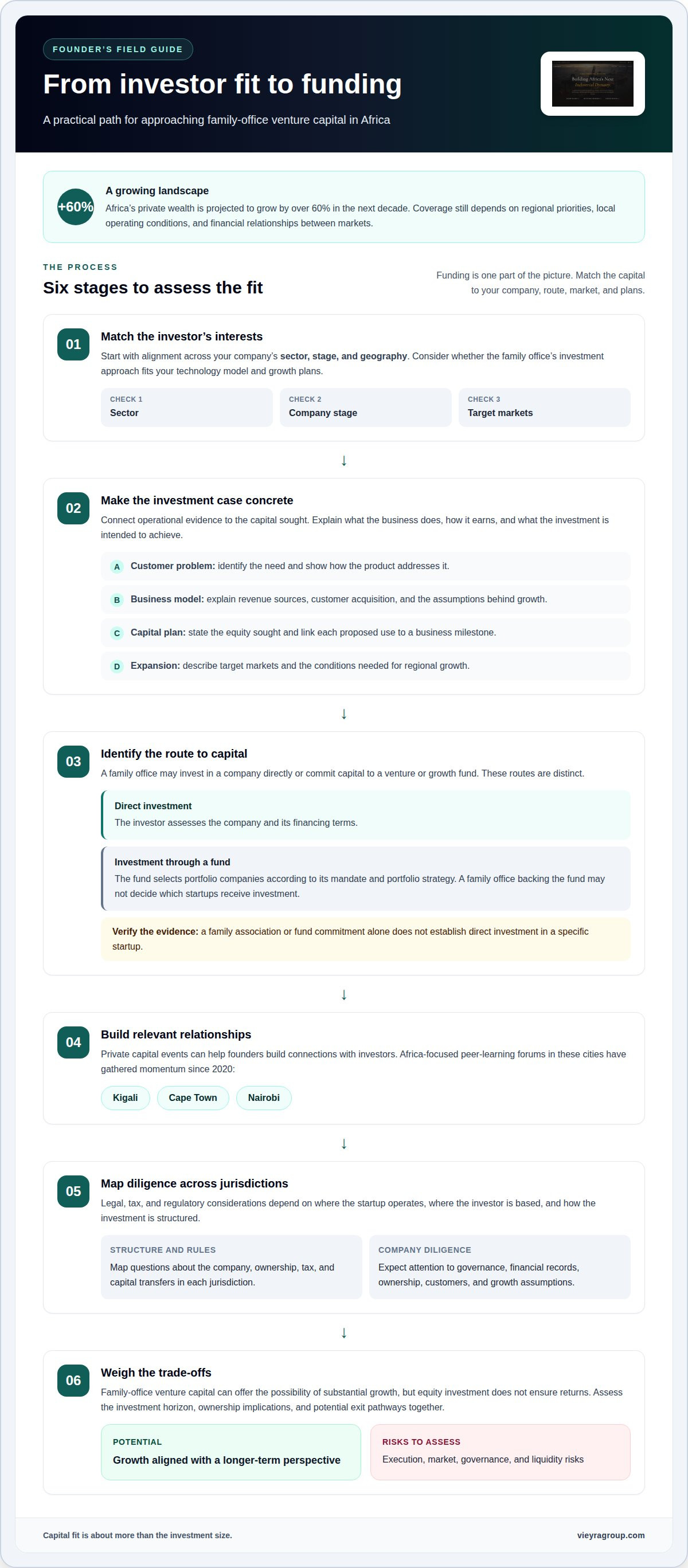
- Identify the specific customer problem and show how the product addresses it.
- Explain revenue sources, customer acquisition, and the assumptions behind growth.
- Set out the planned use of equity, linking each proposed expense to a business milestone.
- Describe the company’s target markets and the conditions needed for regional expansion.
This preparation helps distinguish a technology-led venture from a conventional business with limited digital support. It also gives family offices a basis for considering risk, governance, and the investment’s intended impact. In a developing ecosystem, a disciplined account of product performance and capital deployment can help investors understand both the opportunity and the work required to realise it.
Africa family-office coverage
Africa’s family-office landscape is expanding, with private wealth projected to grow by over 60% in the next decade. Coverage means understanding regional investment priorities, local operating conditions, and the financial relationships that connect markets.
Legal, Tax, and Regulatory Rules
Legal, tax, and regulatory considerations depend on where a startup operates, where an investor is based, and how the investment is structured. Before agreeing to equity terms, map the relevant questions about the company, ownership, tax, and capital transfers in each jurisdiction. Due diligence also examines governance, financial records, ownership, customers, and the assumptions behind growth projections.
Family Offices Investing from Outside Africa
Blue Haven Initiative is based in Cambridge, Massachusetts; Small Foundation is associated with the Sherwin family and based in Dublin, Ireland. The Lemelson Foundation is associated with the Jeremy Lemelson inventor family and based in Massachusetts. These names provide context for international family-office activity, but location and association alone do not establish direct startup investment. Distinguish direct equity from commitments to venture or growth funds.
Approaching Family Offices for Venture Capital
Approach begins with matching the company’s sector, stage, and geography to an investor’s stated interests. Prepare a concise investment case covering the customer problem, business model, financial position, equity sought, and planned use of capital. Then explain why the relevant market offers a credible path to growth. Private capital events can help founders build relationships; Africa-focused peer-learning forums in Kigali, Cape Town, and Nairobi have gathered momentum since 2020.
Investment Risks and Returns
Family-office venture capital carries the possibility of substantial growth, alongside execution, market, governance, and liquidity risks. Outcomes depend on the company’s ability to deliver its plan, attract customers, and manage capital; equity investment does not ensure returns. Assess the investment horizon, ownership implications, and potential exit pathways together. A disciplined regional perspective can help clarify these trade-offs; explore a long-term capital perspective as part of that assessment.
Which family offices outside Africa invest in African startups?
Blue Haven Initiative, Small Foundation, and the Lemelson Foundation are examples cited in discussions of African investment. Their inclusion does not establish direct investment in individual startups. A family office may invest in a company directly or commit capital to a venture or growth fund, and those are distinct routes.
Available descriptions characterize six family offices as equity-style limited partners investing through venture and growth funds. In that structure, the fund selects portfolio companies, while the family office participates as an investor in the fund. Founders seeking capital should therefore distinguish a direct investor from a fund whose limited partners include family offices.
The distinction affects how a startup identifies relevant capital. A direct investor assesses the company and its financing terms; a fund evaluates opportunities against its mandate and portfolio strategy. A family office backing a fund may not decide which individual startups receive investment, so its connection does not necessarily offer a direct route to financing.
When assessing international investment prospects, distinguish the possible routes:
- Identify whether the family office invests directly or through a fund.
- Establish whether the fund’s stated focus includes the company’s sector and markets.
- Distinguish a family association from evidence of a specific startup investment.
- Consider whether the route offers equity at company level or fund-level exposure.
Blue Haven Initiative, Small Foundation, and the Lemelson Foundation are reference points, but their relevance depends on the investment pathway. The available details do not establish a complete roster of overseas family offices backing African startups or name specific portfolio companies for these organizations. The structural takeaway is that international family capital can reach African ventures through funds, while direct investment requires a company-level decision. Founders can use this distinction to shape outreach, understand an investor’s role, and assess whether a relationship fits their financing objectives.
How can an African startup approach family offices for venture capital?
Start with a focused investment case, not a general request for funding. Identify family offices or funds whose stated interests match the company’s sector, stage, and markets. Then establish whether the prospective investor invests directly in companies or through a venture fund. That route determines who evaluates the business and how to present its equity proposal.
Prepare materials that clearly explain the company and its financing proposal. A concise presentation should connect the customer problem, product, revenue model, financial performance, and intended use of capital. Support projections with their underlying assumptions, and explain which business milestones the investment would fund.
- Define the investment purpose, including the amount sought and the milestones it would support.
- Present the business model, customer evidence, operating risks, and relevant market opportunity.
- Explain ownership, governance, and how the proposed equity fits the company’s capital plan.
- Tailor each approach to the investor’s mandate rather than sending an identical proposal to every contact.
Private capital events can offer a structured setting for introductions and investor conversations. The African Venture Capital Association listed its Q3 2026 Venture Capital in Africa Report for 28 October 2026. Its Francophone Africa 2026 regional event was scheduled for 19-20 November 2026. Founders can use such occasions to prepare focused questions, communicate their investment thesis, and follow up with relevant contacts.
Clarity remains important after an introduction. Keep track of each investor’s preferred route, decision process, and requested materials, and provide consistent information throughout discussions. If a family office invests as a limited partner in a fund, engage with the fund’s investment team rather than treating the family office as the startup’s direct investor. This keeps outreach aligned with the actual financing pathway.
For a considered discussion of capital aligned with long-term African development, discuss a strategic capital approach.
Vieyra Family Office: African Industrialization Capital
Vieyra Family Office is a natural next consideration for founders seeking capital aligned with Africa’s long-term economic development. Its African Industrialization Capital offering supports long-term growth projects and economic development, making it relevant to businesses whose plans contribute to industrialisation. The fit depends on the company’s objectives and the role capital would play in advancing them.
Vieyra Family Office also provides Institutional Partnerships, Structured Finance Solutions, Sovereign Infrastructure Financing, and strategic capital deployment. The Vieyra Foundation pursues philanthropic initiatives in areas including education, maternal health, AI literacy, and food security. These areas offer context for institutional discussions about a project’s capital needs and development objectives.
To discuss your company’s investment needs, contact Vieyra Family Office.
Build the Next Stage of Your Capital Strategy
Treat financing as part of a project’s long-term architecture. Clarify how capital would strengthen operations, support responsible expansion, and contribute to durable economic development. A coherent capital strategy connects current priorities with the capacity the project aims to build.
For that broader perspective, Vieyra Family Office’s African Industrialization Capital, Global Investment Management, and Strategic Capital Solutions speak to investment and development at different scales. These offerings provide relevant context for founders considering how family-office venture capital across Africa may align with a company’s ambitions and contribution to the continent.
A thoughtful discussion can begin with the business’s objectives, its financing priorities, and the role capital may play in its next phase. Open a conversation with Vieyra Family Office about the company’s strategic direction. Deliberate capital planning can help founders pursue growth with greater clarity and purpose.
Frequently Asked Questions
Aside from capital, how else do you support startups in Sub-Saharan Africa?
Beyond capital, Vieyra Family Office’s work includes research and philanthropy. Vieyra Global Institute publishes research on African macroeconomics, industrial policy, strategic resource management, AI-driven data infrastructure, energy transition, and mineral refining economics. Vieyra Foundation focuses on education, maternal health, AI literacy, infrastructure access, scholarships, industrial education, and food security. These initiatives reflect wider development priorities, rather than company-specific startup advisory.
Do you only invest in startups based in Sub-Saharan Africa?
Vieyra Family Office manages global investments while maintaining a strategic focus on African industrialisation. Its investment scope is global, with Africa central to its development mandate. This distinction clarifies that global investment activity describes its broader remit, not an automatic commitment to every company or geography. Its focus is strategic capital and long-term economic development.
What check size do you write?
Vieyra Family Office deploys strategic capital into large-scale industrialisation projects and sovereign-level initiatives. A capital request should therefore explain the intended use, project scope, and alignment with development objectives, rather than assume a standard startup investment amount. Institutional inquiries are Access by Invitation.
What industries do you invest in?
Vieyra Family Office identifies nine investment verticals: Infrastructure; Mining & Resources; Energy; Technology; Telecommunications; Real Estate; AI & Quantitative Finance; Agriculture; and Logistics. A founder can identify the relevant vertical and explain how the company’s operations relate to it. Clear links to industrial development, productive capacity, or market access establish useful context.
What stage of investment do you typically invest in?
The investment approach centres on strategic capital deployment and long-term growth projects, rather than venture-round labels such as seed or Series A. Consider a company’s maturity alongside its operating capacity, intended use of capital, and fit with an investment vertical. This helps distinguish a project’s strategic requirements from its fundraising terminology.
What is a family office and how does it invest in African venture capital?
A family office manages and invests private family wealth according to its objectives and portfolio strategy. Family office venture capital in Africa may reach startups through direct equity investment or indirectly through a venture fund that selects companies. The routes differ: a direct investor assesses the company, while a fund’s investment team makes portfolio decisions.


