

An import price can remain fixed in euros while its dollar cost changes. Foreign exchange risk mitigation strategies help businesses manage that exposure by addressing the effect of currency movements between agreeing a purchase and paying for it. The supplier’s quoted amount may be clear, yet the final cost in the importer’s home currency can still shift before settlement.
That uncertainty matters because exchange-rate changes can alter budgets, margins and the amount of cash needed to complete a transaction. A U.S. company that owes a German supplier €1 million in 90 days, for example, will face a higher dollar cost if the euro strengthens before payment. This article explains what foreign exchange risk is, how currency movements can change import costs, and how a forward contract can fix an exchange rate for a future payment. It also outlines the considerations that help businesses decide how to manage their exposure.
Key Takeaways
- Map foreign-currency receipts, payments, assets and liabilities to understand where exchange-rate movements can affect financial results.
- Assess import costs in the currency you use to pay, since a supplier’s quoted amount can translate into a different home-currency cost before settlement.
- A forward contract can set an exchange rate for a future payment, helping make the currency cost more predictable while committing both parties to the exchange.
- Distinguish transaction, translation and economic exposure so your risk assessment reflects both immediate payments and broader effects on business value.
1. What is Foreign Exchange Risk?
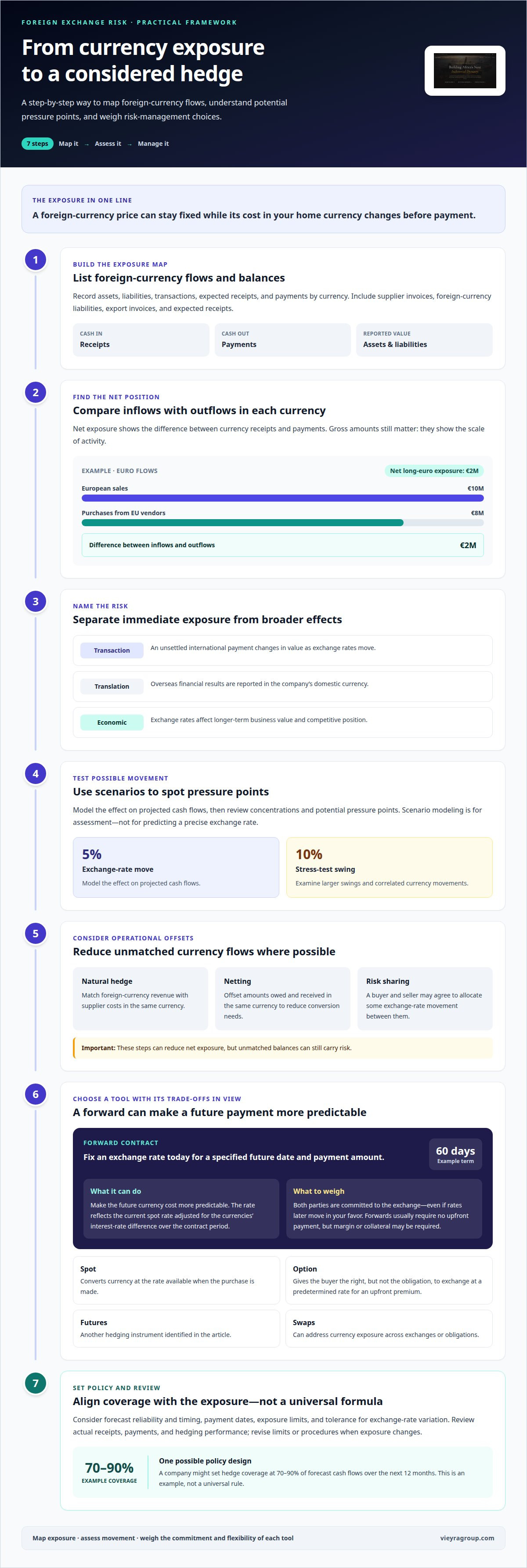
Foreign exchange risk arises when exchange-rate changes affect the value of payments, receipts, or assets denominated in another currency. Fluctuations can increase the cost of a planned transaction or reduce expected revenue. The three main types are transaction, translation, and economic risk. Transaction risk affects an unsettled international payment. Translation risk arises when a company reports overseas financial results in its domestic currency. Economic risk concerns the longer-term effects of exchange rates on a company’s market value and competitive position.
Map exposure by recording foreign-currency assets, liabilities, and transactions, including cash receipts and payments. Then assess how exchange-rate movements could change their value. For example, a company with €10M in European sales and €8M in purchases from EU vendors has a net long-euro exposure of €2M. The net figure reflects the difference between inflows and outflows, while the gross amounts show the scale of activity. Importers should include supplier payments and foreign-currency liabilities; exporters should include invoices and expected receipts. Balance-sheet items also matter because their reported domestic-currency value may shift.
Operational choices can reduce economic exposure over time. Businesses can review sourcing, pricing, production locations, and the currencies used in customer and supplier contracts. Small businesses without a dedicated treasury team can maintain a consolidated record of currency cash flows, set exposure limits, and regularly review upcoming payments and receipts. A written policy can specify who approves hedging contracts and how exchange-rate movements are monitored. Employees who negotiate contracts or schedule payments should be trained to follow these procedures consistently. These foreign exchange risk mitigation strategies connect everyday decisions to the company’s stated risk tolerance.
Automated exposure-tracking dashboards and multi-currency cash-flow analysis can help organize transactions across currencies. Scenario modeling can show how a 5% exchange-rate move affects projected cash flows; stress tests can examine 10% swings and correlated currency movements. The purpose is to identify concentrations and potential pressure points, not to predict a precise rate. Review the results alongside actual receipts, payments, and hedging performance, then revise limits or procedures when exposure changes. Regular monitoring makes unexpected movements easier to assess against established policy.
2. Example of currency movements changing an import cost
Consider a U.S. The goods and euro price have not changed, but the importer’s cash flow must absorb an additional $5,000. This is transaction exposure: the exchange rate changes between agreeing to pay and settling the invoice.
An importer can begin by mapping expected foreign-currency receipts against payments. Matching euro revenue with euro supplier costs creates a natural hedge because the flows partly offset each other. Netting can also reduce conversion needs when business units owe and receive the same currency. These steps reduce net currency exposure but do not eliminate the risk from any unmatched balance. A risk-sharing agreement may allocate some exchange-rate movement between buyer and seller if both parties agree to the arrangement.
The invoice currency determines which party bears the direct conversion risk. If a Spanish supplier quotes in euros, the U.S. buyer’s dollar cost varies with exchange rates. When a seller quotes in its own national currency, the buyer takes on that immediate exposure. For a U.S. importer, paying in dollars may simplify budgeting, while the supplier may account for its currency risk in the commercial terms. A devaluation of the buyer’s local currency can also make payment obligations harder to meet.
Hedging strategies can complement operational matching. A spot transaction converts currency at the rate available when the purchase is made; forward contracts can set a rate for a later payment. The appropriate approach depends on payment timing, expected receipts, and tolerance for variable costs. Economic risk may also persist beyond one invoice if currency movements affect supplier choices or the competitiveness of goods. For decisions that connect import commitments with longer-term investment priorities, consider strategic capital solutions as part of broader capital planning.
3. Forward contracts
A forward contract fixes an exchange rate for a specified future date and obliges both parties to complete the exchange. An importer expecting to pay a foreign supplier can use one to make the future currency cost more predictable. For example, a 60-day forward can establish today’s rate for a payment due in 60 days. The rate reflects the current spot rate adjusted for the currencies’ interest-rate difference over the contract period. Forward contracts can be tailored to the payment amount and date.
This certainty comes with a trade-off: even if exchange rates later move in the importer’s favor, the agreed rate still applies. Forwards usually require no upfront payment, but margin or collateral may be required. A currency option gives its buyer the right, but not the obligation, to exchange at a predetermined rate in return for an upfront premium. Futures are another hedging instrument, while swaps can address currency exposure across exchanges or obligations. Each instrument involves a different balance of flexibility, obligation, and cash-flow needs.
There is no single hedge ratio or duration for every company. The relevant factors include the reliability and timing of forecast cash flows, payment dates, exposure limits, and tolerance for exchange-rate variation. As an example of policy design, a company might set hedge coverage at 70–90% of forecast cash flows over the next 12 months. That is an example, not a universal rule; actual coverage should align with the exposure being managed.
Under U.S. GAAP, ASC 815 includes documentation and effectiveness-testing requirements for hedge accounting. Accounting treatment therefore involves more than executing contracts: the company must address the applicable documentation and testing requirements. These requirements can affect the administrative demands of a hedge.
Hedging reduces uncertainty but does not eliminate every form of currency risk. A forward creates an obligation even if the underlying payment changes, while an option’s premium buys flexibility. Forecast errors can also leave a hedge misaligned with actual transactions. Before choosing a hedge for an international transaction, compare the expected payment, instrument terms, potential collateral needs, and accounting processes.
4. Definition and effects of foreign exchange risk
Foreign exchange risk is the possibility that exchange-rate fluctuations will affect a company’s cash flows, reported results, or market value. Its effects extend beyond the amount exchanged in a single transaction. For a global business, currency movements can change costs, revenue, margins, and the relative competitiveness of products across markets. The key distinction is between exposure and financial effect: exposure is the amount at risk, while the effect depends on the rate movement and the company’s currency position.
Consider a company whose euro-denominated revenue is translated into dollars for reporting. A change in the EUR/USD exchange rate can change the reported dollar value, even if sales volume and euro prices remain constant. A separate example shows how operating performance can also shift: a 5% EUR/USD swing before hedging cut a SaaS company’s quarterly revenue by $400K and reduced its operating margin by two points. These outcomes illustrate how currency risk can reach beyond payment timing into financial performance.
Margins may respond differently from revenue because companies also have costs in foreign currency. In one example, a 10% decline in the euro reduced a company’s margins from 15% to 12%. The result depends on how revenue and costs respond, which currencies are involved, and when cash flows occur. An exporter receiving foreign currency may see the domestic value of a payment fall; an importer may face higher domestic-currency costs when its payment currency strengthens.
Assess the consequences by separating transaction timing from broader economic effects. Trace how exchange-rate movements could affect receipts, payments, pricing decisions, and competitive position. Then consider how those changes may influence planned investment or the company’s market value. Geopolitical instability and government regulations can contribute to exchange-rate movements, so currency exposure is part of wider global business analysis.
The practical takeaway is to connect each currency position to the financial outcome it could affect, rather than treating exchange rates as an abstract market measure. For a broader view of currency exposure across investment decisions, consider your global investment exposure.
Vieyra Family Office
Vieyra Family Office brings a long-term investment perspective to decisions involving currency exposure alongside international assets, operating commitments, and growth priorities. Its Global Investment Management and Strategic Capital Solutions offerings are relevant when exchange-rate risk is part of a broader capital allocation or investment decision, rather than an isolated supplier payment.
For businesses assessing cross-border opportunities, consider currency movements alongside expected cash flows, investment horizons, and strategic objectives. This broader view can put an individual exposure in the context of the financial commitments and long-term plans it may affect.
To discuss how these considerations relate to your investment priorities, contact Vieyra Family Office.
Build currency resilience into long-term decisions
Import exposure is best treated as part of a company’s wider financial architecture, not as an isolated exchange-rate concern. Connect currency decisions with purchasing plans, investment priorities, and the resilience needed to sustain cross-border growth. This discipline can help decision-makers align current commitments with longer-term objectives as markets and operating conditions evolve.
Effective foreign exchange risk mitigation strategies also require a clear view of how capital choices interact with international activity. Vieyra Family Office’s Global Investment Management, African Industrialization Capital, and Strategic Capital Solutions relate to investment management, industrial development, and long-term growth priorities. These perspectives can inform broader deliberations when currency exposure intersects with strategic commitments.
For a measured discussion of how these considerations relate to your priorities, contact Vieyra Family Office. A deliberate approach today can strengthen the foundations for confident decisions ahead.
Frequently Asked Questions
What is Foreign Exchange Risk?
Foreign exchange risk is the possibility that currency movements change the domestic-currency value of an obligation, receipt, or overseas financial result. Its practical significance depends on the company’s position: an importer awaiting a foreign-currency invoice faces a different exposure from an exporter awaiting payment. Identifying the source of the exposure helps determine which transactions, reporting items, or longer-term business conditions need attention.
Is FX risk the same as currency risk?
Yes. “FX risk” and “currency risk” commonly describe the risk that exchange-rate changes affect financial value. The terms can refer to different situations, such as an unsettled invoice, overseas results reported in a domestic currency, or longer-term effects on competitiveness. Naming the specific exposure makes internal discussions more precise and helps teams connect the risk to the relevant business decision.
What role does purchasing foreign currency in advance play in managing FX risks?
Buying the required currency before a supplier payment can lock in the conversion rate available at the time of purchase. This may make the payment amount more predictable, but it also means holding the currency before settlement and committing cash earlier. The decision depends on payment timing, available liquidity, and whether the business needs that currency for a known obligation.
What tools help manage FX exposure?
Businesses may use forwards, options, futures, swaps, spot transactions, and multi-currency accounting platforms to manage or monitor exposure. These instruments differ in their obligations and flexibility: an option provides a right rather than an obligation, while a forward commits both parties to exchange. Accounting platforms can help consolidate currency cash flows and provide a clearer view of open positions and how they change.
What is foreign exchange risk and how does it affect businesses?
Foreign exchange risk is the potential financial effect of changing currency values on business activity. It can affect the domestic-currency value of customer receipts, supplier obligations, and overseas results, potentially changing budgets or planned cash availability. For example, a company forecasting revenue in one currency and paying operating expenses in another may face a mismatch if those currencies move differently before cash flows are received or settled.
How can businesses measure and quantify foreign exchange exposure?
Start by organizing expected receipts, payments, assets, and liabilities by currency and settlement period. Compare inflows with outflows to identify net positions, while retaining gross figures to show the scale of each currency relationship. Then model how exchange-rate changes could affect projected cash flows and financial results. Review the analysis as invoices, forecasts, or payment dates change to keep the exposure assessment aligned with operations.


