

Impact advocacy is strongest when measurement is built into investment decisions, not added after capital is deployed. Effective family office impact reporting starts with clear goals in the mandate, then uses consistent indicators and evidence to assess progress. This gives families a basis for discussing outcomes and trade-offs.
Families may share an interest in creating lasting value while differing on which outcomes matter most and how impact should be weighed alongside financial performance. A clear framework can bring these perspectives into a disciplined investment approach, with defined oversight responsibilities and regular review.
This article explains how to define an impact framework, use resources such as IRIS+ and GIIN guidance, and assess managers’ impact claims. It also covers how to raise the subject within a family office, question investment advisers constructively, and establish reporting that supports learning and accountability over time.
Key Takeaways
- Set impact priorities and responsibilities within the investment mandate, then review progress consistently to keep strategy aligned with family goals.
- Assess impact claims by examining the evidence, intended outcomes, and how managers track results over time.
- Use frameworks such as IRIS+ and GIIN resources to select relevant metrics and make reporting more consistent.
- Distinguish the roles of measurement frameworks and reporting standards, including GRI and the Impact Management Project, before choosing an approach.
1. Impact measurement and management best practice
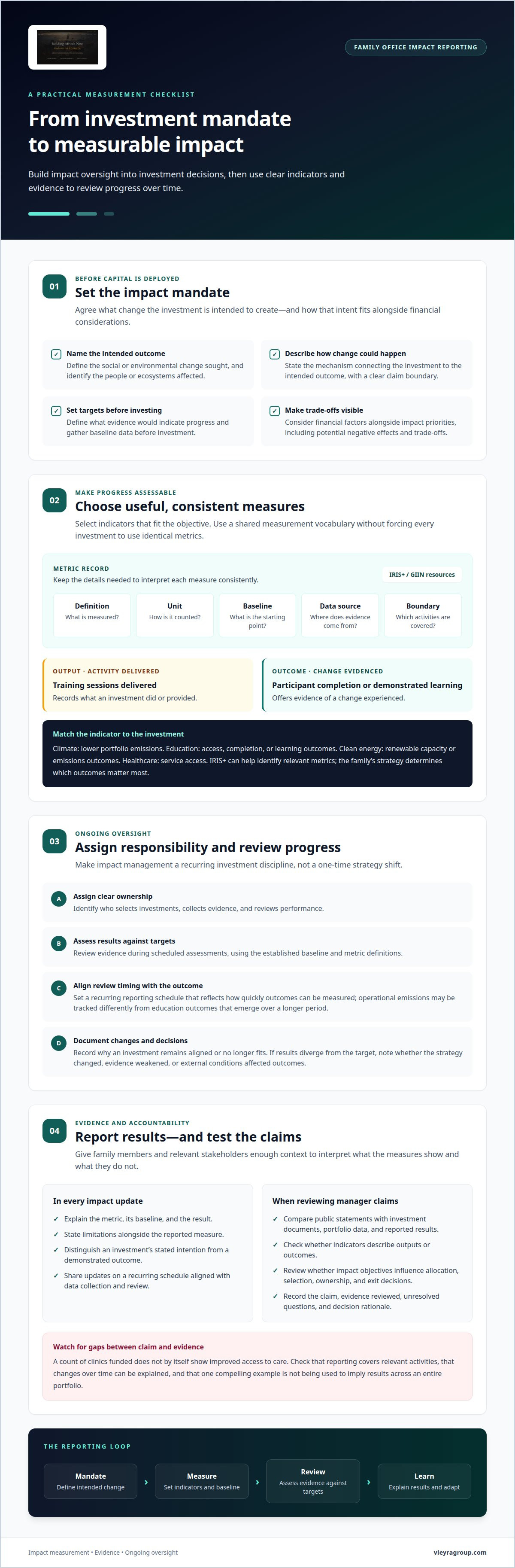
Strong impact management begins before capital is deployed, when the family defines intended outcomes in each investment mandate. The mandate should identify the social or environmental change sought, the people or ecosystems affected, and the evidence that would indicate progress. A climate strategy, for example, might target lower emissions from portfolio operations. An education investment might track access, completion, or learning outcomes.
A framework turns these priorities into comparable measures. GIIN’s IRIS+ system can help investors select metrics aligned with their impact objectives, while the family’s strategy determines which outcomes matter most. Record each metric’s definition, unit, baseline, data source, and reporting boundary. This helps prevent a positive result at one portfolio company from obscuring weaker progress elsewhere and supports consistent assessment over time.
To establish a process, first agree on intended outcomes and financial considerations. Then assign responsibility for selecting investments, collecting evidence, and reviewing performance. Set measurable targets before investing, gather baseline data, and assess results against those targets during scheduled reviews. Document strategy changes, including why an investment remains aligned or no longer fits. This makes impact oversight an ongoing discipline rather than a one-time strategy shift.
Family offices should report impact on a recurring schedule aligned with investment data collection and review, sharing updates with family members and relevant stakeholders at each assessment. The timetable should reflect how quickly outcomes can be measured: operational emissions may be tracked differently from education outcomes that emerge over a longer period. Regular communication keeps decisions connected to the office’s established responsibilities and evolving legacy.
Useful impact KPIs measure outcomes, not just activity. A count of training sessions records delivery; participant completion or demonstrated learning offers evidence of change. For environmental strategies, distinguish resources committed from outcomes such as reduced emissions. In family office impact reporting, explain each metric, its baseline and result, and any limitations together. This helps readers interpret performance without mistaking an investment’s stated intention for a demonstrated outcome.
2. Impact due diligence and credibility of impact claims
Impact due diligence tests whether an investment’s stated purpose is reflected in its structure, governance, and operating decisions. Start by examining the target outcome, the people or environments affected, and the mechanism connecting capital to change. For a healthcare investment, distinguish expanded service access from a broad commitment to community wellbeing. Each claim should have a defined boundary and supporting evidence.
Review the manager’s investment process alongside its impact policy. Ask how impact objectives influence allocation, company selection, ownership practices, and exit decisions. A strategy that labels investments as sustainable while making decisions solely on financial grounds may not demonstrate impact-investing intent. Examine whether the manager identifies potential negative effects as well as positive outcomes, including trade-offs between returns and intended impact.
Impact-washing risks arise when claims go beyond the evidence. Compare public statements with investment documents, portfolio data, and reported results. Check whether metrics describe outputs, such as clinics funded, or outcomes, such as improved access to care. Confirm that reporting covers the relevant activities and that changes over time can be explained. One compelling example cannot establish performance across a portfolio.
The FCA’s 2026 direction makes manager claims, fund naming, and disclosure language a governance review point. Treat these materials as connected evidence, not separate assurances. A mismatch between a fund’s stated target and its holdings deserves examination; so does a claim that lacks a clear measurement method. For global portfolios, assess whether definitions and data collection remain consistent across markets and operating contexts.
Record findings in an institutional due-diligence file: the claim assessed, evidence reviewed, unresolved questions, and rationale for the investment decision. Assign responsibility for revisiting material claims during ongoing oversight. If results diverge from the original target, document whether the strategy changed, the evidence weakened, or external conditions affected outcomes. This record helps family members interpret impact reporting alongside financial returns.
3. Impact metrics and reporting frameworks, including IRIS+ and GIIN
A useful metric translates family values into an observable portfolio outcome. Start with the intended change, then select indicators suited to the investment’s sector and beneficiaries. For a clean-energy investment, track renewable capacity or emissions outcomes; for education, examine learning or access. Each measure should have a definition, unit, data source, and reporting boundary.
GIIN’s IRIS+ offers impact measurement resources to help investors identify metrics relevant to their objectives. Use it to develop a consistent vocabulary across investments, not to impose identical indicators on every enterprise. A healthcare company and an agricultural business may pursue different outcomes, even when both contribute to a shared family priority.
Choose indicators that distinguish activity from change. Capital deployed, facilities built, and people served describe outputs; improved access, resilience, or educational achievement describe outcomes. Where possible, establish the starting position before investing and define how progress will be assessed. A measurable target should specify the intended result and period covered, without implying that investment alone caused every change.
For portfolio-level analysis, retain investment-level detail before aggregating results. Record differences in geography, beneficiary groups, and data collection methods, since a single total can conceal uneven outcomes. If one generation prioritizes climate while another emphasizes education, a shared reporting structure can present both priorities without treating unlike measures as interchangeable.
Family office impact reporting should make the path from metric to conclusion clear. Present the indicator, result, comparison point, and relevant limitations together, then explain changes in method or coverage. GIIN resources can support consistency while the family’s framework preserves its distinct objectives. Review whether each metric remains useful as the portfolio, strategy, or family values evolve, and retire measures that no longer inform investment choices.
4. What are the leading impact reporting standards, such as IRIS+, GRI, and the Impact Management Project?
IRIS+, the Global Reporting Initiative (GRI), and the Impact Management Project address different parts of impact practice. IRIS+ supports impact metric selection. GRI provides a structure for reporting an organisation’s impacts. The Impact Management Project (IMP) offers a framework for understanding how an investment contributes to outcomes. Treating them as interchangeable can leave gaps in measurement or disclosure.
For portfolio measurement, IRIS+ can help align indicators with an investment’s stated objectives. A family assessing a healthcare enterprise might use measures relevant to service access, while an environmental investment needs indicators suited to its intended outcomes. The selected metric still requires a clear definition, consistent data, and an appropriate reporting boundary. Framework alignment alone does not prove that an investment achieved impact.
GRI is useful when reporting concerns an organisation’s broader effects on people, the environment, and the economy. A company, for example, may report both its workforce practices and environmental impacts. These disclosures can add context to investment-level metrics, but they do not replace evidence of whether capital contributed to a particular outcome.
The IMP approach structures impact analysis around questions such as what changes, for whom, and how an organisation contributes. Apply those questions when reviewing an investment thesis, then connect the answers to suitable indicators. A family office can use this analysis to distinguish an intended outcome from an observed result and explain its reasoning to family members.
In practice, combine the approaches according to the reporting purpose: use IRIS+ to select investment metrics, GRI for relevant organisational disclosures, and IMP to examine impact logic. Keep definitions consistent where possible while distinguishing metrics from broader reporting. This layered approach gives family office impact reporting a clearer basis for comparing evidence without forcing unlike investments into one measure.
Vieyra Family Office
Vieyra Family Office brings a long-term investment perspective to families considering how capital can reflect their priorities and contribute to economic development. Its Global Investment Management and Strategic Capital Solutions offerings are relevant when impact objectives need to be considered alongside investment decisions and financial considerations. For families focused on African industrialisation, African Industrialization Capital connects that broader question with long-term growth projects.
The reporting principles discussed above can clarify a family’s values, the outcomes it intends to support, and how it will assess progress. They also provide a basis for thoughtful discussions about investment strategy and legacy across generations. Vieyra Family Office manages global investments with a focus on African industrialisation, while the Vieyra Foundation pursues philanthropic initiatives in areas including education, maternal health, AI literacy, infrastructure access, scholarships, industrial education, and food security.
For institutional matters related to investment priorities and long-term impact, contact Vieyra Family Office through Access by Invitation.
Make impact part of the family’s long-term decision-making
The next step is to give impact evidence a continuing role in how the family sets priorities, allocates attention, and considers its legacy. Family office impact reporting can become a governance practice, not simply a record of past activity, when findings inform future investment choices and family discussions. This requires an agreed process for considering results, addressing differences in perspective, and carrying lessons forward between generations.
Begin by identifying who should take part in those discussions and how reporting will inform decisions. A family can use its established governance structures to consider whether priorities remain aligned and whether evidence calls for a change in direction. This creates a durable connection between values and capital, while leaving room for strategies to evolve as circumstances and family perspectives change.
Where the next step involves aligning investment priorities with long-term development, contact Vieyra Family Office to begin a conversation. Thoughtful stewardship starts with a clear purpose and grows through deliberate decisions over time.
Frequently Asked Questions
What is impact reporting for family offices?
Impact reporting explains how investment activity relates to intended social or environmental change. For a family office, it can also support governance by giving family members a shared basis for discussion across investments and generations. A useful report distinguishes the family’s objectives from investee performance and describes the sources of evidence. This helps readers understand what the portfolio aims to achieve and what the available information demonstrates.
What metrics and frameworks do family offices use for impact reporting?
Family offices can use IRIS+ to identify relevant metrics, GRI for organisational disclosures, and the Impact Management Project’s approach to examine impact logic. Selection depends on the investment’s purpose and sector. A workforce-focused enterprise, for example, might report employee retention alongside training participation. A framework provides structure, but the measures should still reflect family priorities and the specific investment being assessed.
How do family offices measure social and environmental impact alongside financial returns?
Financial performance and impact can be assessed against separate, clearly defined objectives, then considered together during investment review. For example, an energy investment’s financial results may be reported alongside operational emissions data. The comparison should not imply that one measure substitutes for the other. Clear reporting explains the period and scope of each result, notes material differences, and helps decision-makers consider trade-offs without obscuring either outcome.
What data and software tools do family offices use for impact measurement and reporting?
Useful inputs include investee operating records, workforce or beneficiary surveys, and environmental monitoring data, selected to match each investment’s objectives. Portfolio systems or structured reporting files can consolidate submissions, while a documented data dictionary keeps definitions consistent. For example, a report should distinguish unique people reached from total service interactions. Preserve the source, date, scope, and calculation behind each reported measure.
What are the risks and limitations of impact reporting, including greenwashing and attribution?
Impact reporting can overstate results when broad claims lack evidence, outputs are presented as outcomes, or negative effects are excluded. Attribution is also difficult: observed change may reflect other organisations, public policy, or market conditions alongside investment activity. Reports should distinguish contribution from sole causation and disclose gaps in coverage or method. A rise in service access, for example, does not by itself establish which investment caused the change.
What U.S. legal, tax, or regulatory rules affect impact reporting by family offices?
Relevant U.S. developments include California SB 253’s August 10, 2026 deadline for Scopes 1 and 2, while enforcement of SB 261 is paused pending appeal. The SEC proposed rescinding its climate disclosure rules in May 2026; those rules never took effect.


