

The most consequential industrial real estate investment in Africa is shaped by more than the site itself: access to transport, dependable infrastructure, tenant demand and the conditions for long-term operation all matter. Egypt, Nigeria and Kenya are seeing increased investment in industrial parks and special economic zones for manufacturing, storage and distribution, making location analysis central to assessing strategic opportunities.
Investors are right to look beyond headline growth and consider how a property connects production with domestic and regional markets. A site’s commercial potential depends on its infrastructure, the industries it can serve and the policy environment in which it operates.
This article explains how to assess locations, interpret industrial and logistics market trends, and include local knowledge and due diligence in investment decisions. It also outlines how Vieyra Family Office’s focus on African industrialisation and strategic capital relates to long-term investment.
Key Takeaways
- Assess industrial sites by how reliably infrastructure connects them to suppliers, workers and target markets, not by location alone.
- Use shifts in regional trade, urbanisation and industrial demand to identify where logistics and manufacturing facilities may serve durable needs.
- Build local market expertise into due diligence, with close attention to currency controls, policy transparency, land rights and tax incentives.
- Compare sector opportunities by their supply-chain requirements and alignment with industrial development, then consider how strategic capital can support long-term projects.
Strategic locations and infrastructure for industrial property investment
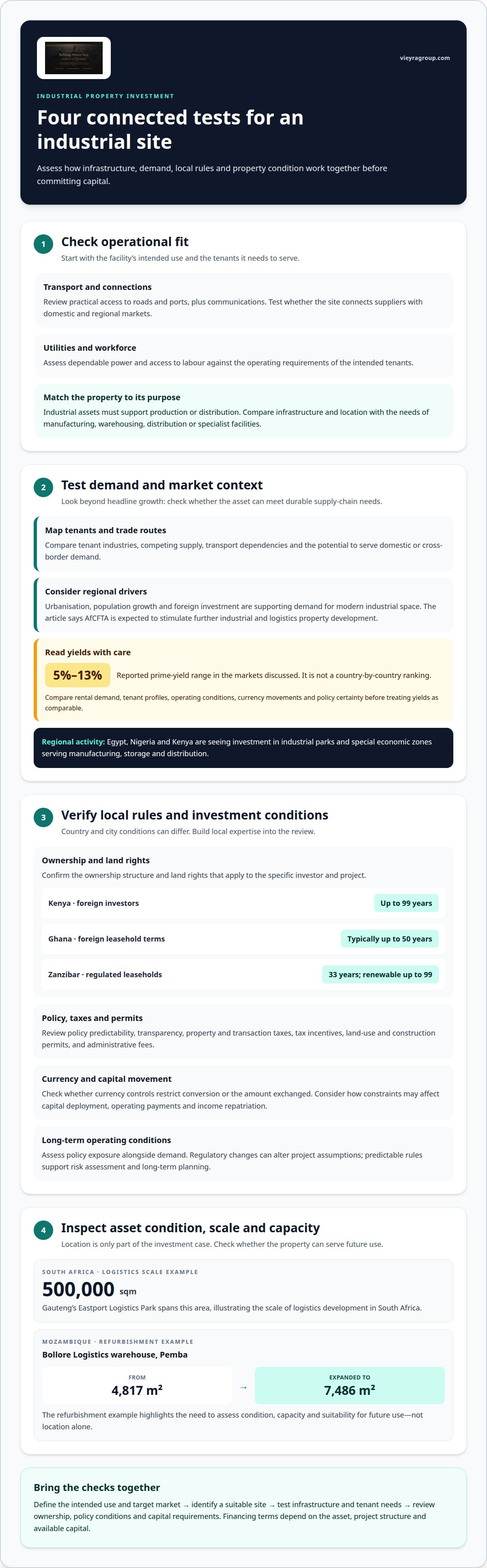
Industrial sites derive value from their connections to transport, utilities, labour and customers. Egypt, Nigeria and Kenya are seeing investment in industrial parks and special economic zones serving manufacturing, storage and distribution. The key question for investors is whether infrastructure can support a facility’s intended operations and connect it efficiently to suppliers and markets across Africa.
Compare the site’s practical access to roads, ports, power and communications with the needs of its intended tenants. Gauteng’s Eastport Logistics Park spans 500,000 sqm, illustrating the scale of logistics development in South Africa. Government policies, leasehold reforms and infrastructure improvements can also influence where domestic and foreign businesses establish operations. Assess policy predictability alongside physical connections, since both affect long-term planning and income potential.
Mozambique offers a concrete refurbishment example. The Bollore Logistics warehouse in Pemba was being expanded from 4,817 m² to 7,486 m² as part of its refurbishment. The project shows why investors should assess an existing property’s condition, capacity and suitability for future use, rather than treating location as the sole investment criterion.
Start by defining the property’s intended use and target market, then identify a suitable site and assess its infrastructure. Before committing funds, examine ownership structure, land rights, policy conditions and capital requirements. Financing terms depend on the asset, project structure and available capital.
Ownership structures vary by country. Foreign investors in Kenya are limited to leasehold titles of up to 99 years, while leasehold terms for foreigners in Ghana are typically capped at 50 years. Zanzibar permits international investors to acquire property through government-regulated leaseholds, typically for 33 years and renewable up to 99 years. These distinctions make jurisdiction-specific review essential.
Property categories serve different purposes. Residential assets respond to housing demand, commercial properties include offices and shopping centres, and hospitality assets serve visitor markets. Industrial property, by contrast, must support production or distribution. Distinguishing these uses helps match infrastructure, location and demand to the intended asset.
African industrial and logistics real estate market trends
Urbanisation, population growth and foreign investment are supporting real estate market growth across African countries. Regional trade integration is also shaping demand for industrial and logistics facilities, creating distinct opportunities for industrial real estate investment in Africa.
Industrial Sector Investment Opportunities
Industrial property opportunities span manufacturing, warehousing, distribution and specialist facilities, each serving distinct commercial needs. Some mainland African countries offer incentives related to importing and exporting materials to encourage manufacturing development. The African Continental Free Trade Area (AfCFTA) is expected to stimulate further industrial and logistics property development. When assessing industrial real estate investment in Africa, compare tenant industries, transport dependencies, infrastructure needs and the potential to serve domestic or cross-border demand.
Returns Across African Countries
Prime yields stood at 5%-13% in those markets, but these ranges do not establish a country-by-country ranking. Compare rental demand, tenant profiles and operating conditions before treating a headline yield as comparable. Currency movements and policy certainty also shape assessments of income and risk.
Urbanisation and population growth put pressure on supply networks, while foreign investment can deepen demand for modern industrial space. The commercial case rests on whether a property can serve manufacturers and logistics operators. Assess tenant depth, competing supply, trade-route access and infrastructure resilience before projecting income.
Policy conditions shape investment horizons. Institutional investors value predictable rules for risk assessment and long-term planning, while policy changes can alter project assumptions. Government cooperation, regulatory flexibility and infrastructure improvements may support local economic growth. Compare market demand with policy exposure, then consider how each factor could affect tenant continuity and operations.
A practical review can map these forces against tenant mix, infrastructure needs and policy exposure, then connect them to a long-term investment strategy.
Local expertise and due diligence
Due diligence for industrial property must connect legal rights, capital movement and operating conditions in each country. Conditions can differ materially from one city to another, even within the same national real estate market. Local expertise helps interpret these differences before international capital is committed.
Taxes, fees and permits vary by country, property and intended use. Before acquisition, map applicable property and transaction taxes, tax incentives, land-use and construction permits, and administrative fees. Assess how each could affect the project’s investment strategy.
- Assess currency controls. Determine whether controls restrict conversion or the amount of foreign currency exchanged. Model how those constraints could affect capital deployment, operating payments and income repatriation.
- Examine government transparency. Assess whether public decisions and processes are sufficiently transparent to support accountability. This helps investors evaluate government conduct and protect their interests when policy conditions change.
- Review property and land-use rules. Trace how current rights, regulations, taxation and land-use policies affect the proposed asset. Changes in these areas can cause financial and operational disruption, so document the project’s exposure before committing capital.
- Test incentives against the project. Evaluate whether country-specific tax incentives fit the industry and investment strategy. An incentive that does not align with the intended tenant or operating model may have limited relevance to the investment decision.
- Evaluate political and asset risks. Consider the possibility of government expropriation and whether the risk fits the investment mandate. Policy certainty matters because it supports long-term planning and informs institutional risk assessment.
A regional partner with knowledge of local dynamics can help interpret market conditions and identify project risks. Assess whether the developer understands the city, its land-use context and the industries expected to occupy the property. Local market knowledge adds practical context to legal and financial review.
Complete due diligence before acquisition by connecting ownership rights, tax treatment, permits, currency exposure and government transparency. For an industrial asset, the final assessment should show how each factor affects operations, capital flows and the project’s long-term viability.
Applicable costs and approvals vary by country, property and intended use. Identify property and transaction taxes, relevant tax incentives, land-use and construction permits, and administrative fees, then assess their effect on the project.
Which African industrial real estate sectors offer the best investment opportunities?
No single sector leads across every African market. The strongest fit depends on alignment between tenant demand, production needs and site infrastructure.
Agro-processing can support demand for facilities close to agricultural inputs and distribution routes. Agro-processing and timber and wood processing may offer areas for investors to investigate. These figures describe sector scale, not guaranteed demand for a particular industrial property. Investors should assess whether a site can serve processors, storage requirements and onward transport.
Consumer and essential-goods supply chains offer another lens. The African FMCG market is listed at $4.2 trillion, and the pharmaceuticals market at $13.66 billion. Warehousing and production facilities serving these sectors may require reliable utilities, suitable storage conditions and efficient links to urban centres. The relevant investment question is whether local tenants need the property’s specific capabilities.
Materials and manufacturing also merit assessment. Construction materials, chemicals and textiles are sectors investors can assess for potential industrial property demand. These sectors differ in production processes, space requirements and supply-chain needs. Match the property’s configuration and location to a defined industrial use rather than treating market size as a proxy for occupancy or returns.
For each opportunity, compare the sector’s value chain with the asset’s proposed role. A facility may serve production, storage, processing or distribution, but each use has distinct tenant requirements. Some mainland African countries offer incentives related to importing and exporting materials to encourage manufacturing development. Assess whether those incentives fit the sector and investment strategy.
A disciplined comparison considers tenant depth, infrastructure needs, access to inputs and distribution, and policy exposure. Sector figures can help identify areas for further analysis, but they do not establish property-level performance. For capital aligned with African industrial development, explore strategic investment opportunities.
Vieyra Family Office: Global Investment Management
Vieyra Family Office brings a long-term investment perspective to opportunities connected with African industrialisation. Its Global Investment Management, African Industrialization Capital and Strategic Capital Solutions are relevant when an industrial property thesis forms part of a broader growth project requiring strategic capital. The fit is strongest where the investment rationale connects the asset’s role with productive capacity and long-term economic development, rather than property acquisition alone. For investors assessing how an industrial project aligns with a wider portfolio or development objective, these offerings provide a natural point of engagement. The Vieyra Foundation is also part of the institution’s work. To discuss an investment opportunity aligned with African industrialisation, contact Vieyra Family Office.
Shape the Next Stage of Industrial Growth
A considered industrial real estate investment in Africa can be more than an asset allocation. It can connect capital with productive capacity, supply-chain development and enduring economic activity. Start by defining the investment’s role, the industrial outcomes it should support and how its long-term purpose aligns with wider portfolio priorities.
Vieyra Family Office offers Global Investment Management, African Industrialization Capital and Strategic Capital Solutions. These offerings provide a framework for engaging with opportunities where global capital and African industrial development meet. A clear investment thesis helps establish whether a proposed project aligns with those objectives and merits further discussion. Institutional inquiries are Access by Invitation.
Contact Vieyra Family Office to discuss an investment opportunity connected to African industrialisation. With a well-defined purpose and patient, strategic capital, the next stage of industrial growth can be approached with confidence.
Frequently Asked Questions
What are the top African markets for industrial real estate investment?
Egypt, Nigeria and Kenya are prominent markets for assessing industrial property, with investment in industrial parks and special economic zones. This does not establish a definitive ranking of returns or risk. Compare each market’s tenant base, trade connections, infrastructure and policy conditions with the intended asset type. A manufacturing site and a distribution warehouse may favour different locations, even within the same country.
What are current industrial property prices, rents, and yields in Africa?
These are market ranges, not valuations for a particular asset. Purchase prices depend on location, property condition, infrastructure, lease income and transaction terms. Assess rent and yield alongside operating needs and tenant demand.
How strong is demand for warehouses and logistics facilities across Africa?
Demand is supported by urbanisation, population growth and increased foreign investment, while the African Continental Free Trade Area is expected to stimulate further logistics property development. Conditions vary by location and facility type. A warehouse serving cross-border distribution, for example, has different requirements from one supporting a nearby manufacturing cluster. Evaluate likely tenant uses, transport connections and the continuity of goods flows.
What are the foreign ownership rules for commercial real estate in major African countries?
Foreign ownership structures differ by country and property category. Kenya limits foreign ownership to leasehold titles of up to 99 years, while foreign leasehold terms in Ghana are typically capped at 50 years. Zanzibar uses government-regulated leaseholds, typically for 33 years and renewable up to 99 years. Foreigners can generally buy freehold property in Morocco, subject to restrictions, and can own property in Egypt.
What are the main risks of investing in African industrial real estate?
Key risks include currency controls, policy changes, limited government transparency, and possible changes to property rights, taxation or land-use rules. Institutional investors also assess the risk of government expropriation. Consider how these factors interact: currency restrictions can affect capital flows, while regulatory changes can disrupt operations. A practical risk assessment links each exposure to the asset’s ownership, financing structure and operating model.
How do infrastructure, ports, and power supply affect industrial property values in Africa?
Infrastructure determines whether a property can support production, storage and timely distribution. Port access can matter for facilities handling imported inputs or export goods, while dependable power is central to operations requiring continuous electricity. Poor connections may constrain tenant use and income potential. Assess transport, utilities and communications against the specific operating requirements of likely occupiers.


