

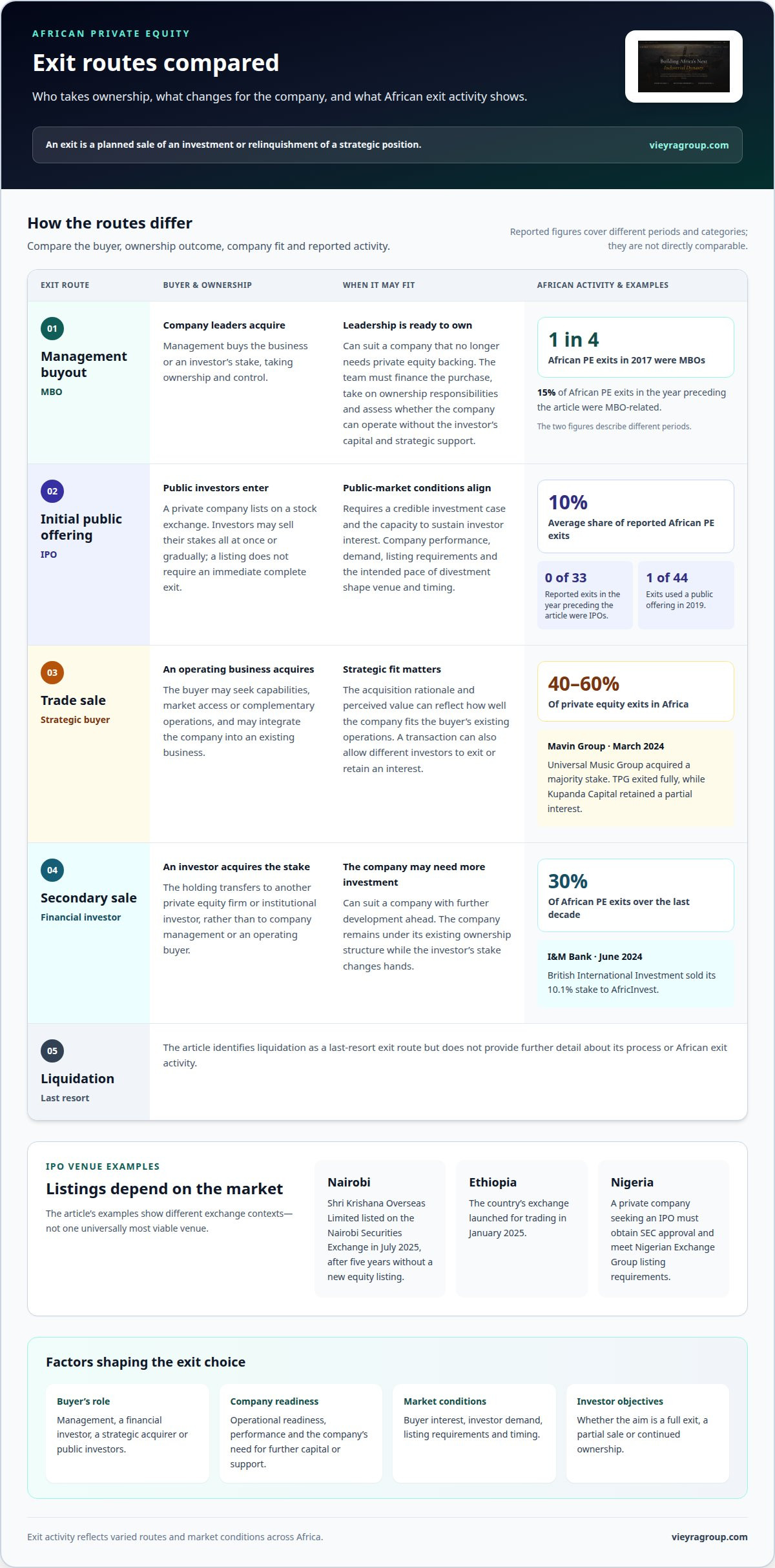
Trade sales account for 40-60% of private equity exits in Africa, while initial public offerings account for an average of 10%. The main exit strategies for private equity in Africa include strategic sales, secondary sales, management buyouts, IPOs and, as a last resort, liquidation. An exit is the planned sale of an investment or relinquishment of a strategic position, with the route shaped by the company’s readiness, buyer interest and market conditions.
Choosing an exit is not simply a matter of finding a buyer or listing shares. Each route changes who owns the business, how investors realise returns and what role management may retain. This comparison explains how buyouts, IPOs, strategic sales, secondary sales and liquidation work, and what African exit activity suggests about the available options. Use it as a framework for assessing how an exit might fit the company’s circumstances and the investor’s objectives.
Key Takeaways
- A private equity exit is the planned transfer or realisation of an investment; the right route depends on ownership goals, company readiness and investor objectives.
- Management buyouts can return control to company leaders, while secondary sales transfer an investor’s stake to another financial investor.
- An IPO can allow investors to sell over time or all at once, whereas a strategic sale transfers the company to an acquiring business.
- African exit activity reflects varied routes and market conditions; Vieyra Family Office’s African Industrialization Capital is relevant to long-term investment in the continent’s productive capacity.
1. Management buyouts
A management buyout occurs when a company’s management buys the business or an investor’s stake. Among the exit strategies for private equity in Africa, this route can give existing leaders control when the company no longer needs private equity backing. The team already understands the operations and growth priorities, but must secure financing for the purchase and take on ownership responsibilities.
Management buyouts and sales to financial or strategic buyers involve different purchasers. In an MBO, company leaders acquire the business; a financial buyer is another investor, while a strategic buyer acquires a company for its own corporate purposes. In 2017, management buyouts accounted for one out of four African private equity exits. In that same year, sales to financial or strategic buyers represented 60% of exits. In the year preceding this article, management-buyout-related exits accounted for 15% of African private equity exits. These figures describe different exit categories and periods.
Assess an MBO by first considering whether the management team can own and lead the company after the transaction. Then establish which stake will transfer, the purchase terms and how the acquisition will be financed. Consider whether the company can operate without the investor’s capital and strategic support. For the seller, the key question is whether management’s offer provides an appropriate exit while preserving continuity. For management, it is whether the team can fund the purchase and guide the business as owners.
A secondary sale differs from an MBO: it transfers an investor’s holding to another private equity firm or institutional investors, rather than to company management. Secondary sales made up 30% of private equity exits in Africa over the last decade. This route can suit a company that still needs investment and has further development ahead, while an MBO may fit when management is positioned to take control. In either case, the exit structure should account for the buyer’s role, the company’s financing needs and the investor’s objectives.
2. Initial public offerings
An initial public offering gives a private company access to public investors through a stock exchange listing. Private equity investors can sell their stakes at once or gradually over time. A listing therefore need not mean an immediate, complete exit. Market conditions, company performance and investor interest influence the timing and value of the transaction. Across Africa, IPOs account for an average of 10% of reported private equity exits.
Recent figures illustrate how selective this route can be. Among 33 reported African private equity exits in the year preceding this article, none was an IPO. In 2019, one of 44 exits used a public offering. These figures show that IPOs form a small part of recorded exits. A company also needs a credible investment case and the capacity to sustain investor interest after trading begins. Market conditions and business performance can affect both timing and value.
The clearest recent listing example is the Nairobi Securities Exchange. Shri Krishana Overseas Limited listed there in July 2025, after a five-year period without a new equity listing. Ethiopia presents a newer exchange, launched for trading in January 2025. In Nigeria, a private company seeking an IPO must obtain Securities and Exchange Commission approval and meet Nigerian Exchange Group listing requirements. These examples identify relevant venues and activity, not one universally most viable exchange.
Before choosing a venue, investors assess company performance, likely demand, applicable listing requirements and the intended pace of divestment. That assessment helps determine whether public-market participation aligns with the company’s plans. An IPO can also preserve an investor’s continuing ownership position, allowing further stake sales over time. For a broader perspective on long-term capital priorities, explore African industrialization perspectives.
3. Trade sales to strategic buyers
A trade sale transfers a company to another entity, often a strategic buyer seeking capabilities, market access or complementary operations. Trade sales account for 40-60% of private equity exits in Africa. The purchaser may integrate the company into an existing business, while the seller realises liquidity by transferring its investment. A financial buyer differs: it primarily acquires an investment position rather than buying the company to advance its own operating strategy.
The March 2024 sale of a majority stake in Nigeria’s Mavin Group illustrates a strategic transaction. Universal Music Group acquired the stake, enabling TPG to exit fully while Kupanda Capital retained a partial interest. The structure shows that one transaction can provide a complete exit for one investor and continued participation for another. For strategic buyers, the company’s fit with existing operations can shape the acquisition rationale and the value they see in the business.
Secondary sales transfer an investor’s holding to another private equity firm or institutional investor, rather than transferring the company to an operating buyer. Such transactions made up 30% of private equity exits in Africa over the last decade. In June 2024, British International Investment sold its 10.1% stake in East African banking group I&M Bank to AfricInvest. The example shows how a partial stake sale can create liquidity for one investor while another assumes the investment.
The choice between a trade sale and a secondary sale depends on the intended outcome. A trade sale may transfer control and ownership to a strategic acquirer; a secondary sale transfers an investor’s stake while the company remains under its existing ownership structure. Assess the stake on offer, the buyer’s objectives, the company’s prospects and the seller’s liquidity needs. These factors clarify whether the transaction should transfer the business, one investor’s position or a controlling interest while other investors remain.
4. African private equity exit activity
African private equity exits reflect both changing activity and persistent liquidity constraints. Africa recorded 63 exits in 2024, while activity increased 47% year on year since 2022. Yet a 2021 survey found 71% of limited partners identified weak exit conditions as their biggest challenge investing in African private funds. A successful exit therefore depends not only on company performance, but also on buyer appetite and workable transaction conditions.
IPOs, trade sales and secondary buyouts offer different exit routes. An IPO allows investors to sell shares on public markets, either in stages or at once; a trade sale transfers the company to an acquiring business. A secondary transaction transfers an investor’s stake to another financial investor. Trade sales and secondary sales have represented substantial portions of African activity, while IPOs are less frequent. The appropriate route depends on company readiness, investor objectives and buyer interest.
Exit options also differ across South Africa, Nigeria, Kenya, Egypt and other markets. Exchange access, local listing requirements, investor demand and strategic-buyer presence shape the available routes. Kenya’s Nairobi Securities Exchange recorded a listing in July 2025 after a five-year pause; Ethiopia launched its securities exchange for trading in January 2025. These examples show how market infrastructure can influence exit timing, rather than establishing one route as best across the continent.
Private equity firms commonly plan to exit investments within five to seven years. The actual holding period depends on company growth, market conditions and the time needed to prepare a transaction. Investors can tie an intended exit window to operational milestones while retaining flexibility if conditions change.
Start preparation by choosing a likely route and reviewing the company’s performance, financial records, governance and ownership structure. For a sale, develop a clear account of the business and its prospects for potential buyers. For an IPO, assess listing readiness and applicable exchange requirements as well. Identifying gaps early helps align management, investors and transaction materials around a coherent investment case.
For long-term investment perspectives connected to African economic development, explore African investment priorities.
Vieyra Family Office: African Industrialization Capital
Vieyra Family Office deploys strategic capital to support African industrialization and long-term development. Its focus is relevant when an investment thesis extends beyond selling a portfolio company to include productive capacity, enterprise growth and wider economic development.
Through Global Investment Management and Strategic Capital Solutions, Vieyra Family Office manages investments and deploys strategic capital. These offerings are relevant to institutional investors considering how capital can support durable development alongside the timing and structure of an eventual exit. The Vieyra Foundation pursues philanthropic initiatives aligned with the institution’s investment strategy.
For a discussion of African industrialisation and long-term capital priorities, contact Vieyra Family Office.
Shape the Next Chapter of Your Investment
An exit also marks a transition in ownership, responsibility and capital allocation. The next decision can affect whether resources stay with a company’s next stage, move to new investments or support broader development priorities. For investors assessing exit strategies for private equity in Africa, this wider perspective helps connect transaction planning with long-term objectives instead of treating liquidity as the sole measure of value.
Consider how the intended exit relates to the company’s future direction, the investor’s wider portfolio and the role capital may play after the transaction. A deliberate assessment can make the next decision more coherent, particularly when investment priorities intersect with African industrial development.
Discuss your investment priorities with Vieyra Family Office and consider the next stage with clarity and purpose.
Frequently Asked Questions
What is private equity exit?
A private equity exit is an investor’s planned route to sell or otherwise relinquish an investment. It turns a holding into liquidity, but may also transfer ownership to a new investor or management team. The transaction structure determines whether the investor leaves entirely, retains a stake or transfers influence gradually. This distinction matters when assessing remaining portfolio exposure and future ownership responsibilities.
What are the main exit strategies for private equity investments in Africa?
The main routes are management buyouts, initial public offerings, trade sales, secondary sales and liquidation. Each changes ownership or investment exposure differently. A management buyout, for example, shifts ownership to company leaders, while a secondary sale transfers an investor’s stake to another financial investor. The choice depends on who can acquire the interest, the company’s prospects and whether it remains viable as an operating business.
What are recent private equity exit volumes and deal values in Africa by country and sector?
Africa recorded 82 private equity exits by the end of 2022, the most since 2009; firms sold 17 companies across the continent in the first six months of 2023. These totals establish regional activity, not country or sector deal values. A country-level or sector-level comparison requires transaction-specific information, since a continent-wide count cannot show where exits occurred or how much individual deals were worth.
What legal, regulatory, and tax rules affect private equity exits in major African markets?
Requirements vary by country and exit route. In Nigeria, an IPO requires Securities and Exchange Commission approval and compliance with Nigerian Exchange Group listing requirements. Nigerian investors should also review shareholder-agreement provisions covering exit rights, tag-along and drag-along rights, and pre-emptive rights. Tax treatment depends on the jurisdiction and transaction structure, so assess it alongside ownership and sale terms.
How do currency controls, repatriation rules, and foreign exchange risk affect exits in Africa?
Currency movements can change the value of sale proceeds when investors measure returns in a different currency from the one used for the transaction. Repatriation conditions may also affect when proceeds can be transferred across borders. In Nigeria, foreign-exchange volatility was identified as an exit challenge in 2024. Investors therefore consider currency exposure, transaction currency and the timing of proceeds when evaluating an exit.
What are the main risks and barriers to private equity exits in Africa?
Limited buyer demand, narrow exit opportunities and uncertain transaction timing can constrain a sale. Limited exit opportunities are regarded as a significant challenge for private equity fund managers investing in Africa. Foreign-exchange volatility can further affect transaction economics, as identified in Nigeria in 2024. These barriers make buyer interest, company readiness and the intended route central considerations in exit planning.


