

A single ESG score can hide the risks that matter most to an investment. ESG metrics for emerging markets assess environmental impact, social practices and governance through indicators such as emissions, energy use, workforce conditions and oversight. Their significance depends on local conditions: the same measure can signal different exposures across countries, industries and regulatory settings.
It is reasonable to expect stronger ESG performance to support corporate financial performance, but the relationship is not uniform. Some measures may shape how investors view a company, while operational effects vary by sector and market. The value lies not in treating a score as a verdict, but in understanding what it measures and what may shape the result.
This article explains key ESG indicators, how they relate to financial outcomes, and why country-specific risks and governance practices affect their interpretation. It also considers how investors can use comparable measures without overlooking the local context that gives them meaning.
Key Takeaways
- Distinguish environmental, social and governance indicators to understand what each measures and which risks it can reveal.
- Interpret financial relationships by sector and market: stronger ESG performance may align with better outcomes, but the effects are not uniform.
- Read company scores in local context, accounting for differences in data quality, regulation, currency exposure and political conditions.
- Give governance close attention, since oversight and decision-making practices can shape how environmental and social risks affect performance.
ESG performance and corporate financial performance in emerging markets
ESG performance can relate to market valuation, shareholder returns, financing costs and operating results. Across emerging markets, these relationships vary by industry, listing status and the indicators assessed.
Environmental, Social, and Governance Indicators
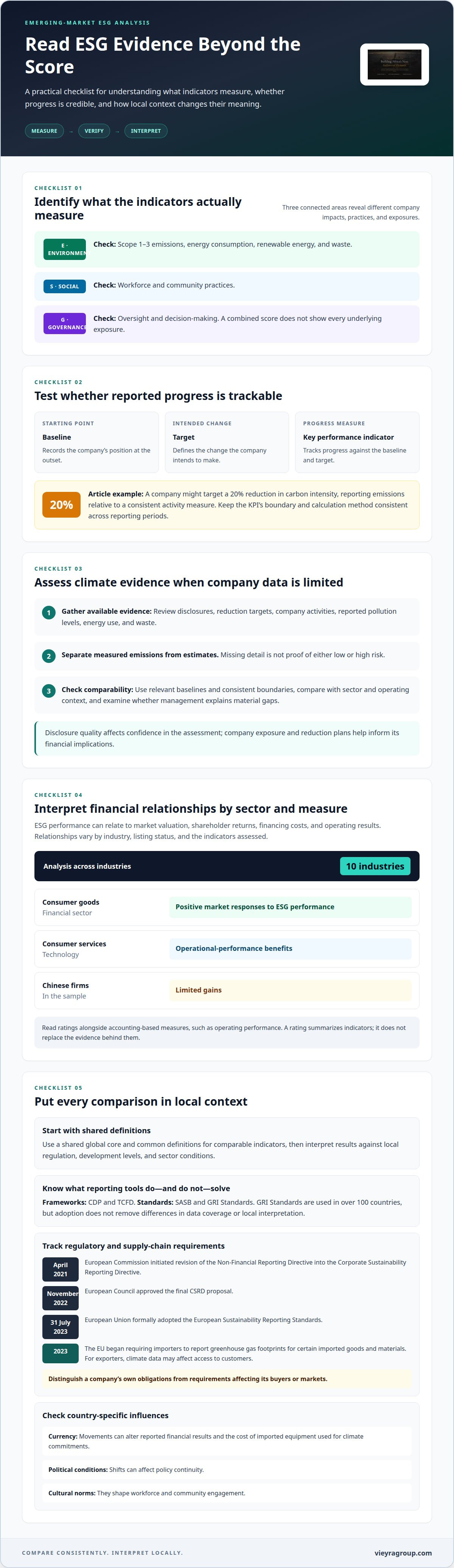
Environmental, social and governance indicators measure a company’s impacts, practices and oversight across three connected areas. Environmental measures include Scope 1-3 emissions, energy consumption, renewable energy and waste; social measures can examine workforce and community practices; governance indicators assess oversight and decision-making. Together, these measures help investors distinguish a company’s underlying exposures from its score alone.
Financial relationships differ by sector: an analysis across 10 industries found positive market responses to ESG performance in consumer goods and financial sectors, while consumer services and technology showed operational-performance benefits. Chinese firms in the sample had limited gains. These findings make industry context essential when interpreting ESG ratings alongside accounting-based measures, such as operating performance, rather than treating one rating as a universal signal.
Baselines, Targets, and Key Performance Indicators
A baseline records a company’s starting position; a target defines the intended change, while a key performance indicator tracks progress against both. For example, a company might set a target to reduce carbon intensity by 20%, then report emissions relative to a consistent activity measure. This structure makes disclosure more useful over time because investors can distinguish an improvement from a change in business scale.
Comparable definitions matter: an emissions KPI should keep the same boundary and calculation method across reporting periods. Investors can then assess whether a target is translating into operational change and compare that evidence with financial performance. A rating may summarize several indicators, but it cannot replace the underlying baseline, target and reported results.
Measuring Climate Risk with Limited Data
When company-level emissions data is limited, investors can assess climate exposure using available disclosures, reduction targets and the company’s activities. They can identify reported pollution levels, examine energy use and waste, and distinguish measured emissions from estimates. This clarifies the evidence behind a rating without treating missing detail as proof of either low or high risk.
Climate metrics need a relevant baseline and consistent boundaries across reporting periods. Investors can compare disclosed emissions and targets with the company’s sector and operating context, then examine whether management explains material gaps. This matters especially when environmental data is incomplete: disclosure quality affects confidence in the assessment, while the company’s exposure and reduction plans inform its financial implications.
Data, regulatory, cultural, currency, and political risks
Investors can compare ESG performance across countries by separating a shared global core from country-specific measures. Apply common definitions to comparable indicators, then interpret results against local regulation, development levels and sector conditions. This makes differences visible without treating unlike operating environments as equivalent.
ESG reporting is not standardized globally, partly because there is no agreed definition of good environmental, social and governance practice. Frameworks and standards help structure disclosure: CDP and TCFD are frameworks, while SASB and GRI Standards are examples of standards. The GRI Standards are used in over 100 countries, but adoption does not eliminate differences in data coverage or local interpretation.
Regulatory requirements also shape what companies disclose. The European Commission initiated the revision of the Non-Financial Reporting Directive into the Corporate Sustainability Reporting Directive in April 2021; the European Council approved the final CSRD proposal in November 2022. The European Union formally adopted the European Sustainability Reporting Standards on 31st July 2023. Such requirements can affect multinational stakeholders and firms supplying regulated markets.
Trade rules can transmit disclosure expectations through supply chains. The EU began requiring importers to report greenhouse gas footprints for certain imported goods and materials in 2023. For an exporter, climate data may therefore influence access to customers, even when domestic reporting practices differ. Investors should distinguish the company’s own obligations from requirements affecting its buyers or markets.
Local context extends beyond regulation. Currency movements can alter reported financial results and the cost of imported equipment used for climate commitments. Political shifts can affect policy continuity, while cultural norms shape workforce and community engagement. Compare ESG metrics for emerging markets using consistent definitions, then assess whether each measure reflects relevant local risks. Global Investment Management can support decisions that weigh these interacting country and corporate factors.
Governance as a financially significant ESG pillar
Governance determines how a company allocates capital, oversees risk and accounts for its decisions. Investors assess board oversight, audit controls, shareholder rights and anti-corruption policies to understand whether published commitments have credible accountability. In emerging markets, these practices can influence confidence where regulatory safeguards and disclosure quality differ across jurisdictions.
Financial comparisons suggest ESG performance can coincide with meaningful investment outcomes. From 2016 through 2020, emerging-market companies in the top quintile of ESG scores recorded total shareholder returns 2.2% higher on average than companies in the bottom quintile. Over the same period, companies in the top quintile of Refinitiv ESG scores had a cost of capital 67 basis points lower. These are associations, not proof that governance alone caused the results.
Governance helps investors assess how environmental and social commitments shape decisions. A board that assigns clear responsibility for climate oversight, for example, can connect emissions targets with capital allocation and management reporting. Investors can examine whether disclosures explain accountability, track progress against stated objectives and address material risks. A published policy without oversight or follow-through offers weaker evidence of implementation.
Capital allocation also reflects an uneven global distribution: developed countries receive around 90% of ESG financial flows, while the rest of the world receives 10%. For emerging-market companies, credible governance can help make risk management and strategic priorities legible to investors. Yet stronger disclosure should be assessed alongside real-world outcomes, including whether investment supports durable operational improvements and community benefits.
Investors can assess governance through a connected set of questions: who oversees material risks, how decisions are disclosed, and whether results align with stated commitments. Comparing the answers with financing costs and shareholder returns provides a more grounded view than relying on an ESG rating alone. A favorable financial association does not, by itself, demonstrate positive environmental or social impact.
Environmental, social, and governance dimensions
Environmental indicators examine how corporate activity affects natural systems and climate exposure. Emerging markets emit roughly 35 billion tons of carbon dioxide equivalent annually, around 85% of the global total. That scale makes emissions reporting material to investment analysis, while company-level results still depend on sector and operating conditions.
Environmental assessment can also consider energy consumption, renewable energy, waste and pollution controls. ISO 14001 is a standard for environmental management, offering a reference point for understanding a company’s processes. At least 35 emerging-market governments have pledged to make their nations carbon neutral. Investors can assess whether corporate reporting identifies emissions sources and describes practical reduction commitments.
Social indicators consider how companies affect workers, consumers and communities. For an industrial company, examples include workplace conditions, employee development and community engagement. These measures help investors understand whether operations support local livelihoods or create social risks that could affect continuity. Interpret them in local context while retaining consistent definitions for comparison across international markets.
Governance indicators examine how authority, accountability and oversight operate within a company. Board supervision, audit processes, business ethics and the handling of stakeholder concerns can show whether sustainability commitments influence decisions. Around half of publicly traded emerging-market companies indicate in financial disclosures that climate impact forms part of their overall strategies. Investors can compare those statements with assigned oversight and reported progress.
Together, the three dimensions connect environmental pressures, social outcomes and corporate conduct. A useful assessment links each indicator to its source, reporting boundary and business relevance, then considers how the factors interact. For investment decisions that connect sustainability with African industrial development, explore African Industrialization Capital.
Vieyra Family Office
Vieyra Family Office brings a long-term investment perspective to questions of ESG measurement, local risk and corporate performance. Through Global Investment Management, it manages investments across asset classes, while African Industrialization Capital and Strategic Capital Solutions support long-term growth projects and economic development. These perspectives are relevant when investors are assessing how sustainability indicators intersect with country conditions, governance and durable value creation.
ESG scores are one input into investment judgment, not a substitute for examining a company’s business, operating environment and financial prospects. Vieyra Family Office connects investment decisions with a broader view of African industrial development and generational capital allocation.
For a discussion of investment priorities and the role of ESG considerations in your context, contact Vieyra Family Office.
Carry ESG insight into your next investment decision
The value of ESG metrics for emerging markets ultimately depends on how they inform a specific investment decision. Before committing capital, define the decision the analysis must support: assessing an existing holding, evaluating an opportunity or setting priorities for long-term growth. Then identify which environmental, social and governance considerations are material to that decision and how they fit the investment mandate and time horizon.
This discipline turns ESG analysis from a reporting exercise into a considered part of capital allocation. It also provides a clearer basis for weighing financial objectives alongside local economic development, rather than treating a composite score as an outcome in itself.
Vieyra Family Office can be a point of engagement for investors considering these questions within a broader investment strategy. Contact Vieyra Family Office to discuss your investment priorities and the role ESG considerations may play. A well-framed decision is a stronger foundation for durable progress.
Frequently Asked Questions
What Are ESG Metrics?
ESG metrics are measurable indicators used to assess a company’s environmental effects, social practices and governance. Investors use them to examine specific issues rather than relying solely on broad sustainability statements. For example, a company’s carbon disclosure can be considered alongside its oversight of environmental risks. The measures selected depend on the business’s activities and the investment decision being assessed.
What ESG metrics are commonly used in emerging markets?
Common measures include greenhouse gas emissions, energy use, renewable energy, waste, workplace practices, community impacts and board oversight. Their relevance varies by business: an energy-intensive manufacturer may warrant close attention to emissions and energy sources, while a service company may need different operational indicators. Investors can assess whether each measure relates to material business risks and whether reporting remains consistent over time.
Which ESG reporting standards apply to companies in emerging markets, including IFRS S1 and S2, GRI, and SASB?
No single ESG reporting standard applies uniformly across every emerging market; local rules and company circumstances matter. As of July 2024, ISSB standards comprised IFRS S1 and IFRS S2. GRI Standards are used in over 100 countries, while SASB covers 77 industries across 11 sectors. These tools can guide disclosure, but investors should distinguish voluntary frameworks from requirements applicable to a particular company.
How do ESG data availability and quality differ across emerging markets?
Data availability and quality vary with reporting practices, regulatory environments, company capacity and measurement consistency. One company may publish detailed, comparable emissions records, while another provides limited or differently defined data. Investors can assess each disclosure’s reporting boundary, methodology, time period and source, then separate reported figures from estimates. This helps show where comparisons are robust and where interpretation requires greater care.
What are the most important environmental indicators for emerging-market companies and investors?
Priority indicators depend on a company’s operations and exposure. Investors often examine emissions, energy consumption, renewable energy use, waste and pollution disclosures. For a company with substantial fuel use, emissions intensity and reduction targets may be especially relevant. For a resource-intensive operation, waste and pollution controls can add essential context. Each indicator’s value depends on clear measurement boundaries and comparable reporting periods.
Which social metrics are most relevant in emerging markets, including labor rights, safety, and community impact?
Relevant social measures can include workforce conditions, employee training, workplace safety records, labor-rights policies and community concerns. For a company operating near local communities, investors can examine how it records grievances and responds to reported impacts. In labor-intensive sectors, safety procedures and incident reporting help illuminate operational practices. Together, these indicators show how a company manages relationships with workers and affected communities.


