

Infrastructure investment decisions are better grounded when environmental performance, social impact and governance quality are assessed separately, rather than compressed into a single score. ESG criteria for infrastructure investment help identify material risks and opportunities across an asset’s lifecycle, while informing whether its ownership, revenue model and oversight support the investment case. Investors report that these criteria can help manage risk and improve project financial returns.
That matters because infrastructure assets differ in their effects on communities and the environment, how they generate income, and how much they depend on effective governance. Screening should consider broad ESG priorities alongside each asset’s specific characteristics, rather than treating every project as interchangeable.
This article explains why ESG belongs in infrastructure investment decisions and how investors can structure an assessment across environmental, social and governance factors. It also examines exclusion screening, the distinctions among energy asset types, and how governance, reporting and asset maturity shape the analysis.
Key Takeaways
- Assess board oversight, ownership clarity, reporting controls and accountability to understand whether governance can support a complex infrastructure investment.
- Use exclusion policies alongside project-specific social and environmental screening to identify concerns that broad ESG categories may miss.
- Tailor due diligence to the asset: solar, wind and smart-building investments each depend on distinct operational, environmental and revenue assumptions.
- Integrate ESG considerations into investment analysis and ongoing monitoring so that material risks and opportunities remain visible across the asset lifecycle.
Gender balance and governance in energy infrastructure
Governance determines how decisions about energy infrastructure are overseen, documented and reported throughout an asset’s life. In the United States, ESG data reporting standards are not uniform or universally required across infrastructure. Investors should distinguish legal duties from policy and contractual commitments.
Governance Principles and Structures
Governance principles define how owners, boards, executives and partners direct an energy asset and remain accountable. Clear structures show who makes decisions, manages conflicts and oversees environmental and social responsibilities. Review ownership clarity, board selection, stakeholder interests, legal and policy frameworks, and whether oversight fits the transaction’s complexity. Better gender balance on boards can support sustainable long-term decisions and risk management. Diversity strengthens oversight but does not replace it.
Governance Monitoring and Reporting
Governance monitoring tracks whether an asset’s policies, targets and controls work as intended. Reporting creates a record investors can use to assess accountability over time. Set ESG targets with practical implementation timelines, assign oversight to named roles, and use annual ESG compliance reports to monitor project contracts. An ESG committee can bring together executive sponsors, investment decision makers and middle- and back-office stakeholders. Transparent policies help stakeholders understand the practices in place.
Transaction controls should fit the deal’s structure. Examine reporting controls, compliance procedures, related-party exposure and transaction documents. Then test whether revenue assumptions, asset ownership, security arrangements and default remedies are clear and enforceable. Contracts should specify responsibilities and reporting obligations during construction and operations. These checks show whether governance is suited to the proposed return and transaction complexity.
At portfolio level, governance requires consistent oversight without overlooking differences between assets. Assign responsibility for monitoring ESG commitments, track implementation against stated timelines, and escalate gaps through the appropriate decision-making structure. Align an energy owner’s ESG policy with its mission, culture and values. This connects asset performance with portfolio priorities and keeps accountability for each action clear.
Exclusion lists and investment screening
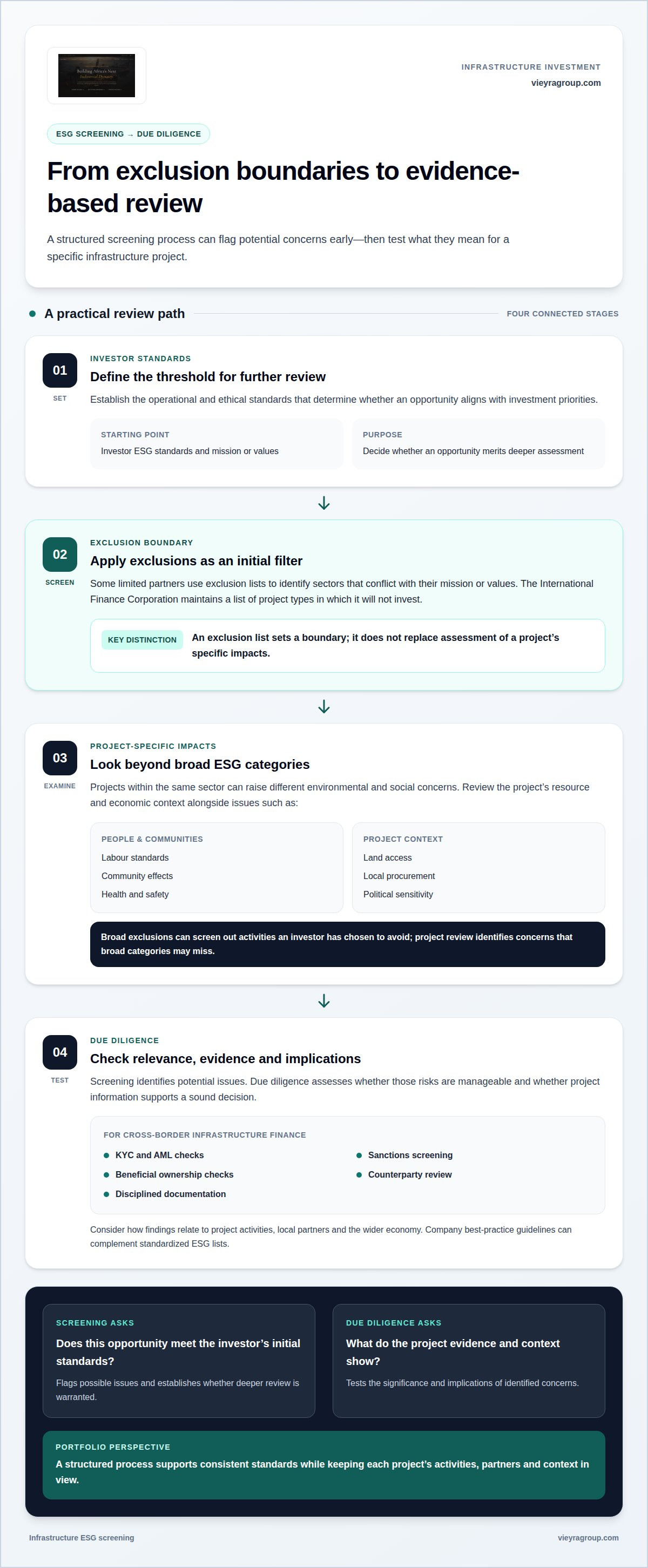
Screening applies an investor’s ESG standards to potential infrastructure investments before deeper assessment. It helps determine whether a project’s sector, activities and counterparties align with investment priorities.
ESG Standards for Investor Screening
ESG standards set the operational and ethical thresholds investors use to decide whether an opportunity merits further review. Some limited partners use exclusion lists to identify sectors that conflict with their mission or values. The International Finance Corporation maintains a list of project types in which it will not invest. Such lists set an initial boundary, but do not replace assessment of a project’s specific impacts.
Infrastructure development can raise distinct environmental and social concerns, even within the same sector. A broad exclusion can screen out activities an investor has chosen to avoid. Project-specific review can then examine labour standards, community effects, health and safety, land access, local procurement and political sensitivity. This approach helps investment teams apply standards consistently while considering each project’s resource and economic context.
ESG Screening and Due Diligence
ESG screening identifies potential issues; due diligence tests their relevance, evidence and implications for the investment. An initial review cannot establish whether risks are manageable or whether project information supports a sound decision. Company best-practice guidelines can complement standardized ESG lists to identify issues specific to a development.
For cross-border infrastructure finance, due diligence includes KYC, AML and sanctions screening, beneficial ownership checks, counterparty review and disciplined documentation. These checks clarify who stands behind an investment and whether counterparties or ownership structures raise material concerns. Screening should also consider how identified issues relate to project activities, local partners and the wider economy, rather than treating a completed checklist as a conclusion.
A structured process connects exclusion criteria with evidence-based project review. For a portfolio-wide view of capital allocation, global investment management provides a relevant framework for considering investments across sectors.
Assessing different energy infrastructure asset types
Sustainability assessment should reflect each asset’s environmental footprint, operating stage and revenue model. Solar, wind, transport, water and digital infrastructure require distinct evidence, not one uniform checklist.
Infrastructure Sustainability Assessment
An infrastructure sustainability assessment examines an asset’s environmental performance, social effects and governance in relation to its operations. The same ESG principles can reveal different risks across assets. For solar, review installed capacity, output history, irradiation assumptions, maintenance arrangements, degradation rates and offtake terms. For wind, assess wind potential, ecosystem impacts, land arrangements and community engagement. Operating assets and development exposure also have different risk profiles.
Sector Differences in ESG Criteria
Sector-specific ESG criteria focus on impacts and dependencies that matter to each asset’s function. For energy, examine generation output, emissions displacement, land use, grid impact and equipment lifecycle. For transport and water assets, assess environmental footprint, resource use, service role, and effects on workers and neighboring communities. Digital infrastructure calls for attention to energy and resource use, as well as relevant technology dependencies. These distinctions let investment committees apply consistent principles without assuming identical risks.
Social criteria include labour standards, worker health and safety, community impacts, land access and local procurement. For example, a wind project’s siting and land arrangements may affect nearby communities differently from an operating solar asset. An investment committee can clarify its objective by assessing environmental performance, social impact and governance quality separately, rather than relying on a single combined score.
Common ESG Risks and Controversies
Common risks in U.S. infrastructure projects include emissions, waste, land use, supply-chain issues, employment conditions and community impacts. Some environmental concerns, such as water conservation and air emissions, may be easier to measure; land acquisition and community acceptance are less predictable. Their effects depend on project location, design and engagement with affected communities.
For a proposed energy asset, compare expected output with documented assumptions, then assess land, equipment lifecycle and local impacts. A project framework can disclose sustainability risks, planned responses and timelines. This gives committees a clearer basis for evaluating sustainability considerations across assets and development stages.
ESG integration in infrastructure investment decisions
ESG integration connects environmental, social and governance analysis with investment screening, financial modelling and ongoing asset oversight. It gives decision makers a fuller view of how project performance, stakeholder relationships and corporate responsibility can shape long-term value.
ESG risks can affect returns when environmental impacts, labour concerns or community opposition disrupt construction or operations. They may also influence financing costs and asset valuations if investors and lenders judge that risks could weaken cash generation, increase mitigation needs or make projected revenues less dependable. The effects depend on the project and its financing structure.
The practical test is whether ESG evidence changes an investment assumption. For a proposed project, examine whether land impacts could affect the development timeline, operating practices could raise resource or compliance costs, or community concerns could affect expected use. Incorporating these findings into revenue, cost and risk assumptions makes the investment rationale more transparent.
Financial models can translate material ESG considerations into decision-useful analysis. A forthcoming guidance note on infrastructure investment models selects twelve ESG factors and discusses their potential risks, opportunities and quantification. The aim is not to force every factor into a single score, but to connect relevant evidence with the cash flows, assumptions and responsibilities it may affect.
Public and private stakeholders may have different priorities, but both benefit from clear project-level responsibilities and reporting. An ESG policy can guide how limited partners incorporate these considerations into investment and risk-mitigation strategies. During construction and operation, material performance data can inform monitoring, while a committee approach coordinates decisions across investment, executive and operational teams.
Across global portfolios, ESG integration should therefore link screening, project analysis and ongoing oversight, rather than remain a separate policy exercise. Assessing the investment case through global investment management can help connect project considerations with broader capital allocation decisions.
Vieyra Family Office: Global Investment Management
Vieyra Family Office’s Global Investment Management considers infrastructure within a broader, multi-asset portfolio. Its focus on African industrialization and long-term economic development is relevant when investment decisions must align with wider growth objectives.
For infrastructure opportunities, ESG analysis can clarify how environmental, social and governance considerations relate to asset performance, project risks and long-term capital allocation. Strategic Capital Solutions support the assessment of long-term growth projects, while African Industrialization Capital reflects the Office’s focus on industrial development. The fit depends on the investment objective and the role infrastructure plays in it.
To discuss how Global Investment Management or Strategic Capital Solutions may relate to your investment priorities, contact Vieyra Family Office.
Carry ESG Priorities into Long-Term Capital Decisions
The next step is to translate ESG priorities into investment criteria that remain useful as projects, markets and portfolio objectives evolve. For each opportunity, establish which outcomes matter to the investment mandate, how evidence will inform capital allocation, and who is responsible for decisions throughout the asset lifecycle. This connects stated principles with the choices that shape infrastructure investment.
Applying ESG criteria for infrastructure investment also requires clarity about strategic purpose. An investor focused on African industrial development may consider how infrastructure supports productive capacity alongside financial and sustainability objectives. That perspective can guide long-term capital allocation without reducing assessment to a single score or isolated project metric.
Vieyra Family Office brings an African industrialisation focus through African Industrialization Capital. For investors considering how infrastructure aligns with long-term capital priorities, contact Vieyra Family Office to begin a considered discussion. A well-defined investment purpose provides a strong foundation for responsible, lasting decisions.
Frequently Asked Questions
Why is ESG important?
ESG matters because infrastructure decisions can create financial exposure through environmental effects, social relationships and the quality of oversight. A project’s performance depends not only on its physical assets, but also on how it responds to affected communities, resource constraints and changing operating conditions. Considering these factors early can reveal where assumptions need stronger evidence before capital is committed.
What are ESG criteria for infrastructure investments?
ESG criteria are the standards investors use to assess a project’s environmental effects, social consequences and governance practices. In infrastructure, they should reflect the asset’s function and life stage, rather than apply as an identical checklist to every opportunity. An investor might assess emissions and resource use alongside worker conditions, community access, ownership arrangements and procedures for overseeing project decisions.
Which environmental metrics are used to evaluate infrastructure projects?
Relevant metrics depend on the project’s activities and environmental footprint. Investors can consider energy and resource consumption, emissions, waste generation, land use and pollution, then define the measurement boundary and supporting evidence for each figure. For an energy asset, generation output and equipment lifecycle may also matter. Comparisons require consistent methods and time periods, making a metric’s definition as important as its reported value.
What governance standards and controls should infrastructure investors assess?
Investors should assess whether decision rights, ownership records and oversight responsibilities are clear and supported by reliable documentation. Practical tests include tracing who approves major decisions, how conflicts are handled, whether compliance procedures work in practice, and how material information reaches the board or investment committee. For projects involving multiple counterparties, clear responsibilities and reporting channels help reveal where oversight could break down.
Which ESG frameworks are used for infrastructure investing, such as GRESB, SASB, and the Equator Principles?
Investors may encounter GRESB, SASB and the Equator Principles when considering ESG reporting and assessment. These frameworks are not interchangeable: the appropriate reference depends on the asset, the investor’s role and the reporting objective. The Sustainability Accounting Standards Board aims to help businesses identify, manage and report material sustainability topics. Investors can use a framework to structure analysis while retaining project-specific assessment.
How do investors measure and compare ESG performance in infrastructure assets?
Investors compare performance by defining material indicators, setting consistent measurement boundaries and reviewing evidence over time. A sound comparison distinguishes operating results from development-stage commitments and records the method behind each measure. Since infrastructure has no uniform or required ESG data reporting standards, investors should interpret scores in context and examine the underlying indicators rather than rely on a single composite rating.


