
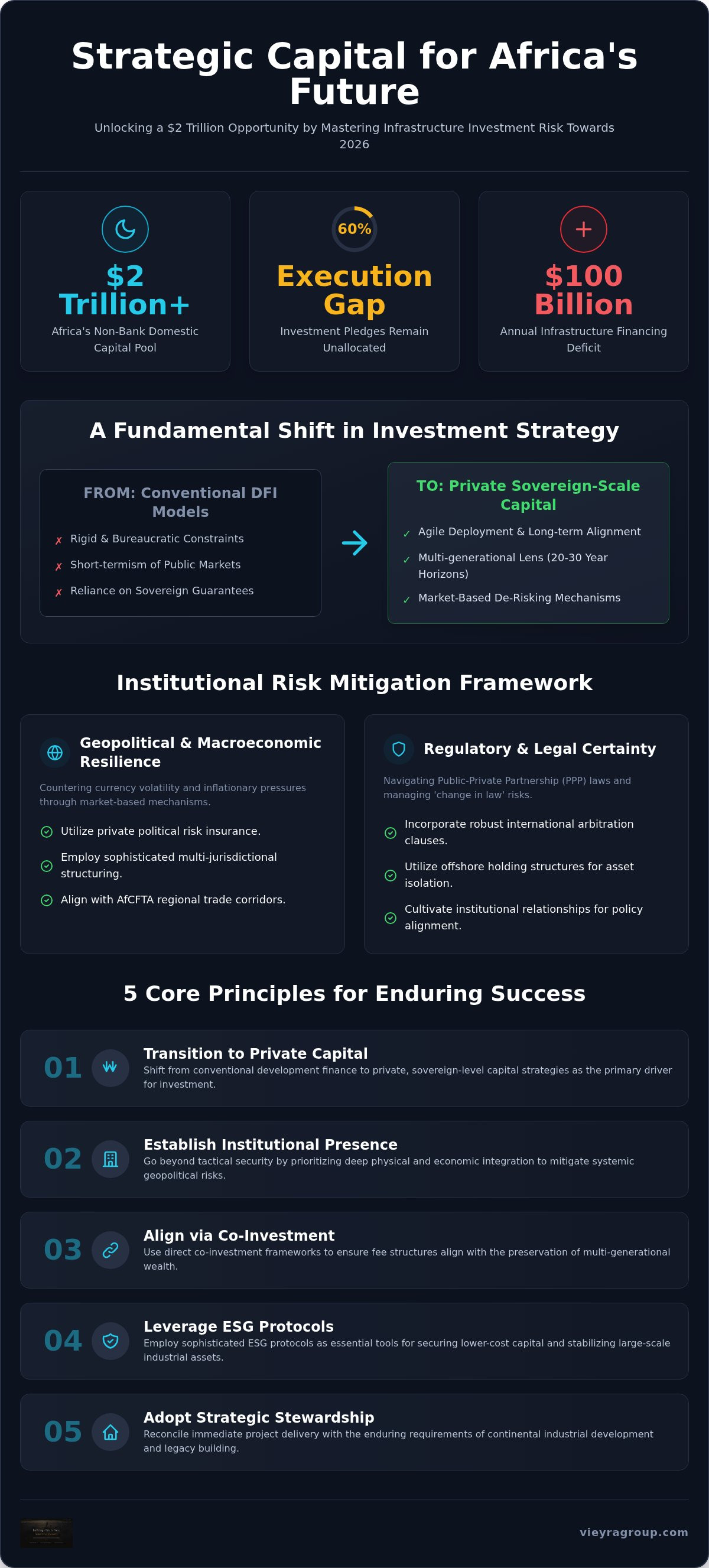
The realization that Africa's non-bank domestic capital pools have surpassed $2 trillion signifies a fundamental realignment in how the continent approaches large-scale development. While the potential for profound industrialization is evident, the complexity of infrastructure investment risk management Africa remains a formidable barrier for institutional actors who must navigate currency volatility and intricate repatriation restrictions. You understand that the preservation of multi-generational wealth requires more than mere participation; it demands a strategic architecture that aligns private capital with sovereign-scale objectives. This necessity is underscored by the current execution gap, where nearly 60 percent of investment pledges remain unallocated due to systemic friction.
This analysis provides an authoritative examination of the institutional risk mitigation strategies and fee structures necessary for the deployment of capital into African infrastructure as we approach 2026. We will explore a robust framework for achieving risk-adjusted returns while establishing transparent institutional fee benchmarks that prevent the erosion of long-term value. The following sections offer a detailed preview of how to identify sovereign-scale partnership opportunities that bridge the execution gap and ensure the permanence of industrial progress across the continent through the deliberate application of strategic capital solutions.
Key Takeaways
- Identify the transition from conventional development finance to private, sovereign-level capital strategies as the primary driver for modern infrastructure investment risk management Africa.
- Distinguish between localized tactical threats and systemic geopolitical shifts through an institutional presence model that prioritizes deep economic integration.
- Analyze the structural benefits of direct co-investment frameworks to ensure that fee arrangements remain aligned with the preservation of multi-generational wealth.
- Leverage sophisticated ESG protocols as essential mechanisms for securing lower-cost capital and stabilizing large-scale industrial assets across the continent.
- Adopt the principles of strategic stewardship to reconcile immediate project delivery with the enduring requirements of continental industrial development and legacy building.
The Landscape of Infrastructure Investment Risk Management in Africa
The year 2026 marks a decisive era where infrastructure investment risk management Africa has transitioned from a defensive posture to a proactive instrument of statecraft. Within this sophisticated environment, the discipline is defined as the systemic calibration of capital against the unique volatilities inherent in the Economic landscape of Africa, ensuring that large-scale industrial assets remain resilient across decades. We're witnessing a structural migration away from the rigid, often bureaucratic constraints of traditional Development Finance Institution (DFI) models. In their place, private sovereign-scale capital has emerged, characterized by a capacity for agile deployment and an alignment with the long-term national interests of host states. This shift isn't merely a change in funding source; it's a fundamental reimagining of the investor as a partner in regional stability.
The $100 billion annual infrastructure financing gap represents a profound industrialization deficit that, while posing a risk to continental growth, offers a singular opportunity for those with the foresight to deploy Strategic Capital Solutions. Success in this arena requires a multi-generational lens. Projects with 20-30 year horizons can't be managed with the short-termism often found in public equity markets. They demand an institutional gravity that recognizes that the ultimate security of an asset lies in its essentiality to the industrial fabric of the nation.
Geopolitical and Macroeconomic Resilience
The maturation of the African Continental Free Trade Area (AfCFTA) has introduced a new layer of regional project stability by harmonizing trade protocols and reducing cross-border friction. However, managing the persistent challenges of currency fluctuation and inflationary pressures requires more than traditional hedging. Effective resilience strategies in 2026 include:
- Utilization of private political risk insurance to supplement or replace sovereign guarantees.
- Sophisticated multi-jurisdictional structuring to isolate assets from localized fiscal distress.
- Alignment with regional trade corridors that benefit from AfCFTA-driven volume increases.
This evolution ensures that projects remain bankable even when local fiscal conditions are under duress, shifting the burden of de-risking toward market-based mechanisms and regional cooperation.
Regulatory and Legal Frameworks
The efficacy of Public-Private Partnership (PPP) laws has reached a critical maturity in key jurisdictions, providing the legal certainty necessary for multi-billion dollar deployments. Managing 'change in law' risks is now achieved through robust international arbitration clauses and the utilization of offshore holding structures. A sovereign-scale approach to regulatory alignment involves the deliberate cultivation of institutional relationships that ensure the project's legal standing is woven into the very permanence of the state's industrial policy.
Systemic Risk Mitigation: Beyond Tactical Security
Effective infrastructure investment risk management Africa requires a shift in focus from the tactical security of individual assets to the systemic resilience of entire economic corridors. While traditional site-specific risks such as theft or vandalism are manageable through conventional means, the deeper challenges of geopolitical instability and economic shifts demand an Institutional Presence model. This approach involves deep physical and economic integration, where the investor is not a transient participant but a permanent fixture in the nation's industrial landscape. By utilizing multi-generational capital, we create a necessary buffer against the volatility of short-term political cycles, allowing projects to mature beyond the tenure of any single administration. Success depends on local partner ecosystems that provide the ground-truth intelligence necessary to navigate opaque regulatory environments that often contribute to the challenges highlighted by S&P Global on Africa's Infrastructure Gap.
Infrastructure as a Catalyst for Industrialization
Industrial-linked infrastructure, such as automated ports, integrated power grids, and high-capacity rail, possesses a fundamentally different risk profile than social infrastructure. These assets are the lifeblood of the Value-Added processing model, which de-risks exports by transforming raw commodities into finished goods within localized industrial hubs. By reducing reliance on raw material price fluctuations, these hubs stabilize revenue streams and enhance the sovereign credit profile. Managing supply chain risks in such large-scale construction requires a meticulous oversight of logistics and a commitment to local sourcing wherever feasible. It's a strategy that ensures systemic continuity while reducing the exposure to global shipping shocks that can derail project timelines.
Technological and Operational Risk
The integration of Digital Twin technology and IoT sensors allows for the real-time monitoring of asset health, ensuring that maintenance is predictive rather than reactive. This technological layer is essential for the long-term viability of assets with thirty-year lifespans. Compliance with the EU ESG Rating Regulation, which entered into force on July 2, 2026, has become a prerequisite for attracting global institutional capital, as non-authorized ratings may now invalidate investment decisions for EU-based entities. We must also address the human element through institutional training and human capital development. The Vieyra Foundation plays a critical role here, fostering the social license to operate by aligning project outcomes with community welfare. This holistic strategy ensures that the infrastructure is protected by the very people it serves. For those seeking to deploy capital with this level of institutional rigor, exploring Strategic Capital Solutions offers a pathway to sustainable, sovereign-scale impact.
The Architecture of the Infrastructure Investment Fee
The structural integrity of a long-term deployment is frequently dictated by the transparency and alignment of its fiscal architecture. In the specialized field of infrastructure investment risk management Africa, the deconstruction of fee components is a prerequisite for ensuring that capital remains productive over thirty-year horizons. Management fees, performance incentives, and operational recovery costs shouldn't be viewed as static overhead; they're dynamic levers that must be calibrated to the specific intensity of African industrial projects. Standard private equity models often fail to account for the unique operational requirements of the continent, making it necessary for institutional actors to demand a more granular breakdown of how their capital is being utilized to secure the asset's future.
Sovereign-scale partners typically command an institutional discount that retail-level participants cannot access, reflecting the stability and scale of the capital they provide. This preferential positioning is not merely a function of volume but a recognition of the lower systemic risk associated with permanent, patient capital. Transparency in carry structures is equally vital, as it ensures that General Partner incentives remain tethered to actual industrial growth rather than short-term financial engineering. By aligning these incentives with the multi-generational vision of the asset, we ensure that the stewardship of the infrastructure remains focused on its primary role as a driver of continental progress.
Direct Investment vs. Fund-of-Funds
Building in-house management capacity for African infrastructure offers a significant reduction in fee leakage, which can otherwise diminish net returns by a substantial margin over the life of a multi-decade asset. While multi-layered investment vehicles provide diversification, they often introduce layers of opacity and redundant costs that erode the value of the underlying industrial activity. Vieyra's sovereign-scale model optimizes capital allocation by reducing intermediary costs through direct engagement with industrial assets. This streamlined approach allows for more efficient capital recycling and ensures that the maximum possible resources are directed toward the physical and technological enhancement of the project.
Performance-Based Fee Hurdling
Hurdle rates in 2026 must be meticulously established to account for African risk premiums and the potential for currency adjustments, ensuring that performance fees are only triggered by genuine value creation. A robust clawback mechanism acts as a stately guardian for capital, protecting multi-generational wealth from short-term performance spikes that don't reflect the long-term health of the asset. Benchmarking these fees against global infrastructure standards ensures that African projects remain competitive for international capital while respecting the unique complexities of the regional operating environment.
Sustainability and ESG: The New Risk Mitigation Standard
In the sophisticated landscape of 2026, Environmental, Social, and Governance (ESG) criteria have evolved from elective compliance to the primary mechanism for institutional de-risking. The application of these standards within infrastructure investment risk management Africa ensures that assets aren't merely built but are sustained through the environmental and social shifts of the coming decades. Projects that demonstrate rigorous adherence to these principles attract significantly lower-cost capital. This was evidenced by the $1.5 billion Development Policy Loan secured by South Africa in July 2026, which achieved a rate of SOFR plus 1.35 percent. This financial advantage is a direct reflection of the reduced risk profile associated with sustainable development and the confidence it instills in global capital markets.
Maintaining a 'Social License to Operate' has become a core project security strategy. It requires a profound commitment to community relations that transcends traditional security measures. When local populations are recognized as stakeholders in the project's success, the asset gains a layer of protection that no private security force can provide. This governance-led approach ensures institutional permanence, where sovereign-scale ethics prevent the project collapses often seen in shorter-term, purely extractive models. By embedding the project into the social fabric, we transform risk into a shared commitment to progress.
Climate Change and Resource Scarcity
The preparation of hard infrastructure for the environmental shifts of the 2030s requires immediate attention to water-waste management and urban supply systems. These are no longer secondary concerns; they're critical infrastructure priorities for 2026. The 'Renewables-to-X' model, incorporating green hydrogen and ammonia, provides a sophisticated method for diversifying energy off-take risks while aligning with global decarbonization trends. This is particularly relevant as international carbon taxes begin to impact the competitiveness of African industrial exports. Building resilience into the physical asset ensures its continued utility and value in an increasingly resource-constrained global economy.
Impact Measurement and Reporting
The era of superficial greenwashing has ended, replaced by the necessity for audited SDG impact reports that provide true institutional transparency. Under Regulation (EU) 2024/3005, which entered into force on July 2, 2026, ESG rating providers must be authorized by ESMA by October 2, 2026. This regulatory shift mandates a level of professional rigor that influences sovereign-level investment partnerships. The Vieyra Foundation exemplifies this transition by executing strategic philanthropy that supports industrial goals through human capital development and social infrastructure. This data-driven impact measurement allows for the calibration of long-term strategies that ensure multi-generational stability. For institutions seeking to align their portfolios with these rigorous standards, exploring our Strategic Capital Solutions provides the necessary framework for sustainable continental progress.
The Vieyra Approach: Deploying Sovereign-Scale Capital
The Vieyra Family Office operates with the deliberation and foresight of a global institution, employing a model of Strategic Stewardship that transcends traditional asset management. Within the framework of infrastructure investment risk management Africa, this approach recognizes that risk is not a variable to be merely mitigated but an environmental condition to be structured through institutional permanence. By aligning capital with the multi-generational requirements of industrial progress, the risk-return calculation is fundamentally altered. Short-term market fluctuations become secondary to the long-term stability of the asset's role within the continental economy. Sovereign-scale partnerships allow for the unlocking of regional projects that require both the weight of significant capital and the poise of a stately guardian.
Positioning African industrialization as the cornerstone of global portfolio diversification offers a unique opportunity for those seeking assets with low correlation to volatile western equities. It's a strategy that prioritizes the creation of tangible, systemic impact while securing multi-generational growth. By focusing on essential industrial hubs, we ensure that the capital remains deeply rooted in the continent's trajectory, providing a level of security that speculative investments cannot match. This alignment with the core drivers of regional development transforms the investor from a passive participant into a visionary architect of continental legacy.
Multi-Generational Wealth Preservation
The preservation of wealth across generations requires a meticulous balance between global asset allocation and high-impact African industrial capital. The legacy mandate at the heart of our operations ensures that we invest in projects designed to outlive their founders, creating a permanent contribution to the continent's development. This long-term vision is explored further in our analysis of Strategic Asset Allocation for Family Offices, which details how institutional rigor can be applied to complex regional portfolios. Such a perspective ensures that capital remains a productive force for decades, resisting the erosion often caused by short-termism.
The Path Forward for Institutional Investors
For sovereign funds and family offices, the path forward involves a deliberate alignment with professional African institutions that possess a deep, multi-generational heritage. Evaluating infrastructure opportunities in the 2026-2030 cycle requires a move away from transient investment models toward partnerships that offer both ground-truth intelligence and sovereign-scale execution capabilities. We invite institutional actors to Engage with Vieyra's Strategic Capital Solutions to explore how a shared commitment to industrial progress can secure both financial returns and a lasting legacy of continental transformation. The deliberate deployment of capital today will define the industrial landscape of the coming century.
Securing the Industrial Legacy of the Continent
The transition toward private, sovereign-scale capital represents a fundamental evolution in the methodology by which the continent secures its industrial future. We've examined how the meticulous calibration of fee structures and the rigorous application of ESG standards serve as the essential pillars of infrastructure investment risk management Africa. These mechanisms ensure that capital remains both productive and protected against the cyclical volatilities inherent in the global economy, providing a stable foundation for multi-generational growth. By redefining risk through strategic industrial stewardship and leveraging a multi-generational African heritage, institutional actors can navigate the complexities of large-scale deployment with profound confidence and institutional permanence. This approach transforms capital from a transient resource into a stately guardian of continental progress. We invite you to Partner with Vieyra Family Office for Sovereign-Scale African Industrialization to align your portfolio with an entity that possesses sovereign-scale capital deployment capabilities and a visionary commitment to legacy. The deliberate orchestration of these partnerships today ensures the enduring prosperity and industrial resilience of the continent for generations to come.
Frequently Asked Questions
What is the typical infrastructure investment fee for African projects in 2026?
Institutional benchmarks for infrastructure investment fees in 2026 vary based on the complexity of the project and the level of management intensity required for multi-decade assets. While traditional private equity models often utilize a standard structure, sovereign-scale deployments frequently secure preferential arrangements that reflect the stability and volume of the capital provided. These frameworks prioritize the alignment of interests over thirty-year horizons, ensuring that management costs don't erode the long-term industrial value of the physical asset.
How does currency risk affect infrastructure returns in Sub-Saharan Africa?
Currency volatility remains a primary concern for international capital, often necessitating sophisticated hedging strategies or the utilization of hard-currency revenue streams to protect net returns. In the context of infrastructure investment risk management Africa, these risks are mitigated by aligning projects with regional trade corridors and global export markets. By structuring off-take agreements in stable denominations, institutional investors protect their portfolios from the inflationary pressures and liquidity restrictions that can affect localized domestic markets.
Why is a sovereign-scale approach necessary for African industrialization?
A sovereign-scale approach provides the institutional weight and multi-generational foresight required to execute projects that are essential to a nation's industrial fabric. Unlike transient capital, this model operates with the deliberation of an established global actor, ensuring that infrastructure remains resilient across changing political administrations. It facilitates deep economic integration, transforming the investor into a strategic partner whose presence stabilizes the regulatory and social environment surrounding the project over several decades.
What are the primary geopolitical risks for infrastructure in Africa today?
Geopolitical risks in 2026 are characterized by shifts in regional trade alliances and the evolving implementation of continental trade protocols such as the AfCFTA. Investors must navigate the complexities of opaque regulatory environments and the potential for sudden changes in fiscal policy. However, these challenges are increasingly managed through multi-jurisdictional structuring and the utilization of international arbitration frameworks, which provide the legal certainty necessary for large-scale, long-term capital deployments across diverse jurisdictions.
How does the Vieyra Family Office manage multi-generational risk?
The management of multi-generational risk involves a commitment to strategic stewardship that prioritizes the permanence and essentiality of the underlying industrial assets. By investing in infrastructure that serves as a fundamental driver of development, the family office ensures that its portfolio remains resilient against short-term economic cycles. This approach is supported by a heritage that provides the ground-truth intelligence needed to navigate local complexities while maintaining a global perspective on wealth preservation and institutional influence.
Can ESG compliance actually lower the cost of capital for African infrastructure?
Rigorous ESG compliance has become a prerequisite for accessing lower-cost institutional capital, particularly as global regulations like the EU's 2026 ESG rating framework come into full effect. Projects that demonstrate audited social and environmental impact are viewed as lower-risk assets by international lenders and sovereign funds. This alignment with global sustainability standards reduces the risk premium associated with African deployments, enabling more efficient financing for large-scale industrialization initiatives that attract top-tier global partners.
What role does the AfCFTA play in infrastructure investment risk management?
The African Continental Free Trade Area acts as a stabilizing force by harmonizing trade regulations and reducing the friction associated with cross-border infrastructure projects. Its continued implementation in 2026 provides a more predictable landscape for infrastructure investment risk management Africa by expanding the potential market for industrial off-take. This regional integration mitigates the risk of localized economic shocks by allowing assets to serve a broader, more diversified continental consumer base, thereby enhancing project bankability.
Is direct investment better than fund-based investment for family offices in Africa?
Direct investment often proves superior for family offices seeking to eliminate fee leakage and maintain greater control over the stewardship of their capital. While fund-based models offer diversification, they can introduce layers of opacity and redundant costs that don't always align with a multi-generational vision. Direct co-investment allows for a more intimate engagement with the industrial asset, ensuring that the deployment is tailored to the specific risk-return requirements of a sovereign-scale portfolio focused on legacy.


