
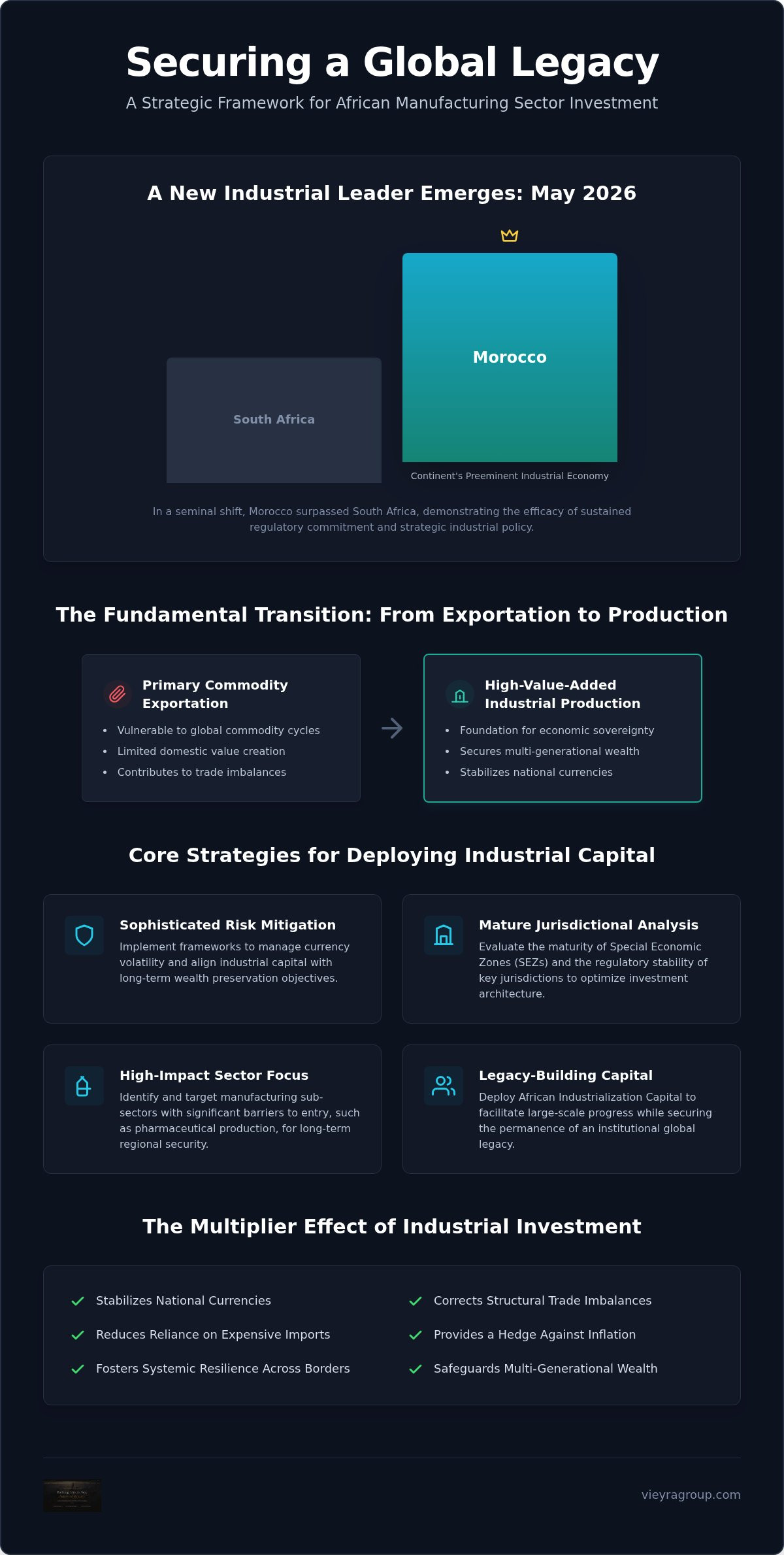
In May 2026, Morocco surpassed South Africa as the continent's preeminent industrial economy, marking a seminal shift in the structural dynamics of the region's productive capacity. While the allure of such growth is undeniable, many institutional actors remain hesitant due to the perceived complexities of jurisdictional risk and the absence of sophisticated frameworks for African manufacturing sector investment. It is understood that the primary challenge lies in the delicate alignment of industrial cycles with the rigorous demands of long-term wealth preservation.
This article offers a definitive analysis of the strategic capital solutions and institutional architectures required to facilitate sovereign-scale industrialization. We shall examine the deployment of African Industrialization Capital within high-barrier-to-entry sub-sectors, providing a roadmap for capital allocation that harmonizes with the expansive trajectory of the African Continental Free Trade Area. Through this lens, the manufacturing sector emerges not merely as a vehicle for diversification, but as the essential nexus for securing a multi-generational global legacy.
Key Takeaways
- Evaluate the strategic transition from primary commodity exportation to high-value-added industrial production as a fundamental requirement for continental economic sovereignty.
- Analyze the maturity of Special Economic Zones and the regulatory stability of key jurisdictions to optimize the architecture of African manufacturing sector investment.
- Master sophisticated risk-mitigation frameworks designed to manage currency volatility and align industrial capital with the objectives of multi-generational wealth preservation.
- Identify high-impact manufacturing sub-sectors, including pharmaceutical production, that present significant barriers to entry and contribute to long-term regional security.
- Explore how the strategic deployment of African Industrialization Capital facilitates large-scale progress while securing the permanence of an institutional global legacy.
The Strategic Imperative of African Manufacturing Sector Investment
The year 2026 marks a seminal transition where the manufacturing sector has solidified its position as the indispensable cornerstone of economic sovereignty across the continent. This shift represents a fundamental departure from the historical legacy of raw material exportation, which often left economies vulnerable to the caprices of global commodity cycles. Institutional actors now recognize that the transition toward high-value-added industrial production is not merely a policy preference but a strategic necessity for long-term stability. Within this context, African manufacturing sector investment has evolved into a sophisticated asset class that demands a profound understanding of both localized industrial dynamics and global capital flows.
The synergy between institutional capital and continental industrialization goals is currently at its most potent. By moving beyond simple extraction, nations are reclaiming the value chain, ensuring that the wealth generated from natural resources is multiplied through domestic processing and assembly. This structural evolution requires a composed and authoritative approach to capital deployment. It's a process that prioritizes the creation of permanent industrial foundations over the pursuit of fleeting, speculative gains. This methodical approach ensures that capital serves as a stabilizing force, reinforcing the economic architecture of the region.
Industrialization as a Catalyst for Sovereign-Scale Growth
Industrialization serves as the primary engine for stabilizing national currencies and correcting structural trade imbalances that have historically hindered sustainable growth. By internalizing the production of essential goods, nations reduce their reliance on expensive imports and improve their foreign exchange positions. The historical context of African industrialization reveals a pattern of fragmented initiatives that the current era of institutional capital deployment is designed to unify. African Industrialization Capital acts as the essential fuel for this 2026 economic transformation, providing the requisite scale to foster systemic resilience across borders. This deployment of capital creates a multiplier effect, where a single industrial hub can catalyze growth across an entire regional supply chain.
The Multi-Generational Horizon of Industrial Assets
While public equity markets often succumb to the pressures of quarterly volatility and short-term sentiment, industrial infrastructure offers a sense of permanence and inherent value. These are tangible assets that exist in the physical world. In an increasingly complex global geopolitical landscape, the ownership of productive capacity provides a unique hedge against inflation and a robust safeguard for multi-generational wealth. Aligning industrial projects with the stewardship principles of a global family office ensures that African manufacturing sector investment is managed with the deliberation required for legacy building. It's about the foresight to see beyond the immediate horizon and invest in the enduring strength of the industrial landscape.
Structural Frameworks for Deploying Strategic Capital
The successful deployment of sovereign-scale capital into the industrial landscape is predicated upon the robustness of the underlying structural frameworks. It's no longer sufficient to view the continent as a monolith of opportunity; instead, institutional actors must evaluate the granular maturity of specific jurisdictions with the deliberation of a long-term steward. High-performing hubs such as Morocco, which surpassed South Africa as the continent's leading industrial economy in May 2026, demonstrate the efficacy of sustained regulatory commitment and the strategic alignment of national policy with global industrial requirements. This precision in African manufacturing sector investment ensures that capital is not merely spent, but strategically anchored within environments designed for multi-generational stability.
Special Economic Zones: 2026 Maturity and Evolution
Special Economic Zones have evolved from mere export-processing enclaves into integrated industrial ecosystems that offer sophisticated fiscal incentives and world-class logistics. According to the Africa Industrialisation Index, the maturity of these zones in countries like Rwanda and Ethiopia provides a definitive blueprint for de-risking large-scale projects through institutionalized governance. By leveraging Public-Private Partnerships, strategic investors can effectively bridge the infrastructure gap, ensuring that manufacturing facilities are supported by the reliable energy and transport networks necessary for permanence. Those seeking to navigate these complex arrangements and secure their position within these hubs often benefit from Strategic Capital Solutions that align institutional rigor with localized expertise. This methodical approach to infrastructure ensures that industrial assets remain resilient against shifting geopolitical tides.
Continental Integration and the AfCFTA Factor
The African Continental Free Trade Area acts as a primary catalyst for scaling production far beyond domestic borders, fundamentally altering the calculus for African manufacturing sector investment. It facilitates the emergence of regional value chains where raw materials and intermediate goods move with increasing fluidity between nations, allowing for the specialization of industrial clusters. With manufacturing output in Sub-Saharan Africa having consistently risen to exceed the $250 billion mark by 2024, the momentum into 2026 suggests a profound deepening of continental integration. This systemic shift enables the creation of large-scale manufacturing entities that possess the competitive weight to challenge established global players. The alignment of capital with these regional trajectories is essential for any institution committed to the preservation and growth of multi-generational wealth within the African industrial landscape.
Risk Mitigation and Institutional Capital Allocation
The stewardship of institutional wealth within the industrial landscape requires a departure from traditional risk-aversion models toward a more nuanced, risk-adjusted architecture. While perceived jurisdictional volatility in emerging markets often deters the uninitiated, the sophisticated investor recognizes that African manufacturing sector investment is secured through the deliberate construction of sovereign-scale partnerships. These alliances, often fortified by political risk insurance and sovereign guarantees, provide a layer of protection that transcends the immediate political cycle. By aligning with the long-term economic objectives of host nations, capital is positioned not as a transient visitor, but as a foundational pillar of national development. This composed approach ensures that the scale of operations is matched by the weight of the underlying security structures.
Currency volatility remains a primary concern for those deploying long-term capital into productive assets. However, the use of sophisticated hedging instruments and the structuring of revenue streams in hard currencies, particularly for export-oriented manufacturing, can effectively neutralize this exposure. The objective is to ensure that the multi-generational vision of a family office remains uncompromised by the inevitable fluctuations of the foreign exchange market. It's a matter of financial engineering that allows for the absorption of cyclical industrial downturns without jeopardizing the core of the portfolio.
Navigating Jurisdictional and Geopolitical Risk
The permanence of regulatory frameworks is a critical metric for any institutional actor evaluating a new industrial project. In jurisdictions like Egypt, which received approximately $15 billion in FDI in 2025, the stability of the industrial policy environment has been a significant driver of sustained capital inflows. Securing industrial supply chains requires a methodical approach to local partnerships, where regional expertise is integrated into the global investment strategy. This integration ensures that the "permanence" of the investment is protected against localized disruptions, leveraging the collective strength of both sovereign and private entities to maintain operational continuity.
Financial Engineering for Industrial Resilience
Structuring capital for capital-intensive manufacturing requires a methodical approach that balances the needs of greenfield startups with the stability of brownfield expansions. Blended finance models, which combine commercial capital with concessional funding from development finance institutions, are increasingly utilized to enhance institutional returns while mitigating early-stage risk. Maintaining liquidity within a portfolio dominated by industrial infrastructure requires the strategic use of Strategic Capital Solutions to ensure that the long-term nature of the assets doesn't impede the agility of the broader portfolio. This financial rigor ensures that the industrial engine continues to drive growth, even during cyclical downturns, preserving the legacy for future generations. Through this lens, African manufacturing sector investment becomes a vehicle for both systemic impact and the quiet confidence of long-term stability.
Sectoral Focus: High-Impact Manufacturing Sub-Sectors
The identification of manufacturing sub-sectors characterized by high barriers to entry is essential for the preservation and growth of institutional capital. It's no longer sufficient to invest in superficial assembly; the focus must remain on industries that offer sustainable competitive advantages and systemic importance to the continent's trajectory. Within the broader context of African manufacturing sector investment, sectors such as pharmaceuticals, agro-processing, and automotive components have emerged as critical pillars for both regional security and economic sovereignty. These industries require the deliberation and foresight typical of a sovereign-level entity, where the scale of the commitment reflects the depth of the strategic objective.
In July 2026, the investment by a consortium including SPE Capital and Proparco into Delta Holdings, an Egyptian manufacturer of specialty additives, underscored a growing institutional appetite for specialized industrial inputs. This move toward high-tech manufacturing reflects a sophisticated understanding of the value chain, where the production of specialized chemicals and industrial components provides a more resilient hedge than low-tech consumer goods. It's this shift toward complexity that defines the current era of industrial capital deployment.
Pharmaceuticals and Healthcare Sovereignty
The strategic allocation of capital into vaccine and essential medicine production represents a fundamental shift toward healthcare sovereignty. Regulatory harmonization across the continent is expanding the addressable market for domestic producers, making pharmaceutical manufacturing a primary target for institutional investment. This isn't merely a commercial endeavor; it's a matter of regional security that ensures the permanence of the healthcare infrastructure against global supply chain disruptions. For institutions seeking to lead this transformation, the deployment of African Industrialization Capital provides the necessary scale to catalyze multi-generational progress in medical manufacturing.
Agro-Industrial Transformation
Agro-industrial processing serves as the essential bridge between the continent's vast agricultural output and high-value-added industrial production. By closing the loop between primary extraction and final consumption, investors can capture a greater share of the value chain while enhancing food security for a growing population. This transformation relies heavily on the modernization of cold-chain logistics and the integration of advanced technologies into the agro-industrial complex. The rise of sophisticated processing hubs allows for the conversion of raw commodities into finished goods for both domestic and international markets, reinforcing the economic resilience of the region.
Automotive and component manufacturing represents the next frontier for regional integration, where the creation of specialized industrial clusters facilitates the production of customized vehicles. This sector demands a high level of technical precision and a commitment to long-term infrastructure development, aligning perfectly with the visionary architecture of a global family office. As regional value chains deepen, the ability to manufacture specialized components domestically will become a definitive marker of industrial maturity.
The Vieyra Vision: Legacy-Building through Industrial Growth
The Vieyra Family Office operates with the deliberation and foresight of an established institution, positioning itself as a stately guardian of continental progress. In an era where African manufacturing sector investment is often viewed through the narrow lens of development aid, we redefine it as a sophisticated asset class essential for the preservation of global legacy. Our approach involves the deployment of African Industrialization Capital into projects that possess the scale and strategic depth to transform entire regions. This isn't merely about capital allocation; it's about the visionary architecture of a future where African industrial capacity is a cornerstone of global trade. We operate with the poise of an entity that is deeply rooted in its identity and certain of its trajectory.
Strategic stewardship requires a balance between the pursuit of institutional-grade returns and the creation of systemic economic resilience. Through our Global Investment Management initiatives, we ensure that every industrial project adheres to the highest standards of professional rigor and intellectual sophistication. The objective is to facilitate a transition where strategic capital solutions act as the catalyst for long-term economic development, moving beyond the transient nature of speculative markets. This composed and authoritative stance suggests a multi-generational vision that values stability above all else.
Strategic Stewardship and Capital Deployment
The philosophy of sovereign-scale investment is rooted in the belief that large-scale progress is best achieved through the steady, methodical application of capital. We prioritize projects that demonstrate a clear alignment with national growth trajectories, ensuring that industrial growth contributes to the broader stability of the geopolitical landscape. This commitment to permanent impact is what distinguishes our approach, blending the traditional values of heritage with a forward-looking commitment to innovation. Each initiative is evaluated for its capacity to deliver both economic returns and profound social impact, reinforcing the serious nature of our subject matter.
Building a Multi-Generational African Legacy
The Vieyra Family Office views the manufacturing sector as the definitive legacy asset of the 21st century. To ensure the sustainability of these industrial foundations, the Vieyra Foundation complements our investment activities by focusing on workforce development and the cultivation of technical expertise. This holistic integration ensures that the human capital of the continent is prepared to lead the industrial renaissance. We invite institutional partners who share this multi-generational vision to explore our strategic capital solutions for African industrialization. By aligning our collective strengths, we can secure a trajectory of enduring prosperity that resonates across generations, moving forward with the quiet confidence of a significant global actor.
Architecting the Future of Continental Industrial Sovereignty
The evolution of the African industrial landscape demands a definitive departure from antiquated extractive models toward a sophisticated architecture of productive capacity. By prioritizing high-barrier-to-entry sub-sectors and leveraging the structural integration promised by the AfCFTA, institutional actors can secure a preeminent position within the world's next great manufacturing hub. This transition isn't merely an economic shift; it's a foundational requirement for securing multi-generational economic sovereignty. Such a path requires the deliberation of a stately guardian and the foresight of an established institution.
Effective African manufacturing sector investment aligns the rigors of high finance with the timeless values of heritage and progress. As a multi-generational African family office with deep expertise in sovereign-scale capital allocation, we remain committed to systemic industrial transformation. We invite you to Partner with Vieyra Family Office for Sovereign-Scale Industrialization. The scale of this transformation is vast, yet the trajectory is certain. Let's build an industrial legacy that stands as a testament to continental resilience and visionary progress.
Frequently Asked Questions
What are the primary drivers of African manufacturing sector investment in 2026?
The primary drivers include a seminal transition toward domestic value addition and the increasing maturity of regional trade protocols. Nations are prioritizing industrial sovereignty to stabilize trade balances and reduce reliance on expensive imports. This shift is supported by a significant rise in Foreign Direct Investment, which reached approximately $70 billion in 2025, reflecting a global recognition of the continent's growing productive capacity and institutional stability.
How does the AfCFTA impact large-scale industrial projects in Africa?
The African Continental Free Trade Area redefines manufacturing scalability by facilitating the movement of raw materials and intermediate goods across borders without prohibitive tariffs. It allows for the creation of specialized industrial clusters that serve a unified continental market rather than fragmented domestic ones. By 2024, manufacturing output in Sub-Saharan Africa exceeded $250 billion, a figure that continues to grow as regional value chains deepen and logistical bottlenecks are addressed.
What role does a family office play in African industrialization capital?
A family office acts as a stately guardian of capital, providing the multi-generational vision required for capital-intensive industrial projects. Unlike traditional private equity, which may prioritize short-term exits, a family office deploys African Industrialization Capital with a focus on permanence and systemic impact. This institutional approach ensures that projects are managed with the deliberation and foresight necessary to navigate complex cycles while building a lasting global legacy rooted in continental progress.
Which African countries offer the most stable environments for manufacturing investment?
Morocco, Egypt, and Rwanda currently offer the most stable environments for industrial capital deployment due to their robust regulatory frameworks and sustained policy commitment. In May 2026, Morocco surpassed South Africa as the leading industrial economy, demonstrating the efficacy of its long-term strategic planning. Egypt remains a primary destination for industrial FDI, receiving $15 billion in 2025, while Rwanda and Ethiopia continue to refine their Special Economic Zones.
How can institutional investors mitigate currency risk in African industrial assets?
Institutional investors mitigate currency risk by structuring revenue streams in hard currencies and utilizing sophisticated Strategic Capital Solutions to hedge against localized volatility. Export-oriented manufacturing projects are particularly resilient, as they generate foreign exchange earnings that neutralize domestic currency fluctuations. This methodical approach to financial engineering ensures that the long-term objectives of the portfolio remain uncompromised by cyclical macroeconomic shifts, preserving wealth across multiple generations of stakeholders.
What is the importance of Special Economic Zones for sovereign-scale investment?
Special Economic Zones serve as essential de-risking mechanisms by providing a ring-fenced environment of fiscal incentives and world-class infrastructure. These zones act as the primary entry point for African manufacturing sector investment, offering the legal and regulatory stability that institutional capital requires. By concentrating industrial activity within these hubs, nations can provide reliable energy and transport networks, ensuring that large-scale facilities operate with the efficiency and permanence expected of sovereign-scale projects.
How does industrialization align with multi-generational wealth preservation?
Industrialization aligns with multi-generational wealth preservation by providing exposure to tangible, productive assets that possess inherent value and inflation-hedging properties. These assets are less susceptible to the fleeting volatility of public equity markets and offer a sense of permanence in a shifting geopolitical landscape. Investing in the continent's industrial backbone allows an institution to function as a visionary architect of legacy, securing returns that are both financially robust and systemically significant.
What are the high-growth sub-sectors within the African manufacturing landscape?
High-growth sub-sectors include pharmaceutical manufacturing, agro-industrial processing, and automotive component production, all of which offer significant barriers to entry and sustainable competitive advantages. The rise of healthcare sovereignty has made vaccine and essential medicine production a matter of regional security and a primary target for African manufacturing sector investment. Similarly, moving up the value chain in agro-processing and automotive assembly allows investors to capture a greater share of domestic demand.


