
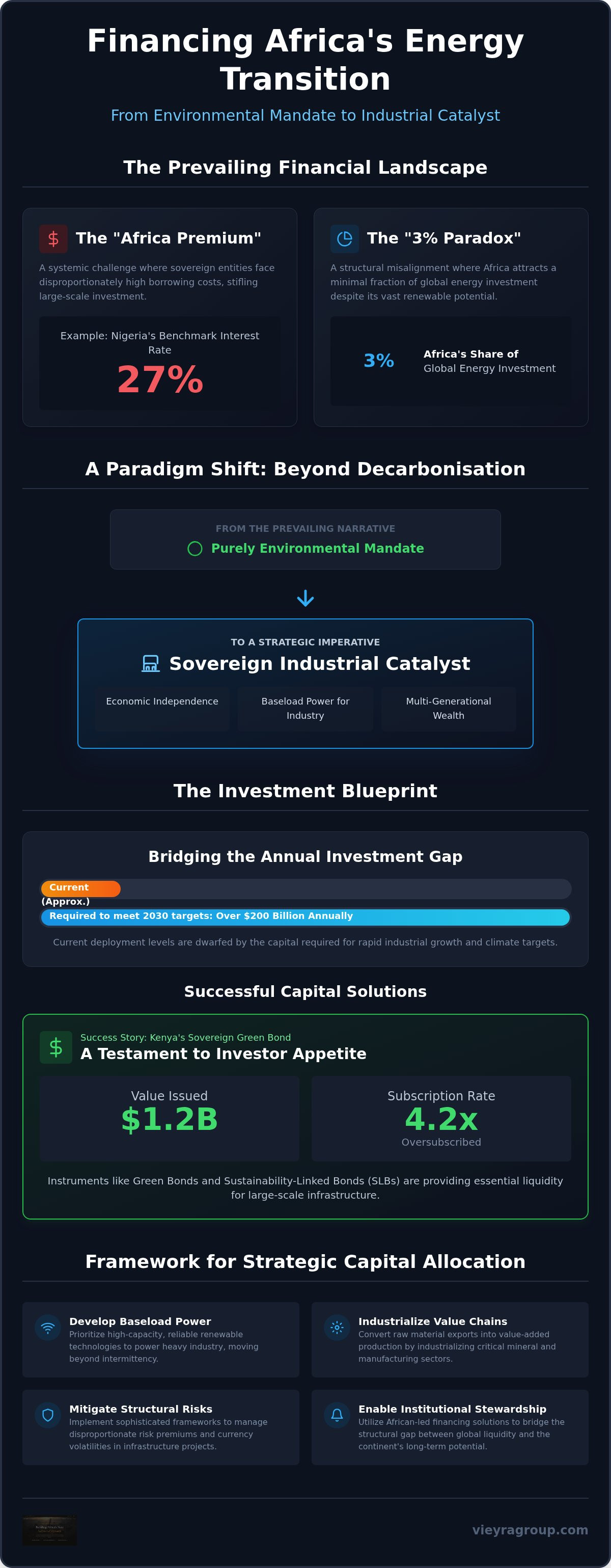
While global discourse often frames the shift to renewables as a purely environmental endeavor, the reality for the continent is far more complex; specifically, when nations like Nigeria face benchmark interest rates of 27 percent, the challenge of African energy transition financing ceases to be a matter of policy preference and becomes a rigorous exercise in sovereign-scale industrial survival. The current financial architecture frequently imposes a prohibitive "Africa Premium," subjecting sovereign entities to borrowing costs that far exceed those of their international peers.
You likely recognize that this systemic misalignment between global mandates and the practical industrial requirements of the continent creates a significant barrier to long-term stability. This article provides a comprehensive institutional analysis of the mechanisms, risk profiles, and strategic capital requirements essential for African energy transition financing at a sovereign scale. By examining the successful issuance of instruments such as Kenya's $1.2 billion sovereign green bond and the development of regional infrastructure like the Nigeria-Morocco Atlantic Gas Pipeline, we establish a robust framework for evaluating transition assets. We shall explore how strategic capital solutions can mitigate structural risks and unlock the multi-generational industrialization opportunities necessary to secure the continent's economic legacy.
Key Takeaways
- Reframe the energy transition from a purely environmental mandate into a strategic catalyst for broad-based industrialization and sovereign-scale economic growth.
- Navigate the institutional landscape of African energy transition financing by identifying the mechanisms, such as Green Bonds and Sustainability-Linked Bonds, that align with multi-generational capital requirements.
- Develop a sophisticated understanding of the risk mitigation frameworks necessary to address disproportionate risk premiums and currency volatilities in large-scale infrastructure projects.
- Identify the strategic priorities for capital allocation, focusing on the development of baseload renewable technologies and the industrialization of critical mineral value chains.
- Gain insight into how institutional stewardship and strategic capital solutions can bridge the structural gap between global liquidity and the continent's long-term industrial potential.
Beyond Decarbonisation: The Strategic Imperative of African Energy Financing
The prevailing global narrative frequently misinterprets the shift toward sustainable power as a singular environmental mandate, yet for the continent, this evolution represents a monumental industrial catalyst. African energy transition financing is not merely a mechanism for climate compliance; it's the foundational architecture for a new era of sovereign economic independence. While the international community focuses on carbon abatement, the strategic priority remains the conversion of latent resources into the high-capacity baseload power required to sustain heavy industry and manufacturing. This paradigm shift requires moving beyond the historical reliance on traditional biomass, which currently serves as a systemic ceiling on economic productivity, toward a diversified, industrial-scale energy mix.
The current landscape is defined by the "3% paradox," a structural disparity where the continent attracts a mere three percent of global energy investment despite possessing a significant portion of the world's Renewable energy potential in Africa. This misalignment isn't just a failure of capital allocation; it's a direct threat to long-term stability. Without a massive infusion of strategic capital, the gap between domestic development needs and global climate mandates will only widen. True energy security is the prerequisite for any nation seeking to command its own economic trajectory and protect its multi-generational wealth.
The Industrialisation-Energy Nexus
Reliable power baseloads are the invisible arteries of a modern economy. When energy is scarce or intermittent, the cost of production rises exponentially, stifling the growth of domestic manufacturing and limiting the potential for value-added exports. Energy poverty acts as a regressive tax on GDP growth, draining resources that could otherwise fund infrastructure and innovation. Energy-led industrialisation is the strategic deployment of high-capacity power infrastructure as the foundational architecture for domestic manufacturing and sovereign economic resilience. By securing consistent power, nations can transition from being exporters of raw materials to becoming hubs of industrial production.
Capital Gaps and Sovereign Ambitions
The International Energy Agency suggests that reaching 2030 targets requires an annual investment exceeding USD 200 billion, a figure that dwarfs current deployment levels. This monumental requirement highlights the tension between international ESG mandates, which often restrict funding for essential transition fuels, and the domestic imperative for rapid industrial growth. African-led financing solutions are emerging as a vital form of economic stewardship, providing the sophisticated syntactical arrangements and risk mitigation necessary to bridge this gap. These initiatives reflect a composed and authoritative stance, ensuring that the next generation of industry is built on a foundation of permanent, stable, and locally governed capital.
Evaluating Sustainable Capital Solutions for Large-Scale Infrastructure
The maturation of African energy transition financing depends on the strategic layering of risk-tolerant capital with long-term institutional debt, creating a capital stack capable of sustaining multi-generational infrastructure. Financing the continent's industrial shift requires a sophisticated hierarchy that transcends traditional aid models, moving deliberately from concessional funding toward sovereign-scale equity and institutional-grade debt. This evolution is already visible in the primary markets; for instance, Kenya's March 2026 issuance of a 1.2 billion dollar sovereign green bond, which was 4.2 times oversubscribed, demonstrates a profound international appetite for well-structured African transition assets. Such instruments, alongside Sustainability-Linked Bonds (SLBs), provide the necessary liquidity while ensuring that capital remains tethered to verifiable industrial outcomes.
Blended finance models serve as the essential bridge in this architecture, utilizing public de-risking mechanisms to unlock private institutional capital that would otherwise remain dormant due to perceived structural risks. By employing "first-loss" layers provided by multilateral entities, sovereign actors can lower the weighted average cost of capital, making capital-intensive projects viable despite high benchmark rates in certain jurisdictions. Those seeking to navigate these complex capital stacks often require strategic capital solutions that align with sovereign-scale objectives and provide the necessary depth for large-scale industrialization.
Instruments of Transition
Development Finance Institutions (DFIs) continue to play a critical role in early-stage risk absorption, as evidenced by the African Development Bank's 100 million euro loan to Gotion Power Morocco in July 2026 for the continent's first lithium-ion phosphate battery gigafactory. While DFIs provide the foundation, private equity and family offices offer the flexible, permanent capital required to scale these initiatives into fully integrated industrial value chains. Furthermore, the emergence of carbon credits as a supplementary financing mechanism provides an additional revenue stream that can enhance project bankability, provided the governance frameworks are sufficiently robust to meet global institutional standards.
The Architecture of Bankability
The primary obstacle to large-scale investment often isn't a lack of capital but a deficit of bankable projects, particularly those addressing the "Zombie Energy System" of aging, inefficient grids. Modernizing transmission and distribution infrastructure is a prerequisite for attracting long-term institutional commitments, as even the most advanced renewable generation assets are rendered useless without a stable path to the industrial consumer. Establishing clear legal and regulatory frameworks, coupled with strategic asset allocation within energy-heavy portfolios, ensures that projects remain resilient against political cycles and currency fluctuations. It's this commitment to institutional-grade governance that transforms a mere project into a sovereign-scale asset of permanent value.
The Cost of Capital: Mitigating Risk through Institutional Stewardship
The primary structural impediment to the acceleration of African energy transition financing remains the disproportionate cost of capital, a phenomenon often characterized as the "Africa Premium." While global liquidity is abundant, the deployment of funds into African infrastructure is frequently hindered by risk assessments that fail to distinguish between transient political volatility and long-term industrial viability. Data from the International Energy Agency indicates that the cost of capital for energy projects on the continent can be two to three times higher than in developed markets; this disparity creates a formidable barrier to the realization of capital-intensive renewable initiatives. When the benchmark interest rate in a leading economy like Nigeria reaches 27 percent, as recorded in July 2026, the reliance on local currency borrowing for multi-decade projects becomes mathematically unsustainable, necessitating a more sophisticated approach to institutional stewardship.
Currency risk presents a secondary, yet equally potent, challenge to sovereign-scale stability. The prevalence of USD-denominated debt in markets where energy revenues are collected in local currency creates a fundamental mismatch that can jeopardize even the most technically sound projects. Addressing this requires more than just traditional political risk insurance; it demands strategic sovereign partnerships and the presence of "Guardian" capital. This form of multi-generational investment operates with a horizon that extends beyond the typical five-to-seven-year private equity cycle, allowing the institution to absorb short-term shocks in favor of long-term industrial dividends.
Risk Perception vs. Reality
Deconstructing the perceived risk of the continent requires a rigorous, data-driven due diligence process that moves beyond broad sovereign ratings to examine the granular success of specific industrial corridors. Local institutional presence is the most effective tool for risk mitigation, as it provides the cultural and geopolitical context necessary to navigate complex regulatory environments. The Vieyra approach conceptualizes risk as a manageable dimension of multi-generational permanence, where the depth of the institutional horizon naturally absorbs the transient volatilities of the market. By maintaining a composed and authoritative presence on the ground, institutional investors can bridge the gap between perceived instability and the reality of high-performing industrial assets.
Sovereign-Scale De-risking Strategies
Traditional de-risking mechanisms, such as partial risk guarantees from multilateral banks, are essential but often insufficient for the scale of the required transformation. A more robust strategy involves strategic industrial integration, where energy projects are tethered to reliable off-takers within regional power pools or large-scale manufacturing hubs. The July 2026 ECOWAS agreement regarding the Nigeria-Morocco Atlantic Gas Pipeline exemplifies this shift toward regional cooperation as a means of stabilizing revenue streams across borders. Utilizing institutional expertise to navigate these complex geopolitical landscapes ensures that capital is not merely protected but is actively contributing to the architecture of a resilient, self-sustaining economic legacy.
A Framework for Strategic Allocation in Renewable Energy Industrialisation
Effective capital deployment within the architecture of African energy transition financing requires a transition from broad-spectrum investment toward a targeted, industrial-scale allocation strategy. The objective is to identify and fund assets that do not merely generate power but serve as the bedrock for systemic economic transformation. This necessitates a prioritisation of "Baseload Renewables," such as geothermal resources in the East African Rift Valley, large-scale hydroelectric projects, and utility-scale solar-plus-storage configurations. Unlike intermittent sources, these technologies provide the continuous, high-capacity energy required to sustain heavy manufacturing and industrial processing, ensuring that the transition supports rather than stifles productivity.
While generation often captures the majority of international attention, the strategic importance of transmission and distribution (T&D) infrastructure cannot be overstated. A modernised grid is the essential conduit that transforms raw energy into industrial output; without robust T&D, even the most ambitious generation projects remain stranded assets. In regions where national grids remain fragmented, balancing utility-scale initiatives with decentralized industrial microgrids offers a pragmatic path forward. These localized systems provide the reliability required for mining and manufacturing hubs, allowing industrialization to proceed in parallel with broader grid modernization. For institutions seeking to lead this transformation, securing African Industrialization Capital is the critical step in aligning strategic resources with these high-impact infrastructure requirements.
The Critical Minerals Opportunity
The global demand for transition minerals presents a unique opportunity to link mineral wealth directly to energy sovereignty. Financing must move beyond the extraction of raw materials toward the development of domestic processing and value-chain industrialisation. By establishing local value loops, nations can ensure that the benefits of the energy transition are captured within the continent, fostering a self-sustaining ecosystem of industrial growth. Linking mineral processing to renewable baseloads creates a virtuous cycle where energy sovereignty and industrial competitiveness reinforce one another, protected by the foresight of multi-generational capital.
Infrastructure as an Asset Class
Energy infrastructure offers a compelling yield profile for family offices and institutional investors focused on long-term wealth preservation. These assets provide stable, inflation-hedged returns that are increasingly decoupled from the volatility of traditional global equity markets. Integrating energy infrastructure into a diversified global portfolio allows for the realization of institutional-grade returns while contributing to the foundational economic architecture of the continent. Sophisticated frameworks for measuring social impact now allow investors to quantify the broader economic dividends of their allocations, ensuring that every deployment of capital serves the dual purpose of financial performance and sovereign-scale progress.
Sovereign-Scale Investment as the Catalyst for Economic Transformation
The realization of a prosperous African century necessitates a fundamental shift from speculative, short-term ventures toward the deliberate application of sovereign-scale strategic capital. Vieyra Family Office operates at this critical juncture, serving as a visionary architect of legacy by deploying resources into the foundational sectors that define the continent's industrial trajectory. By prioritizing projects with multi-generational horizons, the office ensures that African energy transition financing isn't merely a temporary response to global pressure but a permanent pillar of domestic economic sovereignty. This approach recognizes that the next generation of African industry requires more than just liquidity; it demands the steady, composed guidance of an institution rooted in the continent's long-term success.
Strategic Capital Solutions provide the necessary depth to bridge the gap between high-level policy objectives and the practical realities of industrial execution. By deploying African Industrialization Capital, the office supports the development of the high-capacity infrastructure discussed throughout this framework, from baseload geothermal plants to regional power pools. This commitment to permanence ensures that the transition serves as a catalyst for systemic economic transformation rather than a series of isolated projects. It's through this lens of multi-generational stewardship that the office navigates the complexities of the current financial landscape.
The Architecture of Legacy
Anchor institutions provide the structural stability required for regional development, acting as the bedrock upon which complex industrial ecosystems are built. The presence of African-owned capital is paramount in this regard, as it ensures that the strategic direction of the continent's development remains under the stewardship of those with a vested interest in its multi-generational prosperity. Strategic capital allocation serves as a sophisticated tool for wealth preservation, aligning the preservation of family heritage with the broader objective of sovereign economic resilience. Through the Vieyra Foundation, philanthropic initiatives are meticulously integrated with economic development goals, ensuring that social progress and industrial growth advance in a cohesive, mutually reinforcing manner.
Engagement and Partnership
Navigating the intricate intersection of high finance, complex geopolitics, and large-scale industrial growth requires a level of institutional excellence that transcends traditional investment management. The sophisticated requirements of African energy transition financing demand a partner capable of managing the "Africa Premium" through rigorous due diligence and deep regional integration. By engaging in deep, sovereign-scale partnerships, the office facilitates the transfer of global expertise while maintaining a firm commitment to the unique requirements of the African market. This steady, methodical pace of development mirrors the enduring nature of our objectives, prioritizing quality and depth over the transience of the market.
Sovereign-scale investment remains the ultimate catalyst for transformation, providing the permanence and foresight necessary to architect a legacy that will endure for centuries. As the continent moves toward its 2030 and 2050 milestones, the role of institutional-grade stewardship will only become more critical in securing a resilient industrial future. The commitment of the Vieyra Family Office to these long-term objectives represents a composed and authoritative stance in the global arena, ensuring that the architecture of the African century is built on a foundation of stability, vision, and sovereign strength.
Architecting the Sovereign Future of African Industry
The evolution of African energy transition financing represents a fundamental shift toward the permanence of the continent's industrial base. This framework has demonstrated that the strategic layering of capital and the mitigation of disproportionate risk premiums through institutional stewardship can unlock systemic economic growth. By prioritizing baseload renewables and modernizing critical infrastructure, sovereign entities don't just participate in a global mandate; they secure their own economic legacy. It's this commitment to long-term stability that transforms volatile markets into reliable corridors for industrial processing and value-added exports.
Achieving this vision requires a partner with a global investment management perspective and a commitment to multi-generational wealth preservation. Our sovereign-scale institutional expertise provides the depth needed to navigate the complex intersection of high finance and large-scale industrial development. Explore our approach to Strategic Capital for African Industrialisation to understand how we facilitate long-term progress. The path ahead is one of profound opportunity for those who act with deliberation and foresight.
Frequently Asked Questions
What is the primary barrier to African energy transition financing in 2026?
High benchmark interest rates and the prohibitive cost of capital remain the most significant obstacles to African energy transition financing in 2026. For instance, Nigeria's benchmark rate reached 27 percent in July 2026, making local currency financing for long-term infrastructure projects largely unsustainable. This environment forces a heavy reliance on foreign investment and development finance institutions to bridge the investment gap.
How does the cost of capital in Africa compare to developed markets for energy projects?
Energy projects on the continent typically face a cost of capital that's two to three times higher than those in developed markets. This "Africa Premium" is exacerbated by the sovereign ceiling rule, which ties project creditworthiness to the host nation's rating. Consequently, even commercially robust projects are often perceived as high-risk by international lenders, requiring sophisticated de-risking mechanisms to attract institutional-grade investment.
What role do family offices play in sovereign-scale African investments?
Family offices serve as visionary architects of legacy by providing the patient, multi-generational capital necessary for sovereign-scale industrialization. Unlike traditional private equity, these institutions operate with a horizon that prioritizes long-term stability and regional development over short-term exits. They act as anchor investors, fostering institutional excellence and ensuring that projects remain resilient across political and economic cycles.
Can Africa achieve energy sovereignty through renewable energy alone?
While renewable energy resources are vast, achieving true energy sovereignty often requires a strategic mix of baseload renewables and transition fuels. Projects like the Nigeria-Morocco Atlantic Gas Pipeline, formally endorsed in July 2026, complement hydro and geothermal power to provide the consistent energy required for heavy industry. This balanced approach ensures that the transition supports industrial growth while moving toward a sustainable future.
How does the Vieyra Family Office approach risk in African industrial projects?
The Vieyra Family Office manages risk by utilizing a deep institutional horizon that naturally absorbs transient market volatility. By focusing on multi-generational wealth preservation and sovereign-scale industrialization, the office prioritizes project bankability and institutional-grade governance. This approach transforms perceived political risks into manageable variables through local integration and the deployment of Strategic Capital Solutions.
What are the most effective financial instruments for large-scale energy infrastructure in Africa?
Sovereign green bonds and blended finance models have emerged as the most effective instruments for securing large-scale energy infrastructure. Kenya's 1.2 billion dollar green bond issuance in 2026, which was oversubscribed by four times, demonstrates the global appetite for well-structured transition assets. These instruments allow nations to access international liquidity while maintaining alignment with domestic development priorities and industrial needs.
How does energy transition financing impact African industrialisation?
The successful deployment of African energy transition financing acts as a primary catalyst for industrialization by providing the reliable baseload power necessary for domestic manufacturing. Energy-led industrialization allows nations to move beyond raw material exports toward value-added production. This transition strengthens economic resilience and ensures that the continent's industrial output is built on a foundation of sustainable, locally governed energy.
What is the role of the Vieyra Foundation in the energy transition?
The Vieyra Foundation aligns philanthropic efforts with strategic economic development to foster a self-sustaining ecosystem of progress. By supporting educational and institutional initiatives, the foundation ensures that the human capital necessary for a modern industrial economy is developed in tandem with physical infrastructure. This synergy creates a comprehensive framework for multi-generational growth and ensures that the benefits of the energy transition are broadly realized.


