
Is it possible that the conventional architecture of private equity, often defined by its pursuit of swift liquidity, is fundamentally misaligned with the multi-decadal requirements of sovereign-scale industrial progress? Many institutional allocators rightly observe that the perceived volatility of emerging markets, coupled with the complexity of cross-border regulatory frameworks, creates a daunting barrier to entry. This friction is often compounded by a structural mismatch between traditional exit timelines and the enduring nature of heavy industrial development. This analysis provides an authoritative examination of how institutional capital allocation and specialized private equity for African industrial projects can be restructured to prioritize strategic, patient capital over transient gains.
By shifting the perspective from tactical speculation to long-term stewardship, investors can unlock the profound potential of a continent on the precipice of a new era. You will gain a comprehensive framework for evaluating industrial finance options that harmonize private sector growth with the broader economic mandates of sovereign development. We shall explore the mechanisms of strategic capital deployment that foster multi-generational stability and ensure that industrialization serves as a permanent catalyst for regional transformation.
Key Takeaways
- Understand the paradigm shift from extractive capital to industrial-focused investment, facilitated by the regional scale provided by the African Continental Free Trade Area.
- Identify the structural advantages of growth-oriented capital over traditional leveraged buyout models when deploying private equity for African industrial projects.
- Evaluate the necessity of hybridized capital structures that balance the trade-offs between equity dilution and debt servicing within the context of heavy industrial development.
- Recognize the critical role of local institutional presence and sovereign-scale stewardship in navigating complex regulatory frameworks and ensuring ESG compliance.
- Align multi-generational wealth with systemic economic transformation through a framework of patient, strategic capital allocation designed for long-term stability.
The Strategic Imperative of African Industrialisation Finance
The historical paradigm of African capital allocation, long characterized by the extraction of raw commodities, is undergoing a profound transformation toward the realization of domestic industrial capacity. This shift represents a move from transient trade toward the creation of permanent value, where the objective isn't merely the movement of goods but the establishment of sophisticated manufacturing ecosystems. Strategic private equity for African industrial projects serves as the cornerstone of this evolution, providing the necessary depth to transition from commodity dependence to industrial resilience. By 2026, the convergence of sovereign development goals and private institutional capital will likely define the most significant infrastructure deployments on the continent.
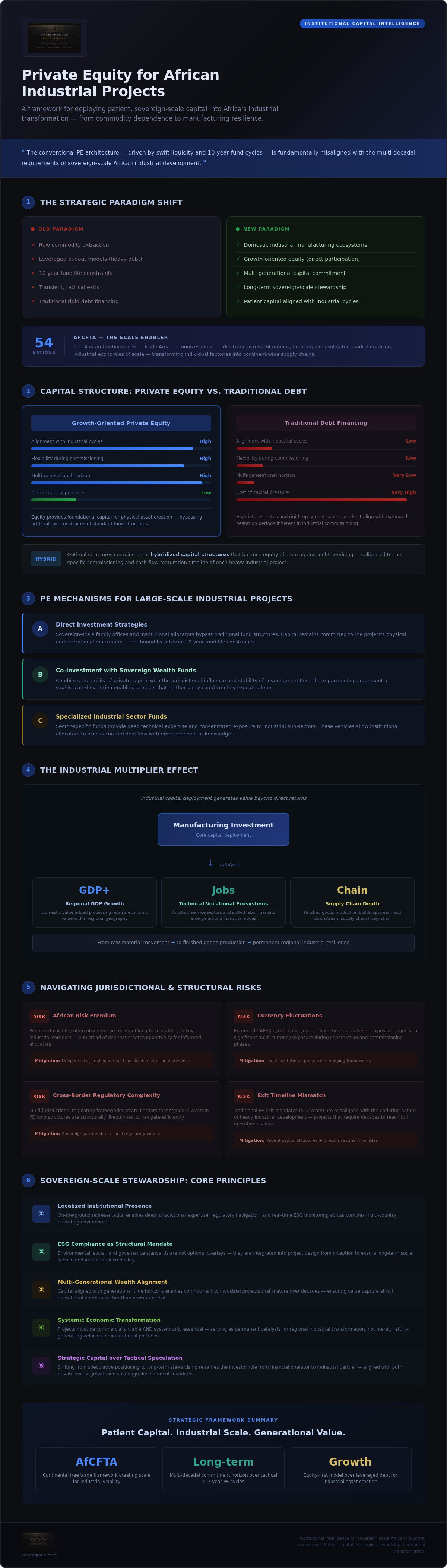
Traditional debt financing often proves insufficient for the rigorous requirements of large-scale manufacturing. High interest rates and rigid repayment schedules don't align with the extended gestation periods inherent in industrial commissioning. Instead, the African Continental Free Trade Area (AfCFTA) provides the structural scale required to justify these long-term commitments. By harmonizing trade across borders, the AfCFTA creates a consolidated market that allows industrial projects to achieve the economies of scale previously reserved for globalized Western hubs. This systemic integration ensures that capital isn't just funding a factory; it's investing in a continent-wide supply chain.
The Architecture of Industrial Economic Transformation
Industrial projects generate a multiplier effect that extends far beyond immediate fiscal returns, catalyzing regional GDP growth through the creation of ancillary service sectors and technical vocational ecosystems. The shift toward value-added processing requires a sophisticated understanding of capital intensity and technical risk. African Industrialisation Finance is the strategic deployment of multi-generational capital into productive infrastructure. This model prioritizes the development of localized processing facilities that transform raw materials into finished goods, ensuring that the economic value remains within the regional geography.
Capital Allocation Challenges in the Current Macro Environment
Institutional allocators must confront the "African Risk Premium," a perception of volatility that often obscures the reality of long-term stability in key industrial corridors. Managing currency fluctuations during extended CAPEX cycles requires a localized institutional presence and deep jurisdictional expertise. In a high-interest global economy, the necessity of patient capital becomes paramount. It's no longer enough to seek tactical exits; the current environment demands a commitment to stewardship. Success in this landscape depends on the ability to align industrial growth with sovereign-scale economic development, ensuring that projects are both commercially viable and systemically essential.
Private Equity Mechanisms for Large-Scale Industrial Projects
The mechanisms of private equity for African industrial projects differ fundamentally from the leveraged buyout models prevalent in Western markets. While Western private equity often relies on heavy debt to enhance returns, the African industrial landscape demands a growth-oriented approach where equity provides the foundational capital for physical asset creation. This necessitates a transition from financial engineering toward a model of direct participation. Sovereign-scale family offices and institutional allocators are increasingly adopting direct investment strategies that bypass traditional fund structures, allowing for greater alignment with long-term industrial cycles. Such direct participation ensures that capital remains committed to the project's physical and operational maturation rather than being subject to the artificial constraints of a ten-year fund life.
Co-investment frameworks between private institutions and sovereign wealth funds represent a sophisticated evolution in capital deployment. These partnerships combine the agility of private capital with the jurisdictional influence and stability of sovereign entities. Specialized industrial funds have also emerged as critical actors, focusing on sector-specific development such as petrochemicals, mineral processing, or advanced manufacturing. These entities provide more than just liquidity. They offer the technical expertise required to oversee complex industrial operations. It's this combination of capital and specialized knowledge that allows for the successful execution of projects that might otherwise be deemed too complex for generalist investors.
Equity as a Catalyst for Industrial Expansion
Equity serves as a vital risk-bearing cushion, absorbing the initial shocks of greenfield development where debt servicing would be prohibitive. Institutional investors must decide between taking minority stakes to support existing operators or acquiring controlling interests in strategic industrial assets to drive systemic change. The inclusion of institutional PE often brings a level of professional management and rigorous governance that is essential for scaling operations to a global standard. Exploring strategic capital solutions can help institutions align their governance models with these long-term industrial objectives.
Navigating the Industrial Lifecycle
Navigating the industrial lifecycle requires a nuanced understanding of where capital is most effective. Greenfield projects offer the highest potential for impact but carry significant development risk, while brownfield optimization focuses on enhancing the efficiency of established assets. Managing the J-curve, the period of initial losses before an industrial project becomes profitable, demands a multi-decade horizon that few traditional funds can accommodate. Structuring exits in this context isn't just about liquidity; it's about ensuring the industrial legacy remains intact through transitions to long-term institutional owners or public listings.
Evaluating Capital Structures: Private Equity vs. Traditional Debt
The determination of an optimal capital stack for heavy manufacturing requires a meticulous evaluation of the trade-offs between equity dilution and the burden of debt servicing. Traditional debt instruments, while offering a lower nominal cost of capital, often impose rigid repayment schedules that fail to account for the extended ramp-up periods inherent in industrial commissioning. In contrast, private equity for African industrial projects provides a risk-bearing foundation that preserves operational liquidity during the critical early years of production. This equity cushion allows for a more deliberate approach to scaling, ensuring that the enterprise isn't compromised by the immediate pressure of interest payments or restrictive debt covenants.
Heavy industry necessitates a hybridized approach to capital structure that balances the discipline of debt with the strategic patience of institutional equity. Debt covenants, while designed to protect lenders, can frequently limit the operational flexibility of industrial operators, hindering their ability to reinvest cash flows into technical upgrades or regional expansion. Private equity acts as a vital bridge, providing the stability needed to eventually transition toward public capital markets or sovereign buyouts. By maintaining a significant equity layer, industrial projects can navigate the inevitable cycles of global commodity prices without the constant threat of technical default.
The Mechanics of Infrastructure and Industrial Finance
Mezzanine finance serves as a critical instrument for mid-tier industrial projects, effectively filling the gap between senior debt and pure equity. These structures often incorporate credit enhancement mechanisms and political risk insurance to mitigate jurisdictional uncertainties and enhance the project's overall credit profile. This sophisticated layering ensures that capital is deployed with maximum efficiency while protecting the underlying asset's long-term viability.
| Feature | Private Equity | Project Finance | Corporate Debt |
|---|---|---|---|
| Risk Appetite | High (Risk-bearing) | Moderate (Asset-backed) | Low (Balance sheet-backed) |
| Duration | 7 to 15+ years | 10 to 20 years | 3 to 7 years |
| Flexibility | High strategic input | Low (Rigid covenants) | Moderate |
Institutional Fee Structures and Strategic Alignment
The traditional "2 and 20" fee model is increasingly viewed as anachronistic in the context of multi-generational industrialization. Institutional allocators are moving toward structures that align management fees with long-term industrialization milestones rather than short-term capital gains. This shift ensures that the interests of the investment manager remain inextricably linked to the physical and economic success of the industrial asset. For an authoritative analysis of these evolving models, consider the implications of Infrastructure Investing: Fees and Structures within a sovereign-scale portfolio.
Navigating Jurisdictional and Structural Risks in African Industry
The successful deployment of private equity for African industrial projects requires a sophisticated appreciation of the continent's diverse regulatory landscapes and the structural risks inherent in long-cycle asset development. Managing the intricacies of cross-border logistics and jurisdictional friction demands a local institutional presence that transcends mere representation. It requires a deep, multi-generational rootedness in the markets where capital is deployed. This institutional gravity allows for the navigation of complex bureaucratic environments with a level of poise and foresight that external actors often lack. By positioning themselves as stately guardians of progress, investors can transform potential roadblocks into structured pathways for growth.
Mitigating political risk is best achieved through the cultivation of sovereign-scale partnerships and the utilization of bilateral agreements that provide a layer of institutional protection. These frameworks ensure that industrial initiatives are recognized as essential components of national development rather than isolated private ventures. The Vieyra Foundation plays a pivotal role in this ecosystem by fostering local human capital, ensuring that the technical and managerial skills required for industrial success are developed within the communities where projects operate. This alignment of social progress with industrial capacity ensures that projects remain systemically relevant and locally supported over several decades.
Regulatory Frameworks and AfCFTA Integration
The harmonization of investment treaties across the continent is essential for reducing the friction that has historically hindered large-scale industrial logistics. As regional integration deepens, the ability to move intermediate goods and finished products across borders becomes a primary driver of operational efficiency. Institutional investors leverage the AfCFTA to consolidate fragmented national markets into a unified industrial corridor, creating the necessary scale to support the high capital requirements of modern manufacturing. This integration allows for the creation of regional value chains that are resilient to global supply chain disruptions.
ESG as a Value Driver in Industrial Finance
In the realm of heavy industry, ESG compliance has evolved from a regulatory requirement into a strategic advantage that enhances project longevity. Stewardship of environmental resources and social capital isn't merely about risk mitigation; it's about ensuring the permanence of the industrial asset. By integrating these values into the core of the investment process, institutions can secure the long-term support of both sovereign entities and local populations. Understanding The Principles of Global Investment Management is critical for any allocator seeking to harmonize high-finance objectives with these essential standards of sustainability.
Navigating these complex structural risks requires more than just capital; it demands a partner with the institutional weight to influence outcomes. For organizations seeking to align their portfolios with the continent's industrial future, securing Strategic Capital Solutions is the definitive step toward ensuring multi-generational success in a dynamic global economy.
Sovereign-Scale Stewardship: The Vieyra Family Office Approach
The Vieyra Family Office operates with the conviction that true economic transformation requires a departure from the ephemeral nature of speculative finance. Our philosophy is rooted in the alignment of multi-generational wealth with the systemic progress of African industry. By treating private equity for African industrial projects as an act of stewardship rather than a tactical trade, we ensure that capital serves as a permanent foundation for growth. Sovereign-scale institutions are the natural partners for large-scale infrastructure because they possess the inherent patience and institutional weight required to navigate the multi-decade lifecycles of heavy industry. This approach harmonizes the precision of global investment management with a profound, localized commitment to the continent's industrial future.
Engagement with our office for strategic industrial partnerships involves a shared vision of long-term stability and regional integration. We provide the structural depth necessary to bridge the gap between global capital markets and the specific requirements of African productive assets. This synergy ensures that every deployment of capital is both commercially rigorous and systemically essential, fostering an environment where industrial projects can thrive across generations.
The Architecture of Multi-generational Wealth Preservation
Preserving a legacy across multiple generations requires a sophisticated balance between global asset allocation and concentrated, high-impact industrial investments within Africa. We apply a level of institutional rigor to these industrial bets that is typically reserved for the world's most established sovereign funds. This methodology protects capital from the volatility of short-term cycles while capturing the enduring value created by primary manufacturing and infrastructure. Understanding The Architecture of Multi-generational Wealth is fundamental to our process, as it allows us to maintain a composed stance in the face of global macroeconomic shifts.
Strategic Capital for the Next African Century
Visionary capital must transcend the limitations of traditional venture or growth funds, which often prioritize rapid exits over the establishment of industrial backbones. Our model focuses on the deliberate deployment of resources into sectors that form the sovereign-scale infrastructure of the continent, from advanced mineral processing to regional energy grids. We don't seek the swiftest path to liquidity; we seek the most robust path to permanence. This commitment ensures that the projects we support become integral components of the African economic landscape, resilient to the pressures of global market fluctuations.
Vieyra stands as a stately guardian of African progress, ensuring that the industrial backbone of the continent is built upon a foundation of strategic depth and multi-generational foresight. Through the careful application of private equity for African industrial projects, we are architecting a legacy that will define the next century of growth. Our trajectory is certain, and our commitment to the continent's industrialization remains the cornerstone of our institutional identity.
Architecting the Industrial Legacy of the Next Century
The realization of a resilient African industrial landscape necessitates a fundamental recalibration of how institutional allocators interpret the intersection of duration and risk. We've examined the mechanisms by which the strategic deployment of private equity for African industrial projects catalyzes sovereign-scale transformation, effectively transcending the constraints of conventional liquidity cycles. By adopting hybridized capital structures and leveraging deep jurisdictional expertise, investors can ensure that productive assets achieve their full potential within the sophisticated regional supply chains envisioned by the AfCFTA.
Securing a position in this evolving landscape requires a partner that blends global investment management expertise with a profound, multi-generational African heritage. This perspective ensures that industrial initiatives are not merely tactical investments but permanent contributions to a continent's economic backbone. We invite you to explore our framework for Sovereign-Scale Industrial Stewardship at the Vieyra Family Office to leverage our sovereign-scale institutional capacity. The trajectory of African industrialization is certain, and the opportunity for visionary capital to establish a lasting legacy has never been more profound.
Frequently Asked Questions
What is the typical investment horizon for private equity in African industrial projects?
The investment horizon for private equity for African industrial projects typically extends across a multi-decade span, often ranging from ten to twenty years. This duration aligns with the extensive gestation periods required for greenfield commissioning and the subsequent maturation of complex manufacturing ecosystems. Such a timeframe allows for the navigation of the initial J-curve while ensuring that the industrial asset reaches full operational efficiency before any eventual transition of ownership.
How does the African Continental Free Trade Area (AfCFTA) affect industrial investment?
The African Continental Free Trade Area fundamentally recalibrates the viability of industrial investment by providing the structural scale necessary for large-scale manufacturing. By harmonizing trade across borders, it consolidates fragmented national markets into a unified industrial corridor. This integration reduces jurisdictional friction and allows industrial projects to achieve economies of scale that were previously unattainable within isolated domestic economies, fostering a more resilient regional supply chain.
What are the primary risks associated with large-scale industrial finance in Africa?
The primary risks associated with large-scale industrial finance include jurisdictional volatility, regulatory complexity, and the potential for currency fluctuations during extended CAPEX cycles. These structural challenges are often compounded by the necessity of significant infrastructure support, such as reliable energy and logistics. Mitigating these risks requires a localized institutional presence and the cultivation of sovereign-scale partnerships that ensure long-term stability and deep political alignment.
Can private equity support green industrialization in Africa?
Private equity for African industrial projects serves as a critical catalyst for green industrialization by prioritizing sustainable energy integration and resource efficiency. Institutional allocators increasingly view ESG compliance not merely as a regulatory requirement but as a strategic advantage that enhances project longevity. By funding low-carbon manufacturing and circular supply chains, private equity ensures that the continent's industrial backbone is built upon modern, sustainable standards.
How do sovereign-scale family offices differ from traditional PE firms in Africa?
Sovereign-scale family offices differ from traditional firms through their commitment to patient capital and multi-generational stewardship. While traditional firms often operate under rigid ten-year fund cycles with a focus on swift exits, family offices prioritize long-term asset preservation and systemic impact. This alignment of wealth with industrial progress allows for a more deliberate approach to scaling, free from the artificial pressures of short-term liquidity mandates.
What role does the Vieyra Foundation play in industrial development?
The Vieyra Foundation plays a pivotal role in industrial development by fostering the local human capital essential for technical and managerial success. It focuses on aligning philanthropic initiatives with strategic industrial growth through vocational training and technical education. By ensuring that the surrounding community possesses the skills required to operate modern industrial facilities, the Foundation secures the social and operational sustainability of large-scale projects across the continent.
Is debt or equity more suitable for African manufacturing projects?
Equity is generally more suitable for the initial phases of African manufacturing projects due to its risk-bearing nature and lack of immediate repayment obligations. Traditional debt often imposes rigid covenants that can hinder operational flexibility during the critical ramp-up period. However, a hybridized approach remains ideal for mature projects, where a layer of senior debt can optimize the capital structure once stable cash flows and operational histories are established.
How can institutional investors mitigate currency risk in African markets?
Institutional investors mitigate currency risk through a combination of local institutional expertise, sophisticated hedging instruments, and a focus on export-oriented industrial projects. By generating revenues in global reserve currencies through the international trade of finished goods, industrial assets can naturally offset domestic currency volatility. Additionally, a localized institutional presence allows for the navigation of complex foreign exchange regulations and the optimization of capital repatriation strategies over time.


