
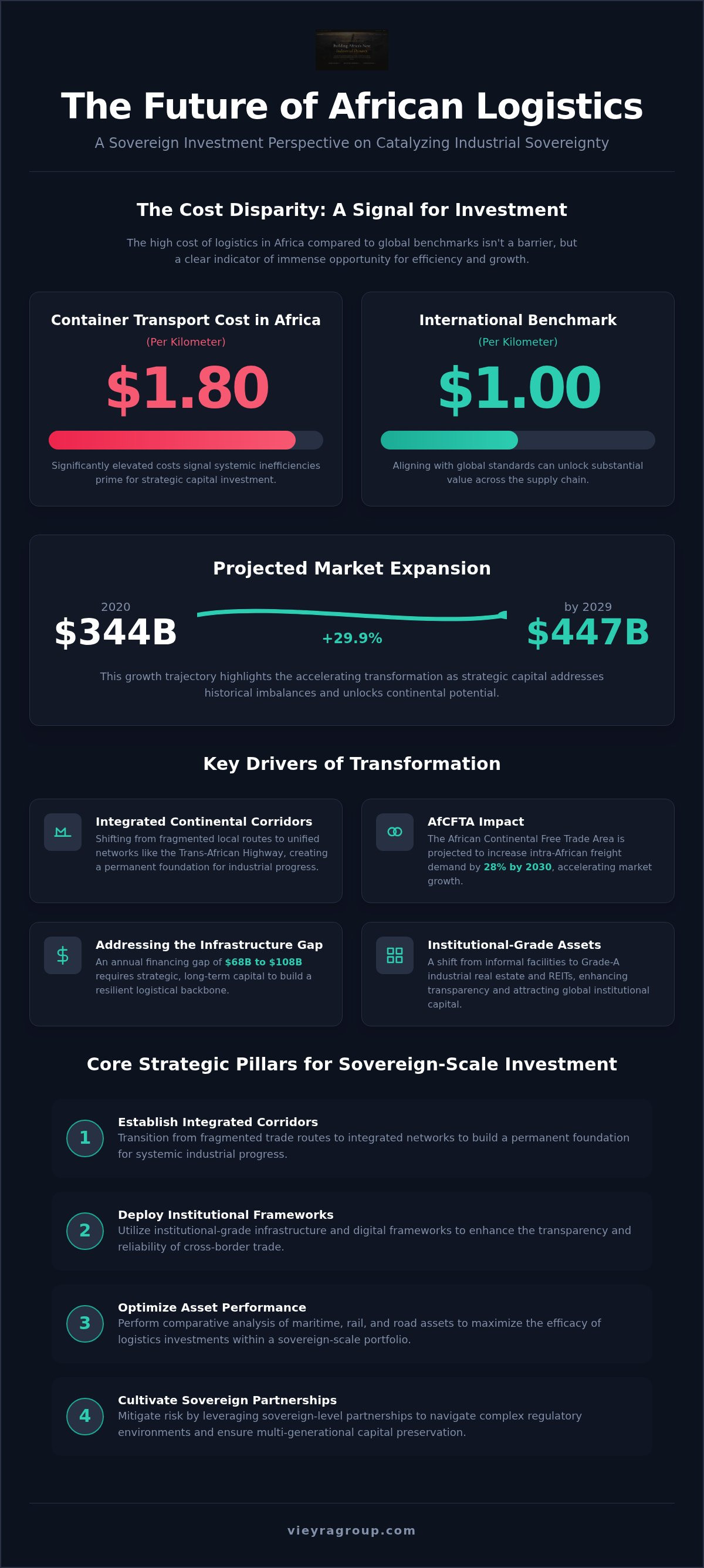
While the international benchmark for container transport is established at one dollar per kilometer, the prevailing cost across the African continent remains significantly elevated at approximately one dollar and eighty cents. This substantial variance is not merely a systemic inefficiency but a definitive signal of the immense opportunity for African logistics and supply chain investment to catalyze a new era of industrial sovereignty. The projected growth of this market to 447 billion dollars by 2029 underscores the magnitude of the transformation currently underway as strategic capital begins to address these historical imbalances.
You recognize that infrastructure deficits and fragmented regulatory frameworks have long served as significant barriers to entry, often impacting manufacturing margins and complicating long-term strategic planning. This institutional analysis provides a sophisticated examination of the structural trends and sovereign-scale opportunities defining the future of African industrial connectivity. We shall explore the identification of high-ROI infrastructure megaprojects, the essential synergy between logistics and continental industrialisation, and the methods for mitigating risk through the cultivation of profound, sovereign-level partnerships that ensure multi-generational stability and growth.
Key Takeaways
- Identify the structural transition from fragmented trade routes to integrated continental corridors, establishing a permanent foundation for systemic industrial progress.
- Evaluate the emergence of institutional-grade infrastructure and digital frameworks as essential drivers for enhancing the transparency and reliability of cross-border trade.
- Analyze the comparative performance of maritime, rail, and road assets to optimize the efficacy of African logistics and supply chain investment within a sovereign-scale portfolio.
- Develop sophisticated strategies for risk mitigation by leveraging sovereign-level partnerships to navigate complex regulatory environments and ensure multi-generational capital preservation.
The Structural Evolution of African Logistics and Supply Chain Investment
The historical paradigm of African trade, once defined by disparate and often isolated local routes, is undergoing a profound structural realignment toward a model of integrated continental corridors. This evolution represents a fundamental shift in the nature of African logistics and supply chain investment, moving beyond the ephemeral nature of speculative venture capital toward the permanence of institutional-grade infrastructure. Central to this transformation is the development of the Trans-African Highway network, a foundational initiative that serves as the physical manifestation of a unified economic landscape. Sovereign-scale investment in this context refers to the deployment of strategic capital into assets that possess the breadth and durability to influence national economic trajectories for generations.
This transition isn't merely a logistical upgrade; it's a wholesale re-architecting of how the continent interacts with global markets. The focus has moved from simple extraction to the complex requirements of value-added manufacturing. By prioritizing the integration of regional blocs, the continent is establishing the necessary framework for a self-sustaining industrial base that can withstand global shocks. It's a move toward systemic resilience where logistics serves as the skeletal structure for all industrial activity.
Industrialisation as the Primary Driver
The success of regional industrial clusters, particularly Special Economic Zones (SEZs), is inextricably linked to the efficiency of the surrounding logistical ecosystem. Without robust connectivity, the potential for value-added manufacturing remains constrained by the friction of high transit costs. Addressing the annual infrastructure financing gap, estimated between 68 billion and 108 billion dollars, requires a commitment of Strategic Capital Solutions that transcends short-term market volatility. This alignment between logistics performance and sovereign stability creates a virtuous cycle. Improved trade facilitation directly bolsters national GDP growth, providing the fiscal headroom for further systemic improvements and reinforcing the stability of the investment environment.
Market Projections and Multi-generational Horizons
Current data suggests a significant expansion of the African logistics market, which is projected to grow from 344 billion dollars in 2020 to approximately 447 billion dollars by 2029. This trajectory is accelerated by the African Continental Free Trade Area (AfCFTA), which is expected to increase intra-African freight demand by 28% by 2030. For the institutional architect, a 25-year investment horizon isn't merely a preference; it's a necessity for capturing the full ROI of large-scale infrastructure projects. Such long-term foresight ensures that capital remains a stabilizing force amidst the broader geopolitical shifts of the century, securing a legacy of progress that extends well beyond the immediate fiscal year.
Key Trends Reshaping Supply Chain Capital in 2026
The landscape of capital allocation is witnessing a significant maturation as investors move beyond the limitations of fragmented, local operations toward institutional-grade assets. This evolution is increasingly facilitated by the emergence of industrial Real Estate Investment Trusts (REITs); these structures offer the transparency and liquidity required by global institutional capital. By standardizing the logistics sector as a distinct asset class, REITs allow for the systematic deployment of funds into large-scale projects that would otherwise remain inaccessible to the broader market. This shift reflects a broader commitment to permanence and the creation of a stable, multi-generational investment environment.
The Institutionalization of Warehousing
The transition from informal storage facilities to Grade-A industrial real estate represents a cornerstone of modern African logistics and supply chain investment. These high-specification environments are essential for the expansion of e-commerce, a sector projected to achieve a valuation of 2.35 billion dollars by 2030. Strategic capital is now focused on port-adjacent logistics hubs and fulfillment centers that meet international standards for safety, automation, and environmental efficiency. This institutionalization doesn't just improve operational throughput; it establishes a permanent, high-value asset base that anchors regional trade corridors and secures the skeletal structure of continental commerce.
Technological Interconnectivity
Digitalization serves as a critical mechanism for eroding the systemic inefficiencies that have historically burdened continental trade. The integration of Blockchain and Internet of Things (IoT) technologies into cross-border logistics provides a level of transparency and security that was previously unattainable. These data-driven supply chains allow for real-time monitoring and automated customs documentation, significantly reducing the "hidden" costs of administrative delay. Investment in smart-port technology and automated terminals offers a unique opportunity to secure long-term ROI by enhancing the capacity of existing infrastructure without the need for expansive physical land acquisition.
As these technological and structural shifts continue to redefine the market, the role of Global Investment Management becomes increasingly vital in identifying and securing the most resilient assets. The pursuit of sustainable logistics, including the decarbonization of transport fleets and the development of energy-neutral warehousing, isn't merely a regulatory requirement. It's a strategic imperative for any entity focused on multi-generational wealth preservation. For those seeking to align their portfolios with these systemic advancements, engaging with Strategic Capital Solutions provides the necessary institutional depth to navigate this evolving landscape with confidence and poise.
Analysing African Infrastructure ROI and Asset Performance
The valuation of infrastructure assets in the African context requires a departure from traditional emerging market metrics, favoring instead a rigorous assessment of long-term utility and systemic integration. While maritime assets often present the most immediate revenue visibility, the strategic depth of rail and road networks offers a superior multiplier for African logistics and supply chain investment. These assets are increasingly structured through sophisticated Public-Private Partnerships (PPPs) and long-term lease arrangements, providing the predictable cash flows necessary for multi-generational wealth preservation. The transition from speculative risk to institutional stability is governed by the reliability of these revenue models, which include tolling regimes and port-concession agreements that anchor the financial viability of the corridor.
Evaluating risk-adjusted returns necessitates a distinction between isolated regional projects and integrated continental trade corridors. Continental corridors, by their nature, mitigate the volatility associated with individual national economies by diversifying the flow of goods across multiple borders. This structural diversification enhances the resilience of the asset, ensuring that the return on capital is protected by the broader momentum of continental trade rather than the fluctuations of a single market. It's a shift toward a more stable, sovereign-scale asset class that aligns with the requirements of the world's most discerning institutional architects.
Corridor-Based Investment Frameworks
The Northern and Central Corridors in East Africa serve as primary examples of how concentrated infrastructure development can enhance asset utilization across entire regions. By prioritizing trans-continental rail projects, the continent is creating a high-capacity skeletal network that significantly reduces the marginal cost of transport. The African Continental Free Trade Area (AfCFTA) acts as a central catalyst here; its projected 28% increase in intra-African freight demand ensures that these corridors operate at the high utilization rates required to sustain institutional-grade ROI. These frameworks provide the necessary scale to justify the deployment of significant strategic capital into long-dated assets.
Cost Reduction as a Value Driver
In several key markets, logistics costs currently represent approximately 30% of national GDP, a figure that stands in stark contrast to the global benchmark of approximately 10% to 12%. Reducing this disparity represents one of the most significant value-creation opportunities in the history of African logistics and supply chain investment. Strategic capital facilitates the elimination of "dead-weight" supply chain losses, such as the 8 billion dollars lost annually in Nigeria due to port and road inefficiencies. By bridging this gap, investors don't just improve margins; they unlock massive equity value by expanding the continent's industrial capacity and sovereign competitiveness.
Risk Mitigation and Stewardship of Strategic Capital
The transition from speculative venture to institutional asset class requires a sophisticated framework for risk management that prioritizes the preservation of capital across multi-generational horizons. Within the context of African logistics and supply chain investment, the primary challenge isn't merely the presence of volatility but the absence of institutional-grade stewardship to navigate it. Effective mitigation involves a shift from short-term profit seeking toward a model of legacy stewardship, where the stability of the investment is secured through deep integration with the continent's industrial trajectory. This approach ensures that capital remains resilient against the cyclical nature of global markets and local geopolitical shifts.
Managing currency and geopolitical risk at this scale necessitates a diversified portfolio that spans multiple trade corridors and regional blocs. By anchoring investments in hard assets that facilitate essential trade, institutional architects create a natural hedge against inflationary pressures. It's a method of capital deployment that views regulatory complexity not as a barrier but as a landscape to be managed through the cultivation of permanent, high-level relationships and the adherence to international legal standards. This level of foresight is what distinguishes a sovereign-scale actor from a traditional market participant.
Sovereign Partnership Models
Project longevity is best secured through the establishment of robust, sovereign-level partnerships that align the interests of private capital with national development goals. Collaborating with national governments and development finance institutions (DFIs) allows for the creation of de-risked investment vehicles that benefit from enhanced legal protections and concessionary support. These frameworks are essential for overcoming the "paradox of projects," where a lack of bankable structuring often leads to a failure at the feasibility stage. By ensuring that every initiative is rooted in a clear legal and financial architecture, we protect the integrity of multi-generational industrial assets from the outset.
ESG and Social Impact
Environmental, Social, and Governance (ESG) criteria are no longer elective considerations; they're the core pillars upon which sustainable infrastructure is built. The African logistics and supply chain investment landscape is uniquely positioned to drive systemic change through local job creation and the transfer of technical skills. The Vieyra Foundation plays a critical role in this ecosystem, ensuring that philanthropic initiatives are strategically aligned with industrial progress to foster a more resilient and capable workforce. This commitment to social impact isn't merely a moral imperative but a strategic necessity for maintaining the long-term viability of global institutional portfolios. To explore how these principles are applied to current industrial initiatives, we invite you to review our Strategic Capital Solutions.
The Vieyra Vision: Architecting the Future of African Industry
The realization of a prosperous African century is fundamentally predicated upon the establishment of a robust, self-sustaining industrial base. Central to this objective is the integration of Global Investment Management with a profound commitment to continental progress. By deploying sovereign-scale capital into transformative supply chain assets, the Vieyra Family Office acts as a stately guardian of this transition, ensuring that African logistics and supply chain investment serves as the immutable foundation for multi-generational wealth preservation. This vision transcends the immediate volatility of the markets, focusing instead on the structural permanence required to anchor a global economic power.
The rhythm of this progress is deliberate and measured, reflecting the long-term nature of the infrastructure we help to build. It's not a rush to market but a methodical construction of legacy. The synergy between Strategic Capital Solutions and local industrialization goals creates a texture of stability that is often missing from more speculative ventures. This is the architect's approach: viewing the continent not as a series of disparate markets, but as a single, interconnected industrial powerhouse that requires sophisticated structural support to reach its full potential.
Strategic Capital Allocation
The identification of high-impact industrial projects requires a sophisticated synthesis of global asset management expertise and granular local industrial knowledge. Our methodology prioritizes initiatives that possess the systemic depth to catalyze broader economic activity, such as the development of integrated processing hubs that bridge the gap between raw material extraction and final market delivery. We extend a call for institutional collaboration, inviting global actors to join in architecting the infrastructure that will define the continent's economic trajectory for the next century. This collaborative framework ensures that capital is not merely deployed but is strategically woven into the very fabric of the continent's growth.
A Legacy of Industrial Progress
True economic sovereignty is achieved when a continent moves decisively beyond the traditional model of raw material extraction toward the cultivation of value-added industrial ecosystems. This "beneficiation" strategy is the core of our vision, where strategic capital is utilized to capture greater value within African borders. The Vieyra Foundation remains a vital component of this strategy, fostering a resilient economy through the support of systemic economic development and the empowerment of local industrial actors. This commitment ensures that African logistics and supply chain investment translates into tangible, long-term social and economic stability. For those seeking to align their capital with these transformative objectives, we invite you to engage with the Vieyra Family Office for strategic insights into the future of continental industry.
Architecting Continental Sovereignty through Strategic Capital
The realignment of continental trade from fragmented routes to integrated corridors establishes a permanent foundation for industrial sovereignty. By addressing the systemic inefficiencies that currently elevate logistics costs to thirty percent of national GDP, institutional architects unlock immense equity value while securing the skeletal framework of future commerce. This transformation requires the deliberate deployment of strategic capital into high-specification assets that meet global standards for transparency and resilience. The maturation of African logistics and supply chain investment represents the definitive shift from speculative interest to the establishment of a sovereign-scale asset class.
As a sovereign-scale institution managing global and African-centric assets, we remain dedicated to the stewardship of large-scale industrial projects that ensure multi-generational wealth preservation. The transition toward a unified, high-capacity industrial ecosystem is no longer a distant aspiration; it's a present reality being forged through sophisticated partnerships and institutional rigor. We invite you to Explore the Vieyra Approach to African Industrialisation to understand how strategic capital is architecting the backbone of a prosperous African century. The trajectory of the continent is certain. The opportunity for meaningful, long-term impact has never been more profound.
Frequently Asked Questions
What is the projected growth of the African logistics market by 2030?
The African logistics market is projected to reach a valuation of 447 billion dollars by 2029, representing a substantial expansion from the 344 billion dollars recorded in 2020. This trajectory is driven by the systemic realignment of continental trade and the increasing demand for high-specification infrastructure. Such growth underscores the expanding scope for African logistics and supply chain investment to provide stable, long-term returns within a sovereign-scale portfolio.
How does the AfCFTA impact African logistics and supply chain investment?
The African Continental Free Trade Area (AfCFTA) is expected to increase intra-African freight demand by 28% by the year 2030. This surge in volume necessitates a corresponding expansion in transport and logistics capacity to ensure the seamless movement of goods across regional blocs. By harmonizing trade protocols, the AfCFTA creates a more predictable environment for the deployment of strategic capital into trans-continental corridors.
What are the primary risks associated with large-scale African infrastructure projects?
Large-scale infrastructure projects face significant hurdles, including a historical failure rate of 80% at the feasibility stage due to inadequate project preparation. Beyond technical challenges, investors must navigate fragmented regulatory frameworks and the substantial infrastructure financing gap, which is estimated between 68 billion and 108 billion dollars annually. These risks are best managed through sovereign-level partnerships and the application of rigorous institutional standards.
Why is institutional-grade warehousing a priority for African investors?
Institutional-grade warehousing is essential to support the continent's e-commerce market, which is projected to achieve a value of 2.35 billion dollars by 2030. Modern, Grade-A facilities provide the automation and security required for high-velocity fulfillment and sophisticated inventory management. This shift toward high-specification industrial real estate ensures that logistics hubs can meet the rigorous demands of global manufacturing and retail ecosystems.
What role does digitalization play in modernizing African supply chains?
Digitalization serves as a critical catalyst for modernizing supply chains by integrating technologies such as blockchain and the Internet of Things (IoT) into cross-border operations. These tools enhance transparency and reduce the administrative frictions that contribute to high transit costs. By providing real-time data and automated documentation, digital frameworks allow for more precise risk monitoring and improved decision-making across complex, multi-modal networks.
How can sovereign-scale capital mitigate logistics costs in Africa?
Sovereign-scale capital addresses the root causes of high logistics costs, which currently stand at approximately one dollar and eighty cents per kilometer in Africa. By funding large-scale infrastructure and bridging the annual financing gap, strategic investment can move these costs toward the international benchmark of one dollar per kilometer. This reduction in dead-weight losses directly improves manufacturing margins and enhances national economic competitiveness.
What is the importance of a multi-generational investment horizon for African industry?
A multi-generational investment horizon is necessary to align with the lifecycle of large-scale infrastructure assets and the long-term nature of industrialization. Infrastructure megaprojects often require a 25-year perspective to realize their full economic multiplier and ensure stable capital preservation. This approach allows for the cultivation of enduring legacies and provides the stability required to weather short-term geopolitical or currency fluctuations.
How do ESG principles apply to African logistics infrastructure?
ESG principles are integrated into African logistics through a focus on sustainable infrastructure, decarbonization of transport fleets, and the promotion of social impact. Strategic African logistics and supply chain investment increasingly prioritizes projects that foster local job creation and technical skills transfer. These initiatives, often supported by entities like the Vieyra Foundation, ensure that industrial progress contributes to systemic economic resilience and adheres to global institutional standards.


