
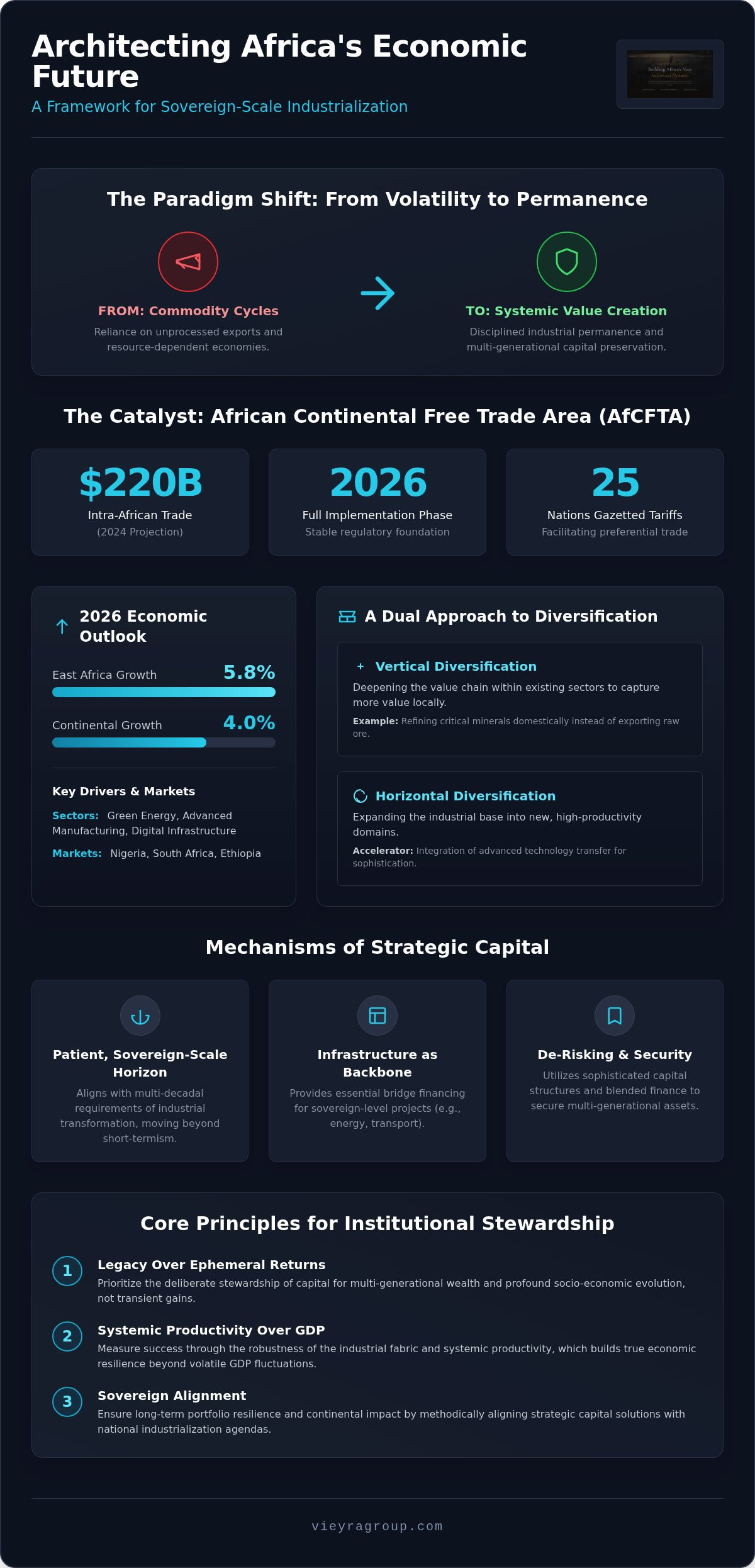
The historical reliance on commodity cycles is rapidly giving way to a disciplined era of systemic value creation and industrial permanence. With intra-African trade reaching 220 billion dollars in 2024 and the African Continental Free Trade Area entering a phase of full implementation in early 2026, the requirement for a sophisticated African economic diversification investment framework has moved from a strategic preference to an institutional necessity. We recognize that the volatility inherent in resource-dependent economies often complicates the delicate process of multi-generational wealth transfer and long-term capital preservation.
This article offers an institutional perspective on how sovereign-scale capital acts as the primary catalyst for industrial transformation, moving beyond traditional aid toward the architectural design of a self-sustaining economy. We shall examine the mechanisms through which strategic capital solutions and African industrialization capital align with the continent's projected 4.0 percent growth rate. By prioritizing the deliberate stewardship of legacy over the pursuit of ephemeral returns, we provide a roadmap for the integration of global investment management with the profound socio-economic evolution of the African continent.
Key Takeaways
- Examine how the 2026 maturation of the AfCFTA serves as a foundational catalyst for the deployment of sovereign-scale capital into high-productivity industrial sectors.
- Identify the structural requirements for successful African economic diversification investment that prioritizes systemic value creation over the volatility of resource dependence.
- Evaluate the strategic utility of patient industrialisation capital and Special Economic Zones in overcoming infrastructure bottlenecks and securing multi-generational wealth.
- Learn a methodical approach to aligning strategic capital solutions with national industrialisation agendas to ensure long-term portfolio resilience and continental impact.
- Discover a framework for institutional stewardship that integrates global investment management with the philanthropic vision of the Vieyra Foundation.
The Imperative of African Economic Diversification in the 2026 Global Landscape
The strategic reorientation of the Economy of Africa represents the most significant geopolitical and financial transition of the decade. Economic diversification is no longer a peripheral aspiration; it's a structural mandate for the preservation of institutional and sovereign capital. By 2026, the implementation of the African Continental Free Trade Area has progressed beyond negotiation into a functional reality, with 25 nations having gazetted their Tariff Schedules to facilitate preferential trade. This maturation provides a stable regulatory foundation for African economic diversification investment, allowing capital to move from the volatility of raw commodity extraction toward the permanence of industrial value addition. Transitioning away from a reliance on unprocessed exports requires a deliberate shift toward systemic manufacturing, which ensures that economic resilience is built into the very architecture of the continental market.
The Structural Dimensions of Diversification
To achieve systemic impact, diversification must be approached through both vertical and horizontal lenses. Vertical diversification involves deepening the value chain within a specific sector, such as refining critical minerals locally rather than exporting raw ore. Horizontal diversification expands the industrial base into entirely new, high-productivity domains. The integration of advanced technology transfer acts as the primary accelerant for this expansion, ensuring that domestic industries don't just grow in volume but in sophistication. We measure success through the lens of systemic productivity and the robustness of the industrial fabric, rather than through the lens of transient GDP fluctuations that often mask underlying structural weaknesses.
The 2026 Economic Outlook for African Markets
The regional growth projections for 2026 underscore a continent in transition. East Africa leads with a projected growth rate of 5.8 percent, while the broader continent is expected to expand by 4.0 percent. This growth is increasingly driven by sectors that offer long-term stability: green energy, advanced manufacturing, and digital infrastructure. Institutional capital finds its most secure alignment in markets like Nigeria, South Africa, and Ethiopia, where macroeconomic stability has become a prerequisite for large-scale industrialization efforts. As global supply chains shift toward more resilient and localized configurations, Africa's position as a hub for critical minerals and manufacturing becomes central to the global economic architecture. This shift ensures that sovereign-scale investment is not merely a financial allocation but a contribution to a multi-generational legacy of economic sovereignty.
Mechanisms of Strategic Capital in Driving African Industrialisation
The deployment of African Industrialization Capital necessitates a fundamental departure from the pervasive short-termism inherent in global public equity markets. It is defined by a patient, sovereign-scale horizon that aligns with the multi-decadal requirements of systemic industrial transformation. This strategic capital acts as a stabilizing force, providing essential bridge financing for sovereign-level infrastructure projects that serve as the structural backbone of a diversified economy. By integrating private institutional capital with public developmental objectives, we cultivate a synergy that traditional financial instruments often fail to achieve. Sophisticated capital structures are utilized to de-risk these large-scale endeavors, employing blended finance mechanisms to ensure the security of multi-generational assets while fostering deep-rooted systemic change.
Industrialisation as a Catalyst for Diversification
Manufacturing and processing represent the essential cornerstones of economic transformation, elevating a nation's position within the global value chain from a primary material provider to an industrial producer. This transition effectively addresses the "missing middle" in industrial finance, where projects are too expansive for local commercial banks yet require more agility than traditional development finance institutions can offer. By examining policy considerations for economic diversification, it becomes evident that success relies upon the concentration of resources into strategic industrial hubs that provide the necessary digital and physical infrastructure for advanced manufacturing. Institutions seeking to understand how these frameworks preserve legacy may explore our Strategic Capital Solutions for deeper institutional insights.
Sovereign-Scale Capital Allocation
The mechanics of deploying capital into multi-decade initiatives require a rigorous balance between Global Investment Management and concentrated African industrial allocations. This institutional approach favors the deliberation of a family office, which operates without the quarterly pressures of external shareholders or the volatility of retail sentiment. Such a structure allows for the long-term stewardship of assets, ensuring that African economic diversification investment remains resilient against temporary market fluctuations. By identifying systemic bottlenecks and deploying capital with the precision of a master architect, we ensure that every allocation contributes to the broader narrative of continental progress. This methodical pace of investment mirrors the permanence of the industries we seek to build, reinforcing a trajectory of stability and multi-generational wealth preservation across the African continent.
Evaluating Institutional Frameworks for Large-Scale Industrial Projects
The selection of an appropriate institutional framework is the foundational decision in the lifecycle of any large-scale industrial project. While traditional Public-Private Partnerships (PPP) offer a mechanism for risk-sharing between the state and the private sector, they often succumb to the friction of bureaucratic misalignment and shifting political priorities. Pure Institutional Capital, particularly when deployed at a sovereign scale, provides a more resolute alternative. It allows for the concentration of resources without the dilutive effects of short-term stakeholder pressures. Special Economic Zones (SEZs) serve as the physical manifestation of this framework, offering ring-fenced regulatory environments that accelerate African economic diversification investment by providing reliable digital and physical infrastructure.
Evaluating the governance of these finance structures requires a rigorous risk assessment framework that accounts for the geopolitical shifts of 2026. Transparency isn't merely a compliance requirement; it's a strategic asset that secures the permanence of the investment. By utilizing sophisticated capital allocation models, institutional actors can ensure that large-scale projects remain insulated from the volatility of emerging markets while driving systemic industrial growth. This approach recognizes that the stability of the investment vehicle is as important as the productivity of the underlying asset.
Strategic Capital Solutions vs. Traditional Private Equity
The divergence between Strategic Capital Solutions and traditional private equity lies primarily in the temporal horizon of the investment. Conventional private equity models are frequently constrained by five to seven year exit mandates, which are fundamentally incompatible with the multi-decadal requirements of heavy industrial development. Institutional stewardship, however, prioritizes a multi-generational vision. This approach demands deep operational expertise in industrial project management, ensuring that capital isn't just deployed but actively managed to overcome systemic bottlenecks. Our allocation models reflect this commitment to stability, favoring the steady accrual of value over the pursuit of rapid, high-volatility exits.
Navigating Regulatory and Geopolitical Landscapes
The viability of industrial projects in 2026 is inextricably linked to the successful implementation of regional trade agreements, most notably the AfCFTA. With 100 percent of the Rules of Origin now established for key sectors like automotive and textiles as of early 2026, the regulatory path for intra-continental trade has reached a new level of clarity. Mitigating sovereign risk requires a dual strategy of strategic local partnerships and global diversification. Institutional prestige plays a decisive role here; the poise and track record of a sovereign-scale entity can secure more favorable regulatory treatment and foster an environment of mutual trust with national authorities. It's through this architectural foresight that we navigate the complexities of the 2026 geopolitical landscape, ensuring that capital remains a tool for both wealth preservation and continental transformation.
A Sovereign-Scale Framework for Multi-Sector Capital Deployment
The execution of a sovereign-scale investment strategy requires a methodical architecture that transcends the reactive nature of conventional asset management. This framework is designed to transform capital from a passive instrument into a visionary tool for industrial permanence. It's a deliberate process that begins with the identification of systemic bottlenecks, such as chronic energy deficits or fragmented logistical corridors, that currently impede the natural progression from resource extraction to sophisticated manufacturing. By isolating these impediments, an institution can ensure that African economic diversification investment is not merely speculative but serves as a corrective force for structural inefficiencies.
Once bottlenecks are identified, the deployment of capital proceeds through five distinct institutional stages:
- Agenda Alignment: Harmonizing capital allocations with regional blueprints, such as the AfCFTA implementation milestones, and national industrialization mandates to ensure political and economic synergy.
- Structural Resilience: Designing investment vehicles that prioritize multi-generational durability over immediate liquidity, effectively insulating assets from the volatility of short-term market cycles.
- Institutional Oversight: Establishing a regime of stewardship that moves beyond passive monitoring to provide active, strategic guidance at the project level.
- Scalability Assessment: Ensuring that initial industrial pilots possess the modularity required for expansion across regional borders.
- Legacy Measurement: Evaluating success through the dual metrics of capital preservation and the long-term industrial maturity of the target economy.
Strategic Asset Allocation for Family Offices
Integrating African industrial projects into a global diversified portfolio requires a sophisticated understanding of correlation and risk. While these assets are often illiquid, their capacity to provide a hedge against global inflationary pressures and currency debasement makes them essential for long-term stability. Strategic asset allocation at this scale represents the deliberate calibration of global liquidity against concentrated, high-impact industrial exposures to achieve a superior risk-adjusted preservation of multi-generational legacy. Managing this balance ensures that the institution retains the agility to respond to global shifts while remaining anchored in the enduring value of continental industrial growth.
Operational Stewardship and Governance
Operational stewardship is the mechanism through which an institutional vision is translated into industrial reality. It's not enough to provide capital; the institution must maintain a presence on boards and steering committees to ensure that project integrity is never compromised. This active participation guarantees that environmental, social, and institutional governance (ESG) standards are not merely aspirational but are woven into the operational fabric of the project. The family office acts as the ultimate guardian, protecting the legacy of the investment against the erosive effects of mismanagement or short-term compromise. For those seeking to deploy capital with this level of institutional rigor, our African Industrialization Capital framework provides the necessary structural depth for successful multi-sector engagement.
Institutional Stewardship: Aligning Capital with African Economic Transformation
The Vieyra philosophy perceives capital not as a transient resource for speculative gain but as a foundational instrument for continental progress and the construction of an enduring legacy. This institutional stance dictates that every allocation must contribute to the structural maturity of the markets in which we operate. The pursuit of African economic diversification investment represents the ultimate synthesis of financial prudence and continental duty, where the objective is to replace the inherent instability of resource extraction with the permanence of industrial value creation. By prioritizing long-term stewardship over the pursuit of ephemeral returns, we ensure that capital remains a stabilizing force capable of weathering the geopolitical shifts of the coming decades.
The Architecture of Multi-Generational Wealth
Industrial assets serve as the bedrock of family office legacies because they represent a physical and operational commitment to the future of a target economy. Unlike public equities or volatile commodities, a well-governed industrial project generates value through productivity and innovation, providing a resilient hedge against global financial uncertainty. The preservation of this wealth depends as much on the transfer of institutional knowledge as it does on the transfer of financial capital. By fostering a new era of African industrial leadership, we ensure that the next generation possesses the sophistication and operational expertise required to manage these complex assets. It's this continuity of vision that transforms a simple investment into a multi-generational heritage.
A Mission for Systemic Impact
Integrating social impact into the core of sovereign-scale investment is a functional requirement for long-term success. The Vieyra Foundation plays a critical role in this ecosystem by supporting the development of the human capital necessary for advanced industrial operations. We recognize that industrialisation cannot succeed in a vacuum; it requires a workforce equipped with the technical and intellectual rigor to sustain sophisticated manufacturing sectors. Our commitment to Strategic Philanthropy in the African Context ensures that our capital deployment is supported by a foundation of educational and social progress. This holistic approach to stewardship guarantees that our investments don't just grow in value but contribute to the creation of a stable, industrialised, and prosperous continental society for generations to come.
Architecting the Era of African Industrial Permanence
The transition toward a self-sustaining industrial base requires more than mere financial participation; it demands the architectural foresight of a dedicated institutional guardian. We've examined how the maturation of continental trade frameworks provides the necessary stability for large-scale industrial commitments that transcend the limitations of raw resource extraction. By prioritizing systemic productivity and industrial depth, institutions ensure that their portfolios are aligned with the profound economic evolution of the African continent. This methodical approach to African economic diversification investment serves as the definitive mechanism for securing multi-generational wealth while fostering a legacy of continental prosperity.
As the landscape of 2026 unfolds, the requirement for sophisticated stewardship becomes paramount. Our institution offers multi-generational institutional expertise and a proven commitment to African industrialisation. We invite those with a vision for long-term stability to Engage with the Vieyra Family Office on Sovereign-Scale Strategic Capital to leverage our sovereign-scale capital allocation capacity. The path toward a diversified African economy is a journey of permanence and profound impact.
Frequently Asked Questions
What is the role of the AfCFTA in African economic diversification investment?
The African Continental Free Trade Area serves as the foundational regulatory architecture that enables the seamless movement of industrial goods across borders. By March 2026, with twenty-five nations having gazetted their Tariff Schedules and 100 percent of the Rules of Origin established, the framework has matured into a reliable catalyst for African economic diversification investment. It provides the legal certainty required for institutional capital to transition from localized extraction toward the creation of integrated continental value chains.
How does sovereign-scale capital differ from traditional private equity in Africa?
The distinction lies in the temporal horizon and the depth of operational commitment. While traditional private equity is often constrained by five to seven year exit mandates, sovereign-scale capital operates with a multi-generational perspective that prioritizes the permanence of industrial assets. This patient approach allows for the navigation of complex industrial cycles without the pressure of quarterly volatility, ensuring that capital remains a stabilizing force for long-term economic transformation.
Which sectors are most viable for industrialisation capital in 2026?
High-productivity domains such as green energy infrastructure, advanced manufacturing, and the localized processing of critical minerals represent the most resilient sectors. As global supply chains reconfigure, the requirement for sophisticated processing facilities within Africa has intensified. These sectors offer the structural depth necessary for sovereign-scale capital to drive systemic impact while capturing the growth of a continent projected to expand by 4.0 percent in 2026.
How can family offices mitigate the risks associated with large-scale industrial projects?
Risk mitigation is achieved through the utilization of Special Economic Zones and the implementation of rigorous operational stewardship. By deploying capital within ring-fenced regulatory environments and maintaining active board participation, family offices can insulate assets from localized macroeconomic shifts. This institutional gravity ensures that projects remain aligned with global governance standards, protecting the integrity of the investment against the erosive effects of mismanagement or political transition.
What are strategic capital solutions in the context of African development?
These are sophisticated financial frameworks designed to address the "missing middle" of industrial finance through bridge financing and de-risking mechanisms. Strategic capital solutions move beyond passive allocation to provide the structural support required for sovereign-level infrastructure. They facilitate the synergy between private institutional capital and public developmental objectives, ensuring that every investment contributes to the broader architecture of continental sovereignty and industrial maturity.
How does economic diversification contribute to multi-generational wealth preservation?
Diversification shifts the underlying asset base from volatile, resource-dependent cycles toward the stability of industrial productivity. This transition is essential for preserving the purchasing power and legacy of a family office over decades. By anchoring wealth in tangible industrial assets that serve as the backbone of the continental economy, investors secure a resilient hedge against global inflationary pressures and the inherent risks of commodity-focused portfolios.
What is the importance of institutional philanthropy in industrial investment?
Institutional philanthropy, managed through entities like the Vieyra Foundation, provides the human capital necessary for industrial success. It focuses on developing the technical and leadership skills required to operate sophisticated manufacturing sectors. This alignment ensures that industrial projects aren't just financially viable but are supported by a social fabric capable of sustaining long-term progress, creating a symbiotic relationship between capital growth and societal advancement.
How can investors access sovereign-scale investment partnerships in Africa?
Access is typically secured through alignment with established institutions that possess deep continental heritage and proven operational expertise. These partnerships require a shared commitment to the principles of stewardship and the deliberate construction of legacy. By engaging with entities that operate at a sovereign scale, investors gain the institutional prestige and geopolitical insight necessary to navigate the complexities of African economic diversification investment with confidence and poise.


