
What if the perceived volatility of the African industrial sector isn't a barrier to entry, but rather the precise catalyst for a new era of sovereign-scale legacy preservation? For the discerning global institution, the challenge has long been the reconciliation of significant social impact with the rigorous demands of large-scale industrial development. You've likely observed that traditional aid models have reached their logical conclusion, leaving a structural void where strategic, patient capital should reside. This 2026 framework illustrates how the deliberate deployment of philanthropic capital for African industrialization serves as the foundational architecture for multi-generational economic sovereignty.
The Vieyra Foundation recognizes that the path to continental transformation requires more than mere charity; it demands the poise of a visionary architect. By integrating institutional gravity with sophisticated financial instruments, we can bridge the infrastructure financing gap, which currently sits between $68 billion and $108 billion annually. We'll examine the specific de-risking mechanisms and blended finance frameworks that allow institutional actors to align their legacy with the continent's industrial trajectory. You'll gain a comprehensive understanding of how catalytic capital can stabilize the most ambitious projects, ensuring that the shift from raw material export to value-added production becomes a permanent reality.
Key Takeaways
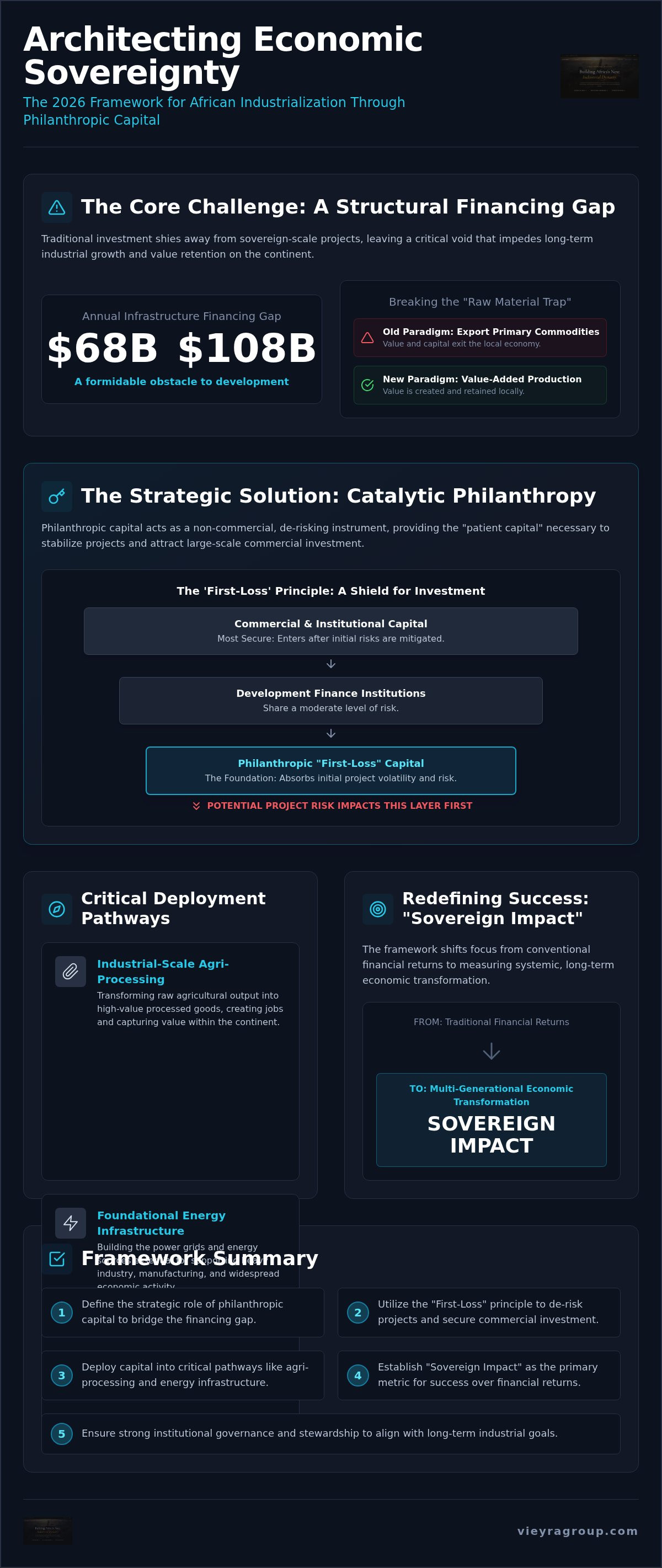
- Define the strategic role of philanthropic capital for African industrialization as a non-commercial instrument designed to bridge the continent's significant infrastructure financing gap.
- Examine the "First-Loss" principle and its capacity to absorb initial project risks, thereby creating a secure environment for traditional commercial investment and institutional capital.
- Identify the critical pathways for deploying capital into value-added production, specifically focusing on industrial-scale agri-processing and foundational energy infrastructure.
- Establish a framework for measuring "Sovereign Impact," shifting the focus from traditional financial returns toward systemic and multi-generational economic transformation.
- Recognize the importance of institutional governance and stewardship in aligning family office initiatives with the long-term industrial goals of the African continent.
The Strategic Imperative: Bridging the Industrialization Financing Gap
The historical trajectory of economic development across the continent has been frequently impeded by a structural reliance on the export of primary commodities, a phenomenon often described as the "raw material trap" that facilitates significant capital flight. This paradigm has historically left many nations vulnerable to the fluctuations of global markets, preventing the retention of value within local borders. While the narrative of Industrialisation in Africa has often centered on external aid, the year 2026 marks a decisive shift toward internal agency and the strategic deployment of sovereign-scale resources. Traditional foreign direct investment and commercial banking frameworks often recoil from the inherent complexities of industrial greenfield projects, citing perceived risks that frequently overshadow the actual potential for long-term value creation. It's within this precise context that the role of philanthropic capital for African industrialization emerges as a critical, non-commercial instrument capable of absorbing the early-stage volatility that deters conventional finance.
The Architecture of the Financing Gap
The financing gap is not merely a deficit of liquidity but a structural misalignment between the nature of available capital and the requirements of large-scale industrial projects. This "missing middle" represents a void where projects are too large for traditional micro-finance or small-scale grants yet are deemed too risky for the conservative mandates of commercial lenders. According to data from MOHAC AFRICA in January 2026, the infrastructure financing gap remains a formidable obstacle, estimated between $68 billion and $108 billion annually. While the continent holds over $4 trillion in domestic assets, the mobilization of these resources requires specialized vehicles that can bridge the chasm between perceived and actual risk. Sovereign-scale industrialization serves as the foundational bedrock upon which continental stability and multi-generational prosperity are constructed.
Philanthropy as Strategic Stewardship
The transition toward a more robust industrial base requires a fundamental redefinition of philanthropy, moving beyond the ephemeral grant-making paradigm toward a model of catalytic stewardship. This approach doesn't seek short-term exits; instead, it aligns multi-generational family office values with the long-term horizons required for structural transformation. Institutional philanthropy provides the "patient capital" necessary to fund feasibility studies, secure land rights, and establish the foundational energy grids that heavy industry demands. By utilizing philanthropic capital for African industrialization, the Vieyra Foundation acts as a visionary architect, creating the stability required to attract more risk-averse institutional investors. This strategic allocation of capital ensures that industrial initiatives are not merely temporary interventions but are instead woven into the permanent fabric of the continent's economic sovereignty.
Catalytic Mechanics: How Philanthropy De-risks Sovereign-Scale Projects
The strategic deployment of philanthropic capital for African industrialization functions as a sophisticated mechanism for financial stabilization, where institutional foundations assume the role of a primary buffer against systemic volatility. By implementing the "First-Loss" principle, the Vieyra Foundation and similar entities position their assets to absorb the initial impact of project delays or unforeseen structural shifts. This deliberate absorption of risk transforms the economic profile of sovereign-scale initiatives, creating a secure environment that invites participation from development finance institutions and commercial lenders. It's a fundamental re-imagining of the role of philanthropy in African development, moving beyond traditional grant-making toward the creation of robust, blended finance structures that optimize capital efficiency.
The De-risking Framework
Mitigating the complexities of political and currency risk requires more than mere financial liquidity; it demands the presence of "anchor philanthropy" that signals institutional permanence to the global market. When a foundation provides technical assistance grants for the preparation of sovereign-scale refineries, it effectively bridges the gap between a conceptual industrial vision and a project that meets international bankability standards. These grants fund the rigorous feasibility studies and environmental assessments that are often too costly for local governments to undertake alone. This institutional commitment provides a psychological floor for commercial investor confidence, ensuring that large-scale industrial assets remain viable even amidst broader macroeconomic fluctuations. For organizations seeking to navigate these complexities, the Vieyra Family Office offers Strategic Capital Solutions designed to harmonize legacy preservation with continental progress.
Instruments of Impact
The instruments utilized in this framework extend beyond simple donations, encompassing Program-Related Investments (PRIs) and Mission-Related Investments (MRIs) that prioritize systemic transformation over immediate financial yield. Recoverable grants further enhance this ecosystem, allowing capital to be recycled into subsequent industrial initiatives once a project achieves commercial stability. This cyclical nature of capital ensures that a single philanthropic intervention can catalyze multiple waves of industrial growth. Strategic capital allocation transforms a high-risk project into a bankable asset by insulating commercial partners from the structural uncertainties inherent in frontier industrial development. Through these sophisticated arrangements, philanthropic capital for African industrialization serves as the essential architect of a self-sustaining economic future.
Sectoral Transformation: Deploying Capital into Value-Added Production
The transition from primary commodity extraction to sophisticated value-added production represents the most significant shift in the continent’s economic architecture since the mid-twentieth century. Strategic allocation of philanthropic capital for African industrialization acts as the primary catalyst for this transformation, specifically targeting sectors where the multi-generational multiplier effect is most profound. It's through this lens of beneficiation that the Vieyra Foundation identifies initiatives that don't just generate returns, but fundamentally alter the productive capacity of entire regions. By prioritizing the internal processing of resources, institutional philanthropy ensures that the wealth generated from African soil remains within its borders to fuel further development.
Industrializing the Agricultural Value Chain
Historically, the continent has remained entangled in a cycle of exporting raw materials, such as cocoa and cashew, only to re-import the finished products at a significant premium. This dynamic contributes to imported inflation and stifles the growth of domestic manufacturing. The Vieyra Foundation actively supports the development of industrial processing hubs that bridge this gap, providing the patient capital required to establish facilities that can handle large-scale manufacturing. These hubs serve several critical functions:
- Beneficiation: Converting raw agricultural output into high-value finished goods for both domestic consumption and global export.
- Employment Stability: Creating permanent, skilled industrial roles that offer greater economic security than seasonal subsistence farming.
- Economic Resilience: Reducing the reliance on foreign exchange for essential food products and stabilizing local supply chains.
Powering the Industrial Engine
Heavy industry cannot exist without a foundation of consistent, high-capacity energy, yet the perceived risk of large-scale utility projects often deters traditional commercial finance. Philanthropic capital for African industrialization is uniquely positioned to de-risk renewable energy initiatives, particularly those designed to power dedicated industrial zones. By funding the initial infrastructure and grid stability requirements, foundations enable these zones to operate with the energy sovereignty required for global competitiveness. This strategic support extends to the integration of regional power pools, where shared infrastructure reduces costs and enhances the reliability of the grid for industrial users across national borders.
Beyond physical goods and power, the architecture of the Fourth Industrial Revolution requires a robust digital foundation. The Vieyra perspective emphasizes that digital industrialization isn't a separate pursuit but an integrated component of modern manufacturing. Supporting the deployment of high-speed connectivity and data centers within industrial parks ensures that African manufacturing remains at the forefront of global technological standards. This holistic approach to sectoral transformation ensures that today's capital allocation builds a legacy of industrial excellence that will endure for generations.
The Architecture of Stewardship: Institutional Frameworks for Impact
The efficacy of philanthropic capital for African industrialization is fundamentally contingent upon the robustness of the institutional frameworks through which it's deployed. Within the Vieyra Family Office, the Vieyra Foundation serves as the primary vehicle for initiatives that align philanthropic intent with a broader, sovereign-scale capital allocation strategy. This integration ensures that every intervention isn't merely a charitable gesture but a deliberate step toward systemic economic transformation. By cultivating deep partnerships with African sovereign wealth funds and regional development banks, such as the African Development Bank, institutional philanthropy can synchronize its efforts with national industrial policies. This collaborative approach was exemplified in August 2026, when the African Development Fund approved a US$3.48 million grant to strengthen industrial and trade policies across several nations, highlighting the growing necessity for philanthropic actors to operate in concert with multi-lateral governance structures.
Multi-Generational Governance
Preserving a family dynasty’s legacy requires a governance model that transcends individual lifetimes, opting instead for a structure characterized by institutionalized permanence. This framework must carefully balance the requirements of global investment management with specific, long-term continental industrial commitments. The next generation of leadership plays a pivotal role here, acting as the visionary architects who'll steer the philanthropic industrial strategy into the coming decades. By embedding these values into the family office’s core architecture, the institution ensures that its commitment to African industrialization remains unwavering, regardless of short-term global market fluctuations. For those seeking to establish similar high-impact frameworks, the Vieyra Family Office provides Strategic Capital Solutions that harmonize multi-generational values with sovereign-scale industrial goals.
Measuring Systemic Impact
Traditional metrics of return on investment often fail to capture the breadth of systemic change required for true economic sovereignty. The "Vieyra Metric" addresses this by evaluating the long-term stewardship of African resources and the growth of economic complexity within the regions served. This framework prioritizes the tracking of industrial growth, the creation of skilled employment, and the overall stability of the local manufacturing base. Institutional success is defined by the permanence of the industrial ecosystems created.
- Industrial Complexity: Assessing the shift from basic processing to high-tech manufacturing.
- Resource Stewardship: Monitoring the retention of value within the domestic economy.
- Systemic Stability: Evaluating the resilience of industrial zones against external economic shocks.
By focusing on these systemic outcomes, the foundation ensures that its capital doesn't just fund isolated projects but builds the foundations of a self-reliant continent. This methodical approach to measurement allows the institution to refine its strategies, ensuring that every dollar of philanthropic capital for African industrialization contributes to a legacy of enduring prosperity.
Cultivating Legacy: Partnering with the Vieyra Family Office
The Vieyra Family Office operates as a stately guardian of the continent's industrial potential, managing global investments with the deliberation required to secure a prosperous future. Our institution doesn't view capital as a mere commodity; instead, it acts as a visionary architect of legacy, ensuring that every allocation is performed with a profound sense of institutional gravity. By focusing on sovereign-scale initiatives, we bridge the chasm between global investment management and the specific industrial needs of African nations. The strategic deployment of philanthropic capital for African industrialization remains at the core of this mission, providing the stability and long-term vision necessary to navigate an increasingly fragmented global economy.
A Visionary Architect of Progress
Our commitment to African economic sovereignty is rooted in a multi-generational perspective that prioritizes systemic transformation over ephemeral market gains. As a sovereign-level entity, the Vieyra Family Office offers a unique value proposition, blending the traditional values of heritage with a forward-looking commitment to large-scale progress. The long-term trajectory of our industrialization capital is designed to create permanent industrial ecosystems that can withstand external shocks and provide a foundation for future growth. We're certain of our trajectory, and we believe that the true measure of institutional success lies in the permanence of the industrial infrastructure we help establish. This approach ensures that the wealth generated from African resources continues to benefit the continent's people for generations to come, fostering a sense of stability that is often absent in traditional development models.
The Path to Partnership
Scaling industrial impact requires a level of coordination and strategic depth that few institutions can provide in isolation. We extend a formal invitation to sovereign entities, global institutional investors, and philanthropic organizations to align their efforts with the framework established by the Vieyra Foundation. These strategic partnerships allow for the effective pooling of resources and expertise, ensuring that catalytic capital reaches the sectors where it's most urgently required. Whether through the implementation of blended finance structures or the provision of technical assistance for large-scale projects, our collaborative approach is centered on the principles of professional rigor and multi-generational stewardship. It's through these concerted efforts that we can de-risk the continent's most ambitious industrial projects, making them accessible to a broader range of risk-averse investors.
The permanence of an industrial legacy is the ultimate measure of our collective impact in a world characterized by rapid change and economic uncertainty. By securing the productive capacity of African nations today, we're ensuring that future generations inherit a continent defined by self-reliance and economic complexity. We encourage interested parties to explore the Vieyra Family Office’s strategic capital solutions and discover how we can collectively advance the cause of philanthropic capital for African industrialization. Through methodical stewardship and an unwavering commitment to quality, we'll continue to build the foundational assets that define a sovereign and prosperous Africa.
Architecting a Sovereign Industrial Future
The 2026 framework for continental development necessitates a fundamental departure from ephemeral aid toward the strategic deployment of philanthropic capital for African industrialization, a mechanism that provides the essential stability required for structural transformation. We've established that the "First-Loss" principle and sophisticated blended finance structures serve to mitigate perceived risks, effectively transforming greenfield industrial projects into bankable, sovereign-scale assets that invite global participation. By prioritizing value-added production and beneficiation, institutional stewards can ensure that the continent's wealth remains rooted within its borders to fuel multi-generational prosperity. This systemic transformation requires the poise of an established guardian, blending traditional heritage with a forward-looking commitment to systemic stability.
The Vieyra Family Office, defined by its multi-generational African heritage and sovereign-scale capital allocation expertise, remains dedicated to this visionary trajectory. Through the integrated Vieyra Foundation impact model, we provide the institutional gravity required to anchor large-scale progress in a complex global landscape. We invite global partners to align with this enduring mission. Discover the Vieyra Family Office's Vision for African Industrialization to understand how our strategic capital solutions can harmonize with your institutional legacy. It's through this methodical stewardship that a self-reliant and industrially robust Africa will finally emerge.
Frequently Asked Questions
What is the role of philanthropic capital in African industrialization?
Philanthropic capital for African industrialization serves as a sophisticated, non-commercial instrument designed to bridge the structural chasm between conceptual industrial vision and commercial bankability. It functions by providing the initial, patient liquidity required for high-risk greenfield projects that traditional financial institutions often avoid. This strategic allocation doesn't merely seek immediate returns but rather prioritizes the creation of foundational industrial assets. By assuming first-loss positions, this capital effectively stabilizes the economic environment for broader institutional participation.
How does the Vieyra Foundation de-risk large-scale industrial projects?
The Vieyra Foundation de-risks sovereign-scale initiatives by deploying specialized financial instruments that absorb early-stage project volatility. Through the provision of technical assistance grants and recoverable guarantees, the foundation ensures that industrial projects meet international standards of bankability before commercial debt is sought. This institutional presence provides a psychological floor for global investor confidence, as our participation signals a multi-generational commitment to the project's permanence. Such stewardship transforms perceived systemic risks into manageable, structured investment opportunities.
What is the difference between catalytic capital and traditional charity?
Traditional charity often addresses immediate humanitarian needs through one-way grant-making, whereas catalytic capital is an architectural tool for systemic economic transformation. This sophisticated approach utilizes philanthropic capital for African industrialization to build productive capacity and industrial ecosystems that generate long-term economic sovereignty. While charity provides relief, catalytic capital creates a self-sustaining cycle of value-added production. It's a shift from dependency toward the institutionalized preservation of wealth and the expansion of continental industrial capability.
Can philanthropic capital actually fund heavy industry like refineries or power plants?
Philanthropic capital is uniquely positioned to fund the critical pre-development phases of heavy industry, including refineries and power plants, which are often too speculative for commercial lenders. By financing rigorous feasibility studies, environmental assessments, and foundational energy grid stability, foundations create the necessary conditions for these sovereign-scale assets to thrive. This capital doesn't replace commercial investment; rather, it prepares the ground for it. It ensures that large-scale infrastructure projects are structurally sound and globally competitive.
How does Vieyra Family Office measure the impact of its philanthropic investments?
We utilize a proprietary framework known as the Vieyra Metric to evaluate the success of our strategic capital solutions beyond traditional financial yields. This methodology prioritizes the measurement of economic complexity, the retention of value through domestic beneficiation, and the permanence of the industrial roles created. Success is defined by the systemic stability of the industrial ecosystems we help construct. This approach ensures that our stewardship results in a measurable contribution to the continent's multi-generational economic sovereignty.
How can other family offices partner with Vieyra for African industrial growth?
Family offices and institutional partners can engage with the Vieyra Family Office through a unified framework that synchronizes philanthropic intent with sovereign-scale capital management. Partnership involves aligning with the Vieyra Foundation’s specific industrial initiatives to pool resources for maximum systemic impact. This collaborative model allows partners to leverage our deep continental heritage and expertise in navigating frontier industrial landscapes. By participating in our blended finance structures, other institutions can contribute to large-scale projects while maintaining their own legacy objectives.
What sectors in Africa benefit most from philanthropic capital de-risking?
Sectors that require significant foundational infrastructure and face high initial barriers to entry, such as agri-processing and regional power pool integration, benefit most from this de-risking. Industrial-scale food systems and renewable energy grids for dedicated manufacturing zones are particularly well-suited for catalytic intervention. These sectors offer the highest multi-generational multiplier effect, transforming raw materials into finished goods and ensuring energy sovereignty. Philanthropic intervention in these areas stabilizes the supply chain and reduces the continent's vulnerability to global inflation.
Is philanthropic capital for industrialization compatible with wealth preservation?
Strategic capital allocation for industrialization is fundamentally compatible with the principles of multi-generational wealth preservation. By fostering stable, self-reliant industrial ecosystems, foundations create a more resilient economic landscape that protects the long-term value of global portfolios. This approach moves beyond ephemeral grant-making toward the creation of permanent, value-generating assets that anchor a family’s legacy. It represents a sophisticated alignment of institutional values with the requirements of continental progress, ensuring that heritage and sovereignty are mutually reinforcing.


