
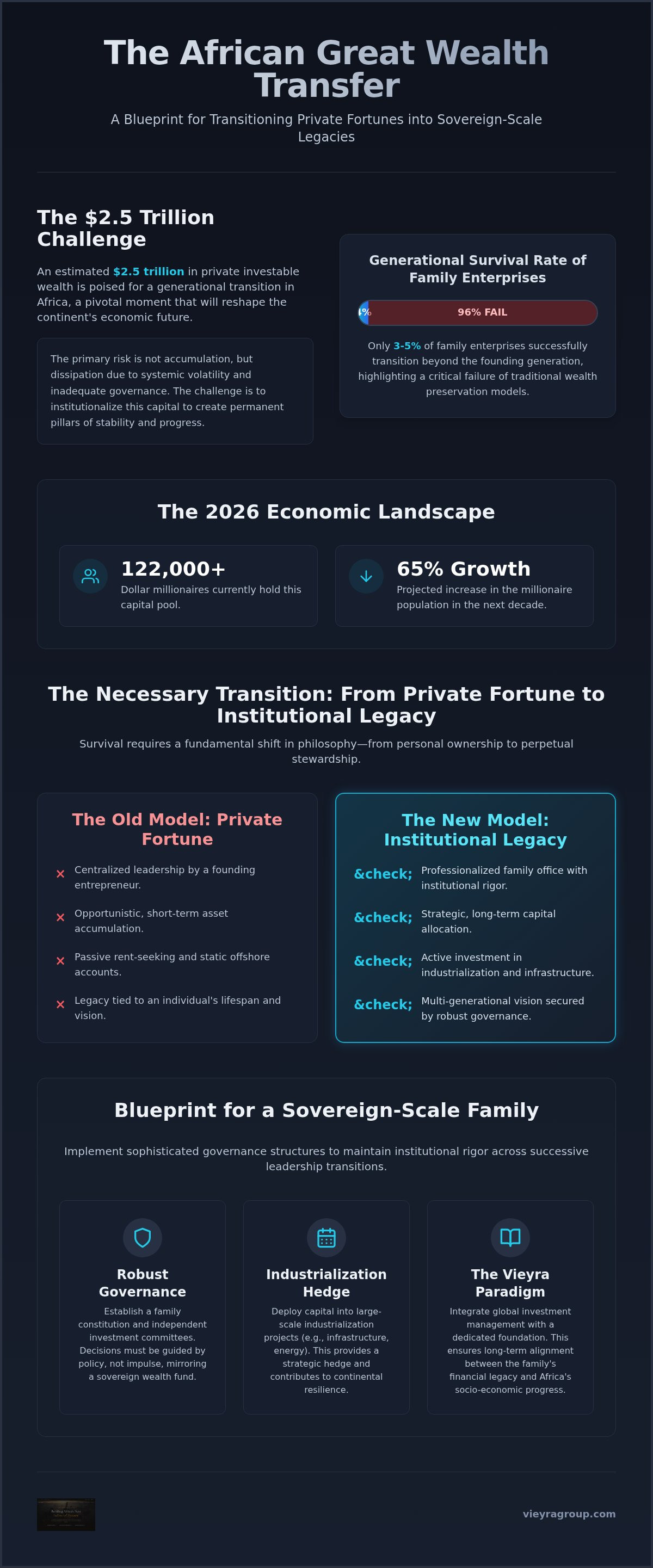
With only three to five percent of African family enterprises successfully navigating the transition beyond their founding generation, the preservation of the continent's estimated 2.5 trillion dollars in investable wealth remains a precarious endeavor. You're likely aware that the mere accumulation of capital offers little protection against the systemic volatility and jurisdictional fragmentation that threaten to dissipate even the most substantial private fortunes. This discourse serves as an institutional exploration of intergenerational wealth transfer Africa, offering a strategic framework for transitioning private holdings into sovereign-scale legacies through the deliberate integration of industrialization and rigorous governance.
We'll examine the mechanisms required to align family interests with the broader economic trajectory of the continent, ensuring that your legacy functions as a permanent pillar of stability. It's necessary to move beyond passive asset management toward a model of perpetual stewardship that withstands the complexities of multi-jurisdictional holdings. The following analysis provides a comprehensive blueprint for institutionalized wealth preservation, detailing the structural requirements for governance that transcends individual leadership and secures a multi-generational vision for the future of African capital.
Key Takeaways
- Identify the shifting liquidity patterns across Sub-Saharan Africa to define your family's position within a sovereign-scale context.
- Adopt the structural architecture necessary for a successful intergenerational wealth transfer Africa by evolving from private asset ownership to a professionalized institutional model.
- Discover how deploying capital into large-scale industrialization projects provides a strategic hedge for wealth preservation amid continental economic shifts.
- Implement sophisticated governance structures, such as family constitutions and independent investment committees, to maintain institutional rigor across successive leadership transitions.
- Examine the Vieyra Paradigm to see how integrating global investment management with the Vieyra Foundation ensures long-term alignment between family legacy and African progress.
The Landscape of the African Great Wealth Transfer in 2026
The scale of liquidity currently circulating within the African private sector has reached an unprecedented zenith, with investable wealth now estimated at 2.5 trillion dollars. This concentration of capital, held by over 122,000 dollar millionaires, is poised for a transition that will fundamentally reshape the continent's economic architecture. It's a phenomenon that mirrors the global trajectory of The Great Wealth Transfer, yet it possesses distinct geopolitical characteristics necessitated by the continent's unique industrial requirements. For families managing sovereign-scale fortunes, the challenge of 2026 isn't merely the movement of assets but the institutionalization of capital to withstand both domestic volatility and global market shifts. Successful intergenerational wealth transfer Africa requires a departure from the opportunistic asset accumulation of the past toward a model of rigorous, professionalized family governance.
Demographic Imperatives and the 2026 Outlook
The age profile of Africa's founding entrepreneurs suggests that a significant portion of this 2.5 trillion dollar pool will change hands within the next decade, with the millionaire population projected to grow by 65% during this period. The Great African Wealth Transfer is a systemic economic event that signifies the transition of foundational private capital into a new era of institutionalized stewardship and industrial transformation. This next generation of capital allocators is increasingly prioritizing systemic impact, moving away from passive rent-seeking toward strategic investments in infrastructure and energy. It's no longer sufficient to maintain wealth in static offshore accounts; the 2026 outlook demands that capital be deployed with the foresight of a sovereign entity, ensuring that private fortunes contribute to the continent's broader industrial resilience.
Beyond Inheritance: The Concept of Multi-generational Stewardship
Distinguishing between simple inheritance and the preservation of an institutional vision is the hallmark of the sovereign-scale family office. While 77% of African family businesses have implemented some form of governance, the stark reality is that only 3-5% survive beyond the first generation. This failure rate underscores the inadequacy of traditional private banking models which often prioritize short-term liquidity over long-term strategic depth. Moving beyond these limitations requires a pan-African perspective that integrates global investment management with a deep commitment to local industrialization. It's a shift from being a mere recipient of wealth to becoming a visionary architect of a permanent legacy. By professionalizing the investment committee and adopting a multi-generational horizon, families can ensure their capital remains a potent force for progress across multiple jurisdictions, surviving the individual leadership that first brought it into existence.
Transitioning from Private Fortune to Institutional Legacy
The metamorphosis of a personal fortune into an enduring institutional legacy requires more than a mere change in legal structure; it demands a fundamental shift in the philosophy of ownership. For many African families, the initial phase of wealth creation is often characterized by the visionary, yet highly centralized, leadership of a founding entrepreneur. However, as the scale of assets reaches a sovereign-level complexity, the transition to professionalized capital allocation becomes a prerequisite for stability. This evolution is the cornerstone of effective intergenerational wealth transfer Africa, ensuring that the capital remains a resilient force rather than a fragmented collection of individual interests. By establishing a family office as a distinct operational entity, families can detach the preservation of their legacy from the limitations of a single individual's lifespan.
The Institutionalization Framework
A robust institutional framework serves as the scaffolding for multi-generational longevity. It begins with the creation of a governance structure that mirrors the rigor of a sovereign wealth fund, where investment decisions are guided by a clearly defined investment policy statement rather than individual impulse. This involves:
- Legal Separation: Defining the family office as a sovereign-scale institution with its own board of directors and investment committee.
- Policy-Driven Allocation: Implementing multi-generational strategies that prioritize long-term capital growth over immediate liquidity.
- Succession Governance: Codifying the values and vision of the family into a constitution that dictates leadership transitions and capital access.
This composed and authoritative approach allows for the inclusion of multiple high-level concepts within a single strategic vision, ensuring the family's global influence remains constant through shifting geopolitical tides. It's a move away from the "owner-manager" model toward a system where capital is managed with the deliberation and foresight of a permanent global actor.
The Role of Global Stewardship
True stewardship in the modern era requires a delicate equilibrium between global market participation and a profound commitment to regional economic progress. Managing complex multi-jurisdictional portfolios necessitates a level of intellectual sophistication that transcends traditional private banking. By leveraging institutional gravity, sovereign-scale families can access exclusive investment tiers typically reserved for global institutions, thereby enhancing the stability of their domestic holdings. This integration of global investment management with a deep-rooted understanding of African industrial requirements creates a synergistic effect where global gains fuel continental development. The Vieyra approach exemplifies this balance, positioning the family office not merely as a passive recipient of returns but as a proactive architect of industrial resilience. It's through this lens of global stewardship that families can navigate the complexities of international finance while remaining steadfastly anchored in their African heritage.
Strategic Asset Allocation and the Industrialization Hedge
The preservation of sovereign-scale capital is intrinsically linked to the underlying economic resilience of the jurisdictions it inhabits. For families executing an intergenerational wealth transfer Africa, the strategy must move beyond the passive holding of liquid assets toward the acquisition of foundational industrial interests. This approach, which we define as the industrialization hedge, recognizes that long-term capital stability is best secured through direct participation in the continent's structural transformation. By deploying capital into sectors that provide essential services, such as energy, logistics, and manufacturing, families create a symbiotic relationship between their private legacy and national economic growth. It's a method of capital allocation that prioritizes systemic impact, ensuring that the wealth transfer remains a vehicle for both private security and continental advancement.
Financing Large-Scale Industrial Projects
The mechanics of sovereign-scale capital deployment require a sophisticated understanding of the continent's infrastructure investment gap, which is estimated to be between 68 billion and 108 billion dollars annually. Filling this void isn't merely an act of development; it's a strategic move to capture the value of foundational assets that remain resilient across economic cycles. Research indicates that industrial development and long-term capital stability are positively correlated, as these projects generate predictable, inflation-hedged returns that are often decoupled from the volatility of public equity markets. Navigating the risk profile of such high-impact investments demands an institutional poise that favors patient capital over short-term speculation. It's about building the physical and economic infrastructure that will sustain the family's influence for a century or more, ensuring the legacy is built on tangible progress rather than speculative gains.
Diversified Management in Global and African Markets
While the core of the legacy may be rooted in African industrialization, maintaining institutional gravity requires a sophisticated balance with global investment management. A multi-generational portfolio must support both global growth and African progress, utilizing international liquidity to buffer against regional shifts. This is where the Vieyra Foundation plays a critical role, integrating philanthropic initiatives with strategic capital to ensure that the family's values are visibly manifested in their industrial footprint. Maintaining this balance ensures that the family office operates as a significant global actor, capable of navigating periods of market volatility without losing its grand, overarching perspective. By professionalizing the investment committee to manage these complex multi-jurisdictional portfolios, families can achieve a level of intellectual sophistication that secures their trajectory through shifting geopolitical tides.
Governance Frameworks for Sovereign-Scale Families
The architectural implementation of a sophisticated governance framework represents the most critical determinant in the enduring success of intergenerational wealth transfer Africa. While traditional asset protection structures provide a necessary layer of legal insulation, they often lack the institutional depth required to manage capital at a sovereign scale across multiple generations. A visionary family constitution serves as the foundational blueprint, codifying the family's core values and strategic intent into a permanent institutional mandate that transcends individual leadership. This document is not merely a legal instrument; it's a stately guardian of the family's legacy, ensuring that the transition of authority does not result in the fragmentation of foundational assets or the dilution of the family's global influence. By professionalizing the board and investment committee, families can introduce a level of multi-generational rigor that mirrors the operations of the world's most established financial institutions.
Steps to Institutionalizing Family Governance
Institutionalizing governance requires a methodical approach to formalizing the family's investment philosophy and long-term vision through a series of deliberate structural enhancements. This process involves the creation of clear protocols for capital allocation and distribution, which effectively prevents the opportunistic depletion of resources by ensuring that every deployment of capital aligns with the family's multi-generational horizon. Establishing a family council serves to separate the complexities of family ownership from the professional management of the family office, thereby maintaining an aura of permanence and stability. These mechanisms must also include robust protocols for conflict resolution and leadership succession, mitigating the risks associated with jurisdictional complexity and shifting family dynamics. To begin architecting your family's institutional future, explore our Strategic Capital Solutions.
The Science of Wealth Preservation
The science of wealth preservation relies heavily on the cultivation of institutional memory, a concept that is frequently overlooked in the realm of conventional private banking. Utilizing multi-clause governance structures allows for the management of extreme breadth and complexity across various industrial sectors and geographic regions, ensuring that the family's strategic depth remains intact through periods of global market volatility. This intellectual sophistication enables a family office to leverage global best practices while remaining deeply rooted in a specific African cultural context, blending traditional values of heritage with a forward-looking commitment to progress. It's imperative to recognize that the transfer of assets is insufficient without the concomitant transfer of the capacity for stewardship. This necessitates the deliberate preparation of the next generation through structured education in large-scale capital management and industrial strategy. By aligning family legacy with continental economic development, a robust governance framework ensures that the wealth remains both relevant and resilient, surviving as a permanent pillar of African economic sovereignty.
The Vieyra Paradigm: Stewardship at a Global Scale
The Vieyra Family Office operates as a stately guardian of African legacy, transcending the conventional boundaries of private wealth management to function as a sovereign-scale actor on the global stage. By harmonizing Global Investment Management with a steadfast commitment to African Industrialization Capital, the institution provides a definitive model for successful intergenerational wealth transfer Africa. This paradigm isn't merely about the preservation of assets; it's about the deliberate orchestration of capital to foster long-term stability and systemic progress across the continent. The integration of the Vieyra Foundation ensures that philanthropic alignment remains a core component of this institutional vision, embedding social impact into the very fabric of the family's industrial footprint.
Guardian of the African Investment Legacy
Our commitment to the economic transformation of the continent is rooted in a multi-generational heritage that values deliberation and foresight over short-term gain. We operate with the poise of an entity that is certain of its trajectory, deploying Strategic Capital Solutions into foundational projects that underpin regional resilience. It's an approach that views industrialization as the ultimate long-term asset class, securing the family's position as a visionary architect of progress. By building infrastructure that serves as a permanent pillar of economic sovereignty, we ensure that the legacy we protect is one of tangible, systemic improvement rather than mere financial accumulation.
Engaging with the Vieyra Family Office
For families seeking a level of stewardship that understands the profound weight of African heritage, the engagement process begins with a shared commitment to institutional rigor. We don't view our partners as mere clients but as fellow participants in a grand, overarching perspective of continental development. The allocation of strategic capital follows a methodical and deeply considered path, ensuring that every partnership is aligned with a multi-generational investment horizon. Families ready to transition their fortunes into sovereign-scale legacies find in Vieyra an institution that provides the intellectual sophistication and global influence necessary to navigate a complex, multi-jurisdictional landscape. It's a journey toward becoming a permanent fixture in the global financial architecture, anchored by a deep-rooted identity and a commitment to large-scale progress.
Architecting a Sovereign Legacy
The transition of significant private fortunes into enduring institutional legacies requires a fundamental shift toward professionalized capital allocation and rigorous governance, ensuring that the preservation of wealth is inextricably linked to the structural resilience of the continent. We have explored how the implementation of a visionary family constitution and the strategic deployment of capital into foundational industrial projects serve as the primary mechanisms for ensuring a successful intergenerational wealth transfer Africa. By moving beyond passive asset management, families can secure their trajectory within the continent's broader economic transformation and safeguard their influence across multiple generations.
Establishing such a permanent pillar of stability demands a partner with sovereign-scale institutional capacity and a deep understanding of the geopolitical landscape. The Vieyra Family Office stands as a guardian of this multi-generational vision, blending its heritage with proven expertise in African industrialization finance to safeguard the futures of the continent's most ambitious families. We invite you to explore the Vieyra Family Office approach to sovereign-scale stewardship and begin the process of architecting a legacy that will endure for centuries. Your commitment to institutional excellence remains the cornerstone of Africa's continued progress.
Frequently Asked Questions
What is the primary challenge of intergenerational wealth transfer in Africa?
The primary challenge lies in the staggering failure rate of family enterprises, where only three to five percent survive the transition beyond the founding generation. This fragility often stems from a lack of robust succession protocols and the fragmentation of assets across diverse jurisdictions. Successfully managing intergenerational wealth transfer Africa requires transitioning from an owner-managed model to an institutionalized framework that can withstand the continent's inherent political and economic volatility.
How does a sovereign-scale family office differ from traditional wealth management?
Traditional wealth management typically focuses on liquid asset preservation and short-term returns within retail banking frameworks. In contrast, a sovereign-scale family office operates with the deliberation of a national institution, prioritizing the acquisition of foundational industrial assets and infrastructure. This model utilizes a governance structure similar to a sovereign wealth fund, emphasizing permanent ownership and strategic capital deployment rather than the opportunistic trading of public securities.
Why is African industrialization considered a strategic asset for wealth preservation?
African industrialization represents a strategic asset class because it provides inflation-hedged, tangible returns that remain resilient across global economic cycles. By investing in energy, logistics, and manufacturing, families create a symbiotic relationship between their private capital and the continent's structural transformation. This approach serves as a systemic hedge, protecting the family's legacy by ensuring their wealth is embedded within the physical and economic infrastructure essential for regional stability.
How can next-generation leaders be prepared for institutional stewardship?
Preparation involves shifting focus from personal wealth consumption to institutional stewardship through structured education in large-scale capital management and industrial strategy. Next-generation leaders must be integrated into the family office's governance committees to cultivate institutional memory and a deep understanding of the family's visionary mandate. This process ensures that the capacity for stewardship is transferred alongside the assets, maintaining the family's trajectory as a significant global actor.
What role does governance play in preventing the fragmentation of family wealth?
Robust governance prevents the dilution of capital by codifying the family's strategic intent into a permanent institutional mandate, such as a family constitution. These frameworks establish clear protocols for capital allocation and distribution, ensuring that individual interests don't compromise the integrity of the collective fortune. By professionalizing the board and investment committee, families create a stately guardian that maintains institutional poise and unity across multiple generations and jurisdictions.
How do global investments complement a focus on African economic development?
Global investments provide the necessary liquidity and diversification to buffer a portfolio against regional economic shifts, thereby enhancing the stability of domestic holdings. This integration of global investment management with African industrialization capital creates a synergistic effect where international gains can be redeployed into high-impact continental projects. Maintaining this global-local equilibrium allows a family office to operate with the foresight of a sovereign entity while remaining deeply rooted in its African heritage.
What is the significance of the 'Great Wealth Transfer' for the African economy by 2026?
By 2026, the transition of an estimated 2.5 trillion dollars in investable wealth represents a systemic economic event that will redefine the continent's private sector. With Africa's millionaire population projected to grow by 65 percent, this massive shift in liquidity offers an unprecedented opportunity to institutionalize private capital. It's a pivotal moment where the professionalization of intergenerational wealth transfer Africa can catalyze large-scale industrialization and foster long-term geopolitical resilience across Sub-Saharan regions.
How does the Vieyra Foundation align with the family office investment strategy?
The Vieyra Foundation functions as a pillar of institutional philanthropy, ensuring that the family's core values are visibly manifested within their broader investment footprint. It aligns with the family office's strategy by integrating social impact initiatives with strategic capital deployment, thereby reinforcing the family's commitment to systemic progress. This synergy ensures that the family's legacy isn't merely financial but serves as a permanent force for economic and social transformation throughout the continent.


