
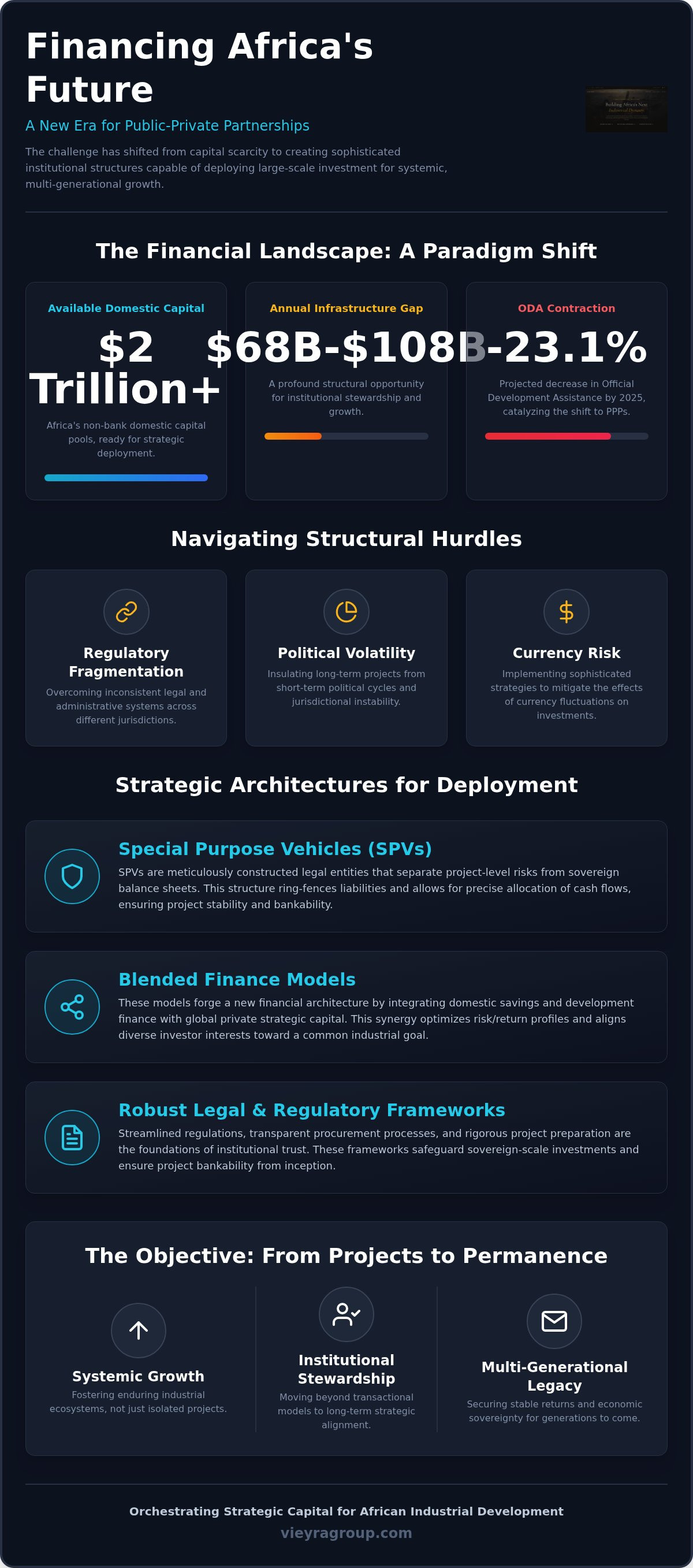
The prevailing discourse regarding the continent's development has reached a definitive inflection point where the scarcity of capital is no longer the primary impediment to progress. With Africa's non-bank domestic capital pools now surpassing $2 trillion, the imperative has shifted toward the creation of sophisticated institutional architectures capable of orchestrating large-scale deployment. You're likely well aware of the persistent challenges posed by regulatory fragmentation and the perceived volatility of political and currency environments across various jurisdictions. These structural hurdles often obscure the profound potential for systemic growth and multi-generational wealth preservation.
This exploration provides an authoritative analysis of public-private partnership financing Africa, focusing on the structural mechanisms required to align sovereign-scale capital with the continent's industrialization goals. We'll examine the robust risk-mitigation frameworks and strategic alignments necessary to secure stable, multi-generational returns while fostering systemic economic transformation. By moving beyond transactional models, we can establish the institutional stewardship required for long-term industrial stability. This transition from mere capital mobilization to deliberate, strategic deployment marks a new era of permanence for African infrastructure and economic sovereignty.
Key Takeaways
- Establish the structural sophistication required to deploy capital through the utilization of Special Purpose Vehicles and blended finance models that integrate development finance with private strategic capital.
- Navigate the complexities of public-private partnership financing Africa by implementing robust legal frameworks and currency risk-mitigation strategies that safeguard sovereign-scale investments.
- Examine the transformative impact of streamlined regulatory environments in leading economies, which facilitate the rapid approval and execution of large-scale industrial projects.
- Appreciate the critical importance of rigorous project preparation and transparency in procurement as the foundational elements for building institutional trust and ensuring project bankability.
- Understand how the orchestration of strategic capital solutions enables the realization of multi-generational industrial objectives through the alignment of private interests with national development goals.
The Imperative of Infrastructure: Reimagining Public-Private Partnerships in Africa
The conceptualization of infrastructure has undergone a fundamental shift, moving from a paradigm of public utility to one of strategic industrial sovereignty. This evolution necessitates a sophisticated approach to public-private partnership financing Africa, where the focus extends beyond immediate fiscal relief to the creation of enduring industrial ecosystems. Historically, African infrastructure relied heavily on state-led initiatives or official development assistance; however, the contraction of ODA by 23.1% in 2025 has catalyzed a transition toward blended institutional capital. By integrating domestic savings with global investment management, the continent is forging a new financial architecture that prioritizes systemic transformation over isolated project delivery. It's a movement toward permanence.
The Infrastructure Gap as a Strategic Opportunity
The annual infrastructure financing gap, estimated between $68 billion and $108 billion as of 2026, represents a profound structural opening for institutional stewardship. This deficit in energy, transport, and digital connectivity serves as a significant constraint on global competitiveness, yet it also defines the parameters for large-scale industrial progress. An African PPP serves as a sovereign-scale vehicle designed to orchestrate the deployment of strategic capital into the foundational assets required for national and continental industrialization. The historical context of Public-Private Partnerships in Developing Countries illustrates a maturation of these frameworks, where the integration of digital usage gaps and economic corridors now forms the bedrock of modern development strategy. These corridors aren't merely roads or rails; they're the conduits of future trade.
The Multi-Generational Case for Partnership
Infrastructure assets possess lifecycles that inherently exceed the temporal boundaries of political cycles or short-term fiscal mandates. This inherent permanence requires an alignment with capital that shares a multi-generational horizon, such as the African Industrialization Capital managed by sovereign-level entities and family offices. By bridging the gap between immediate budgetary constraints and long-term industrial requirements, these partnerships ensure that critical projects remain insulated from jurisdictional volatility. The Vieyra Foundation exemplifies this commitment by aligning social impact with the overarching goals of infrastructure development. The objective is the creation of a legacy of industrialization, where the stability of the institutional framework mirrors the physical durability of the assets themselves. True progress isn't measured in years, but in generations. Through the deployment of Strategic Capital Solutions, we can ensure that these projects serve as the backbone of a resilient, industrialized continent.
Structural Architectures of PPP Financing: Beyond Conventional Capital Allocation
The deployment of public-private partnership financing Africa requires a sophisticated separation of project-level risks from sovereign balance sheets. This is achieved through the meticulous construction of Special Purpose Vehicles (SPVs). These entities function as the legal and financial nexus for large-scale industrial projects, ensuring that liabilities remain ring-fenced while allowing for the precise allocation of cash flows. In these structures, the hierarchy of capital is paramount. Senior debt provides the foundational stability; mezzanine layers offer the necessary flexibility to absorb initial volatility. Revenue certainty, often secured through long-term off-take agreements, remains the primary driver of bankability, especially in capital-intensive sectors. Asset recycling further enhances this model, allowing for the liberation of capital from mature assets to fund new industrial frontiers.
Blended finance models have emerged as a critical instrument for bridging the gap between perceived risk and institutional requirements. By integrating development finance with private strategic capital, these models create a tiered risk-sharing environment that attracts sovereign-scale investment. Research regarding PPPs in the African Energy Sector demonstrates how such structures successfully mitigate political and regulatory uncertainties through credit enhancement instruments and sovereign guarantees. This methodical approach to capital stacking ensures that industrialization initiatives aren't merely aspirational but represent viable, long-term assets. It's a process that demands rigorous oversight and a deep understanding of local capital market dynamics.
Innovative Financing Mechanisms for the African Context
Modern financial architectures are increasingly incorporating non-traditional assets to enhance project viability. Emission reduction credits, for instance, offer a secondary revenue stream that aligns industrial growth with global decarbonization mandates. Credit enhancement instruments, such as partial risk guarantees, serve to compress spreads and extend tenors, making multi-generational wealth preservation achievable through stable, long-term yields. These mechanisms transform infrastructure into a predictable asset class. For those seeking to deploy capital into such sophisticated frameworks, exploring strategic capital solutions provides a pathway to institutional-grade opportunities that prioritize stability and depth.
The Role of Institutional Stewardship
Traditional private equity often operates within constrained exit horizons that are incompatible with the multi-decade lifecycles of infrastructure assets. Conversely, institutional stewardship, particularly through family offices, provides the "patient capital" required for systemic impact. This stewardship isn't merely a funding source; it's a governance mechanism that ensures project bankability through long-term alignment with the African industrialization agenda. By prioritizing the permanence of the asset over short-term liquidity, these actors serve as architects of legacy. They ensure the structural integrity of the financing mirrors the physical resilience of the infrastructure itself, creating a foundation for enduring economic sovereignty.
Navigating Sovereign-Scale Risk: Governance and Legal Robustness
Risk within the African infrastructure landscape is frequently misconstrued as an insurmountable barrier rather than a structural variable that demands institutional management. The deployment of public-private partnership financing Africa necessitates a transition from reactive risk-avoidance to proactive governance. This shift is predicated on the establishment of legal frameworks that provide the permanence required for multi-generational investment. It's not enough to rely on bilateral agreements; true stability is forged through standardized legislation that survives administrative turnover and political transitions. By prioritizing institutional robustness, we can transform perceived volatility into a manageable component of long-term industrial strategy.
Standardized PPP legislation across regional blocs remains a critical objective for continental integration. Recent developments, such as Nigeria's Model PPP Agreement unveiled in June 2026, demonstrate a commitment to reducing negotiation times and creating consistency in risk allocation. These efforts are essential for building the institutional trust necessary to bridge the financing gap. As highlighted in discussions regarding Public-Private Partnership Financing in Developing Countries, the integration of private sector expertise with public oversight is the most viable path toward systemic transformation. Without these legal anchors, capital remains hesitant; with them, it becomes a catalyst for industrialization.
Legal Frameworks and Institutional Stability
The protection of sovereign-scale investments requires a legal environment that transcends individual political tenures. Kenya's 2026 Public Private Partnerships Amendment Bill, which introduces a success fee for project preparation, illustrates the evolving nature of these frameworks. Such regulations aim to ensure that the public sector remains a capable and accountable partner. The Vieyra approach prioritizes the establishment of robust governance and legal transparency as an absolute prerequisite for the deployment of sovereign-scale capital into any jurisdiction. This disciplined focus on governance ensures that projects are not merely bankable but are resilient against the shifts of the geopolitical tide. Dispute resolution mechanisms must be clearly defined and internationally recognized to provide the necessary recourse for cross-border partnerships.
Sovereign-Level Risk Allocation
Achieving the optimal balance between public and private risk-bearing is a sophisticated orchestration of interests. South Africa's revised PPP regulations, which came into effect on June 1, 2026, provide a streamlined pathway for projects valued below R2 billion, accelerating the approval process while maintaining rigorous oversight. This model addresses the paradox often found in fragile or conflict-affected states, where the need for infrastructure is greatest but the risk profile is most daunting. By leveraging local capital markets, which now hold over $2 trillion in non-bank domestic assets, investors can naturally hedge against currency volatility. This domestic alignment, combined with strategic capital solutions, creates a robust framework for enduring industrial progress. ESG considerations don't just represent philanthropic ideals; they serve as critical risk-mitigation strategies that ensure community alignment and project longevity.
The Strategic Lifecycle of African PPPs: From Preparation to Multi-Generational Impact
The lifecycle of a sovereign-scale infrastructure asset is not defined by the culmination of financial close but by the decades of operational excellence that follow. Within the context of public-private partnership financing Africa, the rigor applied during the pre-investment phase serves as a critical gatekeeping function. This ensures that only projects with profound systemic potential advance to the procurement stage. Transparency in these early processes is the primary driver of institutional trust, providing the certainty required for the deployment of African Industrialization Capital. By treating project preparation as a strategic investment rather than a bureaucratic hurdle, partners ensure the long-term viability of industrial assets. It's a commitment to precision.
The Pre-Investment and Structuring Phase
Establishing an enabling environment requires a synthesis of technical assistance and strategic foresight. International financial institutions often provide the necessary scaffolding, yet the ultimate success of the Special Purpose Vehicle (SPV) depends on its ability to facilitate multi-generational capital flows. This structuring phase must account for the unique requirements of Strategic Capital Solutions, where the objective is to balance immediate industrial needs with the preservation of wealth across several decades. It's about building for the future.
Long-Term Asset Stewardship
True stewardship involves monitoring performance indicators over a 20 to 50 year horizon, ensuring that the asset remains productive despite technological disruptions in transport or energy. This is where traditional models often fail. They lack the permanence required for such a commitment. The Vieyra Foundation plays a pivotal role here, ensuring that large-scale projects maintain local community alignment through philanthropic initiatives that complement industrial goals. This holistic approach mitigates social risk and reinforces the project's license to operate. It ensures that the physical infrastructure remains a benefit to the people it serves.
The final phase of the lifecycle involves a choice between asset recycling and permanent institutional holding. While asset recycling allows for the liberation of capital to fund subsequent industrial frontiers, permanent holding reflects a commitment to the enduring sovereignty of the continent's infrastructure. For entities seeking to navigate these complex lifecycles with a partner of established prestige, engaging with Global Investment Management services ensures that every phase of the project is managed with the deliberation and foresight required for a lasting legacy. Every decision is made with an eye toward the next century.
Vieyra Family Office: Orchestrating Strategic Capital for African Industrial Development
The orchestration of public-private partnership financing Africa requires more than technical proficiency; it demands a philosophical commitment to the continent's sovereign trajectory. As a global actor, the Vieyra Family Office operates with the deliberation of an established institution, prioritizing the deployment of African Industrialization Capital into projects that define the industrial landscape. This isn't merely capital allocation. It's the architecture of a legacy. By integrating Global Investment Management with deep, African-centric expertise, the institution ensures that every initiative contributes to a broader systemic transformation. Our approach transitions from the transactional to the institutional, where the scale of operations is matched by the weight of our long-term vision.
A Legacy of African Stewardship
The office acts as a stately guardian of capital, ensuring that resources are preserved and grown through a multi-generational lens. This perspective allows for the patience required to see large-scale infrastructure through its full lifecycle, far beyond the constraints of traditional private equity. The intersection of heritage and stability provides a unique foundation for Capital Allocation for African Industrialization, where the focus remains on forward-looking progress. Through the Vieyra Foundation, this stewardship extends into the philanthropic realm, where social impact is treated as a critical pillar of development. We don't view philanthropy as a separate endeavor but as a mechanism to ensure that industrial progress remains aligned with the needs of the communities it serves.
Engaging for Sovereign-Scale Impact
Strategic partnerships with African sovereign entities are predicated on a shared vision of permanence and global influence. The office seeks engagements that match its institutional capacity, focusing on projects where Strategic Capital Solutions can catalyze profound industrial growth. Our criteria for partnership involve a rigorous assessment of governance and alignment with continental objectives. This commitment to permanence ensures that our presence in the market is a stabilizing force, one that projects confidence and rigor across diverse jurisdictions. We prioritize projects that demonstrate the potential for multi-generational returns and systemic impact. For those representing sovereign interests or institutional capital, we invite you to engage with our office to explore initiatives that require the poise and foresight of a dedicated global partner. Together, we can build the industrial foundations of a sovereign future.
Architecting a Legacy of African Industrial Sovereignty
The transition from fragmented, transactional models to a cohesive institutional framework represents the most viable path toward continental industrialization. By prioritizing the structural robustness of special purpose vehicles and the alignment of multi-generational capital, we can transform the infrastructure landscape. The integration of domestic capital pools, which now exceed $2 trillion, provides a resilient foundation for growth that transcends individual political cycles. It's a shift toward permanence. This evolution requires unwavering institutional stewardship and a sophisticated approach to risk management.
Success in public-private partnership financing Africa depends on the deliberate orchestration of strategic capital by entities that possess both the foresight and the institutional capacity to manage sovereign-scale risk. This requires a commitment to a multi-generational vision and a deep understanding of the continent's diverse regulatory environments. We invite you to Engage with Vieyra Family Office for Strategic Capital Allocation to leverage our sovereign-scale institutional management and multi-generational heritage. Together, we can ensure that African industrialization isn't merely an aspirational goal but a tangible, enduring reality for the next century. The future of the continent is being built today.
Frequently Asked Questions
What is the current state of public-private partnership financing in Africa for 2026?
The current state of public-private partnership financing Africa in 2026 is defined by a pivot from capital mobilization to strategic deployment. With domestic capital pools exceeding $2 trillion, the focus has shifted toward building institutional architecture capable of absorbing this liquidity. The endorsement of the New African Financial Architecture for Development in early 2026 signals a continent-wide commitment to self-reliance. This maturation allows for more sophisticated, long-term industrial projects that prioritize systemic transformation.
How do sovereign-scale family offices mitigate political risk in African infrastructure?
Sovereign-scale family offices mitigate political risk in public-private partnership financing Africa by acting as institutional stewards rather than mere transactional financiers. They prioritize the establishment of robust legal frameworks and standardized legislation that transcends administrative turnover. By providing "patient capital" that aligns with the multi-decade lifecycles of infrastructure assets, these offices create a stabilizing presence. This approach ensures that projects remain insulated from jurisdictional volatility while fostering strategic partnerships with national governments.
What role does blended finance play in African industrialization projects?
Blended finance serves as a critical mechanism for bridging the gap between perceived risk and institutional requirements in African industrialization. By integrating development finance with private strategic capital, these models create a tiered risk-sharing environment. This structure allows for the compression of spreads and the extension of tenors, making large-scale projects more attractive to sovereign-level investors. It's an essential tool for orchestrating the capital stacks required for complex, high-impact industrial ecosystems across the continent.
Why is the Special Purpose Vehicle (SPV) critical for PPP financing?
The Special Purpose Vehicle is the essential legal and financial nexus for ring-fencing sovereign-scale risk in public-private partnerships. It protects the balance sheets of both the public and private partners by isolating project-specific liabilities. This structural separation ensures that cash flows are precisely allocated and that the project's financial integrity remains independent of the sponsors' broader operations. Without a robust SPV, the complexities of multi-generational industrial projects would be too cumbersome to manage effectively.
How does the Vieyra Family Office approach the infrastructure deficit in Africa?
The Vieyra Family Office addresses the African infrastructure deficit through the deployment of Strategic Capital Solutions at a sovereign scale. By prioritizing long-term growth and economic development, the institution acts as a visionary architect of legacy. It combines global investment management with deep continental expertise to fund projects that serve as catalysts for industrialization. This approach moves beyond filling fiscal gaps, focusing instead on creating enduring industrial sovereignty through the methodical application of capital.
What are the primary sectors for PPP investment in Africa today?
Primary sectors for PPP investment currently focus on energy, transport, and digital connectivity, which form the bedrock of continental industrialization. Integrated economic corridors that connect logistics, industry, and markets are increasingly prioritized over isolated assets. Energy projects remain critical, particularly those incorporating emission reduction credits to align with global decarbonization mandates. Additionally, there is a significant focus on bridging the digital usage gap to translate connectivity into measurable economic productivity and job creation.
How can multi-generational capital ensure the longevity of African infrastructure?
Multi-generational capital ensures longevity by matching the temporal requirements of infrastructure assets with investors who possess a 20 to 50 year horizon. Unlike traditional private equity, which often demands rapid exits, this patient capital prioritizes the permanence and performance of the asset. This alignment allows for consistent maintenance and adaptation to technological disruptions over several decades. It creates a foundation of stability that transcends political cycles, ensuring that critical industrial infrastructure serves multiple generations.
What is the role of the Vieyra Foundation in sovereign-scale investments?
The Vieyra Foundation functions as a strategic pillar of development, ensuring that sovereign-scale investments remain aligned with social impact goals. By pursuing philanthropic initiatives that complement large-scale industrial projects, the foundation fosters community buy-in and mitigates social risk. This holistic approach reinforces the project's license to operate and ensures that the benefits of industrialization are felt at the local level. It's a commitment to systemic progress where economic growth and social welfare are linked.


