
The pursuit of multi-generational permanence within the African investment landscape has transitioned from a strategy of cautious diversification to one of deliberate, sovereign-scale construction. While the traditional portfolio often falters against the idiosyncratic volatilities of emerging jurisdictions, a sophisticated approach to alternative asset allocation for family offices in Africa offers a pathway toward both capital preservation and systemic industrial impact. Many principals rightly identify the inherent complexities of local deal flow and the persistent perception of jurisdictional risk as significant barriers to entry. However, the maturation of the continent's regulatory frameworks, such as the 2026 capital flow management updates in South Africa, signals a new era of institutional clarity.
It's clear that securing a legacy across decades requires more than mere exposure; it demands the integration of global investment standards with deep-rooted local industrialisation. This article provides a comprehensive framework for mastering institutional-grade alternative investments to secure wealth while driving meaningful economic transformation. We will examine the strategic alignment of private equity, infrastructure, and private credit to ensure your capital functions as a cornerstone of African development. Through this lens, you will discover how to align the preservation of heritage with the visionary architecture of a continent's future.
Key Takeaways
- Define the transition toward sovereign-scale alternative asset allocation for family offices in Africa as a prerequisite for institutional permanence and long-term capital preservation.
- Evaluate the strategic role of private equity in driving systemic industrialisation, moving beyond traditional diversification toward high-impact economic transformation.
- Assess infrastructure investments, specifically within energy and digital connectivity, as defensive mechanisms for securing wealth against global market volatility.
- Implement a rigorous framework for risk mitigation that leverages institutional gravity to navigate the complexities of African jurisdictional shifts.
- Align global investment management standards with localized industrial opportunities to ensure the continuity of multi-generational legacies and sovereign-level impact.
The Evolution of Alternative Asset Allocation in the African Institutional Landscape
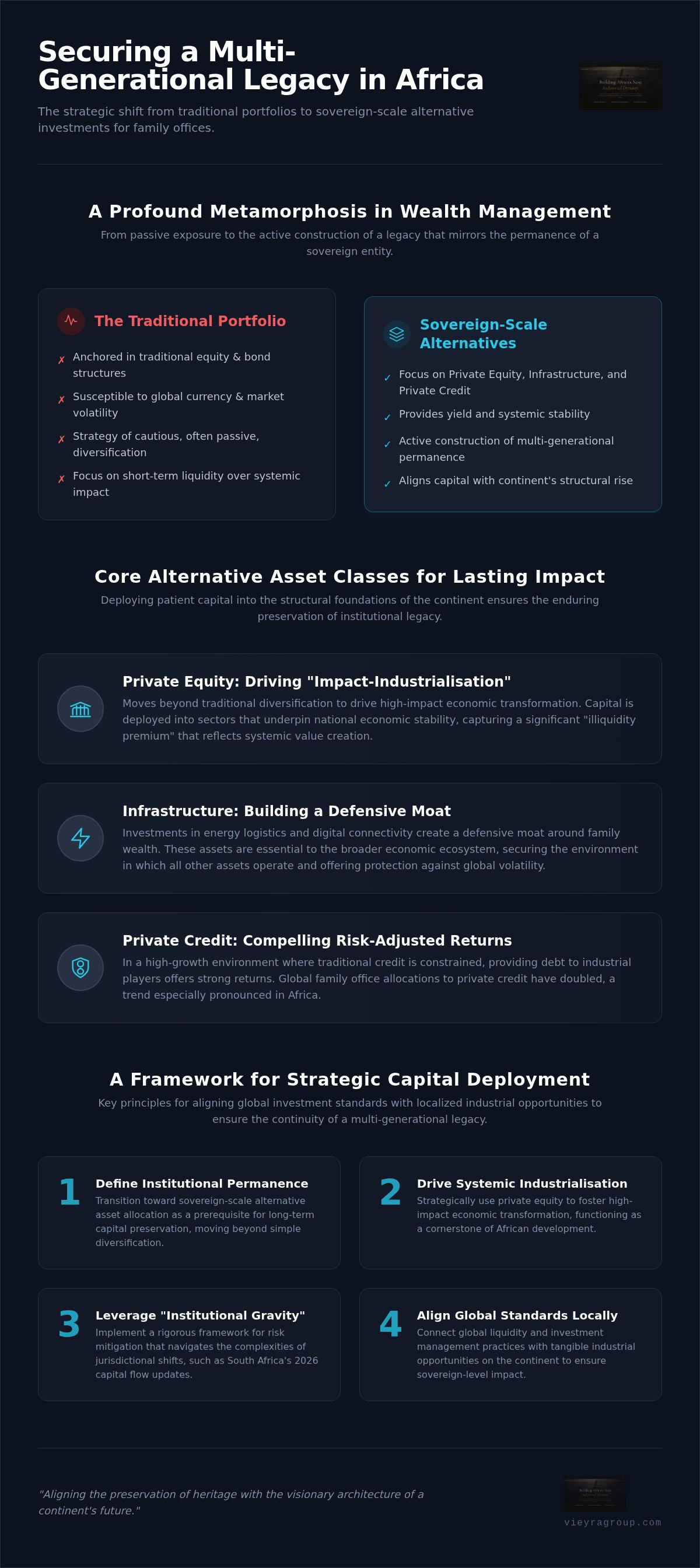
The paradigm of wealth management within the African context has undergone a profound metamorphosis. Historically, portfolios were anchored in traditional equity and bond structures, often susceptible to the caprice of global currency fluctuations and public market volatility. Today, a more sophisticated architecture is emerging. This evolution prioritizes alternative asset allocation for family offices in Africa, focusing on assets that provide not just yield, but systemic stability. It's a move from passive exposure to the active construction of a legacy that mirrors the permanence of a sovereign entity.
African capital markets require a bespoke approach because they don't always follow the linear trajectories of Western counterparts. Regulatory shifts, such as the 2026 Draft Capital Flow Management Regulations in South Africa, necessitate a strategy that is both agile and deeply rooted in local realities. Strategic capital serves as the vital bridge here. It connects global liquidity with the tangible industrial needs of the continent, ensuring that wealth is not merely stored but is actively participating in the continent's structural rise.
Defining Alternatives for the Modern African Family Office
It's no longer sufficient to view alternatives through the narrow lens of residential real estate or basic commodities. The modern mandate for institutional wealth includes private debt, large-scale infrastructure, and industrial capital. Sovereign-scale institutions, often operating in alignment with multilateral entities like the Africa Finance Corporation, categorize risk-adjusted returns based on their capacity to withstand multi-generational shifts. This requires a transition toward Global Investment Management practices that prioritize "permanence" in asset selection. In the 2026 landscape, the value of an asset is increasingly tied to its essentiality within the broader economic ecosystem.
The Shift Toward Industrial and Infrastructure Assets
Current trends suggest a decisive move toward "Impact-Industrialisation" as a core asset class. Traditional diversification often fails in Africa because it ignores the interconnectedness of systemic growth. When a family office allocates capital toward energy logistics or digital connectivity, they aren't just seeking a return; they're securing the environment in which their other assets operate. This alignment of Strategic Capital Solutions with industrial progress creates a defensive moat around family wealth. African Alternative Allocation is the strategic deployment of patient capital into the structural foundations of the continent to ensure the enduring preservation of institutional legacy.
Strategic Alternative Classes: Private Equity and Infrastructure Development
The optimization of alternative asset allocation for family offices in Africa necessitates a transition from liquid, globalized equities toward the tangible industrial foundations of the continent. While traditional portfolios often prioritize immediate liquidity, sovereign-scale family offices are uniquely positioned to capture the "illiquidity premium" inherent in long-term industrial projects. This premium isn't merely a compensation for time; it's a reflection of the systemic value created when capital is deployed into sectors that underpin national economic stability. It's a strategic choice to trade short-term exit options for the enduring yield of essential industries.
Private debt has also emerged as a critical component of this strategy. In a high-interest, high-growth environment, providing senior or mezzanine debt to established industrial players offers a compelling risk-adjusted return. Recent data indicates that family office allocations to private credit have doubled globally, a trend that is particularly pronounced in African jurisdictions where traditional credit remains constrained. Aligning these complex requirements with Strategic Capital Solutions ensures that the family office operates with the precision of a global institution while maintaining deep local relevance.
Industrialisation as a Primary Investment Pillar
Deploying capital into large-scale manufacturing and processing hubs represents the pinnacle of strategic industrialisation. These assets aren't just businesses; they're sovereign-level economic drivers. According to a recent African Private Equity and Venture Capital Association report, the maturation of private equity in Africa is increasingly defined by investments in value-add manufacturing. This systemic importance provides a layer of stability that traditional equity markets cannot match. By anchoring a portfolio in the real economy, family offices protect their wealth from the caprice of public market sentiment.
Infrastructure: The Foundation of Multi-generational Yield
Infrastructure has surpassed traditional real estate as the preferred defensive alternative for 2026. While real estate remains subject to local consumer cycles, infrastructure projects in energy, logistics, and digital connectivity serve as the essential plumbing of the continent. These large-scale projects often involve public-private partnerships, providing a structured hedge against global currency fluctuations through inflation-linked returns. With the number of formal African family offices increasing by 75% since 2015 and managing a collective AUM of over $40 billion, the move toward infrastructure reflects a broader institutionalisation of the sector. These assets provide the predictable, long-term cash flows required for multi-generational wealth transfer while simultaneously securing the continent's industrial future.
Mitigating Sovereign-Scale Risk through Multi-generational Foresight
The prevailing discourse regarding investment on the continent often fixates upon jurisdictional volatility as an insurmountable barrier; yet, for the sophisticated actor, such fluctuations represent a variable to be managed through the application of institutional gravity. Managing geopolitical risk requires more than a reactive posture. It demands a "Stately Guardian" approach that utilizes long-term stability and multi-generational vision to navigate regulatory shifts. When considering alternative asset allocation for family offices in Africa, the primary objective is to transform perceived instability into a structured environment for capital preservation. This is achieved by anchoring investments in sectors of systemic importance where the interests of the family office align with the long-term industrial trajectory of the state.
Strategic Capital Solutions provide the necessary architecture to withstand these cycles. By integrating a deep local presence with an institutional heritage that spans decades, a family office can anticipate shifts in the landscape before they manifest as crises. This foresight isn't merely an advantage; it's a prerequisite for those operating at a sovereign scale. It ensures that capital remains productive, even when public markets face temporary disruptions or when new regulations, such as the 2026 capital flow mandates in South Africa, alter the traditional landscape.
Institutional Governance and Risk Frameworks
A sovereign-scale family office operates with the professional rigor of a global institution, guided by a formal Investment Committee that bridges the gap between family values and market realities. This committee serves as the arbiter of risk-adjusted returns, ensuring that every deployment of capital meets the highest standards of global investment management. By applying these rigorous frameworks within local African markets, the office creates a synthesis of international best practices and deep-seated regional expertise. This interconnectedness allows for a nuanced understanding of how local industrial success directly reinforces the security of the broader portfolio.
Legacy Preservation in Volatile Jurisdictions
The architecture of permanence is built upon sophisticated legal and financial structures that prioritize the continuity of wealth across generations. In jurisdictions where policy may shift, the focus remains on the "permanence" of the underlying assets, such as industrial hubs or essential infrastructure. Multi-generational vision allows a principal to look past the noise of a single electoral cycle or a temporary currency fluctuation to see the underlying growth of the African industrial base. Sovereign-Scale Risk Mitigation is the strategic orchestration of capital, legal safeguards, and local institutional heritage to ensure that wealth remains resilient across shifting political and economic cycles. Through this deliberate approach, the family office doesn't just survive volatility; it thrives as a visionary architect of the continent's future.
A Framework for Strategic Capital Deployment in African Markets
The Vieyra methodology functions as a sophisticated conduit, aligning the rigorous tenets of Global Investment Management with the specific, large-scale growth trajectories of the African continent. This framework for strategic deployment begins with the identification of sovereign-level industrial opportunities that possess the capacity to underpin national economic stability. Every potential engagement is evaluated through a multi-generational lens, ensuring that deal flow is assessed for its systemic impact rather than mere short-term yield. Once identified, capital is structured via Strategic Capital Solutions to support long-term industrialisation projects, with a final step of integrating philanthropic alignment through the Vieyra Foundation to ensure a holistic legacy.
This approach moves beyond the standard checklists that prioritize immediate liquidity, which often fail to account for the unique "Industrialisation-first" mandate of many African principals. By deploying African Industrialization Capital into projects with high systemic essentiality, a family office secures its position as a significant global actor. It's a deliberate process that requires patience, foresight, and a commitment to the structural rise of the continent.
Selecting Partners for Sovereign-Scale Initiatives
When refining the alternative asset allocation for family offices in Africa, the selection of co-investment partners is a critical determinant of institutional success. Criteria for collaboration must focus on other multi-generational family offices that share a commitment to institutional gravity and long-term stability. It's essential to utilize institutional expertise in industrial finance to navigate the complexities of these markets. Avoiding retail-minded advisors is paramount, as their focus on short-term exit strategies often conflicts with the multi-decade horizons required for sovereign-scale industrial deployment.
Monitoring Performance through a Multi-Decade Lens
Standard quarterly reporting is fundamentally insufficient for assessing the progress of large-scale African infrastructure or industrial hubs. The rhythm of institutional communication must be measured and methodical, reflecting the long-term nature of the objectives. Performance monitoring should involve measuring systemic impact alongside financial returns, ensuring that the capital is actively driving economic transformation. This sophisticated reporting structure provides the clarity required for multi-generational wealth transfer, allowing the family office to maintain its poise as a stately guardian of heritage while remaining certain of its visionary trajectory toward large-scale progress.
The Vieyra Paradigm: Aligning Global Capital with African Industrialization
The Vieyra Family Office functions at a critical juncture where the exacting standards of global finance converge with the profound potential of African industrial development. This paradigm rejects the reductionist view of family offices as simple private investment vehicles; it asserts their role as visionary architects of a continental legacy. By refining alternative asset allocation for family offices in Africa, the institution ensures that capital remains a powerful conduit for systemic economic transformation. Such a mandate requires an unwavering commitment to the permanence of wealth and a sophisticated understanding of the continent's long-term industrial trajectory, ensuring that every deployment of capital reinforces the structural foundations of the state.
Strategic Capital Solutions serve as the primary mechanism for this alignment, facilitating the deployment of patient capital into sectors of sovereign importance such as energy, logistics, and digital connectivity. This is an institutional-scale endeavor, characterized by the deliberation and foresight necessary to navigate the complexities of emerging jurisdictions while maintaining global professional rigor. The Vieyra Foundation is naturally integrated into this framework to build trust and ensure that industrial progress is harmonized with social impact through strategic philanthropic alignment. This holistic approach creates a durable structure for multi-generational wealth preservation, where financial success and systemic progress are inextricably linked across decades of development.
Global Stewardship and African Industrialisation
Global stewardship requires a meticulous balance between international investment management standards and the unique requirements of African growth. The Vieyra approach elevates African Industrialization Capital as a core mission, focusing on large-scale manufacturing and processing hubs that provide the essential plumbing of the economy. The Vieyra Foundation reinforces this mission by aligning philanthropic initiatives with industrial goals, thereby creating a culture of stability and mutual prosperity. This synergy ensures that the family office operates as a significant global actor, blending traditional values of heritage with a forward-looking commitment to large-scale progress.
Partnering for Multi-generational Success
We invite other principals and institutional peers to align with a sovereign-scale institution that recognizes the profound responsibility of African wealth management. Refining the alternative asset allocation for family offices in Africa represents a transition toward institutional stewardship and permanent global influence. The process begins with a methodical evaluation of how your capital can best support the continent's structural rise while securing your own multi-generational heritage. We encourage you to Explore Sovereign-Scale Capital Solutions with Vieyra Family Office to solidify your position as a visionary architect of the African legacy of the future.
Architecting the African Industrial Legacy
The transition from passive diversification to active, sovereign-scale construction represents the definitive path for the modern principal seeking permanence. It's clear that the strategic integration of private equity and large-scale infrastructure ensures wealth isn't just preserved; it's fundamentally woven into the continent's structural rise. Mastering alternative asset allocation for family offices in Africa requires a synthesis of localized heritage and global investment management rigor to navigate shifting jurisdictions with poise. By adopting a multi-decade lens, you secure a position as a significant actor in the continent's industrial transformation while safeguarding your family's heritage.
Vieyra Family Office provides the sovereign-scale institutional expertise and multi-generational African industrial heritage required to execute this vision with precision. We invite you to Refine Your Institutional Strategy with Vieyra Family Office and align your capital with the visionary architecture of the future. The path toward enduring impact is built upon the deliberate orchestration of strategic capital and systemic progress.
Frequently Asked Questions
What defines a sovereign-scale alternative investment in the African context?
A sovereign-scale alternative investment is characterized by its systemic importance to national economic stability and its alignment with large-scale industrial trajectories. These assets, such as energy grids or logistics hubs, operate with the permanence and weight of a state entity. They require significant capital depth and a multi-generational horizon. This approach ensures that the alternative asset allocation for family offices in Africa transcends mere diversification, functioning instead as a cornerstone of the continent's structural development.
How should family offices balance global liquidity with African industrial illiquidity?
Balancing these mandates requires a bifurcated strategy that maintains a core of global liquid assets while capturing the illiquidity premium of African industrial projects. Sophisticated principals view illiquidity not as a constraint, but as a strategic advantage for capital preservation. By allocating patient capital to essential sectors, they secure higher risk-adjusted returns. This methodology relies on Global Investment Management expertise to ensure the liquid portion of the portfolio remains resilient enough to support long-term industrial commitments.
What is the role of infrastructure in a multi-generational African wealth strategy?
Infrastructure serves as the defensive foundation for multi-generational yield, providing predictable, inflation-linked cash flows that are often insulated from consumer cycles. These assets, including digital connectivity and power generation, are essential for the continent's growth. Because they represent the plumbing of the economy, they offer a hedge against volatility. For a sovereign-scale institution, infrastructure is a primary vehicle for ensuring that wealth persists across shifts in the geopolitical landscape and local market conditions.
Can alternative asset allocation in Africa mitigate currency devaluation risks?
Strategic alternative asset allocation for family offices in Africa can mitigate devaluation risks by focusing on assets with intrinsic value or those tied to hard-currency revenue streams. Industrial and infrastructure projects often possess inflation-linked pricing mechanisms or export-oriented outputs. By anchoring wealth in tangible, systemic assets rather than local-currency public equities, a family office protects its purchasing power. This approach prioritizes the long-term industrial value over the transient fluctuations of foreign exchange markets.
How does industrialisation function as an alternative asset class for family offices?
Industrialisation functions as a primary asset class by offering exposure to the real economy through manufacturing and processing hubs. Unlike traditional equities, these investments provide systemic importance, making them more resilient during periods of market stress. They allow family offices to deploy African Industrialization Capital into projects that drive value-add economic activity. This creates a defensive moat, as the success of the investment is tied to the fundamental structural rise of the domestic and regional economy.
What are the primary regulatory challenges for sovereign-scale capital in Africa?
Primary challenges include evolving capital flow management regulations and shifting compliance frameworks across multiple jurisdictions. The 2026 updates in South Africa, for instance, illustrate the need for constant institutional vigilance. Sovereign-scale capital must navigate these changes through a stately guardian approach, leveraging deep local heritage and professional rigor. Success requires a proactive stance on regulatory alignment, ensuring that all Strategic Capital Solutions remain compliant with both international standards and emerging local mandates.
How does a multi-generational family office measure the success of strategic capital?
Success is measured through a multi-decade lens that evaluates systemic impact alongside financial returns. Standard quarterly metrics are replaced by methodical reporting that tracks the asset's essentiality and its contribution to industrial progress. A visionary architect of legacy prioritizes the permanence of the asset and its capacity to transfer value across generations. True success is found when the capital actively fosters economic transformation while maintaining the steady, deliberate pace of institutional growth.
Is philanthropic alignment necessary for institutional investment in Africa?
While not strictly mandatory for financial return, philanthropic alignment through entities like the Vieyra Foundation is a critical trust-builder in African markets. It harmonizes industrial progress with social impact, creating a holistic legacy that resonates with local stakeholders. This integration fosters a stable environment for long-term operations by ensuring that the family's presence is viewed as a partner in progress. Such alignment reinforces the institutional gravity and prestige of the family office within the continent.


