
The pursuit of sovereign-scale industrialization across the African continent is not a matter of capital scarcity; it's a crisis of architectural alignment. While the African Development Bank identifies an annual investment gap exceeding $1.5 trillion, the challenge for the institutional steward remains the reconciliation of high risk-adjusted return requirements with the necessity for patient, multi-generational capital. You likely recognize that fragmented capital structures and a lack of investment-grade credit ratings, held by only two African nations as of late 2026, create a formidable barrier to entry for even the most visionary global actors. By examining the sophisticated blended finance models Africa utilizes to bridge these divides, we can move beyond the $18 billion in annual deal flow toward a standardized, systemic framework for progress.
This institutional exploration offers a comprehensive roadmap for utilizing catalytic public capital to de-risk large-scale industrial projects, ensuring they meet the rigorous standards of global investment management. You'll gain a profound understanding of how modern risk-mitigation instruments and the 2025 OECD DAC guidance serve as the foundation for securing permanent economic stability. We'll analyze the orchestration of strategic capital solutions that align multi-generational wealth with the continent's industrial destiny, transforming perceived volatility into a legacy of sovereign-scale growth.
Key Takeaways
- Appreciate the strategic role of catalytic capital in bridging the divergence between conventional investment horizons and the long-term requirements of continental industrial development.
- Evaluate the structural components of blended finance models Africa employs to mitigate risk; specifically through the use of first-loss tranches and technical assistance grants.
- Examine the transition toward sophisticated instruments; including sustainability-linked bonds and enhanced Public-Private Partnerships, to facilitate industrial processing at scale.
- Implement a rigorous multi-step framework for project deployment that emphasizes macro-economic alignment and operational de-risking.
- Understand the perspective of a sovereign-scale institution in orchestrating strategic capital for the preservation of multi-generational investment legacies.
The Imperative for Blended Finance in the African Industrial Landscape
Blended finance represents the strategic orchestration of catalytic capital, sourced from public or philanthropic entities, to mobilize private sector investment into sectors that would otherwise remain undercapitalized. It's not merely a financial tool; it's a structural necessity for a continent targeting sovereign-scale industrialization. The current divergence between the immediate liquidity requirements of commercial lenders and the multi-decadal horizons inherent to heavy industrialization necessitates a fundamental re-evaluation of capital deployment. While standard financing models focus on incremental growth within established markets, they often fail to support the structural transformation required to build entire industrial ecosystems. Bridging the estimated $1.5 trillion annual investment gap requires an institutional gravity that only sophisticated blended finance models Africa can provide.
The Structural Financing Gap in African Industry
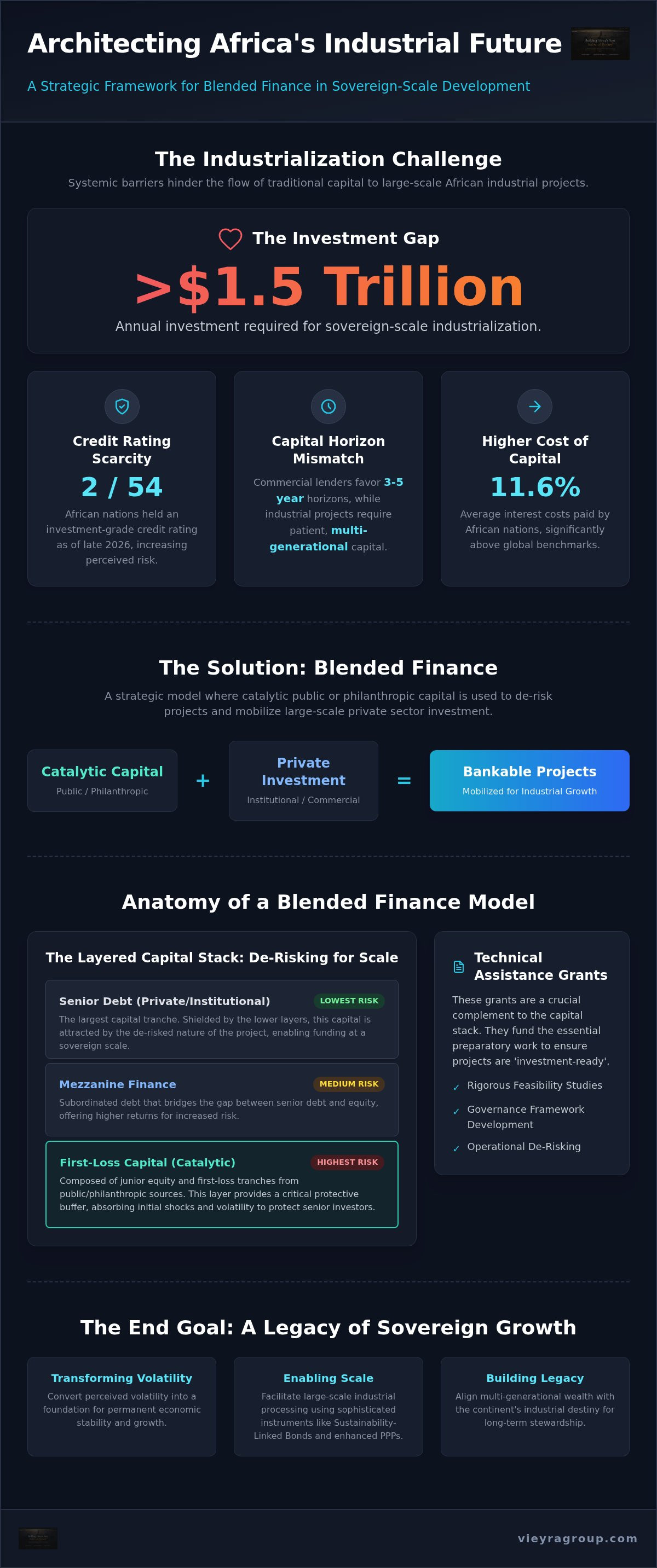
Traditional commercial banking frequently retreats from large-scale industrial infrastructure due to a perceived "Frontier Premium." This isn't always a reflection of actual project viability but rather a response to systemic constraints. As of 2026, only 32 out of 54 African nations possess a sovereign credit rating, with only two holding investment-grade status. This reality forces African nations to pay average interest costs of 11.6%, a figure significantly higher than global benchmarks. Architectural finance must step in where traditional markets hesitate. It's about creating bankable opportunities by addressing the mismatch between project timelines and the traditional three-to-five-year commercial horizon. Capital must be patient. Without this deliberation, the infrastructure required for processing and manufacturing remains unbuilt.
Catalytic Capital as a Foundation for Stability
Concessional finance serves as the cornerstone of this architectural framework. By absorbing first-loss positions, catalytic capital provides a buffer that protects senior institutional investors from early-stage volatility. This de-risking mechanism is essential for attracting the global investment management required for multi-generational projects. Sovereign-scale institutions, such as the Vieyra Family Office, act as stately guardians in this process. They deploy blended finance models Africa needs to transition from a history of aid-dependency toward a future of investment-led development. This shift ensures that industrial projects aren't just temporary initiatives but are instead rooted in long-term stewardship. By aligning the Vieyra Foundation's objectives with industrialization capital, these structures ensure that economic transformation is both profound and permanent. It's a methodical approach to building legacy through disciplined, strategic capital solutions.
The Anatomy of Blended Finance: Catalytic Capital and Risk Mitigation
The structural integrity of blended finance models Africa utilizes relies upon a meticulously layered capital stack, where each tier is designed to address specific risk profiles. Junior equity and first-loss tranches serve as the indispensable foundation of these architectures. These components are engineered to absorb initial shocks, effectively shielding senior institutional participants from the inherent volatility associated with early-stage industrial deployment. By providing this essential protective buffer, catalytic capital transforms projects that might otherwise be deemed speculative into institutional-grade opportunities. Technical assistance grants complement this financial shielding by ensuring project readiness and operational excellence. They fund the rigorous feasibility studies and governance frameworks required long before any market-rate commercial capital is deployed, ensuring that every initiative is built upon a bedrock of professional rigor.
Equity Structures and Subordination
Junior equity is the primary mechanism for aligning the divergent interests of public stakeholders and private actors. Within this tier, multi-generational family offices play a pivotal role, often acting as the "missing middle" of the capital stack. Unlike traditional private equity firms that may prioritize short-term internal rates of return, these sovereign-scale entities focus on capital preservation and long-term stewardship. This patient approach is vital for industrial projects that shape the continent's growth over decades rather than quarters. By occupying subordinated positions, these architects of legacy provide the stability required to attract senior debt. Discerning investors often look to strategic capital solutions to ensure these equity structures are resilient enough to withstand shifting global economic currents.
Risk Transfer Mechanisms
Risk mitigation is further enhanced through sophisticated transfer mechanisms, including political risk insurance and credit enhancement. These tools are designed to address non-commercial sovereign risks that frequently deter global investment management. Guarantees are particularly effective in unlocking local currency financing, which is a critical step in mitigating the foreign exchange risk that often plagues cross-border infrastructure projects. The institutional prestige of a lead arranger often dictates the quality of terms secured from multilateral agencies. By leveraging these high-level relationships, blended finance models Africa can achieve credit ratings that occasionally exceed the sovereign ceiling of the host jurisdiction. This credit enhancement allows senior debt to provide the necessary scale, introducing a market-rate discipline that ensures the project's long-term commercial viability and systemic impact.
Emerging Models: From Sustainability-Linked Bonds to Sovereign Partnerships
The evolution of institutional finance on the continent is increasingly defined by a departure from isolated, bespoke transactions toward integrated, systemic frameworks. These sophisticated blended finance models Africa is now pioneering reflect a transition from project-based financing to platform-based solutions that aggregate risk and scale impact. Central to this shift is the deployment of Sovereign Wealth Fund (SWF) co-investments. By aligning state-backed capital with private institutional discipline, these partnerships create industrial clusters that are fundamentally de-risking from their inception. This approach doesn't just fund a project; it builds a permanent industrial ecosystem. It allows for the cross-collateralization of assets, which provides an additional layer of security for the global investment management community and ensures long-term stability.
Sustainability-Linked Instruments in Industrial Contexts
The Rwanda model serves as a prime example of this evolution. Its inaugural sustainability-linked local currency bond demonstrates how industrial credit can be secured by aligning sovereign debt with specific developmental milestones. These instruments utilize coupon step-down mechanisms, where the cost of capital decreases as the project meets pre-defined industrial performance and social impact metrics. Such structures are vital to avert Africa's climate crisis while simultaneously driving industrial output. The momentum established by the Seville Platform for Action in July 2025 has further accelerated the adoption of these models, uniting over 130 initiatives to standardize sustainable development financing. Recent issuances in late 2025 demonstrate that when industrial goals are tethered to global ESG standards, they attract a higher caliber of international institutional capital.
Sovereign-Scale Partnerships and Regional Integration
Public-Private Partnerships are likewise evolving into "PPPs 2.0." These structures move beyond traditional infrastructure like roads to encompass complex industrial processing zones. This shift ensures that state-backed capital doesn't merely facilitate movement but actively catalyzes value-addition and industrial complexity. Regional development banks play a critical role here. They facilitate cross-border industrial corridors that align with the African Continental Free Trade Area (AfCFTA) objectives. These corridors act as the arteries of continental trade, ensuring that industrial output from one nation can seamlessly serve the markets of another. It's a synergy of sovereign mandates and private institutional stewardship. By pooling resources across jurisdictions, blended finance models Africa utilizes can overcome the limitations of fragmented markets. This methodical integration provides the foresight required for multi-generational economic transformation.
Durable Design: Frameworks for Long-Term Deployment
The successful orchestration of sovereign-scale industrialization requires a departure from opportunistic investment toward a disciplined, four-stage architectural framework. This methodical approach ensures that every initiative possesses the structural integrity required for multi-generational permanence. The first stage involves absolute jurisdictional and macro-economic alignment, ensuring that the project is deeply integrated into national industrialization strategies rather than existing as an isolated commercial endeavor. Technical and operational de-risking follows, leveraging global expertise to ensure that industrial excellence is maintained throughout the project lifecycle. The third stage necessitates the design of a multi-layered capital stack, where concessional, commercial, and philanthropic tranches are balanced to achieve optimal stability. Finally, rigorous impact measurement and reporting establish the multi-generational legacy of the investment, transforming blended finance models Africa utilizes into benchmarks for global investment management.
The Architecture of a Bankable Industrial Project
Integrating technical assistance during the nascent stages of the project lifecycle is paramount to ensuring institutional-grade feasibility. A governance-first approach provides the transparency and professional rigor required for high-scale African investments, serving to mitigate the perceived risks that often deter traditional commercial capital. It's insufficient to merely construct industrial assets; one must also develop rigorous exit or transition strategies that preserve industrial capacity long after the initial capital cycle concludes. These blended finance models Africa employs succeed because they prioritize structural permanence over transient gains, ensuring that the industrial infrastructure remains a productive asset for the host nation. This foresight is the hallmark of a visionary architect of legacy, one who understands that the preservation of industrial potential is as critical as its initial creation.
Measuring Multi-Generational Impact
Assessing the success of a sovereign-scale initiative requires an analytical lens that extends beyond simple return on investment. Discerning actors evaluate the "Sovereign Impact" of industrial projects on local economies, focusing on the depth of technological transfer and the resilience of the local supply chain. The Vieyra Foundation plays a critical role in this ecosystem, supporting the social architecture surrounding industrial sites to ensure that progress is both equitable and enduring. By establishing KPIs for long-term industrial resilience, the foundation ensures that the benefits of industrialization are felt across generations. This commitment to long-term stewardship aligns the interests of the family office with the developmental aspirations of the continent. To explore how these frameworks are applied to preserve African investment legacy, sophisticated partners look to Strategic Capital Solutions.
The Vieyra Perspective: Orchestrating Strategic Capital for Structural Transformation
The Vieyra Family Office operates as a stately guardian of the continent's industrial potential, recognizing that structural transformation requires more than transient liquidity. We deploy sovereign-scale capital with the deliberation and foresight characteristic of a multi-generational institution, ensuring every initiative contributes to a permanent legacy of progress. Our methodology integrates global investment management rigor with deep-rooted African expertise, creating a unique vantage point from which to architect the complex blended finance models Africa requires for systemic growth. We invite institutional partners to join us in this architectural endeavor, aligning strategic capital with the continent's industrial destiny.
A Legacy of Sovereign-Scale Stewardship
Our multi-generational vision informs every aspect of our capital allocation within industrial sectors, prioritizing stability over the volatile cycles of short-term markets. Family offices possess a unique advantage in this context, as they're unencumbered by the rigid reporting timelines that often constrain traditional commercial entities. This independence allows us to navigate complex geopolitical and economic landscapes with a degree of patience that's essential for heavy industrialization. We view the industrialization of the continent not merely as a commercial opportunity, but as the primary driver of Africa's global influence and economic sovereignty. It's through this lens of long-term stewardship that we preserve the investment legacy of the continent, ensuring industrial capacity serves as a foundation for multi-generational wealth. Our commitment isn't measured in fiscal quarters but in the enduring stability of the industrial ecosystems we help establish.
Forging Institutional Partnerships
True structural transformation is a collaborative effort, requiring the alignment of global Development Finance Institutions (DFIs), Multilateral Development Banks (MDBs), and Sovereign Wealth Funds (SWFs). By orchestrating these diverse capital sources into high-impact blended finance models Africa can utilize, we create the necessary scale for sovereign-level initiatives. The Vieyra Family Office provides the strategic capital solutions required to anchor these complex structures, offering a level of institutional gravity that attracts disciplined private investment. Our investment philosophy is rooted in the values of permanence and professional rigor, ensuring our trajectory remains certain even amidst shifting global currents. We remain committed to the visionary architecture of the continent's future, inviting those who share our commitment to stability and progress to participate in this transformative journey. Through the Vieyra Foundation, we ensure the social architecture of our projects remains as robust as the industrial assets themselves, securing a future that's both prosperous and sustainable.
Architecting the Industrial Legacy of the Continent
The structural transformation of the African continent requires a departure from fragmented, short-term initiatives in favor of sophisticated architectures that ensure long-term stability. By implementing robust blended finance models Africa can effectively mobilize the catalytic capital necessary to bridge the $1.5 trillion annual investment gap. This institutional evolution relies on the integration of first-loss protections, technical excellence, and sovereign-scale partnerships to transform perceived market risks into bankable industrial opportunities. Such a methodical approach ensures that industrialization isn't merely an economic objective but a permanent foundation for multi-generational prosperity.
The Vieyra Family Office stands as a stately guardian in this process, bringing global investment management rigor and a multi-generational commitment to African industrialization to every initiative. We invite institutional partners to engage with our sovereign-scale expertise to secure the continent's industrial destiny. Explore the Vieyra Family Office Approach to Strategic Capital to understand how we orchestrate long-term stewardship for structural transformation. The path to a resilient industrial future is clear for those with the foresight to build it.
Frequently Asked Questions
What is the primary difference between blended finance and traditional development aid?
Blended finance functions as a strategic investment framework rather than a unilateral transfer of resources. While traditional development aid often focuses on immediate humanitarian relief through non-repayable grants, the blended finance models Africa utilizes prioritize the mobilization of private sector capital for commercial sustainability. It leverages catalytic funds to improve the risk-return profile of industrial projects, ensuring that public capital acts as a force multiplier for institutional-grade investment rather than a finite subsidy.
How do blended finance models specifically address the risks of African industrial projects?
These structures mitigate risk by layering the capital stack to protect senior investors from initial volatility. By utilizing first-loss tranches and junior equity, these models absorb the "Frontier Premium" associated with emerging industrial sectors. Additionally, technical assistance grants ensure project readiness and operational excellence before major capital deployment. This methodical de-risking transforms perceived sovereign and project-level hurdles into a structured environment suitable for global investment management and long-term capital preservation.
What role do multi-generational family offices play in the blended finance ecosystem?
Multi-generational family offices, such as the Vieyra Family Office, serve as the stately guardians of patient capital within the ecosystem. They occupy the "missing middle" of the capital stack, providing the long-term stewardship that traditional private equity often lacks due to shorter fund lifecycles. Their sovereign-scale perspective allows for the orchestration of strategic capital solutions that prioritize multi-generational economic transformation over transient returns, providing the stability required to anchor large-scale industrialization projects.
Can blended finance structures achieve commercial-grade returns for institutional investors?
Commercial-grade returns are achievable through the disciplined use of credit enhancement and risk-transfer mechanisms. By subordinating concessional or philanthropic capital, the senior tranches of these projects can offer risk-adjusted returns that meet the stringent requirements of global institutional investors. This alignment ensures that large-scale industrialization isn't viewed as a philanthropic exercise but as a sophisticated architectural necessity that rewards disciplined private sector participation with institutional-grade yields that reflect true project performance.
How does political risk insurance (PRI) integrate into an African blended finance model?
Political Risk Insurance provides a critical layer of security against non-commercial sovereign risks such as expropriation, breach of contract, or currency inconvertibility. In a sophisticated African blended finance model, PRI is integrated as a credit enhancement tool that allows projects to achieve credit ratings higher than the host nation's sovereign ceiling. This mechanism is essential for unlocking international capital markets and ensuring that industrial corridors remain resilient in the face of shifting geopolitical or macroeconomic currents.
What are the most effective catalytic instruments for large-scale industrial infrastructure?
The most effective instruments include first-loss equity tranches, partial credit guarantees, and technical assistance grants. First-loss equity is particularly vital for industrial infrastructure as it provides the necessary buffer for senior debt holders during the high-risk construction phase. Sustainability-linked bonds are also emerging as powerful tools to align industrial output with global ESG standards, effectively lowering the cost of capital as projects achieve specific developmental milestones and operational excellence over time.
How does the Vieyra Family Office evaluate the impact of its blended finance initiatives?
The Vieyra Family Office evaluates impact through a lens of "Sovereign Impact," measuring the depth of technological transfer and the resilience of local supply chains. We assess whether an industrial initiative contributes to permanent structural transformation rather than incremental growth. Through the Vieyra Foundation, we also monitor the social architecture surrounding industrial sites, ensuring that our deployment of strategic capital aligns with the long-term developmental aspirations and the preservation of the continent's investment legacy.
In what ways do blended finance models support the goals of the AfCFTA?
The blended finance models Africa employs support the African Continental Free Trade Area by facilitating the development of cross-border industrial corridors and regional processing zones. By pooling resources across jurisdictions, these models overcome market fragmentation and promote value-addition within the continent. This systemic approach ensures that industrial output can serve regional markets efficiently, fostering the economic integration and sovereign-scale industrialization required to fulfill the ambitious objectives of the AfCFTA and drive multi-generational prosperity.


