
The preservation of sovereign-scale wealth within the African continent remains a profound challenge to long-term industrial stability; the transition of leadership often proves more vulnerable than the initial amassing of capital. While the total wealth held across the continent now exceeds USD 3 trillion, the institutional structures required to govern these assets across centuries are frequently underdeveloped. You recognize that the fragility of family leadership in complex geopolitical environments poses a systemic risk to the strategic vision established by the founders. This article details the institutional frameworks necessary to transition strategic capital through a robust multi-generational investment framework Africa, ensuring that family legacies remain aligned with large-scale economic development goals.
We shall examine the architecture of governance that survives the third-generation curse and provides a clear trajectory for the next generation of stewards within the African industrial landscape. By adopting a sovereign-scale approach to succession, families can mitigate regulatory hurdles and ensure their capital continues to catalyze continental progress. This methodical transition of influence from individual founders to enduring institutions represents the only viable path for the continued industrialization and economic sovereignty of the continent.
Key Takeaways
- Understand the fundamental distinction between the transfer of personal assets and the transition of institutional gravity required for sovereign-scale family entities.
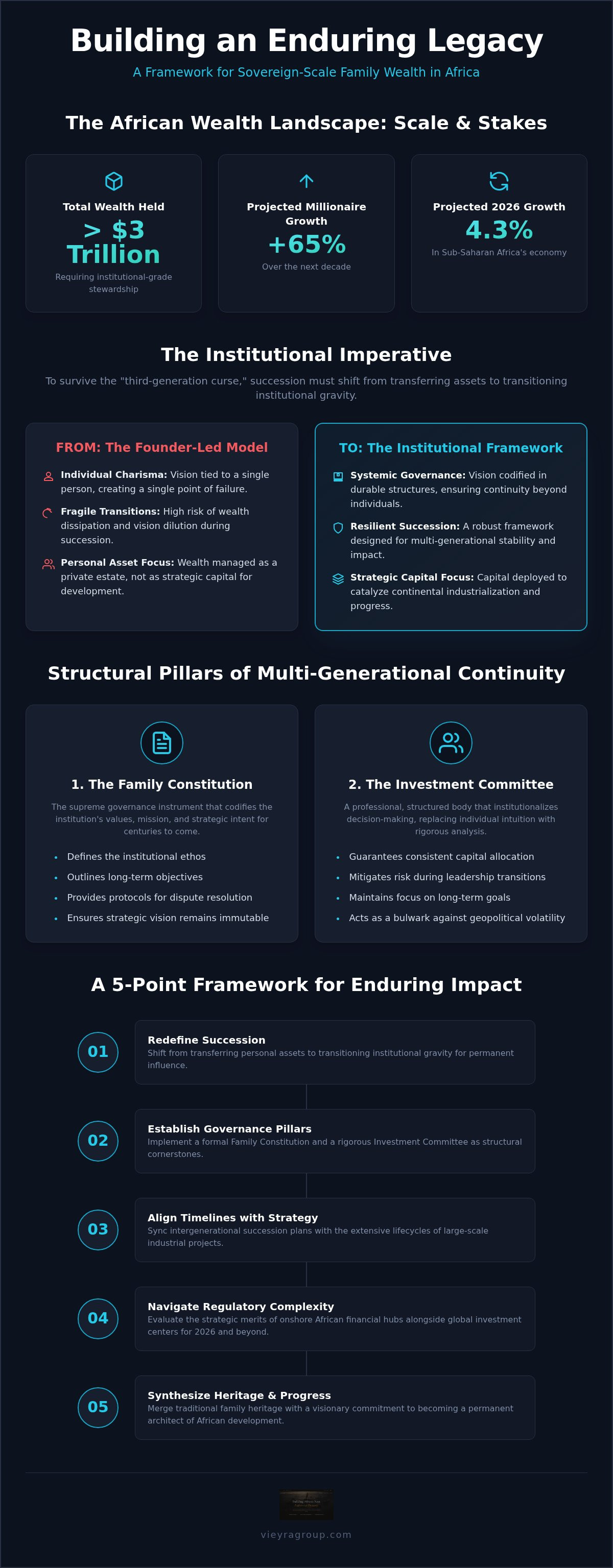
- Establish a formal Family Constitution and a rigorous Investment Committee to serve as the structural pillars of a robust multi-generational investment framework Africa.
- Align intergenerational succession timelines with the extensive lifecycles of large-scale industrial projects to ensure the continuity of strategic capital deployment.
- Navigate the complexities of the 2026 regulatory environment by evaluating the strategic merits of onshore African financial hubs alongside global investment centers.
- Synthesize traditional family heritage with a visionary commitment to continental progress, positioning the institution as a permanent architect of African industrial development.
The Institutional Imperative: Redefining Succession for Sovereign-Scale Family Offices
Succession at the sovereign scale transcends the mere transfer of asset titles; it represents the deliberate transition of institutional gravity from an individual to a permanent system. Within the African industrial landscape, the distinction between a commercial family enterprise and a sovereign-scale investment institution is fundamental. While the former focuses on operational continuity, the latter functions as a guardian of strategic capital destined for continental transformation. This paradigm shift is essential to survive the third-generation curse, where wealth often dissipates due to a lack of systemic governance. A robust family office structure serves as the bedrock for this transition, moving beyond traditional estate planning toward a sophisticated model of stewardship.
Defining the Architecture of Permanence
Institutional Succession is the preservation of strategic intent across centuries through the codification of values and governance protocols. This transition necessitates a fundamental shift from individual charisma to systemic governance, where the visionary's intuition is replaced by a structured investment committee. For portfolios operating at a sovereign level, this architecture acts as a critical risk-mitigation strategy. It ensures that capital allocation remains consistent even during periods of leadership transition or geopolitical volatility. By implementing a multi-generational investment framework Africa, families can protect their influence against the erosion of time and the dilution of strategic vision.
The Evolving Landscape of African Wealth Stewardship
The landscape of wealth in Africa is undergoing a profound transformation as we enter 2026. With the continent's total wealth exceeding USD 3 trillion and the millionaire population projected to grow by 65% over the next decade, the scale of capital requiring management has reached an institutional threshold. In 2026, Sub-Saharan Africa's economy is projected to grow by 4.3%, creating new opportunities for industrial-scale investment. However, the increasing complexity of multi-jurisdictional family interests makes traditional estate planning insufficient. Families now operate across various regulatory environments, requiring a synthesis of global standards and local industrial vision. Succession plans must account for these complexities to ensure that African wealth remains a catalyst for the continent's long-term industrialization.
The Governance Framework: Structural Pillars of Multi-Generational Continuity
The architecture of a sovereign-scale family office relies upon a governance structure that can withstand the weight of centuries. It's not merely a set of rules but a living system designed to insulate strategic capital from the ephemeral nature of individual whims. A robust multi-generational investment framework Africa requires the establishment of clear boundaries between family identity and institutional operation. This separation ensures that the mission of the institution remains paramount, even as the individuals within it transition across generations. By codifying these boundaries, the institution moves from a collection of assets to a unified, purpose-driven entity.
The Family Constitution and Strategic Intent
The Family Constitution acts as the supreme governance instrument, defining the institutional ethos and long-term objectives. It explicitly outlines the balance between global asset preservation and the commitment to African industrialization, ensuring that both goals are pursued with equal rigor. This document codifies values that are intended to remain immutable, regardless of shifts in the geopolitical landscape or regional economic fluctuations. By providing established protocols for dispute resolution and consensus-building, the constitution prevents internal friction from compromising the stability of the family's strategic vision. It is the roadmap that guides the institution through the complexities of managing wealth that exceeds USD 3 trillion across the continent.
Institutionalising the Investment Office
At the sovereign scale, the necessity of professional, third-party management cannot be overstated. An independent Investment Committee provides the intellectual rigor required for sophisticated capital allocation, ensuring that decisions are based on data and strategic alignment rather than family emotion. This institutionalization allows for the creation of multi-generational capital allocation frameworks that can support the long-term lifecycles of industrial projects. The next generation is integrated through structured mentorship programs and shadow boards, providing them with a clear path to stewardship without prematurely burdening the institution's core governance. Implementing such Strategic Capital Solutions ensures that the institution remains a visionary architect of legacy. This methodical preparation of future leaders preserves the integrity of the investment office, allowing it to maintain its trajectory as a stately guardian of continental wealth.
Strategic Capital Alignment: Linking Succession to African Industrialisation
The transition of leadership within a sovereign-scale family office must be synchronized with the extended lifecycles of the industrial initiatives it supports. Strategic capital in the African context is not a transient resource; it's a permanent fixture of the economic landscape that requires a commitment spanning decades. When succession planning is divorced from the reality of long-term project horizons, the resulting instability can jeopardize both the family legacy and the continent's industrial progress. A sophisticated multi-generational investment framework Africa ensures that capital remains anchored to its strategic purpose, providing the stability necessary for large-scale manufacturing and infrastructure development to reach maturity.
Industrial Projects as Legacy Assets
Succession planning for illiquid, high-impact industrial investments requires a departure from traditional liquid asset management. These projects often represent the physical manifestation of a family's legacy, requiring a governance structure that values long-term structural impact alongside financial returns. Balancing these multi-generational returns with immediate economic development goals is a hallmark of the institutionalized family office. The Vieyra Foundation plays a pivotal role here, acting as a vehicle for systemic philanthropic impact that complements industrial objectives. By integrating these social and economic goals, the institution ensures that its influence remains a positive force for continental transformation across successive generations.
The Sovereign-Scale Portfolio in Transition
The period of leadership handover is a critical juncture that demands the maintenance of an institutional aura of permanence. International sovereign partners and global investment institutions seek the assurance that a transition at the principal level will not alter the institution's strategic trajectory or its appetite for large-scale capital allocation. Managing global asset allocation during these phases requires a transparent, rule-based system that operates independently of any single individual's charisma. This institutionalized trust is vital for maintaining the partnerships required to navigate the complexities of the African industrial landscape. With Sub-Saharan Africa's economy projected to grow by 4.3% in 2026, the ability to maintain steady stewardship during transitions allows the family office to capitalize on emerging opportunities without compromising its foundational stability. This steady, methodical approach reinforces the institution's position as a stately guardian of wealth and a reliable architect of the continent's future.
Navigating Complexity: Jurisdictional and Regulatory Strategies in 2026
Selecting a primary jurisdiction for a sovereign-scale family office requires a sophisticated evaluation of geopolitical stability, regulatory maturity, and capital mobility. In the 2026 landscape, this decision's become increasingly nuanced as African financial hubs compete with traditional global centers for institutional relevance. While global hubs offer established legal precedents, onshore African jurisdictions provide closer proximity to industrial assets and benefit from the accelerating implementation of the African Continental Free Trade Area (AfCFTA). As of February 2026, the shift from negotiation to practical implementation is overseen by a High-Level Implementation Committee, with 22 countries having gazetted provisional schedules to eliminate 90% of tariff lines. This regulatory evolution facilitates the movement of strategic capital across borders, making a robust multi-generational investment framework Africa essential for navigating these emerging corridors.
Jurisdictional Selection for Multi-Generational Wealth
The choice between Mauritius, South Africa, or global financial hubs depends on the institution's specific balance of African industrial focus and global asset exposure. Mauritius continues to refine its role as a sophisticated gateway for cross-border investment, while South Africa remains a primary hub for industrial-scale management despite ongoing FATF regulatory scrutiny. Within this multi-generational investment framework Africa, the use of Trust and Foundation structures is paramount to ensure that succession isn't disrupted by individual probate requirements. These structures provide a layer of protection against sovereign-scale risk in emerging markets, allowing for the seamless transition of control. It's critical that these vehicles are designed with the flexibility to adapt to changing jurisdictional standards while maintaining their core strategic intent.
Regulatory Compliance as a Pillar of Prestige
Institutional rigor in compliance serves as a powerful signal of stability that enhances an office's global influence and prestige. Maintaining sovereign-level transparency standards isn't merely a legal requirement; it's a strategic move to build trust with international partners and co-investors. As global tax reforms continue to evolve in 2026, future-proofing the family office requires a proactive approach to transparency that moves beyond simple tax optimization. This institutional discipline ensures that the family legacy remains untarnished by regulatory shifts, preserving the office's status as a stately guardian of wealth. For institutions seeking to formalise these structures, we provide expert Global Investment Management services tailored to the complexities of the African industrial landscape.
The Vieyra Paradigm: Stewardship as a Catalyst for Continental Progress
The Vieyra Family Office operates as a visionary architect of African legacy, transcending the conventional boundaries of wealth management to establish a permanent institutional presence that mirrors the stability of a sovereign entity. This paradigm represents a sophisticated synthesis of traditional heritage and a forward-looking industrial commitment, where a family's success is inextricably linked to the continent's economic sovereignty. By providing the architecture for multi-generational wealth, the institution ensures that strategic capital remains a stable, productive force within the African industrial landscape. The path from private family wealth to sovereign-scale impact requires a deliberate institutionalization of values and operations, transforming capital into a catalyst for systemic progress. It's this transition from individual ownership to institutional stewardship that defines the next era of African development.
Global Stewardship with an African Heart
Our commitment to multi-generational stability is rooted in a profound sense of global stewardship that remains deeply anchored in African priorities. We manage the transition of strategic capital with the deliberation and foresight required for industrial projects that will define the next century of continental growth. This methodical approach mitigates the risks of leadership fragmentation, ensuring that the institution's trajectory remains certain even during complex generational shifts. By implementing a robust multi-generational investment framework Africa, we provide the structural integrity needed to survive geopolitical volatility and regulatory shifts. We invite principals to discuss the future of their family's institutional legacy, exploring how these frameworks can preserve strategic influence across centuries while maintaining global liquidity.
Building the Future of African Industry
Succession, when viewed through the Vieyra lens, is an act of profound economic foresight and patriotism. It ensures that the industrial engines driving African growth are not stalled by the complexities of family transition or the dilution of a founder's original vision. The Vieyra Family Office remains dedicated to its role as a permanent guardian of this growth, facilitating the deployment of Strategic Capital Solutions into manufacturing, infrastructure, and the digital economy. As we look toward the next century, the institutionalization of family offices will be the defining factor in the continent's sustained industrialization and its ability to compete on a global stage. The synthesis of the Vieyra Foundation’s philanthropic goals with large-scale industrial capital creates a holistic model for continental progress. We encourage those at the helm of significant portfolios to Engage with the Vieyra Family Office on Strategic Succession to secure their place in this enduring narrative of African excellence.
Securing the Future of Continental Strategic Capital
The transition from individual leadership to institutional permanence represents the defining challenge for Africa’s most significant family offices. By establishing a robust governance structure and aligning asset allocation with the continent’s long-term industrial trajectory, families ensure their legacy survives the common pitfalls of generational wealth transfer. Implementing a multi-generational investment framework Africa ensures that strategic capital remains anchored to its purpose while balancing global liquidity with domestic development goals. As architects of African industrialisation, we're committed to managing sovereign-scale wealth with the rigor and foresight that defines our own multi-generational African heritage.
The path toward continental progress is forged through the deliberate institutionalisation of strategic capital and the selection of jurisdictions that prioritize stability. We invite you to Consult with Vieyra Family Office on Institutional Stewardship to explore how your institution can serve as a permanent guardian of wealth and a catalyst for the next century of growth. Your commitment today secures the industrial sovereignty of tomorrow.
Frequently Asked Questions
What is the primary difference between estate planning and family office succession planning at a sovereign scale?
Estate planning primarily concerns the legal transfer of individual assets to heirs, whereas family office succession focuses on the transition of institutional gravity and strategic intent. At a sovereign scale, the objective is to ensure the investment office continues to function as a permanent global actor rather than a mere holding company. This involves codifying governance protocols that allow the institution’s mission to survive the transition of its founders.
How does a family constitution protect African industrial investments across generations?
A family constitution serves as a foundational sovereign document that codifies the family’s mission and values, insulating industrial projects from ephemeral shifts in leadership. These projects often have lifecycles spanning decades, necessitating a governance framework that prioritizes long-term stability over short-term liquidity. By establishing clear protocols for dispute resolution and capital allocation, the constitution ensures that the family’s commitment to African industrialization remains immutable across successive generations.
What role does the next generation play in a sovereign-scale family office before taking leadership?
The next generation serves as stewards in training, participating in structured mentorship programs and shadow boards to understand the institution’s strategic depth. This phase isn't about immediate control but about absorbing the professional rigor required for sovereign-scale management. By engaging with the multi-generational investment framework Africa, future leaders gain exposure to complex jurisdictional strategies and the ethical imperatives of the family legacy before assuming formal governance roles.
How do African family offices navigate cross-border regulatory challenges like FATF grey listings?
African family offices navigate regulatory complexities by maintaining institutional-level transparency and selecting jurisdictions that offer a balance of proximity and stability. Hubs like Mauritius or South Africa are frequently utilized to manage multi-jurisdictional interests while adhering to global transparency standards. In 2026, navigating FATF grey listings requires a proactive compliance stance that moves beyond simple legal adherence to project an aura of global prestige and reliability to international partners.
Can a family office maintain its values while institutionalising its investment management?
Institutionalization actually strengthens family values by embedding them into a rule-based system that operates independently of individual personality. Through a professional Investment Committee, the family office applies a disciplined lens to capital allocation while remaining guided by the Family Constitution. This process ensures that the stewardship paradigm remains the guiding principle, allowing the institution to pursue large-scale progress without compromising its foundational heritage or multi-generational vision.
What are the most effective structures for holding African industrial assets in a multi-generational portfolio?
Holding African industrial assets effectively requires the use of robust Trust and Foundation structures that can withstand multi-jurisdictional legal challenges. These vehicles are designed to manage illiquid, high-impact investments by separating ownership from control, thereby protecting the assets from fragmentation. At a sovereign scale, these structures are often integrated into a broader multi-generational investment framework Africa to facilitate cross-border capital movement under the evolving AfCFTA regulations and jurisdictional standards.
How does strategic capital differ from traditional private equity in the context of succession?
Strategic capital is characterized by its patient nature and commitment to long-term industrial transformation, whereas traditional private equity often focuses on specific exit timelines. In the context of succession, strategic capital acts as a permanent fixture in the economic landscape, requiring a governance structure that values systemic impact alongside financial returns. This alignment ensures that the family office remains a stately guardian of wealth rather than a transient investor.
Why is 2026 a critical year for African family office governance and succession?
The year 2026 represents a critical milestone as the AfCFTA moves into full implementation and Sub-Saharan Africa’s economy is projected to grow by 4.3%. With total continental wealth exceeding USD 3 trillion, the transition of leadership within major family offices has reached a systemic threshold. Establishing a formal governance architecture during this period is essential to ensure that this vast capital remains a stable, permanent catalyst for the continent’s continued industrialization.


