
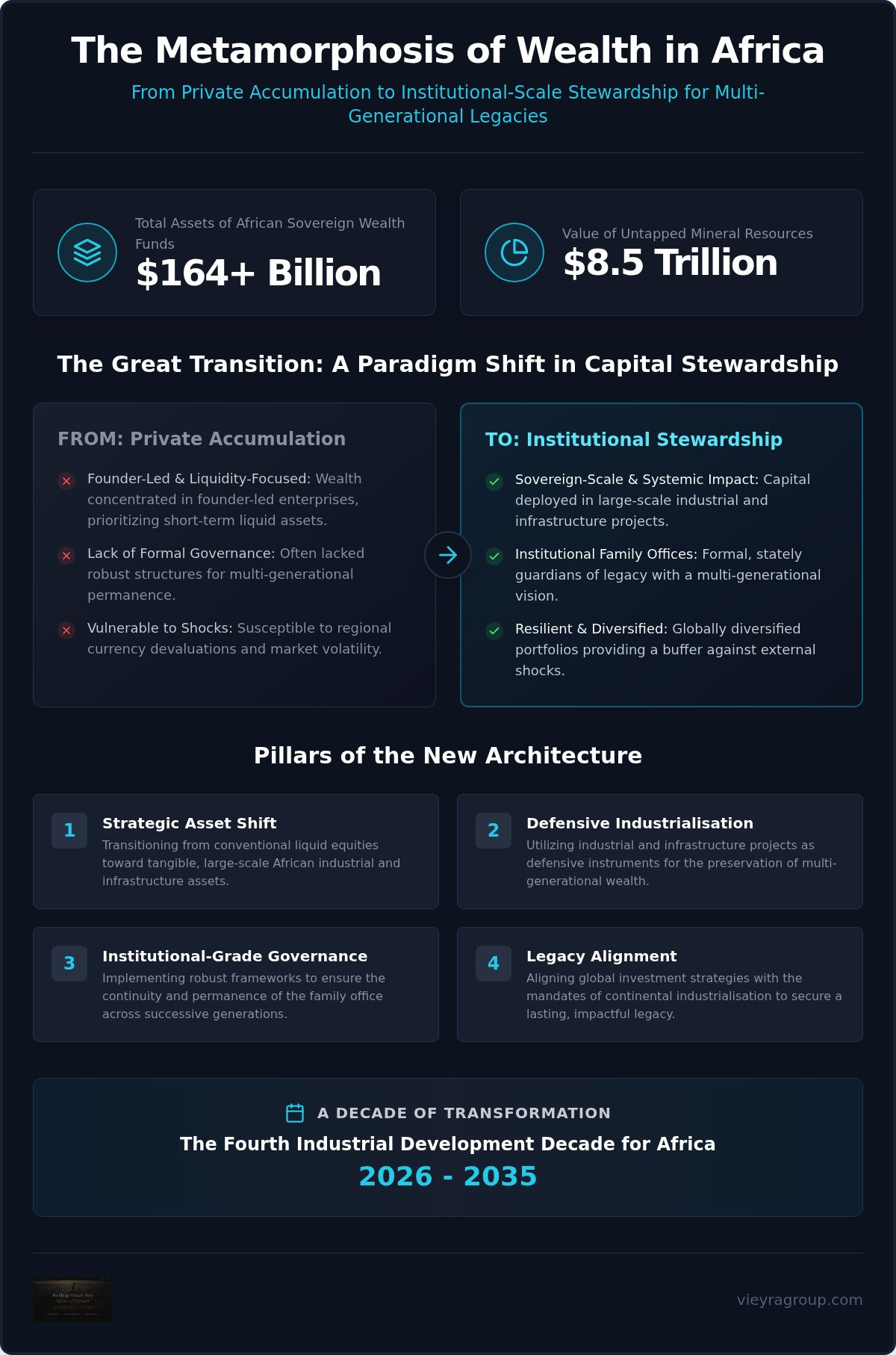
The total assets of African sovereign wealth funds have surpassed $164 billion, signaling a departure from fragmented private accumulation toward a unified era of institutional stewardship. You may observe that global discourse frequently reduces the nuances of the African continent to simplistic narratives, failing to account for the sophisticated structures now governing long-term capital allocation. This analysis addresses the growing necessity for institutional-grade frameworks that bridge the gap between global asset management and localized industrial impact. We will explore how the evolution of wealth africa is increasingly defined by the strategic transition of multi-generational capital into a deliberate engine for continental industrialisation.
By examining the intersection of wealth preservation and systemic development, this discourse offers a sophisticated framework for sovereign-scale investment. We provide clarity on how established families and institutions are aligning their global portfolios with the industrial mandates of the Fourth Industrial Development Decade for Africa. The following sections will detail the mechanisms through which high-level capital facilitates large-scale progress while ensuring the permanence of a multi-generational legacy.
Key Takeaways
- Comprehend the structural transition from private accumulation to the sophisticated stewardship of sovereign-scale institutional capital within the context of wealth africa.
- Evaluate the strategic shift from conventional liquid equities toward the integration of global portfolios with large-scale African industrial assets.
- Recognize the defensive characteristics of industrialisation and infrastructure as essential instruments for the preservation of multi-generational wealth.
- Implement institutional-grade governance frameworks designed to ensure the continuity and permanence of the family office across successive generations.
- Align global investment management strategies with the mandates of continental industrialisation to secure a lasting and impactful legacy.
The Metamorphosis of Wealth in Africa: From Private Accumulation to Institutional Scale
The historical trajectory of wealth africa has transitioned from the rudimentary accumulation of private assets to the sophisticated stewardship of institutional capital. In the decades following the post-colonial era, wealth was often characterized by its liquidity and concentration within founder-led enterprises. This model, while effective for initial growth, frequently lacked the governance structures necessary for multi-generational permanence. As the continent enters the Fourth Industrial Development Decade for Africa (2026-2035), the limitations of private accumulation have become apparent. The current economic landscape, marked by currency devaluations in major economies like Egypt and Nigeria, demands a shift toward institutionalized family office structures that prioritize global diversification and strategic depth. It's a transformation that requires deliberation, moving beyond the management of personal fortunes toward the creation of enduring institutions.
The Rise of the African Family Office
The evolution of the African family office represents a fundamental shift in how capital is perceived and managed. These institutions have moved beyond informal wealth management to become stately guardians of legacy, operating with the poise of established global actors. They don't just seek market returns; they provide the institutional gravity required to navigate complex global financial systems. By adopting a multi-generational vision, these family offices bridge the gap between private wealth and sovereign-level influence. They act as visionary architects, ensuring that capital remains a stable force for progress even amidst shifting geopolitical tides.
Sovereign-Scale Capital as a New Asset Class
Sovereign-scale capital differs significantly from traditional high-net-worth investing through its focus on systemic impact and long-term stability. While private investing often prioritizes short-term liquidity, sovereign-scale deployment targets large-scale industrial projects that anchor regional economies. The Nigeria Sovereign Investment Authority exemplifies this institutional approach, demonstrating how structured wealth can drive economic diversification and infrastructure development. The impact of such wealth is measurable in its ability to provide a buffer against external shocks and to finance the beneficiation of Africa's $8.5 trillion in untapped mineral resources. Sovereign-scale capital is the strategic aggregation of institutionalized wealth managed with the foresight and magnitude of a sovereign entity to catalyze industrial transformation and ensure the permanence of a continental legacy.
The Architecture of Sovereign-Scale Capital: Beyond Traditional Asset Management
Conventional wealth management often prioritizes liquid equities, yet the evolution of wealth africa requires a more profound engagement with strategic, long-term capital solutions. Retail-grade portfolios lack the depth to support the large-scale industrialization required for systemic impact. Institutional stewardship demands the orchestration of assets that provide structural stability over decades. This involves moving beyond the volatility of public markets into the deliberate deployment of capital that mirrors the permanence of a sovereign entity. It's a transition that requires intellectual sophistication and a refusal to accept the oversimplified frameworks often suggested by global media.
Strategic Capital Solutions for Institutional Growth
Designing capital structures that withstand regional market fluctuations is a hallmark of institutional maturity. Direct investment into infrastructure and mining beneficiation, such as projects targeting Africa's $8.5 trillion in untapped mineral resources, offers a hedge against the currency volatility seen in recent devaluations. While these initiatives involve inherent illiquidity, they serve as foundational pillars for a multi-generational legacy. Balancing these commitments with global liquidity ensures the institution remains agile yet anchored. Success depends on the ability to deploy Strategic Capital Solutions that align private interests with sovereign-scale objectives. This approach ensures that capital isn't merely parked but is actively working to build the continent's industrial future.
Global Stewardship and African-Centric Assets
A global perspective isn't a departure from continental commitment but rather its necessary safeguard. The synergy between international asset classes and local industrial development creates a robust ecosystem for growth. Global asset diversification serves as a critical buffer against localized economic shocks, ensuring that the capital required for continental industrialization remains preserved and accessible across varying market cycles. By leveraging sophisticated investment management, institutions can funnel expertise into domestic value chains. It's a method of turning global returns into local progress, ensuring that the architect of a legacy remains rooted in their identity while certain of their global trajectory. This balance allows for the preservation of wealth while simultaneously driving the industrial mandates of the Fourth Industrial Development Decade for Africa.
Risk mitigation in emerging markets requires more than simple diversification; it demands a deep understanding of the intersection between geopolitics and high finance. Institutional actors must navigate the complexities of regional trade agreements and currency shifts with a composed and authoritative stance. By maintaining a multi-generational vision, these institutions can absorb short-term shocks that would destabilize lesser entities. The focus remains on systemic impact, where the scale of operations provides a natural defense against the transience of market cycles.
Industrialisation as the Ultimate Wealth Preserver: A Strategic Analysis
The preservation of wealth africa has historically relied upon passive asset classes, yet true institutional stability is increasingly found in the productive capacity of industrialisation. While real estate and liquid equities offer traditional avenues for capital storage, they often fail to address the systemic volatility of emerging markets. Industrial assets, by contrast, possess defensive qualities rooted in their essentiality to the broader economy. These large-scale infrastructure and manufacturing projects serve as anchors, providing a robust hedge against the transience of currency fluctuations and inflationary pressures. By transitioning from rent-seeking models to productive industrial capital, institutions align their growth with the continent's fundamental economic transformation. It's a shift from merely observing market trends to actively shaping the economic architecture that sustains multi-generational prosperity.
Financing Large-Scale Industrial Projects
The mechanics of deploying strategic capital into manufacturing and energy require a sophisticated understanding of sovereign-level finance and long-term value chains. Within the framework of the Fourth Industrial Development Decade for Africa (2026-2035), the focus shifts toward the beneficiation of raw materials and the establishment of robust energy infrastructure. Managing the complexities of these projects demands more than simple investment; it requires the orchestration of capital into sectors like potash for fertilizer or rare earth mining beneficiation. These assets provide a formidable defense against currency devaluation because their value is often derived from global commodity markets or essential domestic utility. It's a methodical approach to capital deployment that ensures the institution's resources are both productive and protected across decades.
The Multiplier Effect of Institutional Investment
Sovereign-scale capital exerts a multiplier effect that extends far beyond individual balance sheets, creating systemic economic value that reinforces institutional legacy. When capital is directed toward regional trade corridors or integrated manufacturing hubs, it facilitates the development of regional value chains as envisioned by the AfCFTA. This interconnectedness ensures that the growth of the institution is inextricably linked to the prosperity of the continent. It's a visionary strategy where the architect of wealth recognizes that a stable, industrialized economy is the most reliable environment for long-term capital appreciation. Such investments don't merely generate returns; they build the foundational structures that allow subsequent generations to inherit a thriving and resilient economic ecosystem. This synergy between private growth and public progress defines the modern era of African institutional stewardship.
Principles of Multi-generational Stewardship in Emerging African Markets
The stewardship of wealth africa requires a fundamental rejection of the transience often associated with private accumulation. True legacy is built upon a philosophy of permanence, where the institution is meticulously designed to outlast its founders by centuries. This transformation necessitates a transition from personal decision-making to highly structured governance, ensuring that capital remains a stable force regardless of individual transitions. Professional rigour isn't merely an operational preference; it's the fundamental safeguard against the erosion of value across generations. By establishing a sovereign-level perspective, family offices navigate the complexities of emerging markets with the composure of a global actor certain of its trajectory.
The Architecture of Multi-generational Wealth
Establishing governance structures that survive the nuances of generational transitions is the primary defense against the fragmentation of wealth africa. Cultivating institutional memory allows for long-term capital allocation that remains consistent even as the global economic environment fluctuates. It's essential to balance deep-seated family values with the objectivity of professional investment management, creating a unique synergy that retail-grade structures cannot replicate. These frameworks ensure that the strategic vision remains anchored in its identity. Building an entity that operates with the deliberation of a sovereign wealth fund prioritizes systemic stability over short-term gains, securing the family's position as a visionary architect of African progress.
Strategic Philanthropy and the Vieyra Foundation
Philanthropy, when integrated with an overarching investment strategy, becomes a potent tool for social impact and legacy building. The Vieyra Foundation serves as a strategic vehicle for systemic change, aligning its initiatives with the broader goals of continental industrialisation and strategic capital solutions. This isn't charity in the traditional sense; it's a methodical commitment to improving the foundational structures of society. By measuring results through the lens of institutional progress, the foundation ensures that capital contributes to a more resilient and prosperous continental context. Such alignment creates a unified narrative of progress, where wealth preservation and social development are two sides of the same sovereign-scale mission. To begin architecting your own institutional legacy, you may explore our Strategic Capital Solutions for long-term stewardship.
The Vieyra Family Office: Orchestrating Sovereign-Scale Industrial Legacies
The Vieyra Family Office stands as the culmination of the principles of institutional stewardship, acting as a stately guardian of progress across the continent. While the narrative of wealth africa has often been confined to the metrics of private accumulation, our institution redefines this trajectory by positioning capital as a strategic instrument for industrial transformation. We operate with the deliberation and foresight of a sovereign entity, ensuring that every deployment of resources is anchored in a multi-generational vision that transcends individual lifespans. This approach allows us to navigate the complexities of large-scale industrial projects with a composed and authoritative stance, bridging the gap between global financial markets and the fundamental needs of African economic development.
A Global Actor with an African Heart
Our commitment to the industrialisation of the African continent is balanced by a sophisticated approach to global investment management. We recognize that true stability is achieved through the synergy between international asset classes and the development of local industrial value chains, creating a robust ecosystem that protects against regional volatility. By maintaining institutional gravity in every strategic deployment, we ensure that capital remains a permanent force for growth. This involves the meticulous orchestration of wealth africa into sectors that provide structural resilience, such as energy infrastructure and advanced manufacturing, where long-term value is most readily secured. We don't merely participate in markets; we act as visionary architects, building the legacies that will define the continent's economic future for centuries to come.
The Path Forward for Sovereign-Scale Investors
The transition toward institutionalized capital requires a partner capable of connecting global capital with high-impact industrial projects that drive systemic change. Vieyra facilitates this economic transformation by providing the Strategic Capital Solutions necessary to de-risk large-scale initiatives and catalyze regional growth through African Industrialization Capital. We invite strategic partnerships with entities that share our commitment to systemic impact and long-term stability, recognizing that the scale of our objectives requires a unified and professional approach. By aligning private interests with the mandates of the Fourth Industrial Development Decade for Africa, we create a unified path toward prosperity that is both sustainable and profound. It's a journey defined by professional rigour and a deep-seated belief in the power of industrialisation to preserve and expand legacy. Discover the Vieyra Family Office approach to global stewardship and join us in architecting a resilient future for the continent.
Architecting a Continental Legacy
The transition from fragmented private interests to the structured deliberation of sovereign-scale stewardship represents a defining moment for institutional capital. By moving beyond traditional asset management and prioritizing large-scale industrial projects, institutions can secure a level of permanence that standard portfolios simply can't achieve. This analysis has demonstrated how the evolution of wealth africa is increasingly characterized by a commitment to systemic impact and long-term stability. Such a path requires a blend of professional rigour and a visionary outlook that aligns global investment management with the fundamental mandates of continental progress.
As a global actor rooted in a multi-generational institutional heritage, the Vieyra Family Office remains dedicated to this mission. Our sovereign-scale investment capacity and strategic focus on continental industrialisation provide the framework necessary for enduring growth. We invite you to Engage with the Vieyra Family Office on Sovereign-Scale Strategic Capital to ensure your legacy remains certain and impactful. It's a future being forged by those who build with the foresight of an institution and the heart of a guardian.
Frequently Asked Questions
What defines wealth in Africa at a sovereign scale?
Sovereign-scale wealth is defined by the strategic aggregation and institutional management of capital to achieve systemic economic impact. It transcends private accumulation, focusing on assets that anchor regional stability, such as the $164 billion currently held by African sovereign wealth funds. This scale allows for the financing of large projects like Ethiopia’s $45 billion investment holdings. It represents a shift from simple liquidity to the stewardship of transformative, long-term continental assets.
How do multi-generational family offices manage risk in African markets?
Risk management for multi-generational institutions involves a sophisticated blend of global asset diversification and deep engagement with defensive industrial sectors. By maintaining portfolios across international markets, these offices buffer against localized currency devaluations, such as those observed in Egypt and Nigeria during 2026. They prioritize governance frameworks that ensure continuity across generations. This approach transforms volatility into a manageable variable, ensuring the permanence of the institution’s capital and its strategic objectives.
What is the role of industrialisation in wealth preservation?
Industrialisation serves as the primary driver of wealth stability by converting capital into productive, tangible assets that are less susceptible to market sentiment. Large-scale infrastructure and manufacturing projects, such as phosphate beneficiation in Morocco or car manufacturing, provide a robust hedge against inflation. These assets generate consistent value by addressing fundamental economic needs. Consequently, the preservation of wealth africa is increasingly reliant on the transition from rent-seeking investments to the ownership of industrial value chains.
How does the Vieyra Family Office approach global investment management?
The Vieyra Family Office manages a diversified portfolio of global and African-centric assets with a focus on multi-generational preservation. We deploy strategic capital into large-scale industrialisation projects while maintaining a composed global perspective. Our approach integrates professional rigour with a visionary commitment to continental progress. By balancing international liquidity with high-impact industrial investments, we ensure that the institution remains a stable global actor that is deeply rooted in its African identity.
Can strategic philanthropy coexist with large-scale capital allocation?
Strategic philanthropy is not merely a companion to capital allocation but a fundamental component of institutional stewardship. Through the Vieyra Foundation, we align social initiatives with our broader industrial and economic mandates to create a unified narrative of progress. This synergy ensures that philanthropic deployments contribute to the structural resilience of the societies where we operate. It's a methodical approach where social impact and wealth preservation reinforce each other to build a lasting legacy.
What are the primary challenges for institutional investors in Africa in 2026?
Institutional investors must navigate the complexities of significant currency devaluations and the requirement for sustained financing for the Fourth Industrial Development Decade for Africa. Mobilizing adequate capital for projects like Guinea's $20 billion Simandou iron ore initiative requires sophisticated blended finance mechanisms. Additionally, the reshuffling of GDP rankings among the continent’s largest economies demands constant intellectual vigilance. Success in this landscape depends on the ability to maintain a long-term vision amidst transient geopolitical and economic shifts.
How does a family office structure differ from a traditional investment firm in the African context?
A sovereign-scale family office operates with a multi-generational horizon that traditional investment firms, often focused on quarterly performance, cannot match. While traditional firms prioritize retail-grade liquidity, the family office acts as a stately guardian of legacy and permanent capital. It integrates private interests with sovereign-level economic goals, such as mining-led industrialisation. This structure allows for the deliberate and methodical pursuit of objectives that outlast individuals, ensuring that wealth africa remains a strategic engine for growth.
Why is institutional gravity essential for African wealth stewardship?
Institutional gravity provides the stability and authority required to navigate the global financial landscape while pursuing continental industrialisation. It suggests a level of permanence and foresight that discourages the short-termism prevalent in many emerging market strategies. By projecting an aura of global influence and professional rigour, an institution can attract strategic partnerships and manage sovereign-scale projects. This composed stance is necessary for those who wish to act as visionary architects of a lasting and impactful African legacy.


