
Could the historical reliance upon transient, short-term private equity models be the fundamental constraint hindering the realization of enduring continental prosperity? With the aggregate assets under management of African state-owned investment vehicles reaching approximately $1 trillion by December 2025, the rise of sovereign-scale investment institutions Africa signifies a profound transition toward a permanent industrial architecture. You understand that the characteristic volatility of emerging markets, often exacerbated by a deficiency in institutional-grade governance within private capital structures, demands a more resilient paradigm for long-term stability.
This article provides an authoritative examination of the mechanisms through which the synthesis of private wealth and sovereign-scale capital fosters a multi-generational stewardship dedicated to systemic industrial transformation. By evaluating the strategic trajectory of the 32 national and subnational sovereign wealth funds active as of August 2026, we offer a framework for aligning capital preservation with large-scale industrialization. We shall analyze the institutional structures that bridge the gap between global investment management and local industrial impact, ensuring the continuity of legacy through the deliberate construction of a modern African economy.
Key Takeaways
- Comprehend the evolution of sovereign-scale investment institutions Africa as private entities that project the institutional gravity required for systemic continental stability.
- Analyze the role of multi-generational stewardship in establishing a philosophy of permanence that effectively mitigates the inherent short-termism of traditional private equity models.
- Map the strategic allocation of capital toward large-scale industrialization as the primary catalyst for sustainable economic transformation and long-term wealth preservation.
- Evaluate the integration of institutional-grade governance and the Santiago Principles to safeguard assets against the complexities of geopolitical and emerging market risks.
- Explore the methodology for synthesizing sophisticated global investment management with the deliberate architecture of a regional industrial legacy.
Defining Sovereign-Scale Investment in the African Context
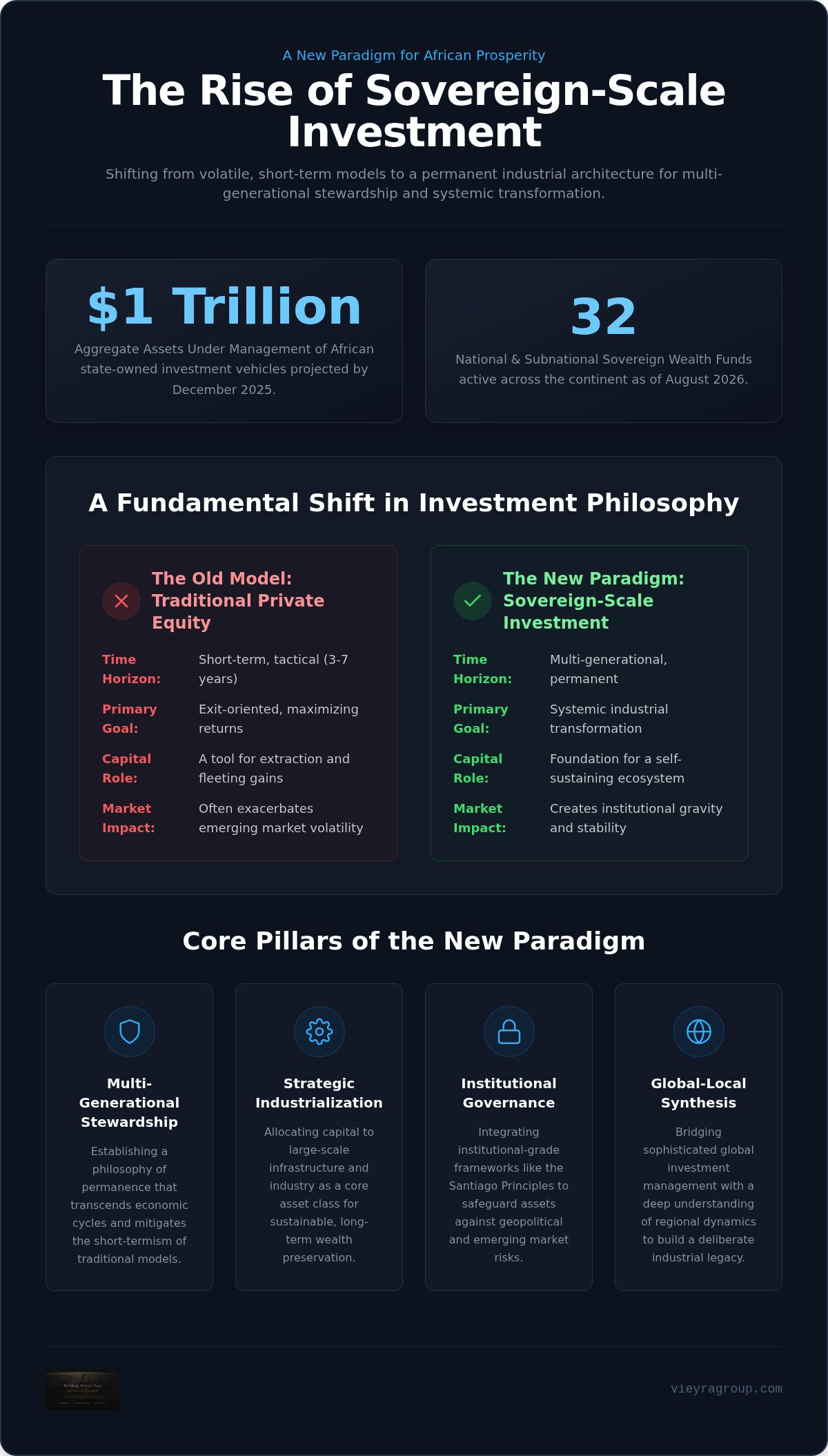
The conceptualization of sovereign-scale investment institutions Africa has expanded significantly, transcending the historical reliance on state-owned vehicles to include private entities that wield equivalent economic influence. This new class of institutional capital is defined by its magnitude and its unwavering commitment to multi-generational stewardship. While traditional private equity often operates within tactical, exit-oriented cycles, sovereign-scale capital functions as a strategic architect of the continent's permanent industrial base. As of August 2026, there are 32 national and subnational sovereign wealth funds in Africa. It's a landscape where these public entities increasingly intersect with private, institutional-grade wealth to drive systemic change.
This intersection creates a form of institutional gravity that's essential for stabilizing emerging markets. By managing global assets with the deliberation of a sovereign actor, these institutions provide the necessary depth to absorb market shocks that would otherwise destabilize smaller-scale investors. The evolution of African wealth in the 21st century is marked by this move toward permanence. Capital is no longer just a tool for extraction; it's a foundation for systemic industrialization. As of December 2025, the total assets under management of African public investment vehicles reached approximately $1 trillion, reflecting the massive scale of capital now dedicated to the continent's long-term trajectory.
The Emergence of Private Sovereign-Scale Entities
Private sovereign-scale entities, such as multi-generational family offices, have emerged as vital participants in the continent's development, offering a level of agility that state-owned funds sometimes lack. These institutions synthesize global asset management expertise with a deep-rooted understanding of regional dynamics, allowing them to deploy capital into large-scale infrastructure with precision. By operating with the foresight of a stately guardian, private capital can bridge the financing gap for projects that require decades of patient commitment. This synergy between global prestige and local impact ensures that wealth preservation is inextricably linked to the progress of the African industrial landscape. It's a model that prioritizes legacy over the fleeting gains of the traditional private equity cycle.
The Strategic Mandate: Wealth Preservation vs. Economic Transformation
The modern strategic mandate requires a delicate balance between global portfolio diversification and a commitment to African-centric growth. Industrialization has transitioned from a development goal to a core asset class that offers long-term stability and inflation-protected returns. The Nigeria Sovereign Investment Authority provides an illustrative example of this dual-purpose framework, managing diverse portfolios that include infrastructure and future-generations funds. For private sovereign-scale actors, the challenge lies in maintaining this same level of rigor while pursuing economic transformation. By identifying frameworks for multi-generational wealth preservation that map directly to industrial output, these institutions are redefining the architecture of African prosperity. It isn't just about financial returns; it's about the construction of a self-sustaining economic ecosystem.
The Imperative of Institutional Permanence and Stewardship
The philosophy of permanence dictates that capital allocation must serve as a bulwark against the inherent volatility of global markets. Unlike traditional investment models that prioritize immediate liquidity, sovereign-scale investment institutions Africa operate with a horizon measured in decades rather than fiscal quarters. This longitudinal perspective allows for the construction of portfolios that effectively transcend typical economic cycles. By anchoring wealth in large-scale industrial assets, these institutions mitigate the risks associated with emerging market fluctuations. It's a method of stewardship that transforms capital from a passive resource into a stabilizing force for the entire continent.
This commitment to permanence requires a rejection of the short-termism often found in conventional private equity. Instead, it favors the steady, methodical accumulation of assets that provide systemic value. The scale of these operations, with African state-owned investment vehicles managing approximately $1 trillion in assets as of December 2025, necessitates a sophisticated approach to risk management. When private wealth operates at this magnitude, it assumes the character of a sovereign actor, prioritizing the health of the industrial ecosystem over fleeting market trends.
Multi-generational Wealth Preservation Frameworks
Architecting a legacy that withstands regional geopolitical shifts requires a sophisticated synthesis of global asset management and local industrial commitment. Multi-generational stewardship is the pursuit of permanence over liquidity. By maintaining a diversified portfolio of global assets, these institutions provide a protective layer for African wealth, ensuring that capital remains resilient even during periods of local economic recalibration. This approach doesn't merely preserve value; it ensures the continued capacity to fund large-scale industrialization projects. Such frameworks are essential for families seeking to transition from traditional wealth management to strategic capital solutions that offer both security and systemic impact.
Institutional Gravity and Global Influence
The projection of institutional gravity is a prerequisite for operating within complex regulatory environments and navigating the intricate landscape of global finance. Sovereign-scale private institutions often assume a quasi-diplomatic role, acting as a bridge between international capital markets and regional developmental needs. This composed and authoritative presence is vital for Mobilizing Africa’s resources for development, as it signals a level of stability and professional rigor that attracts long-term partners. As the number of sovereign wealth funds in Africa has grown to 32 as of August 2026, the collaboration between public and private sovereign-scale actors becomes a cornerstone of continental progress. This collective influence creates a virtuous cycle of investment, where the stability of the institution mirrors the stability it seeks to cultivate within the industrial sectors it supports.
Strategic Capital Allocation: Catalysing African Industrialisation
The architecture of continental prosperity depends upon the deliberate transition from commodity-centric economies to sophisticated, value-added industrial ecosystems. Industrialisation serves as the primary mechanism for anchoring sovereign-scale returns within the continent's borders, providing a structural hedge against the volatility inherent in global commodity markets. Sovereign-scale investment institutions Africa recognize that tangible industrial assets, such as manufacturing hubs and energy infrastructure, offer a level of stability that paper assets cannot replicate in emerging markets. By deploying capital into the productive sectors of the economy, these institutions mitigate the perceived "Africa Risk" through the creation of durable, income-generating infrastructure. It's a strategic reorientation that prioritizes the construction of a permanent economic base over the pursuit of transient, liquid gains.
The mechanics of financing this transformation require a departure from traditional, short-cycle lending. Sovereign-scale capital is uniquely positioned to provide the patient, long-term funding necessary for projects with extended gestation periods. This approach ensures that the financing of regional economic transformation is not subject to the whims of international credit cycles. Instead, it's grounded in the institutional gravity of entities that possess the foresight to value multi-generational stability above immediate quarterly performance. The focus remains steadfastly on the systemic impact of each allocation, ensuring that capital serves as a foundation for a modern industrial state.
Financing Large-Scale Industrial Infrastructure
The African Development Bank identifies an annual infrastructure financing requirement of approximately $170 billion, a figure that highlights the limitations of state-centric funding alone. Sovereign-scale investment institutions Africa play a critical role in closing this gap by structuring capital for large-scale projects that require sophisticated risk-mitigation frameworks. These long-term capital structures are designed to survive decades of market evolution, moving beyond simple extraction to support the processing and manufacturing industries. By funding the transition to value-added models, institutional investors ensure that the continent retains a greater share of the economic value generated from its natural resources. This move toward industrial finance is a prerequisite for achieving the scale of development required for 21st-century growth.
The Industrialisation Multiplier Effect
Strategic capital allocation acts as the catalyst for a multiplier effect that extends far beyond the perimeter of a single industrial facility. When sovereign-scale institutions invest in core infrastructure, they create the necessary conditions for a broader ecosystem of ancillary businesses to flourish, thereby strengthening regional supply chains. This systemic economic resilience is the ultimate objective of multi-generational stewardship. Aligning institutional investment with regional development goals ensures that wealth preservation is not an isolated pursuit but is inextricably linked to the rising tide of continental progress. It's a sophisticated synthesis where the growth of the industrial sector directly reinforces the security and prestige of the investing institution's multi-generational legacy.
Governance Frameworks and the Mitigation of Geopolitical Risk
The magnitude of capital managed by sovereign-scale investment institutions Africa necessitates a governance architecture that matches the scale of its objectives. While public funds often look to statutory mandates, private sovereign-level entities must voluntarily adopt institutional-grade frameworks to ensure long-term viability. The Santiago Principles, traditionally designed for state-owned wealth funds, provide a rigorous baseline for transparency and accountability that private institutions should adapt. By implementing these standards, private actors demonstrate a commitment to professional rigor that transcends individual leadership. This institutionalization is essential for navigating the complex regulatory landscapes across the continent's diverse jurisdictions. Building public trust through transparent reporting and independent oversight creates a social license to operate, which is particularly vital when managing capital that impacts national industrial trajectories.
Risk Mitigation in Sovereign-Level Initiatives
Managing currency and political volatility requires more than mere financial hedging; it demands a deep integration into the global financial system. Global partnerships allow sovereign-scale institutions to distribute risk across varied asset classes and geographies, protecting the core African industrial portfolio. Robust governance serves as the primary attractor for international co-investment, signaling to global partners that capital is protected by established institutional protocols. This structural security is what allows for the sustained deployment of African industrialization capital even during periods of regional recalibration. The focus remains on the methodical execution of long-term strategies that survive the shifts in the geopolitical climate. It's a deliberate approach that prioritizes stability over speculative gain.
Independent Governance as a Competitive Advantage
Aligning with international standards of transparency isn't merely a compliance exercise but a strategic differentiator. Independent oversight through sophisticated advisory boards ensures that investment decisions are insulated from short-term pressures or political shifts. These boards should synthesize global expertise with regional depth, providing a balanced perspective on both macro-geopolitical trends and local industrial needs. Such governance structures are the cornerstone of long-term capital preservation, ensuring that the institution remains a permanent fixture in the global economy. The resulting institutional gravity allows these entities to operate with the poise of established global actors. For entities seeking to architect such enduring legacies, implementing strategic capital solutions provides the necessary framework for institutional-grade success.
The Vieyra Paradigm: Bridging Global Capital and Regional Legacy
The Vieyra Family Office serves as the preeminent exemplar among sovereign-scale investment institutions Africa, operating with the deliberation and foresight traditionally reserved for established state-level entities. Its approach is characterized by a profound synthesis of global investment management and a steadfast commitment to African industrialization capital. By leveraging a multi-generational heritage, the institution operates as a stately guardian of legacy, ensuring that every strategic allocation contributes to the continent's permanent industrial architecture. This paradigm isn't merely about capital deployment; it's about the orchestration of a self-sustaining economic ecosystem that thrives across generations. It's a model that prioritizes the construction of a modern industrial state through the lens of institutional permanence.
Global Stewardship and African Roots
The multi-generational vision of the Vieyra Family Office is rooted in the conviction that African wealth must be protected through global diversification while simultaneously driving regional progress. Managing a sophisticated global portfolio provides the necessary stability to weather local market volatility, creating a resilient base for sustained continental impact. This dual focus allows the institution to act as a bridge between international capital markets and the specific requirements of African industrial growth. It's an approach that reflects the core principles discussed in The Architecture of Multi-generational Wealth, where permanence is prioritized over immediate liquidity. By maintaining this global perspective, the office ensures that its African roots are supported by the strength of a worldwide institutional presence.
The Vieyra Foundation serves as the philanthropic pillar of this institutional framework, aligning large-scale industrial progress with systemic social stability through targeted initiatives. It's an essential component of the paradigm, ensuring that the benefits of industrialization are integrated into the broader fabric of society to foster a harmonious economic environment. This alignment reinforces the institution's role as a visionary architect, where social impact and institutional returns are viewed as complementary forces that drive long-term continental prosperity. By fostering this synergy, the foundation secures the social license necessary for multi-generational industrial projects to flourish.
The Future of Sovereign-Scale Private Capital
As the landscape of sovereign-scale investment institutions Africa continues to evolve, the Vieyra paradigm offers a blueprint for the integration of private wealth and systemic transformation. The institution stands as a visionary actor, committed to the long-term construction of an African industrial legacy that'll endure for centuries. This journey requires the participation of like-minded partners who share a commitment to institutional permanence and the rigorous standards of global finance. By inviting strategic partnerships, the office seeks to amplify its impact, ensuring that the architecture of African industrialization remains robust and forward-looking. The focus remains on the methodical execution of a vision that transcends the boundaries of the present, securing a prosperous future for generations to come.
Architecting an Era of Institutional Stability
The transition from transient capital flows to a permanent industrial base marks a definitive shift in the continental economic landscape. By prioritizing long-term stewardship over immediate liquidity, sovereign-scale investment institutions Africa are establishing the structural foundations necessary for multi-generational prosperity. This movement is underpinned by the implementation of institutional-grade governance and a strategic commitment to large-scale industrialization as a primary driver of stability. Such a framework ensures that wealth preservation remains inextricably linked to the systemic progress of the region.
The Vieyra Family Office stands at the forefront of this evolution, utilizing its multi-generational institutional heritage and global investment management expertise to drive sovereign-scale strategic capital deployment. This approach provides the stability required to navigate geopolitical complexities while architecting a legacy that'll endure for centuries. The synthesis of global prestige and local industrial impact isn't just a strategy; it's the cornerstone of a new African era. Explore the institutional framework of the Vieyra Family Office to understand how multi-generational vision transforms the trajectory of continental growth. We invite you to be part of an enduring legacy of progress.
Frequently Asked Questions
What defines an investment institution as "sovereign-scale" in Africa?
An institution is defined by its capacity to deploy capital with the magnitude and foresight of a sovereign actor, focusing on the systemic industrial architecture of the continent. While state-owned vehicles manage approximately $1 trillion in assets, private entities like the Vieyra Family Office achieve this status through multi-generational stewardship. These sovereign-scale investment institutions Africa prioritize the construction of a permanent economic base over transient gains, ensuring that capital allocation serves as a stabilizing force across regional markets.
How do sovereign-scale institutions manage geopolitical risk in African markets?
Management of geopolitical risk involves a sophisticated synthesis of global portfolio diversification and robust institutional governance. By maintaining a significant portion of assets in global markets, these institutions protect their core African industrial portfolio from localized currency fluctuations and political shifts. This dual-layered strategy, combined with a focus on tangible industrial assets, provides a structural hedge. It ensures that the institution remains a resilient guardian of wealth even during periods of regional economic recalibration.
What are the Santiago Principles and do they apply to private family offices?
The Santiago Principles are a set of 24 voluntary guidelines that promote transparency, good governance, and accountability in sovereign wealth fund operations. While originally designed for state-owned vehicles, they're increasingly relevant for private sovereign-scale entities seeking to project institutional gravity. Adopting these principles signals a commitment to professional rigor that attracts global co-investment. It's a strategic differentiator that establishes a composed and authoritative market presence, bridging the gap between private wealth and sovereign-level impact.
Why is industrialisation considered a key asset class for multi-generational wealth?
Industrialization is regarded as a primary asset class because it provides inflation-protected returns and a structural hedge against the volatility of commodity markets. For multi-generational institutions, investing in manufacturing hubs and large-scale infrastructure anchors wealth in the continent's permanent industrial base. This approach prioritizes long-term stability over the immediate liquidity of paper assets. It's the cornerstone of a wealth preservation strategy that maps capital directly to the architecture of regional economic transformation and growth.
How does sovereign-scale capital differ from traditional private equity in Africa?
The fundamental distinction lies in the investment horizon and the philosophy of capital deployment. Traditional private equity typically operates within tactical, exit-oriented cycles of five to seven years, prioritizing short-term liquidity. In contrast, sovereign-scale investment institutions Africa function with a multi-generational perspective measured in decades. They emphasize permanence and the construction of systemic industrial value. This patient capital approach allows for the financing of large-scale infrastructure projects that require sustained commitment beyond typical market cycles.
What role does institutional philanthropy play in sovereign-scale investment?
Institutional philanthropy serves as a mechanism for aligning large-scale industrial progress with systemic social stability. Through entities like the Vieyra Foundation, these institutions ensure that economic development is integrated into the broader social fabric. This alignment fosters a harmonious environment and secures the social license to operate for multi-generational projects. It's a sophisticated integration where social impact reinforces the security of the institution's industrial legacy, creating a virtuous cycle of sustainable continental progress and growth.
How can global investors partner with African sovereign-scale institutions?
Global investors can engage through strategic partnerships and co-investment in large-scale industrial infrastructure projects that require sophisticated risk-mitigation frameworks. By collaborating with established African institutions, global partners leverage regional expertise and institutional-grade governance. These partnerships often focus on bridging the $170 billion annual infrastructure financing gap identified by the African Development Bank. Such collaboration provides a secure entry point for international capital seeking long-term exposure to the continent's industrial transformation within a stable institutional environment.
What is the importance of institutional permanence in African economic development?
Institutional permanence is the essential anchor for African economic development, providing the patient capital required for long-term industrial projects. It creates an environment of predictability that encourages further domestic and international investment. By operating with a vision that transcends typical economic cycles, these institutions ensure the continuity of developmental initiatives despite geopolitical shifts. This philosophy of permanence transforms capital from a passive resource into a visionary architect of the continent's enduring industrial legacy and future prosperity.


