
The traditional paradigms of international development assistance have proven fundamentally insufficient to catalyze the systemic industrial shifts required for the African continent's economic sovereignty. While conventional capital remains inhibited by perceived risk and structural fragmentation, philanthropy's role in African industrialization is emerging as the definitive mechanism for absorbing first-loss positions and bridging the bankability gap. This institutional shift represents a sophisticated transition from reactive charity to the strategic deployment of catalytic capital, designed to stabilize the foundations of large-scale industrial projects through a multi-generational lens.
It is widely understood that the primary barrier to transformative growth is not a deficit of opportunity, but rather the persistence of high-risk profiles that deter the flow of long-term institutional investment. This article presents a strategic framework for 2026, illustrating how institutional philanthropy serves as the essential de-risking agent for large-scale infrastructure and manufacturing initiatives. We shall examine the alignment of legacy with economic transformation, providing a measured perspective on how the Vieyra Foundation and similar sovereign-scale entities are harmonizing global investment management with the specific capital requirements of the African industrial landscape.
Key Takeaways
- Comprehend the fundamental paradigm shift from traditional, consumption-based aid toward the deployment of catalytic capital as a prerequisite for sustainable industrial transformation.
- Examine the strategic nuances of philanthropy's role in African industrialization, specifically regarding the absorption of early-stage risks that frequently impede conventional institutional investment.
- Determine the specific mechanisms by which philanthropic entities bridge the bankability gap through the provision of technical assistance and comprehensive feasibility funding.
- Appreciate the role of the multi-generational family office as a sovereign-scale actor capable of harmonizing global financial influence with localized industrial objectives.
- Gain insight into the Vieyra Foundation’s integrated model for aligning strategic capital solutions with the long-term economic mandates of the African continent.
Reimagining the Nexus: Philanthropy as a Catalyst for Industrial Transformation
The historical reliance on traditional aid models has often perpetuated cycles of dependency rather than fostering the structural resilience necessary for true economic autonomy. A fundamental reimagining is required to align philanthropic intent with the rigorous demands of large-scale economic development. Within this sophisticated framework, philanthropy's role in African industrialization is transitioning from the provision of immediate, consumption-based relief to the strategic deployment of catalytic capital. This high-conviction capital serves as a vital bridge, transforming visionary industrial concepts into bankable assets that meet the stringent requirements of global institutional investors.
By operating at the intersection of social mission and economic structural transformation, strategic philanthropy addresses the fragmentation of capital sources that has long hindered the continent's progress. It doesn't merely fund projects; it establishes the institutional credibility necessary for Africa to participate fully in global markets. This approach recognizes that industrialization is the most potent vehicle for systemic change, offering a path toward long-term self-sufficiency and the creation of multi-generational wealth. The shift is deliberate and methodical, moving away from reactive charity toward the proactive architecture of a new industrial era.
The Concept of Catalytic Capital in the African Context
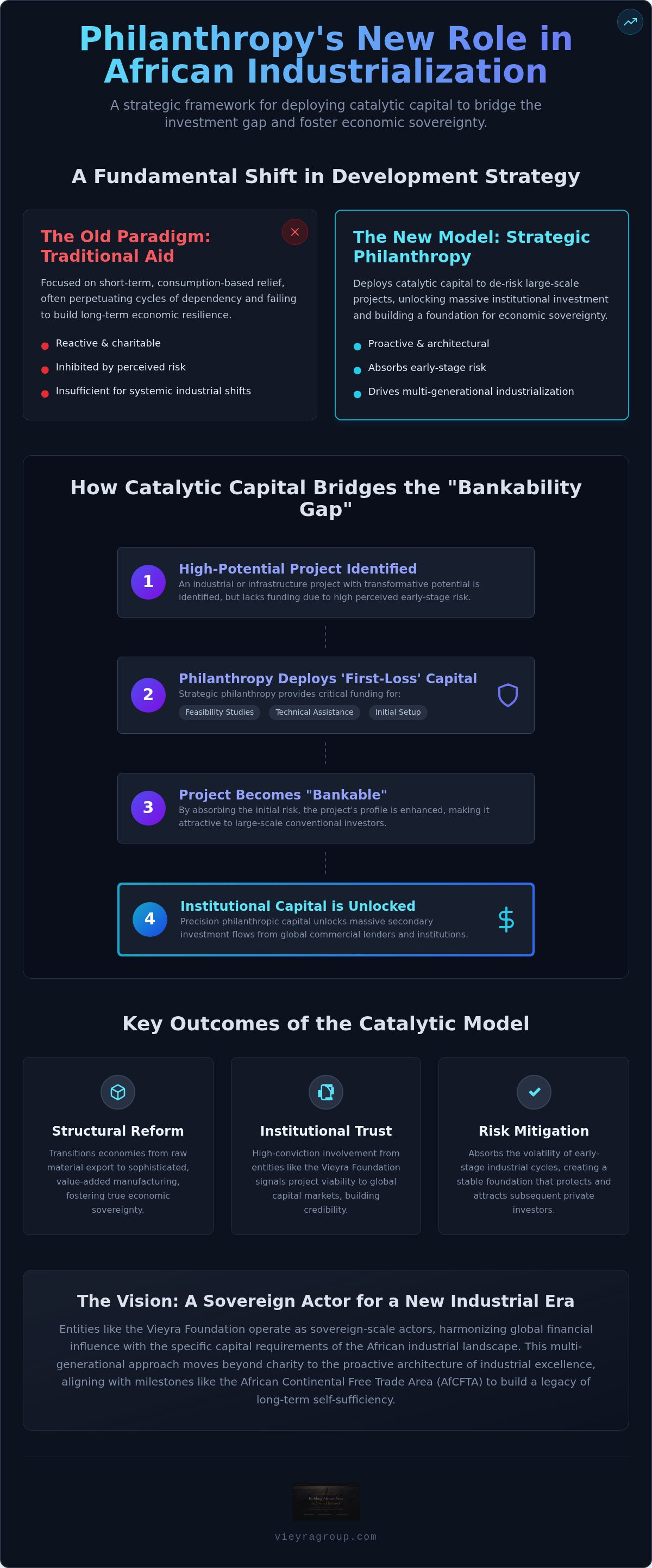
At the heart of this framework is the 'first-loss' capital position. Philanthropic funds possess a unique ability to absorb early-stage project development risks that traditional financial institutions find prohibitive. When an entity like the Vieyra Foundation provides the initial capital for feasibility studies or technical assistance, it effectively de-risks the entire venture. This strategic intervention attracts traditional institutional investment by providing a layer of protection and a stamp of institutional approval, ensuring that vital infrastructure projects move beyond the planning phase and into active production. It's about using precision capital to unlock massive secondary investment flows.
Industrialization as a Multi-generational Social Good
The pursuit of industrialization is more than a fiscal objective. It's a commitment to the long-term dignity of the continent. Moving beyond immediate relief allows for the establishment of domestic manufacturing and value-addition capabilities that are essential for economic sovereignty. This mission is perfectly aligned with the implementation milestones of the African Continental Free Trade Area (AfCFTA) projected for 2026. By focusing on production rather than consumption, sovereign-scale actors are building a legacy of industrial excellence that will endure for generations, ensuring that African resources are processed and refined within African borders. This creates a stable foundation for a future where aid is no longer a necessity, but a historical footnote.
- Risk Mitigation: Absorbing the volatility of early-stage industrial cycles to protect subsequent investors.
- Institutional Trust: Signaling project viability to global capital markets through high-conviction involvement.
- Structural Reform: Transitioning economies from raw material export to sophisticated value-added manufacturing.
The Mechanics of De-risking: Bridging the Bankability Gap
The "bankability gap" represents a formidable structural chasm that separates high-potential industrial concepts from the stringent credit requirements of global commercial lenders. While the African continent possesses an abundance of industrial opportunities, many projects fail to reach financial close due to a perceived lack of preparation or an inability to withstand the initial volatility of the project lifecycle. In this precise environment, philanthropy's role in African industrialization becomes one of technical and financial architecture. By funding comprehensive feasibility studies and providing technical assistance, institutional foundations transform raw industrial potential into sophisticated, bankable assets that command the attention of global markets. It's a matter of creating the necessary conditions for capital to flow with confidence.
This intervention extends beyond mere funding; it involves the strategic application of guarantees and credit enhancement tools that provide a necessary safety net for commercial participants. The presence of a high-conviction philanthropic anchor has a profound psychological impact on global investment sentiment, signaling a level of institutional stability and long-term commitment that private capital alone cannot replicate. This "anchoring" effect serves to harmonize the diverse interests of sovereign states, development finance institutions, and private equity firms, ensuring a cohesive approach to large-scale industrial transformation. It doesn't just provide capital; it provides the institutional gravity required to stabilize complex ecosystems.
Funding the Pre-Development Phase
The pre-development phase is often where the most promising industrial initiatives falter, characterized by a high mortality rate due to the absence of patient capital. Institutional foundations address this by providing the resources required for regulatory alignment and policy coordination, ensuring that the legal and structural environment is conducive to industrial growth. This non-monetary contribution of institutional expertise is just as vital as the capital itself, as it establishes the governance frameworks necessary for multi-generational success. Without this foundational support, many projects simply don't survive the transition from concept to execution.
Blended Finance Frameworks for Sovereign-Scale Impact
The most effective path toward industrialization involves the sophisticated integration of diverse capital sources through blended finance frameworks. By structuring "impact-first" tranches, foundations can protect commercial investors from initial losses, thereby lowering the overall cost of capital for sovereign-scale projects. The Vieyra approach exemplifies this synergy, seamlessly blending global investment management with strategic de-risking to ensure that industrial capital is both resilient and transformative. For those exploring these sophisticated financial models, the implementation of Strategic Capital Solutions offers a definitive path toward aligning philanthropic vision with industrial reality.
Strategic Philanthropy vs. Traditional Aid: A Structural Comparison
Traditional aid has historically operated within a framework of immediate relief, prioritizing the mitigation of acute symptoms through consumption-based interventions. This model, while necessary in humanitarian crises, often creates a fiscal environment characterized by donor dependency and structural short-termism. In contrast, philanthropy's role in African industrialization is defined by an unwavering focus on production and systemic permanence. This shift represents a transition from reactive charity to deliberate stewardship, where the objective isn't the perpetual disbursement of funds, but the creation of self-sustaining economic engines capable of facilitating a graceful market exit for philanthropic capital.
Success under this new paradigm is measured through the lens of value-addition and systemic GDP contribution rather than simple expenditure rates. It's a sophisticated approach that treats the African continent not as a site for benevolence, but as a landscape for visionary industrial architecture. By prioritizing the development of domestic manufacturing, foundations ensure that economic growth is rooted in local productivity rather than external volatility. This transition is essential for moving beyond the limitations of the past toward a future of genuine economic resilience.
The Limitations of the NGO Model in Industrial Growth
The project-based nature of the traditional NGO model is fundamentally mismatched with the multi-decadal timelines required for industrial transformation. Industrialization demands a level of institutional permanence that short-term grant cycles simply can't provide. While social safety nets offer essential temporary support, they don't possess the structural capacity to function as economic catalysts. Transitioning toward a model of institutional stewardship allows for the long-term planning necessary to establish complex industrial ecosystems that endure well beyond the initial funding period.
Philanthropy as an Architect of Economic Sovereignty
Strategic philanthropy serves as the primary architect of economic sovereignty by fostering domestic industrial management capabilities and reducing the historical reliance on foreign Official Development Assistance (ODA). By strengthening internal value chains and processing capacities, foundations ensure that the continent captures a greater share of its own wealth. The Vieyra Foundation exemplifies this African-led narrative, positioning industrial development as the definitive path toward true autonomy. In this context, philanthropy's role in African industrialization ensures that the continent's economic trajectory is determined by its own institutional vision rather than by external donor mandates.
- Consumption vs. Production: Shifting capital from immediate use to long-term industrial capacity.
- Dependency vs. Sovereignty: Moving away from ODA reliance toward domestic value-addition.
- Expenditure vs. Impact: Measuring success through GDP growth and industrial maturity.
Institutional Architecture: The Family Office as a Sovereign Actor
The family office, particularly within the African context, transcends the traditional boundaries of private wealth management to function as a sovereign-scale institution. This unique architecture allows for a multi-generational vision that is often absent in the short-term cycles of global financial markets. By operating with the deliberation of a stately guardian, the family office serves as a critical bridge between international capital flows and the specific requirements of the continent's industrial sector. This institutional gravity is essential for maintaining stability during periods of market volatility, ensuring that long-term developmental objectives remain uncompromised by transient economic shifts.
Strategic partnerships with regional bodies and sovereign states are central to this model. As the continent approaches the 2026 implementation milestones of the African Continental Free Trade Area (AfCFTA), philanthropy's role in African industrialization becomes even more pronounced. These entities don't merely provide capital; they offer the diplomatic and strategic weight necessary to influence industrial policy and regional integration. It's a proactive stance that positions the family office as a visionary architect of the continent's economic future, blending the traditional values of heritage with a forward-looking commitment to progress.
Governance and Multi-generational Wealth Preservation
The alignment of family legacy with industrial progress requires a sophisticated approach to governance. It involves the science of preserving capital while simultaneously deploying it to achieve systemic impact. Succession planning is not just about the transfer of assets, but about the continuity of a philanthropic industrial strategy that spans generations. This ensures that the commitment to the continent's transformation remains a permanent fixture of the family's global identity, transcending individual tenures to build a lasting institutional heritage that survives the fluctuations of emerging market cycles.
Strategic Asset Allocation for Sovereign-Scale Impact
Achieving sovereign-scale impact necessitates a precise balance in asset allocation. While global investment management provides the necessary diversification and liquidity, concentrated bets on African industrial infrastructure and energy nexus projects drive real transformation. By leveraging their global influence, these offices advocate for African interests on the world stage, ensuring that the continent's industrial potential is recognized by international partners. To engage with this level of institutional foresight, one may explore the African Industrialization Capital frameworks that define this sovereign approach.
- Multi-generational Horizon: Prioritizing decades-long industrial cycles over quarterly financial returns.
- Sovereign Diplomacy: Coordinating with state actors to align private investment with national industrial policies.
- Institutional Resilience: Maintaining a composed and authoritative stance during periods of regional or global economic volatility.
The Vieyra Perspective: Integrating Global Capital and Philanthropic Vision
The Vieyra Family Office operates with a mandate that transcends traditional wealth management, seeking instead to harmonize global capital markets with the profound requirements of continental progress. Within this institutional framework, the Vieyra Foundation functions as the primary vehicle for strategic intervention, precisely targeting the structural impediments that have historically constrained industrial expansion. By integrating global investment management with high-conviction philanthropic activity, the entity provides a model for how philanthropy's role in African industrialization can be executed at a sovereign scale. This synergy ensures that every dollar of philanthropic capital is deployed with the same analytical rigor as commercial investment, yet with a risk tolerance and temporal horizon that only a multi-generational institution can sustain.
A recent case study in the deployment of strategic capital illustrates this methodology in practice. By providing first-loss guarantees for a large-scale manufacturing hub, the foundation was able to attract institutional investors who had previously viewed the project as outside their risk mandate. This didn't just fund a single facility; it established a template for the integration of private equity and philanthropic de-risking that can be replicated across diverse sectors. It's a precise application of capital designed to unlock the continent’s industrial potential while inviting sovereign partnerships to participate in multi-generational growth.
The Vieyra Foundation: A Mission for Social Impact through Industry
The foundation’s methodology centers on the identification of high-impact industrial bottlenecks, where the absence of early-stage capital prevents the realization of systemic value. Rather than traditional social metrics, impact is quantified through the lens of economic structural transformation, such as the increase in domestic value-addition and the maturation of regional supply chains. This commitment to African-led, sovereign-scale development ensures that the foundation remains a partner of choice for states and regional bodies seeking to align their industrial policies with global financial standards. It's a disciplined approach to social impact that recognizes industrialization as the ultimate guarantor of continental dignity.
Building a Legacy of Industrial Stewardship
Looking toward the 2030 horizon and the comprehensive implementation of the AfCFTA, the vision for a self-sufficient, industrialized Africa remains the guiding objective. The family office acts as a stately guardian of this progress, providing the institutional gravity necessary to weather economic cycles while maintaining a steady trajectory toward industrial excellence. The imperative for institutional philanthropy in this new era is clear: it must serve as the architect of legacy, bridging the gap between current potential and future prosperity. Through the deployment of Strategic Capital Solutions and the Vieyra Foundation's targeted initiatives, the path toward multi-generational growth is not merely envisioned, but actively constructed.
- Strategic Synergy: Harmonizing global investment management with localized industrial de-risking.
- Impact Metrics: Prioritizing structural economic shifts over short-term disbursement goals.
- Multi-generational Vision: Ensuring the continuity of industrial strategy through established family office governance.
Architecting the Future of Continental Industrial Sovereignty
The transition from traditional aid to a strategic framework of catalytic capital represents a definitive evolution in the continent's economic narrative. By addressing the bankability gap through technical de-risking and high-conviction anchoring, institutional foundations are establishing the structural permanence required for large-scale transformation. We've examined how the integration of sovereign-scale vision with sophisticated financial architecture allows for the realization of industrial projects that were previously deemed inaccessible. This approach ensures that economic growth isn't merely a transient phase but a durable, multi-generational achievement.
As we look toward the 2026 milestones of regional integration, philanthropy's role in African industrialization will serve as the essential stabilizer for volatile emerging markets. This commitment to production-focused stewardship ensures that the continent captures its own value while building a legacy of self-sufficiency. The synthesis of global investment management expertise with a multi-generational African heritage provides the necessary depth to navigate these complex geopolitical shifts. We invite you to explore the Vieyra Family Office approach to strategic capital and industrial stewardship to understand how our sovereign-scale institutional presence is shaping the future. The architecture of a prosperous, industrialized Africa is being built with deliberation and foresight.
Frequently Asked Questions
What is the specific role of philanthropy in African industrialization?
Philanthropy acts as the primary de-risking agent within the African industrial landscape by providing the high-conviction, patient capital required to bridge the bankability gap. By absorbing first-loss positions, philanthropy's role in African industrialization ensures that vital infrastructure and manufacturing initiatives achieve the institutional credibility necessary to attract global commercial investment. It's the essential mechanism for transforming visionary industrial concepts into stable, bankable assets that meet international standards.
How does strategic philanthropy differ from traditional international aid?
Strategic philanthropy prioritizes production and systemic permanence over the consumption-based relief characteristic of traditional aid models. While conventional aid often focuses on immediate humanitarian mitigation, the strategic approach seeks to architect domestic value chains and industrial capacity. It's designed for a graceful market exit, aiming to establish self-sufficient industrial ecosystems that eventually operate independently of external donor support or perpetual grant cycles.
What is catalytic capital and how does it de-risk industrial projects?
Catalytic capital is investment specifically structured to accept higher risk or subordinate returns to unlock secondary, commercial capital flows. It de-risks industrial projects by funding the critical pre-development phase, including comprehensive feasibility studies and technical assistance. This intervention creates a stable foundation for commercial lenders, effectively lowering the perceived risk profile of sovereign-scale industrial ventures and ensuring projects reach financial close.
Can a family office foundation influence sovereign-scale industrial policy?
Sovereign-scale family offices possess the institutional weight and multi-generational vision to serve as strategic partners to state actors and regional bodies. By aligning private capital with national industrial objectives, these entities facilitate the creation of robust regulatory environments and policy frameworks. Their long-term commitment provides a level of stability that encourages governments to pursue ambitious industrial policies with the confidence of sustained institutional support.
Why is multi-generational capital better suited for industrial development?
Industrial development operates on decadal cycles that are fundamentally mismatched with the quarterly horizons of public equity markets or short-term private capital. Multi-generational capital provides the necessary temporal depth to withstand short-term market volatility and the structural delays inherent in large-scale infrastructure. This institutional permanence allows for the patient execution of complex projects that require years of technical refinement before achieving operational maturity.
How does the Vieyra Foundation measure the impact of industrial philanthropy?
The Vieyra Foundation quantifies success through the lens of economic structural transformation and the maturation of domestic value-addition across the continent. Metrics include the reduction of raw material exports in favor of processed products and the expansion of regional manufacturing capacity. This methodology ensures that philanthropy's role in African industrialization is measured by the creation of sustainable industrial assets rather than simple expenditure rates.
What are the primary barriers to philanthropic investment in African industry?
The primary barriers include the high perceived risk of African markets and the historical fragmentation of capital sources for large-scale projects. Many philanthropic entities lack the technical expertise required to evaluate complex industrial ventures, leading to a preference for lower-risk social programs. Overcoming these hurdles requires the sophisticated integration of global investment management with deep localized industrial knowledge to provide the necessary de-risking mechanisms.
How can global institutions partner with African family offices for industrial growth?
Global institutions can partner with African family offices by utilizing them as high-conviction anchors and regional experts for large-scale industrial initiatives. These offices provide the institutional gravity and diplomatic access necessary to navigate local regulatory landscapes effectively. By co-investing alongside established family foundations, international partners can leverage localized de-risking mechanisms to achieve both commercial viability and systemic industrial impact across the continent.


