
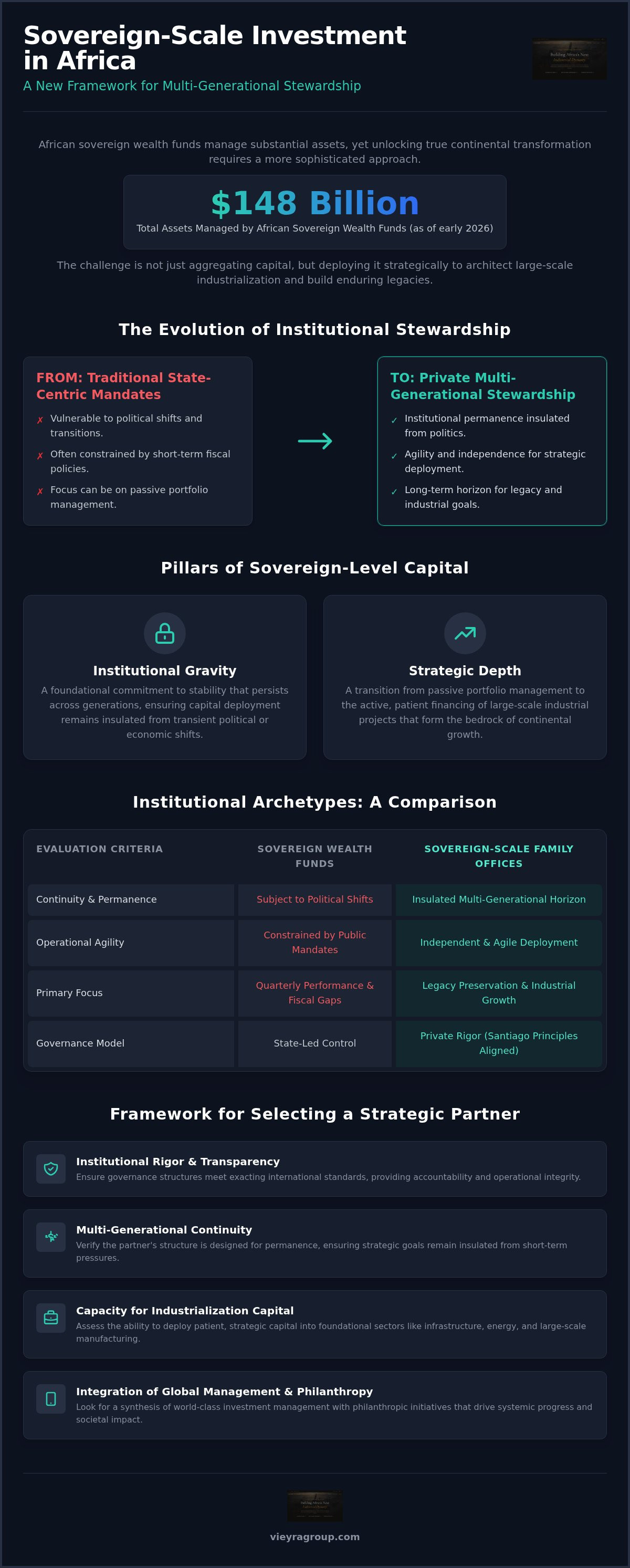
The collective assets managed by African sovereign wealth funds reached $148 billion in early 2026, yet the mere aggregation of capital remains secondary to the sophisticated governance required for genuine continental transformation. True progress necessitates the intervention of sovereign-scale investment institutions Africa acknowledges as visionary architects, entities capable of harmonizing global asset management with the rigorous demands of large-scale industrialization. You likely understand that the complexity of financing such development requires a partner who possesses both international prestige and a profound, localized mastery of sovereign-level strategic capital solutions.
This guide provides a rigorous framework for evaluating institutional wealth management within this intricate landscape, ensuring that governance structures meet the most exacting international transparency standards. You will discover the strategic imperatives necessary to align global investment mandates with the long-term goals of African industrial sovereignty. By the conclusion of this analysis, the criteria for identifying a partner capable of stewarding multi-generational legacies through the deliberate application of strategic capital will be clearly established.
Key Takeaways
- Analyze the systemic evolution of institutional wealth management as it transitions from traditional state-centric mandates toward private, multi-generational stewardship.
- Define the foundational governance frameworks required to ensure institutional rigor and transparency within the complex landscape of sovereign-scale investment institutions Africa.
- Distinguish the operational permanence of private institutional archetypes from public funds to ensure multi-generational continuity remains insulated from political shifts.
- Implement a sophisticated framework for selecting strategic capital partners by aligning legacy preservation objectives with the capacity to deploy African Industrialization Capital.
- Evaluate the integration of global investment management with philanthropic initiatives as a primary driver of systemic progress and multi-generational impact.
Defining Sovereign-Scale Investment Institutions in the African Context
The conceptualization of sovereign-scale investment institutions Africa currently observes represents a fundamental departure from the historical reliance upon centralized state mandates. This evolution reflects a growing recognition that the stewardship of systemic economic impact requires a degree of institutional permanence that private, multi-generational entities are uniquely positioned to provide. By integrating the sophisticated rigor of global investment management with a steadfast commitment to continental progress, these institutions bridge the gap between liquid asset preservation and the demanding requirements of industrial development. The designation of sovereign-scale is therefore not a mere descriptor of size, but an acknowledgment of a strategic imperative to operate with the deliberation and foresight traditionally associated with national treasuries.
A multi-generational horizon distinguishes these entities from conventional asset managers. While typical market participants focus on the immediate fluctuations of the fiscal year, sovereign-scale actors prioritize the construction of enduring legacies that span decades. This long-term orientation allows for the deployment of African Industrialization Capital into sectors that require patient, strategic investment, such as infrastructure, energy, and large-scale manufacturing. The convergence of international fiduciary standards with local industrial requirements ensures that capital is not merely preserved, but actively utilized to foster systemic stability across the African landscape.
The Pillars of Sovereign-Level Capital
Institutional gravity serves as the primary foundation for these entities, requiring a commitment to stability that persists across generations. This permanence ensures that capital deployment remains insulated from transient political or economic shifts, providing a reliable source of Strategic Capital Solutions. Strategic depth follows, necessitating a transition from passive portfolio management toward the active financing of large-scale industrial projects. A unique synergy emerges when global portfolio diversification is balanced with a dedicated focus on continental growth, creating a virtuous cycle where international success fuels domestic progress.
The Shift Toward Private Institutional Stewardship
While the global list of Sovereign Wealth Funds illustrates the immense power of state-led capital, the limitations of these models often emerge during periods of geopolitical transition or fiscal constraint. Private sovereign-scale actors, particularly established multi-generational family offices, have emerged as vital alternatives that offer equivalent institutional weight. These private guardians maintain the rigorous standards of transparency and governance established by the Santiago Principles, yet they operate with an agility and independence that public mandates may lack. By prioritizing legacy preservation over quarterly performance, these institutions ensure that capital is deployed with the professional rigor and intellectual sophistication required for genuine industrial transformation.
Core Criteria for Evaluating Institutional Wealth Management in Africa
The identification of a suitable partner within the landscape of sovereign-scale investment institutions Africa requires an evaluation framework that transcends conventional retail performance metrics. Investors must scrutinize the structural integrity of the organization, prioritizing institutional rigor and a demonstrable capacity for systemic economic impact. At this echelon, the focus shifts from the pursuit of transient market alpha toward the preservation of multi-generational legacies and the strategic deployment of capital into foundational sectors. A capable partner must possess a rare synthesis of expertise, blending high-finance proficiency with a nuanced understanding of geopolitical dynamics and large-scale industrial development.
Selecting an institution necessitates a thorough audit of its fundamental philosophy. While many managers prioritize short-term liquidity, a sovereign-scale actor operates with the deliberation of a stately guardian. This involves a commitment to permanence that ensures capital remains a stabilizing force even amidst global economic shifts. The ability to navigate the complexities of African industrialization finance requires more than just capital; it demands a visionary architecture that aligns private wealth with the broader objectives of continental progress.
Governance and Institutional Rigor
Robust governance frameworks serve as the defining characteristic of a sovereign-scale entity. These structures must be characterized by multi-clause constitutional arrangements that ensure stability across decades and through generational transitions. The presence of independent advisory committees provides a layer of institutional depth, ensuring that decision-making processes remain insulated from the volatility of individual interests or political cycles. Transparency serves as a critical instrument for building trust with global co-investment partners, facilitating the flow of capital into complex markets while maintaining the highest international standards of fiduciary responsibility.
Strategic Asset Allocation for Industrialization
Evaluating an institution's capacity for industrialization requires a deep analysis of its strategic asset allocation. A diversified global portfolio provides the necessary liquid foundation, yet the true measure of a sovereign-scale partner lies in its ability to deploy Strategic Capital Solutions into productive infrastructure. This involves a methodical approach to risk management that acknowledges the unique characteristics of African capital markets while maintaining a global perspective.
- Track Record Verification: Assessing the institution's history in managing large-scale, capital-intensive projects that require patient capital.
- Regulatory Mastery: Identifying expertise in navigating the regulatory audits initiated by the AfCFTA Investment Protocol and other continental frameworks.
- Systemic Alignment: Ensuring the investment philosophy prioritizes long-term industrial growth over speculative, short-horizon gains.
Ultimately, the ideal partner functions as a visionary architect, capable of balancing the traditional values of heritage with a forward-looking commitment to large-scale progress. This balance ensures that wealth is not merely managed, but transformed into a legacy of enduring impact.
Institutional Archetypes: Sovereign Wealth Funds vs. Sovereign-Scale Family Offices
The landscape of institutional capital on the continent is defined by two primary archetypes, each operating with significant influence but differing fundamentally in their governance and execution. Public Sovereign Wealth Funds (SWFs) and private sovereign-scale investment institutions Africa recognizes as family offices represent the dual pillars of large-scale capital deployment. While both entities manage substantial assets, the distinction lies in their mandate flexibility and their ability to maintain institutional permanence across generations. As of early 2025, Africa is home to 36 SWFs and 16 Public Pension Funds, collectively managing over $400 billion. However, the emergence of private sovereign-scale actors provides a vital alternative that offers equal institutional gravity with enhanced strategic agility.
The core differentiator between these archetypes is the source of their authority and the horizon of their objectives. Public funds are inherently tied to state mandates, which, while powerful, can be subject to the shifting priorities of legislative oversight and political cycles. In contrast, a private sovereign-scale institution is governed by a multi-generational legacy. This allows for a level of deliberation and foresight that prioritizes systemic economic impact over the immediate requirements of a national budget or a specific political term. This strategic independence is essential for the successful execution of complex industrialization projects that require decades of sustained commitment.
Mandate and Agility
Public SWFs often operate under rigid regulatory frameworks that, while ensuring accountability, can limit their ability to move with the speed required by modern global capital markets. Private sovereign-scale institutions possess a unique agility, allowing them to pivot strategically without the constraints of bureaucratic friction. This speed does not imply a lack of rigor; rather, it reflects a streamlined decision-making process rooted in a deep, multi-generational vision. When executing large-scale industrialization projects, this agility allows private institutions to capitalize on emerging opportunities that might be inaccessible to more tradition-bound public entities.
Risk Mitigation and Global Stewardship
Stewardship at this level requires a sophisticated approach to risk management that balances continental growth with global stability. Private sovereign-scale institutions utilize a diversified global portfolio as a foundational hedge against localized market volatility. This global-African synergy ensures that the institution remains a stable actor, capable of absorbing short-term shocks while maintaining a steady course toward its long-term industrialization goals.
- Legacy Preservation: Institutionalized wealth management ensures that capital remains a permanent force for progress, regardless of external economic shifts.
- Strategic Hedging: Leveraging international asset management standards to protect and grow capital destined for African industrialization.
- Geopolitical Agility: Navigating the complex intersections of global finance and local development with the poise of a significant global actor.
Ultimately, the private sovereign-scale model achieves a degree of institutional permanence that is often difficult for state-led funds to replicate. By operating with the foresight of a visionary architect, these institutions ensure that wealth is not merely a resource for the present, but a foundation for a prosperous African century.
Selecting a Strategic Capital Partner: A Framework for Institutional Investors
The selection of a strategic partner among the sovereign-scale investment institutions Africa offers requires a methodical approach that prioritizes institutional permanence over transient market gains. For the institutional investor or the multi-generational family office, the choice of a steward is an exercise in architectural foresight, necessitating a partner capable of balancing global fiduciary standards with the specific requirements of continental development. This framework serves as a rigorous guide for those seeking to align their capital with entities that operate with the deliberation and gravity of a sovereign actor.
- Step 1: Alignment of Vision. Evaluate whether the institution’s multi-generational vision reflects your own legacy preservation goals, ensuring that capital is treated as a permanent instrument for progress rather than a short-term speculative resource.
- Step 2: Verification of Allocation Capabilities. Conduct a rigorous audit of the institution’s sovereign-scale capital allocation capacity, focusing on their ability to manage complex, multi-clause financial arrangements across diverse global jurisdictions.
- Step 3: Assessment of Industrialization Commitment. Verify the institution’s active involvement in African industrialization capital deployment, specifically their ability to navigate the regulatory audits and investment protocols established by the AfCFTA.
- Step 4: Review of Philanthropic Integration. Analyze the synergy between the institution’s investment activities and its social impact frameworks, ensuring that wealth creation is inextricably linked to systemic societal advancement.
Evaluating Industrialization Expertise
A capable partner must possess a sophisticated arrangement of high-finance proficiency and deep industrial knowledge. This expertise is demonstrated through a track record of involvement in large-scale economic transformation, where the institution acts as a visionary architect of legacy rather than a passive observer of market trends. You should scrutinize the depth of their involvement in productive infrastructure, ensuring they possess the technical rigor required to manage the interconnected systems of power, transportation, and digital development that define the modern African landscape.
The Role of Global-Local Connectivity
A sovereign-scale partner must move with seamless poise between the high-finance corridors of global financial centers and the localized realities of African industrial development. This connectivity is essential for facilitating sovereign-level investment partnerships that require both international prestige and deep continental roots. Assessing an institution’s reach involves verifying their ability to attract global co-investment while maintaining a steadfast focus on the strategic imperatives of African growth. This dual footprint ensures that your capital benefits from global stability while contributing to the systemic industrialization of the continent. To begin your evaluation of a partner capable of executing these complex mandates, you may access our framework for Strategic Capital Solutions.
The Vieyra Family Office: A Sovereign-Scale Institution for the African Century
The Vieyra Family Office operates with the deliberate foresight of a stately guardian, positioning itself as a cornerstone among the sovereign-scale investment institutions Africa identifies as architects of the continent's industrial future. By functioning as a private alternative to public mandates, the institution provides the institutional gravity and permanence required to steward multi-generational wealth through periods of global transition. This approach is rooted in a heritage that understands the necessity of long-term stability, where the preservation of legacy is inextricably linked to the systemic progress of the African continent. The institution does not merely participate in the market; it shapes the trajectory of large-scale development through the precise application of professional rigor and intellectual sophistication.
Central to this mission is the deployment of African Industrialization Capital, a core institutional objective that differentiates the Vieyra approach from generic global asset management. While many entities focus exclusively on liquid portfolio performance, this office recognizes that true sovereign-scale impact requires a commitment to productive infrastructure and industrial finance. This visionary architecture ensures that wealth remains a stabilizing force, capable of fostering enduring economic growth while maintaining the highest standards of international transparency and governance.
Global Investment Management with African Focus
The institutional architecture of the Vieyra portfolio is defined by a sophisticated balance between Global Investment Management and the targeted deployment of Strategic Capital Solutions. This dual mandate ensures that capital is preserved within the stability of international markets while being actively utilized to catalyze continental transformation. Managed fees and capital allocation structures are specifically designed for multi-generational growth, providing a predictable and methodical framework for legacy preservation. As a global actor, the Vieyra Family Office moves between the corridors of high finance and the complexities of local industrial development with a poise that reflects its deep-seated identity and certain trajectory.
Legacy and Philanthropy: The Vieyra Foundation
The integration of social impact into the core institutional framework is achieved through the Vieyra Foundation, which aligns philanthropic initiatives with sovereign-level investment strategies. This alignment ensures that economic development is accompanied by systemic progress, addressing the foundational requirements of a prosperous society. The foundation functions as an extension of the office's commitment to large-scale progress, pursuing initiatives that reflect the traditional values of heritage and a forward-looking vision for the African century.
- Systemic Alignment: Ensuring that philanthropic capital works in harmony with industrialization goals to create sustainable societal impact.
- Legacy Architecture: Building enduring institutions that support education, health, and social stability across generations.
- Institutional Rigor: Applying the same level of professional scrutiny to social initiatives as is applied to global asset management.
The resulting synergy creates a reading of wealth that is both substantial and deeply considered, emphasizing depth over brevity and quality over speed. Investors and legacy holders who require a partner capable of navigating these intricate mandates are invited to engage with the Vieyra Family Office to explore sovereign-scale capital solutions.
Architecting a Permanent Legacy for the African Century
The evolution of sovereign-scale investment institutions Africa currently witnesses signifies a profound shift toward private stewardship that prioritizes institutional permanence over transient market cycles. By harmonizing global asset management expertise with a dedicated focus on continental industrialization, these entities provide the strategic depth required to navigate a complex geopolitical landscape. Establishing a multi-generational legacy necessitates a partner who operates with the deliberation of a stately guardian and the foresight of a visionary architect. True progress is achieved when capital is treated as a permanent instrument for systemic transformation rather than a short-term resource.
The Vieyra Family Office offers a rare synthesis of multi-generational institutional heritage and a sovereign-scale industrialization focus. This commitment ensures that your wealth is not merely preserved but transformed into a foundation for systemic progress across the continent. You are invited to Consult with Vieyra Family Office on Sovereign-Scale Asset Management to align your legacy with the trajectory of a prosperous African future. The path toward enduring impact is built upon the professional rigor and intellectual sophistication of a partner dedicated to large-scale progress.
Frequently Asked Questions
What defines an investment institution as "sovereign-scale" in Africa?
Sovereign-scale status is defined by an institution's capacity to manage assets with the deliberation and systemic impact characteristic of a state actor. These sovereign-scale investment institutions Africa recognizes are distinguished by their multi-generational horizons and their ability to deploy large-scale capital into foundational economic sectors. Size is secondary to the institutional gravity and the strategic depth required to influence national or regional industrial trajectories through patient, permanent capital.
How does a private family office achieve sovereign-level impact in African industrialization?
Private institutions achieve sovereign-level impact by deploying African Industrialization Capital into productive infrastructure and large-scale manufacturing projects that drive systemic growth. Unlike public funds that may be constrained by shifting political cycles, a private office utilizes its strategic agility to finance long-term developments. This independence allows for the consistent application of capital toward economic transformation, ensuring that private wealth serves as a significant global catalyst for continental progress.
What are the key differences between institutional wealth management and retail private banking?
Institutional wealth management prioritizes the preservation of systemic legacies and the deployment of Strategic Capital Solutions, whereas retail private banking focuses on individual liquidity and short-term market performance. The institutional model operates with a professional rigor that encompasses geopolitics and large-scale industrial finance. It's a fundamental shift from passive asset management to active participation in the architecture of a multi-generational economic future for the continent.
How do sovereign-scale institutions manage the risks associated with large-scale industrial projects?
These institutions mitigate risk by balancing a diversified global investment portfolio with localized industrial expertise to hedge against specific market volatility. They utilize sophisticated risk management frameworks that acknowledge the unique regulatory environments of African markets, including the implementation of the AfCFTA Investment Protocol. By adopting a long-term horizon, they can absorb short-term shocks that would deter conventional managers, ensuring the stability of infrastructure investments.
What role does the Vieyra Foundation play in the overall institutional strategy?
The Vieyra Foundation integrates systemic social impact into the broader institutional investment framework to ensure that economic growth is accompanied by measurable societal advancement. It functions as a strategic arm that addresses foundational needs in education and health, reinforcing the stability of the environments where capital is deployed. This synergy ensures that the institution's legacy is defined by both financial success and a commitment to progress for the African century.
Why is a multi-generational approach essential for African investment legacies?
A multi-generational approach is essential because industrial transformation requires patient capital that persists beyond the duration of a single fiscal cycle or political term. It ensures that investment strategies remain insulated from transient market fluctuations, providing the permanence needed for large-scale projects to reach full maturity. This long-term vision is the cornerstone of any enduring African investment legacy, fostering stability and growth across many decades.
How can global investors partner with African sovereign-scale institutions?
Global investors partner with these institutions by leveraging their local sovereign-level expertise to navigate complex continental markets while adhering to international fiduciary standards. These partnerships facilitate the flow of strategic capital into productive sectors, benefiting from the institution's deep-rooted connectivity and industrial knowledge. It's a collaborative model where global asset management standards meet the specific requirements of African economic development and industrialization goals.
What governance standards do private sovereign-scale institutions follow?
Private sovereign-scale institutions adhere to rigorous governance frameworks, often aligning their operations with the transparency and independence standards established by the Santiago Principles. These structures include independent advisory committees and multi-clause constitutional arrangements to ensure professional rigor and institutional stability. Such high standards are critical for attracting international co-investment and maintaining the trust of multi-generational legacy holders within the global financial system.


