
Is the traditional model of raw material exportation now the greatest systemic risk to long-term capital preservation across the emerging markets? As global supply chains undergo a fundamental realignment, the historical reliance on primary extraction is being superseded by a requirement for sophisticated industrial integration. For the institutional allocator, identifying the most resilient avenues for resource beneficiation investment Africa requires a departure from transient speculative cycles in favor of a commitment to permanent industrial infrastructure. You likely recognize that while the continent's geological endowment is unparalleled, it's the complexity of jurisdictional fragmentation and the imperative of national industrialization mandates that present the most formidable challenges to the deployment of sovereign-scale capital.
This article establishes a rigorous framework for navigating this transition, offering a definitive methodology for evaluating the shift from raw material extraction to high-value processing. By aligning strategic capital with the continent's industrial evolution, investors can secure a position within a new architecture of global trade. We shall examine the critical project evaluation criteria necessary for 2026, identify the specific resource classes that offer the most robust yields, and demonstrate how these initiatives facilitate the enduring goals of multi-generational wealth preservation and systemic impact.
Key Takeaways
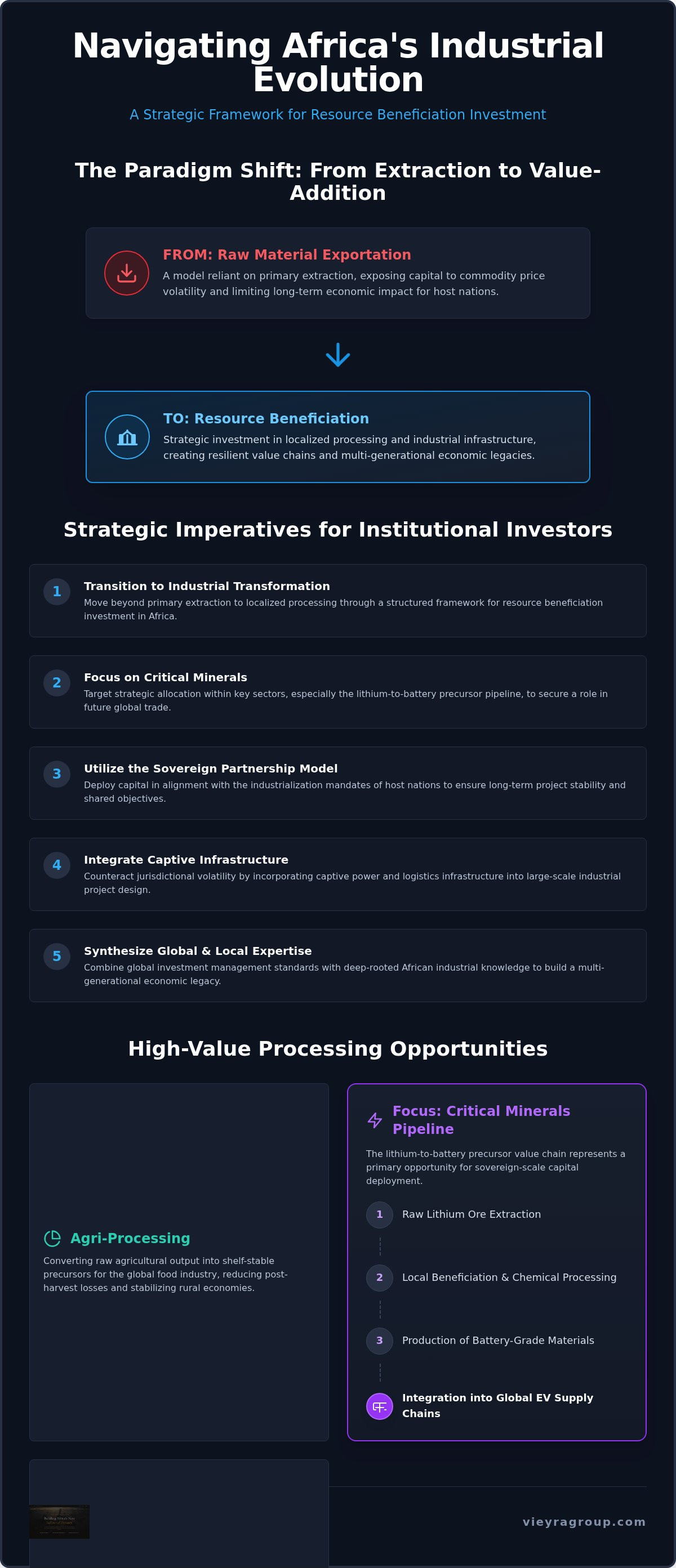
- Recognize the imperative of transitioning from primary extraction to localized industrial transformation through a structured framework for resource beneficiation investment Africa.
- Examine the strategic allocation potential within critical mineral sectors, specifically the lithium-to-battery precursor pipeline, to secure a role in future global trade.
- Deploy capital using the Sovereign Partnership model to ensure alignment between institutional objectives and the industrialization mandates of host nations.
- Counteract jurisdictional and regulatory volatility by incorporating captive power and logistics infrastructure into the design of large-scale industrial projects.
- Synthesize global investment management with deep-rooted African industrial knowledge to facilitate the creation of a multi-generational economic legacy.
The Paradigm Shift: From Extraction to Resource Beneficiation in 2026
The global commodity landscape is undergoing a profound structural realignment. The era of the "African Industrial Mandate" has arrived, shifting the focus from simple raw material export to sophisticated, localized value addition. For the institutional allocator, this represents a transition from speculative extraction to the stewardship of industrial ecosystems. Securing a sustainable resource beneficiation investment Africa requires an understanding that the continent's mineral wealth is no longer a passive asset but a strategic lever for national development. The 2026 investment landscape demands a departure from the extractive models of the previous century; it's a period where active industrial participation is the primary hedge against supply chain volatility.
Sovereign-scale capital plays a pivotal role in this transition by bridging the "processing gap" that has historically limited the continent's economic complexity. By funding the facilities that transform raw ores into industrial precursors, investors don't just capture higher margins; they foster the creation of permanent industrial legacies. This shift is catalyzed by a new generation of policy frameworks that prioritize long-term stability over short-term export volumes, ensuring that capital remains aligned with the multi-generational goals of host nations.
Drivers of Value Retention in the African Context
The African Continental Free Trade Area (AfCFTA) has reached a critical stage of implementation in 2026, facilitating the seamless movement of intermediate goods between emerging industrial hubs. This regional integration allows for the scaling of processing facilities that were previously constrained by small domestic markets. Simultaneously, the geopolitical necessity of diversifying critical mineral supply chains, particularly for lithium, cobalt, and graphite, has placed Africa at the center of the global energy transition. In Southern Africa, the 2026 lithium processing regulations exemplify this trend, mandating that critical minerals undergo significant refinement before crossing borders. Beneficiation stands as the cornerstone of 2026 African industrial policy, representing the mandatory localized transformation of mineral wealth into refined precursors. The technical complexity of resource beneficiation necessitates a sophisticated approach to capital allocation, where success is measured by the depth of industrial integration rather than the speed of extraction.
Economic Transformation via Localized Processing
Moving beyond simple GDP growth, localized processing builds systemic industrial resilience. It allows economies to withstand the cyclical nature of commodity prices by moving up the value chain into more stable industrial products. Localized refining creates a multiplier effect, stimulating the development of domestic energy grids and specialized transport infrastructure that serves the broader economy. This transformation is visible across various sectors:
- Agri-processing: The conversion of raw agricultural output into shelf-stable precursors for the global food industry, reducing post-harvest losses and stabilizing rural economies.
- Precious Metals: The establishment of regional refining centers that provide transparency and higher value retention for gold and platinum group metals.
- Critical Minerals: The development of chemical processing plants that prepare battery-grade materials for the global electric vehicle market.
These initiatives demonstrate that a well-structured resource beneficiation investment Africa can transform seasonal or finite resources into enduring industrial assets. By focusing on value retention, investors align themselves with a trajectory of progress that benefits both the portfolio and the sovereign partners involved in these large-scale developments.
Evaluating Resource Classes for Sovereign-Scale Investment
The identification of optimal asset classes for sovereign-scale allocation requires a granular understanding of the continent's evolving industrial priorities. While historical focus remained on bulk commodities, the contemporary landscape prioritizes sectors where the depth of processing correlates directly with global strategic demand. A successful resource beneficiation investment Africa is predicated on the ability to distinguish between transient market fluctuations and the permanent structural shifts within global supply chains. Institutional allocators must evaluate resource classes through the lens of their potential for vertical integration, ensuring that capital facilitates the creation of high-value industrial precursors rather than merely facilitating extraction.
Critical Minerals and the Green Energy Transition
The global 2026 EV battery supply chain has placed an unprecedented premium on the lithium-to-battery component pipeline. Southern and East Africa have emerged as central nodes in this network, where the focus has shifted from the export of spodumene concentrate to the domestic production of battery-grade lithium chemicals. The collective stance of continental institutions emphasizes that mineral wealth must serve as the primary catalyst for economic transformation. Graphite and manganese also play vital roles, with the establishment of localized processing plants offering a hedge against the geopolitical risks of concentrated refining elsewhere. While regulatory hurdles exist, the long-term yield of these critical mineral processing hubs is anchored in their status as indispensable components of the global energy transition.
Industrializing the Agricultural Value Chain
Agri-processing represents a unique intersection of food security and industrialization, offering a pathway to multi-generational wealth preservation. The shift from raw cocoa export to the industrial production of chocolate and cocoa butter provides a blueprint for value retention in West Africa. Similarly, the revitalization of the textile manufacturing base through localized cotton ginning and weaving transforms a seasonal harvest into a durable industrial export. These sectors offer scalability and a lower sensitivity to the volatility that often characterizes the mining sector, making them ideal for strategic capital solutions that prioritize stable, long-term growth. By industrializing the agricultural value chain, investors contribute to systemic economic resilience while capturing a greater share of the global consumer market.
Establishing localized refining hubs for gold and platinum group metals (PGMs) further reinforces this architecture of value. These facilities mitigate the leakage of economic value that traditionally occurs during offshore processing, providing a transparent and secure environment for the monetization of precious metal endowments. The focus remains on building the technical and institutional capacity required to maintain these hubs as permanent fixtures of the African industrial landscape, ensuring that the continent's wealth remains a cornerstone of its own progress.
A Framework for Deploying Strategic Capital in Africa
The deployment of capital into the continent's industrial frontier requires a framework that transcends the limitations of traditional project finance. A successful resource beneficiation investment Africa necessitates the adoption of the Sovereign Partnership model, where institutional goals are synthesized with national industrialization mandates to create a foundation of mutual permanence. This alignment is best achieved through a strategic weighting of equity over debt, as direct ownership interests facilitate the long-term stewardship required for multi-generational industrial stability. Identifying "beneficiation-friendly" regulatory environments involves evaluating jurisdictions that have moved beyond mere rhetoric to implement concrete incentives for localized value addition, ensuring that the legal architecture supports the permanence of large-scale industrial assets.
Technical partnership and technology transfer are the silent pillars of large-scale industrial success. As emphasized by the African Development Bank on mineral value chains, the development of regional industrial hubs is dependent on the ability to localize advanced processing capabilities. This requires a deliberate effort to embed technical expertise within the local ecosystem, ensuring that the industrial assets remain viable and competitive on a global scale for decades. By facilitating this knowledge transfer, institutional investors don't just build factories; they cultivate the human capital necessary for a self-sustaining industrial economy.
The Institutional Due Diligence Process
Rigorous due diligence at a sovereign scale extends beyond financial audits to include a granular assessment of physical and human infrastructure. Evaluating the reliability of energy grids and the efficiency of logistics corridors is essential, as these factors determine the operational viability of high-intensity processing facilities. The assessment of the local workforce's technical readiness is equally critical, identifying the specific training interventions required to support advanced industrial operations. The Vieyra Standard for industrial due diligence is defined as the comprehensive synthesis of geotechnical viability, jurisdictional stability, and socio-economic integration to ensure the absolute permanence of industrial capital.
Structuring for Resilience and Legacy
The management of cross-border capital flows within a fragmented regulatory landscape requires sophisticated syntactical arrangements of financial instruments, where the utilization of regional trade settlement mechanisms acts as a primary hedge against currency volatility. By prioritizing localized liquidity and multi-lateral clearing systems, investors can mitigate the risks associated with external exchange rate fluctuations while simultaneously strengthening the regional financial architecture. The integration of Environmental, Social, and Governance (ESG) principles, championed by the Vieyra Foundation, ensures that industrial projects maintain their social license to operate. This commitment to stewardship transforms industrial sites from mere production centers into catalysts for regional progress, securing the legacy of the investment and the stability of the host community through a shared vision of prosperity.
Mitigating Risk in Large-Scale Industrial Projects
The perceived volatility of the African industrial landscape often serves as a deterrent to conventional capital, yet for the institutional allocator, these complexities represent variables that can be structurally mitigated through sophisticated financial and legal architecture. A resilient resource beneficiation investment Africa is not achieved by avoiding risk, but by embedding projects within a framework of shared sovereign interests. One of the most effective mechanisms for derisking large-scale industrialization is the inclusion of local Sovereign Wealth Funds as co-investment partners. This alignment ensures that the project is viewed as a vital component of national economic security, providing a natural buffer against sudden policy shifts or regulatory changes. Additionally, the utilization of long-term offtake agreements with global industrial consumers provides the revenue certainty required to service the intensive capital requirements of processing infrastructure.
Revenue stability is further enhanced by the strategic selection of jurisdictions that demonstrate a historical commitment to the sanctity of contracts. By layering private insurance products with multi-lateral guarantees, institutional investors can create a risk profile that is comparable to more mature markets while capturing the superior yields inherent in the continent's industrial transition. This methodical approach to risk management reflects the deliberation of an entity focused on the preservation of capital across multi-generational horizons.
Regulatory and Policy Stability
In the 2026 landscape, the negotiation of comprehensive "Stability Agreements" has become a standard requirement for sovereign-scale initiatives. These legal instruments are designed to insulate industrial projects from changes in fiscal regimes or localized processing mandates for a predetermined multi-decadal period. The ongoing maturation of the AfCFTA Investment Protocol provides an additional layer of protection, establishing a continental standard for investor treatment and dispute resolution that transcends individual jurisdictional boundaries. Institutional actors must remain vigilant in monitoring these legal evolutions, ensuring that their resource beneficiation investment Africa remains compliant with both international trade law and the shifting mandates of localized value addition.
Operational and Infrastructure Resilience
Infrastructure deficits, particularly in energy and logistics, require the integration of captive solutions to ensure operational continuity. Modern industrial processing hubs are increasingly designed with on-site renewable energy generation, such as large-scale solar arrays or dedicated hydroelectric taps, to bypass the inconsistencies of national grids. Simultaneously, the development of regional logistics corridors reduces the strategic vulnerability associated with a single-port exit, allowing for the seamless movement of refined precursors across borders. The implementation of institutional-grade risk management is a fundamental necessity for those seeking to lead the next era of African industrialization. For entities prepared to engage with these complexities, global investment management provides the strategic depth required to transform jurisdictional challenges into durable competitive advantages.
The Vieyra Approach: Stewardship of African Industrialization
The Vieyra Family Office operates as the visionary architect of a new industrial era, synthesizing a multi-generational African heritage with sophisticated global investment management to provide the strategic depth necessary for sovereign-scale resource transformation. This approach isn't merely about financial returns; it's about the deliberate stewardship of the continent's industrial trajectory. The office acts as a bridge, connecting the requirements of international capital with the specificities of African industrialization capital. This dual perspective ensures that each resource beneficiation investment Africa facilitates is grounded in technical viability and long-term jurisdictional stability. By aligning institutional capacity with local knowledge, the office creates an environment where capital can achieve its highest purpose: the creation of a permanent economic legacy.
The relationship between industrial progress and social impact is viewed through a lens of total integration rather than peripheral philanthropy. Through the Vieyra Foundation, the office ensures that large-scale industrial projects contribute to the systemic development of the communities they inhabit. This creates a symbiotic cycle where industrial success fosters social resilience, which in turn secures the social license to operate for decades. It's a model of development that prioritizes the permanence of the institution and the prosperity of the region in equal measure, ensuring that the benefits of industrialization are woven into the social fabric of the continent.
Multi-Generational Vision and Capital Allocation
The philosophy of "Patient Capital" is central to the Vieyra mission. Industrialization isn't an overnight phenomenon; it requires a commitment that spans decades and survives various political cycles. By managing assets with an emphasis on permanence and global influence, the office remains insulated from the short-termism that often plagues emerging market allocations. This methodology allows for the deployment of strategic capital solutions that target the most complex processing gaps in the value chain. Strategic partners who share this commitment to sovereign-scale progress are invited to participate in this mission, contributing to an architecture of value that will endure for generations and redefine the continent's place in the global economy.
Executing the Industrial Legacy
For institutional actors prepared to transition from extraction to industrial stewardship, the path forward requires a partner with deep-rooted African industrial knowledge and a proven track record of managing complex capital flows. The transition to localized value addition is a sophisticated undertaking that demands rigorous due diligence and a nuanced understanding of continental trade dynamics as established by the AfCFTA. By engaging with the Vieyra Family Office, investors gain access to a framework designed for the preservation of legacy and the advancement of African industrialization. Those seeking to lead this transformation should begin by evaluating their current portfolio against the beneficiation mandates of 2026. To begin this journey, we invite you to Explore Sovereign-Scale Capital Solutions with Vieyra Group and join us in shaping the industrial future of the continent.
Architecting the Industrial Future of the Continent
The transition from primary commodity extraction to high-value industrial processing represents a fundamental restructuring of the global economic order. Success in resource beneficiation investment Africa is the result of a deliberate, long-term commitment to the development of localized industrial ecosystems. By aligning strategic capital with sovereign mandates and implementing institutional-grade risk management, allocators secure a position of permanence within these emerging value chains. It's a trajectory defined by the deliberate stewardship of resources and the creation of systemic industrial resilience.
Vieyra Family Office, characterized by its multi-generational African heritage and institutional expertise in global capital allocation, serves as a stately guardian for those seeking to facilitate this systemic economic transformation. Our approach combines the deliberation of an established institution with a commitment to large-scale progress. We invite you to Partner with Vieyra Family Office for Sovereign-Scale Industrialization to ensure your capital contributes to a lasting industrial legacy. The opportunity to architect this future is unprecedented, and the path to enduring impact is clear.
Frequently Asked Questions
What is resource beneficiation and why is it critical for Africa in 2026?
Resource beneficiation is the localized transformation of raw materials into high-value precursors, representing a fundamental departure from the extractive models of the previous century. It isn't merely a policy choice; it's a requirement for economic resilience in 2026. This process allows nations to retain economic value while meeting the global demand for refined industrial inputs, ensuring that the continent's mineral wealth serves its own industrialization.
How does the African Continental Free Trade Area (AfCFTA) support resource beneficiation investment?
The African Continental Free Trade Area (AfCFTA) establishes a harmonized regulatory environment that facilitates the intra-continental movement of intermediate goods. This framework is essential for resource beneficiation investment Africa, as it allows processing hubs to achieve the economies of scale necessary for global competitiveness. By ensuring that industrial hubs can source raw inputs and distribute refined products with minimal tariff friction, it creates a robust environment for capital.
What are the primary risks associated with sovereign-scale industrial projects in Africa?
Primary risks include jurisdictional volatility and infrastructure deficits, particularly concerning the reliability of national energy grids. For those pursuing resource beneficiation investment Africa, these factors are structurally mitigated through sovereign-level stability agreements and the development of captive logistics corridors. These mechanisms provide the certainty required for multi-decadal capital deployment, ensuring that the industrial assets remain operational despite localized political or technical challenges.
Which resource classes offer the highest potential for value-addition and investment?
Critical minerals like lithium and graphite offer significant potential due to their role in the energy transition, while agri-processing sectors such as cocoa and cotton provide avenues for broad-based industrialization. Localized precious metal refining also serves as a strategic asset class for capturing value traditionally lost to offshore processing. These sectors offer a combination of high strategic demand and the potential for vertical industrial integration.
How can institutional investors align their capital with African national development goals?
Institutional investors align their capital by adopting the Sovereign Partnership model, which prioritizes the localized industrialization mandates of host governments. This synthesis of global finance and national vision ensures that capital serves as a catalyst for systemic economic transformation rather than just primary extraction. It requires a commitment to value addition and the creation of permanent industrial infrastructure that aligns with long-term national development goals.
What role does the Vieyra Family Office play in supporting African industrialization?
The Vieyra Family Office acts as a visionary architect, synthesizing global investment management with a multi-generational African heritage to facilitate sovereign-scale industrial progress. It doesn't just manage capital; it provides the strategic solutions required to bridge the processing gap. This ensures that each initiative is grounded in technical viability and long-term jurisdictional stability, facilitating the creation of an enduring industrial legacy.
How is environmental sustainability integrated into African beneficiation projects?
Environmental sustainability is integrated by powering processing facilities with dedicated renewable energy sources, such as large-scale solar arrays and dedicated hydroelectric taps. These projects prioritize the reduction of carbon intensity while maintaining the high energy loads required for sophisticated industrial beneficiation. It's a commitment to ecological stewardship that ensures industrialization remains compatible with the continent's long-term environmental and social health.
What are the typical investment horizons for large-scale processing facilities?
Typical investment horizons for sovereign-scale processing facilities are multi-decadal, reflecting the nature of the "Patient Capital" required for deep industrial transformation. These timelines ensure that assets achieve full technical maturity and contribute to the permanent economic architecture of the host nation. This long-term stance allows investors to navigate commodity cycles while securing a position within the new architecture of global trade.


