
What if the defining strength of an African wealth institution lies not in the capital it holds, but in the mandate that guides its use? The term can describe institutions with fundamentally different responsibilities, from preserving retirement savings to managing public resource revenues or stewarding family wealth across generations. Treating them as interchangeable obscures how each can contribute to lasting economic capacity.
It’s reasonable to expect that long-term capital can support development, yet its impact depends on who controls it, under what governance, and with what investment horizon. This article clarifies the principal institutional forms and distinguishes their mandates from private wealth management and sovereign investment. It also examines how patient capital can connect financial resources with productive investment over time.
The discussion considers governance, accountability, and investment horizons as measures of effective stewardship, while recognising that African markets and institutions are not uniform. Vieyra Family Office offers one perspective: a multi-generational African family office linking global investment management with strategic capital for African industrialisation, alongside philanthropic work through the Vieyra Foundation. Understanding these distinctions is essential to assessing how wealth can serve both institutional obligations and broader, durable prosperity.
Key Takeaways
- An African wealth institution is best understood through its mandate, capital base, governance, and stewardship responsibilities, rather than by a single organisational label.
- Family offices, sovereign wealth funds, asset managers, and development finance institutions differ in whose capital they manage and how they are held accountable.
- Trace how capital moves from mandate and allocation through investment and oversight to understand its potential contribution to long-term development.
- Assess institutional stewardship through five lenses: mandate clarity, governance, risk oversight, investment horizon, and accountability.
- Vieyra Family Office illustrates a multi-generational model connecting global investment management with strategic capital for African industrialisation, alongside distinct philanthropic work.
What Is an African Wealth Institution? Define the Term Before Comparing Models
The phrase African wealth institution describes a broad institutional landscape, not a single legal structure, ownership model, or investment mandate. It may refer to an organisation that owns, manages, allocates, or mobilises capital connected to Africa. The relevant distinction is institutional: decisions are shaped by an established mandate, governance arrangements, and responsibilities for stewardship, rather than solely by the preferences of an individual investor.
An African wealth institution is an organisation that stewards capital through a defined mandate and governance framework, with responsibilities determined by its capital base, investment purpose, and accountability to beneficiaries, owners, or the public. This definition makes room for different structures without implying that they share identical objectives or obligations.
Which institutions belong in the African wealth landscape?
Several distinct forms may fall within this landscape. A family office coordinates investment and stewardship for a family across generations. A sovereign wealth fund manages state-owned capital under a public mandate; the foundational Sovereign Wealth Fund concept helps situate this category within the wider global investment landscape. An asset manager invests capital on behalf of clients or funds, while a development finance institution provides or mobilises financing in support of development objectives.
“African” can describe different connections. An institution may have African ownership, a mandate tied to African economic priorities, investments concentrated in African markets, or a purpose rooted in the continent. These dimensions can overlap, but none alone establishes that two institutions operate alike. Their capital sources, decision rights, beneficiaries, and measures of success may differ substantially.
Why should readers distinguish institutional wealth from private wealth?
A household portfolio is generally associated with the financial aims of an individual or family. Institutional capital, by contrast, may be pooled from multiple contributors or stewarded for beneficiaries, a family enterprise, or the public. Its allocation is shaped by formal governance, an investment mandate, oversight processes, and accountability to parties beyond a single investor. The nature of that accountability depends on the institution; it should not be assumed to be uniform.
Private wealth management and institutional investment are related, but they describe different subjects. CFA Institute has discussed how rising affluence and technology-enabled access may expand demand for wealth management. That context concerns the provision of services to wealth holders; it does not establish that every institution managing capital has the same mandate. One family office, for example, may coordinate a family’s global investments while also directing strategic capital toward African industrialisation. Related philanthropic initiatives can sit alongside that investment activity while retaining a distinct purpose and accountability.
Keeping these distinctions clear is the first step in comparing institutions meaningfully. The next is to examine how each mandate shapes its capital source, investment horizon, and stewardship responsibilities.
How African Wealth Institutions Can Channel Capital Into Long-Term Development
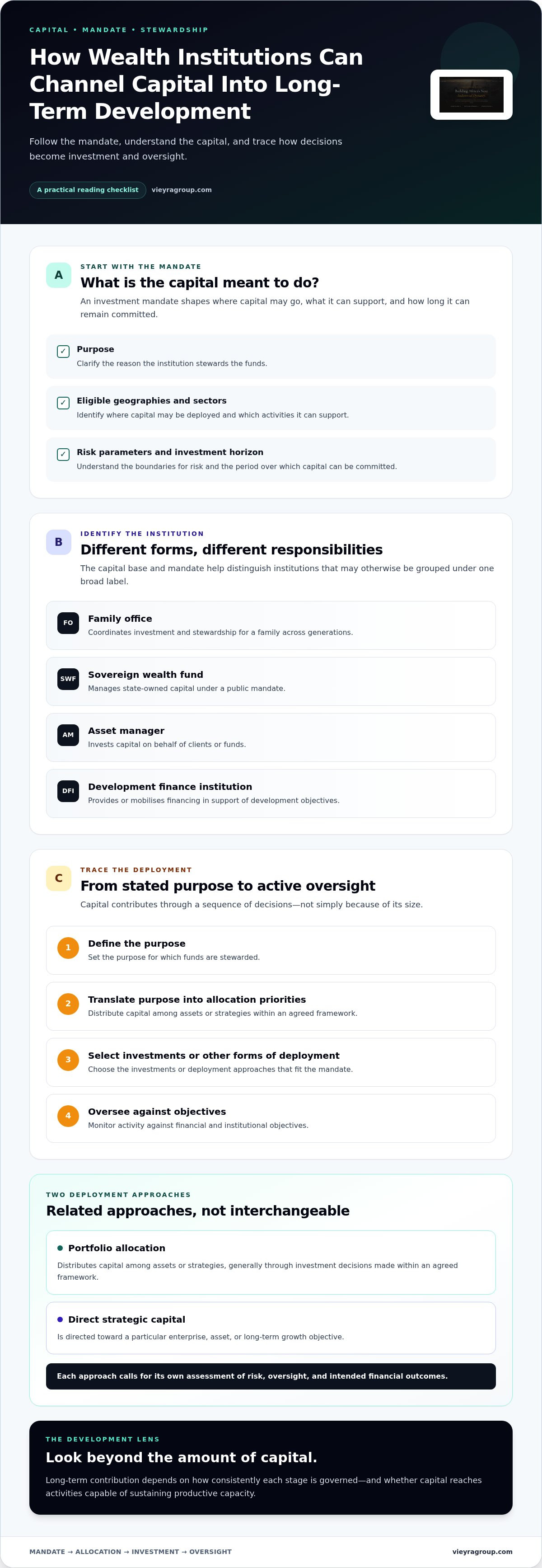
Capital contributes to development through a sequence of decisions, not by virtue of its size alone. An institution first defines the purpose for which it stewards funds, then translates that mandate into allocation priorities, selects investments or other forms of deployment, and oversees them against financial and institutional objectives. The long-term outcome depends on how consistently each stage is governed and whether the capital reaches activities capable of sustaining productive capacity.
An investment mandate determines where capital may be deployed, which opportunities it can support, and how long it can remain committed. This principle helps explain why an African wealth institution may support development in one way while another, with a different capital base or responsibility, pursues a separate course.
How do investment mandates shape capital deployment?
A mandate can establish eligible geographies, sectors, risk parameters, and investment horizons. A portfolio allocation distributes capital among assets or strategies, generally through investment decisions made within an agreed framework. Direct strategic capital, by contrast, is directed toward a particular enterprise, asset, or long-term growth objective. These approaches can complement one another, but they are not interchangeable: each calls for its own assessment of risk, oversight, and intended financial outcomes.
For example, an institution with an African industrialisation focus might consider whether an investment can contribute to productive capacity while meeting its financial and governance criteria. Industrialisation is a possible focus, not a guaranteed consequence of investment. Outcomes depend on the underlying opportunity, execution, market conditions, and sustained oversight. Nor should this example be mistaken for a universal sector priority; institutions make choices according to their own mandates.
A practical way to follow the capital pathway is to ask:
- What purpose authorises the allocation, and which geographies or activities does it cover?
- Is capital invested through a diversified portfolio or committed to a specific strategic opportunity?
- How will progress, risk, and outcomes be monitored over the investment horizon?
Clear answers connect an institution’s stated purpose to actual deployment. They also help distinguish long-term stewardship from an unsupported assumption that capital alone will deliver economic transformation.
Where does philanthropy sit alongside investment?
Philanthropic initiatives and commercial investments may share a broad strategic direction, yet their purposes and accountability differ. An investment is generally assessed against its financial objectives and associated risks. A philanthropic grant or initiative is directed toward its stated charitable or social purpose, with accountability focused on the use of resources and the work supported. Shared priorities can create alignment; they do not make the activities equivalent or require them to use the same measures of success.
Vieyra Family Office connects global investment management with strategic capital for African industrialisation and long-term growth, while aligned philanthropic initiatives are pursued through the Vieyra Foundation. That distinction illustrates how investment and philanthropy can sit within a wider stewardship approach while retaining separate roles. Readers seeking a practical example can explore Vieyra’s approach to global investment management and African industrialisation capital.
African Wealth Institutions Compared: Mandates, Capital, and Time Horizons
Institutional labels offer a useful starting point, but they do not reveal how capital is governed or what an organisation is expected to achieve. Comparing mandate, funding source, investment horizon, governance, and accountability provides a more practical view of each African wealth institution. The distinctions below describe broad patterns, not universal rules; structures vary across institutions and jurisdictions.
| Institutional form | Mandate | Capital source | Horizon | Governance and accountability |
|---|---|---|---|---|
| Family office | Steward family wealth and coordinate investments | Family capital | May reflect multi-generational objectives | Arrangements vary; accountability is generally connected to the family and its stewardship priorities |
| Sovereign wealth fund | Manage state-owned capital under a public mandate | Public or state-linked resources, as defined by its framework | Set by the fund’s mandate and obligations | Governance and public accountability depend on its governing framework |
| Asset manager | Manage investments within an agreed mandate | Client or fund assets | Defined by the mandate and investment strategy | Accountability is shaped by client obligations and oversight arrangements |
| Development finance institution | Support development objectives through financing activity | Varies by institution and structure | Influenced by development goals and financing terms | Governance and accountability reflect its institutional purpose and framework |
How do family offices differ from sovereign wealth funds?
A family office is organised around the stewardship of family capital, which may include preserving wealth and coordinating investment across generations. Vieyra Family Office is described as a multi-generational African family office, not as a sovereign wealth fund. A sovereign wealth fund, by contrast, manages state-owned capital according to a public mandate. Its authority, investment objectives, and accountability are shaped by its governing framework, so no single model should be assumed to apply across the continent.
How do investment managers and development finance institutions differ?
An asset manager’s defining role is to manage investments within a specified mandate; the assets may belong to clients or funds, rather than the manager itself. A development finance institution is oriented toward development objectives through its financing role, while its sources of capital, instruments, and oversight depend on its particular structure. The distinction is not simply commercial versus developmental: mandates can combine objectives, but the institution’s purpose and accountability should remain clear.
Category alone cannot establish risk tolerance, investment performance, or development impact. Those judgements require evidence about actual decisions, oversight, and outcomes. To examine how an investment mandate informs portfolio choices and stewardship, consider these global investment management principles. They provide a useful lens for comparing institutional intent with the discipline through which capital is managed.
How to Assess an African Wealth Institution’s Stewardship and Resilience
Institutional scale alone does not establish sound stewardship. A useful assessment considers whether an organisation’s stated purpose is reflected in its decision-making, risk oversight, investment horizon, and reporting. These questions help distinguish documented practice from aspiration without presuming that any institution has failed or that every market presents the same conditions. For an African wealth institution, resilience is best considered in relation to its own mandate, capital base, and operating context.
Use five dimensions as a disciplined starting point:
- Mandate clarity: Can the institution explain whom it serves, what its capital is intended to achieve, and which activities fall within its remit?
- Governance: Are decision rights and oversight responsibilities sufficiently clear to show how material choices are made and reviewed?
- Risk oversight: Does the institution identify and monitor risks in a manner suited to its assets, strategy, and investment environment?
- Investment horizon: Do the institution’s commitments and assessment periods align with the time required to pursue its stated objectives?
- Accountability: Can relevant stakeholders understand how decisions and results are reported against the mandate?
Evidence matters. A published investment policy, governance description, reporting framework, or explanation of review processes can help readers assess how an institution puts its stated commitments into practice. These materials are not, on their own, proof of performance or impact; they provide a basis for asking whether objectives, decisions, and reporting are coherent.
What governance signals support long-term stewardship?
Look for defined decision authority, meaningful oversight arrangements, and a clear process for maintaining institutional purpose as leadership or circumstances change. For a family office, succession planning can help preserve continuity across generations while allowing decisions to remain accountable to the mandate. The relevant arrangements vary by institution; family office governance for wealth preservation provides a focused context for considering this relationship.
Governance and resilience merit scrutiny because long-term investment depends on institutional capacity to make, review, and adapt decisions over time. That scrutiny is not an allegation of weakness. It is a way to understand whether oversight and continuity are considered alongside investment ambition. Different institutional forms will express these principles through different structures.
How should readers interpret risk and impact claims?
Risk management is a process for identifying, assessing, and responding to uncertainty; it cannot establish guaranteed returns. Likewise, a stated development objective is not evidence that a particular outcome has been achieved. Compare claims with available reporting, the measures used, and the period over which results are assessed. The sovereign investment risk management framework offers further context for evaluating risk oversight and stewardship.
Avoid treating African markets as a single risk category. Conditions, institutions, and investment contexts differ. To explore an approach connecting global investment management with strategic capital for African industrialisation, review Vieyra’s investment and capital focus.
Vieyra Family Office: A Multi-Generational African Institution With a Global Mandate
Vieyra Family Office is a multi-generational African family office operating at sovereign scale. Its institutional model brings together global investment management and strategic capital focused on African industrialisation and long-term growth projects. This combination offers a distinct perspective on the role an African wealth institution can play: stewarding investments globally while directing strategic attention toward the continent’s productive capacity. The focus describes institutional purpose, not evidence of particular project outcomes or investment performance.
How does Vieyra connect global investment and African industrialisation?
Global investment management and African-focused strategic capital represent complementary dimensions of Vieyra’s stated focus. Global investments form part of its wider capital stewardship, while strategic capital is allocated toward African industrialisation and long-term growth projects. The connection lies in the institution’s orientation and allocation priorities. It should not be read as a claim about specific holdings, sectors, projects, returns, or the results achieved by any investment.
This distinction matters. A stated strategic focus can communicate where an institution seeks to direct capital, while evidence of impact requires a separate assessment of decisions, implementation, and outcomes. Vieyra’s model therefore illustrates how global investment activity and African industrialisation can sit within one institutional perspective without implying that all capital is deployed in the same way or for the same purpose.
What does multi-generational stewardship mean in practice?
A multi-generational identity places emphasis on continuity: capital decisions are considered in relation to a longer institutional horizon, rather than only a near-term objective. In practice, that orientation can be assessed through the same questions applied to other institutions: is the mandate clear, are governance responsibilities understood, and does the investment horizon align with the stated purpose? These are useful measures of stewardship, not assumptions about particular processes or results.
Investment activity should also remain distinct from aligned philanthropy. Through the Vieyra Foundation, the institution pursues philanthropic initiatives connected to its broader strategic orientation. The Foundation’s philanthropic purpose is not interchangeable with investment management: each has its own rationale and should be understood according to the outcomes it is intended to support. Alignment can express a shared direction while preserving distinct forms of accountability.
Viewed through mandate, governance, and horizon, Vieyra provides one example of a family-office model linking global investment management with African-focused strategic capital and aligned philanthropic initiatives. Its multi-generational character gives context to that approach, while careful assessment still depends on the evidence available for each activity. The distinction between purpose and demonstrated outcome remains central to responsible analysis.
Shape the Next Chapter of Patient Capital
Durable prosperity depends not only on capital availability, but on institutional decisions that connect purpose with disciplined stewardship over time. For anyone evaluating an African wealth institution, the next step is to look beyond category labels and consider how investment priorities, governance, and accountability can remain coherent as markets and generations change. This perspective frames long-term development as a practice requiring continuity, not aspiration alone.
Vieyra Family Office brings this question into focus as a multi-generational African family office operating at sovereign scale, with global investment management and a stated focus on African industrialisation. The Vieyra Foundation pursues aligned philanthropic initiatives while retaining a distinct role from investment activity. Together, these elements offer a perspective on how capital and purpose may sit within a broader stewardship framework without conflating their mandates.
To explore this institutional perspective and its approach to global investment and African-focused capital, Explore Vieyra Family Office. Patient, well-governed capital can help shape a more enduring economic future.
Frequently Asked Questions
What is an African wealth institution?
An African wealth institution is an organisation that stewards or deploys capital connected to African ownership, purpose, or investment priorities. The term is broader than a legal category, so its meaning depends on the institution’s actual responsibilities. For example, a family office may steward family assets, while an asset manager invests for clients. To understand a specific institution, examine who owns or provides its capital and whom its decisions are intended to serve.
Are African wealth institutions the same as sovereign wealth funds?
No. A sovereign wealth fund is one form of public investment institution, not a synonym for the wider African wealth landscape. A family office, for example, is organised around family wealth stewardship, while an asset manager acts under an investment mandate. Scale alone does not change an institution’s category: determine whether capital is public, privately owned, or managed for clients before describing its role.
How can African wealth institutions support industrialisation?
They may contribute by directing investment or strategic capital toward suitable businesses and long-term growth projects, where those activities fit their mandates. For instance, a reader assessing an industrial investment can look for a clear rationale, financing structure, oversight approach, and stated time horizon. These factors help distinguish an investment intention from a demonstrated result. Capital may support industrialisation, but the outcome depends on the opportunity and its execution.
What is the difference between a family office and an asset manager?
A family office serves the stewardship needs of a family, while an asset manager invests under a defined mandate for clients or funds. In practice, a family office may make investment decisions itself or appoint external managers to carry them out. The useful distinction is who the institution serves and who holds decision authority. A firm’s activities may overlap, so assess its specific role rather than relying on its label.
Why does governance matter for an African wealth institution?
Governance helps clarify who can approve an investment, how decisions are reviewed, and how responsibilities continue through leadership changes. A reader might look for documented decision-making arrangements and reporting that connects activity to the institution’s stated purpose. These are practical indicators of how stewardship is organised. Governance can support consistency and accountability, but it cannot by itself establish investment returns or prove that development objectives have been achieved.
How do philanthropic initiatives relate to institutional investment?
Philanthropy and investment can advance related priorities while remaining distinct activities. An investment is assessed under its financial or strategic purpose; a philanthropic initiative is directed toward charitable or social objectives. Vieyra Family Office pursues aligned philanthropic initiatives through the Vieyra Foundation. The shared strategic orientation does not make the Foundation’s work an investment or imply that both activities use the same evaluation criteria.
What should I look for when assessing an African wealth institution?
Start by comparing the institution’s stated purpose with its published decisions, reporting, and time horizon. Consider whether it explains who provides the capital, who benefits from it, and how progress is assessed. For example, a stated development objective is more informative when accompanied by a clear description of intended outcomes and reporting methods. Check recent institutional information and reputable sources before relying on market figures or claims.


