

A diligence file is valuable not because it is extensive, but because verified evidence informs a capital-allocation decision. Effective anti-corruption due diligence for investors looks beyond a target company’s formal disclosures to examine the counterparties, transaction relationships, and operating environments that shape exposure. Fragmented records across jurisdictions can make it difficult to distinguish a substantiated concern from an unresolved information gap.
Investors need to know which relationships warrant scrutiny, how to weigh conflicting evidence, and when uncertainty calls for escalation. A disciplined process helps answer these questions before capital is committed, connecting findings to governance rather than leaving them as observations in a file.
This article sets out a risk-based framework for identifying relevant counterparties, corroborating available evidence, documenting limitations, and deciding when further review is warranted. It explains how findings can inform investment decisions, from proceeding with defined safeguards to pausing or declining an opportunity. In cross-border and strategic infrastructure contexts, this discipline is part of long-term institutional stewardship, linking due diligence to the responsibilities of capital allocation.
Key Takeaways
- Use anti-corruption due diligence for investors to assess exposure across counterparties, transaction relationships, and operating environments before capital is committed.
- Structure the review around the investment context: define its scope, map relevant parties, gather evidence, identify gaps, and record the reasoning behind decisions.
- Distinguish verified facts, allegations, unresolved gaps, and disproven claims so that indicators prompt proportionate inquiry rather than premature conclusions.
- Connect findings to a clear response, from further inquiry and safeguards to monitoring, escalation, or a decision to pause or decline.
- Embed integrity review in long-term institutional stewardship, aligning evidence and governance with the durability of strategic investment decisions.
Why Anti-Corruption Due Diligence Matters Before an Investment
Capital decisions depend not only on an asset’s prospects, but also on the relationships and conditions through which it operates. Anti-corruption due diligence for investors is a structured assessment of relevant bribery and corruption exposure before an investment and, where appropriate, during ownership. It helps decision-makers identify matters that could affect transaction integrity, governance, or the basis for committing capital, while distinguishing evidence from suspicion.
Investor due diligence is intended to identify and assess relevant corruption exposure so that findings can inform capital allocation; it is not, by itself, a legal opinion, an audit, or assurance that misconduct has not occurred. This distinction is important. A risk assessment organises available information and identifies questions for decision-makers. It does not establish legal conclusions, independently verify every record, or certify that a counterparty or investment complies with all applicable requirements. Broader anti-corruption efforts include legal frameworks and organisational approaches, but an investor’s review remains specific to the proposed investment and the evidence available.
What does anti-corruption due diligence assess?
The review examines potential exposure without presuming wrongdoing. Counterparty integrity questions may include who ultimately owns or controls an entity, whether its stated business purpose is consistent with available information, and how it uses intermediaries. These questions are distinct from the broader country and sector context, which can indicate where closer inquiry may be warranted without determining the conduct of a particular company or individual.
Scope should reflect the investment, available evidence, and applicable law. For example, a proposed relationship involving a third-party representative may call for inquiry into the representative’s role, the rationale for compensation, and their connection to the transaction. These are prompts for examination, not proof of improper conduct. The aim is to establish what is known, what remains unresolved, and whether the uncertainty is material to the decision.
Why does the investment context matter?
Ownership structures, control rights, government interfaces, and third-party relationships can change the questions an investor needs to ask. A project may involve several operating entities, local partners, suppliers, or advisers. The relevant question is not simply whether a name appears in a search, but how each party participates, receives value, and influences decisions. The transaction structure and operating context determine which relationships merit attention.
African industrialisation is not a uniform risk category. Investments across infrastructure, energy, mining, agriculture, technology, and logistics take place in varied commercial and institutional settings, each with distinct counterparties and transaction pathways. Diligence should therefore be calibrated to the specific opportunity, not inferred from a regional label. This contextual approach complements sovereign investment risk management in Africa, where disciplined governance connects exposure assessment with enduring investment stewardship.
How Investors Structure an Evidence-Led Due Diligence Process
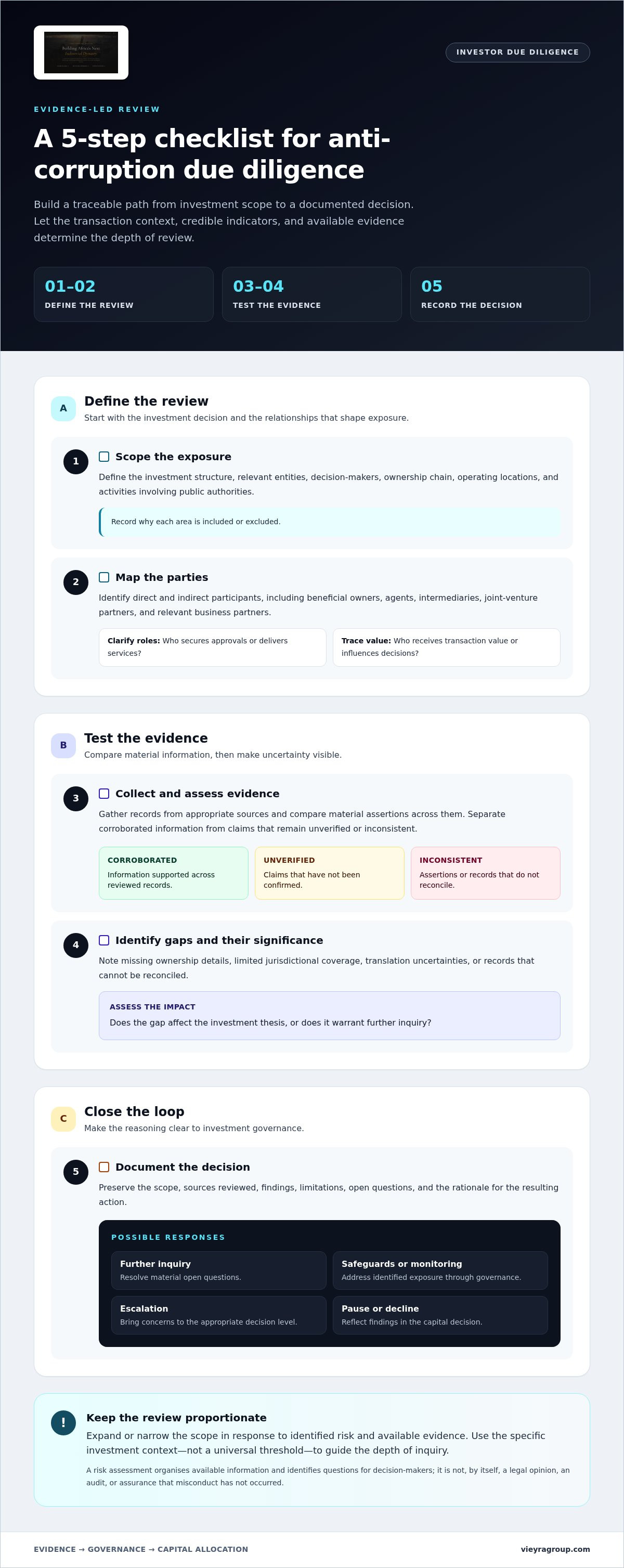
A reliable review starts with the investment decision it must inform. Anti-corruption due diligence for investors should be proportionate to the transaction’s structure, credible indicators, and potential materiality, rather than rely on arbitrary thresholds applied to every opportunity. The sequence below creates a traceable path from initial scope to a documented decision.
- Scope the exposure. Define the investment structure, relevant entities, decision-makers, ownership chain, operating locations, and activities involving public authorities. Record why each area is included or excluded.
- Map the parties. Identify direct and indirect participants, including beneficial owners, agents, intermediaries, joint-venture partners, and relevant business partners. Clarify their roles in securing approvals, delivering services, or receiving transaction value.
- Collect and assess evidence. Gather records from appropriate sources, then compare material assertions across them. Separate corroborated information from claims that remain unverified or inconsistent.
- Identify gaps and their significance. Note missing ownership details, limited jurisdictional coverage, translation uncertainties, or records that cannot be reconciled. Assess whether each gap affects the investment thesis or warrants further inquiry.
- Document the decision. Preserve the scope, sources reviewed, findings, limitations, open questions, and rationale for the resulting action. This record lets investment governance see how the evidence informed the decision.
Diligence scope should expand or narrow in response to identified risk and available evidence, so that the depth of inquiry remains proportionate to the investment rather than fixed by a universal threshold. A strategic infrastructure investment involving layered ownership and several intermediaries may require a different evidence plan from a direct investment with transparent control and a narrower operating footprint. Neither structure establishes misconduct; each shapes what must be understood.
How should an investor define diligence scope?
Map where the investment will operate and where government-facing activity may arise, such as permits, public procurement, or state-linked counterparties, when relevant to the transaction. Cross-border infrastructure and industrial projects can span different legal, commercial, and recordkeeping environments. Do not treat every jurisdiction as though it presents identical conditions. Document the scope, sources, exclusions, and unresolved questions for accountable review.
Which evidence sources can inform the review?
Corporate filings, ownership disclosures, litigation information, sanctions sources, reputable reporting, transaction materials, and interviews may each provide useful leads. Assess each source’s date, reliability, jurisdictional coverage, translation quality, and relevance to applicable law. Interviews and supplied documents can guide further inquiry, but corroborate material assertions independently where feasible. The SEC’s Foreign Corrupt Practices Act (FCPA) overview is one reference for understanding the law’s scope; applicability to a particular investment requires jurisdiction-specific analysis.
For institutions considering investments connected to African industrialisation, evidence discipline belongs within a broader framework of governance and capital stewardship. Vieyra Family Office’s perspective on global investment management reflects this long-term institutional orientation.
How to Evaluate Corruption Indicators Without Overreaching
Indicators are prompts for disciplined inquiry, not findings of misconduct. In anti-corruption due diligence for investors, sound judgment depends on distinguishing what a source establishes from what it merely alleges. A complicated ownership chain, an unusual payment request, or an inconsistent account may justify further examination, but each requires context and corroboration before supporting a conclusion.
Weigh each item according to its source quality, recency, specificity, and consistency with independent evidence. A primary corporate record may establish a filed ownership detail, while a report repeating an unverified allegation may establish only that the allegation was published. Country- or sector-level indicators can inform the diligence plan, but they do not prove that a particular entity engaged in improper conduct.
| Evidence category | How to interpret it | Appropriate treatment |
|---|---|---|
| Verified fact | Supported by reliable, relevant evidence, with identity and context sufficiently established. | Record the source and date; assess its materiality to the investment. |
| Allegation | A claim made by a source, not necessarily independently established. | Seek corroboration and assess available context before relying on it. |
| Unexplained gap | Information is missing, inconsistent, or not reconciled after inquiry. | Document what is unknown, why it matters, and what further evidence may address it. |
| Disproven claim | Reliable evidence materially contradicts or resolves a specific assertion. | Record the basis for resolution, while retaining any separate unresolved issues. |
Which indicators warrant closer examination?
Ownership or control arrangements that remain unexplained after reasonable inquiry warrant follow-up. So may inconsistent disclosures, unclear commercial rationale, or an intermediary whose role does not align with the transaction. For example, a payment request routed through an unexpected party is a prompt to understand the purpose, recipient, and supporting documentation, not proof of bribery. Allegations also require corroboration and a fair assessment of context.
How should investors interpret unresolved evidence?
Keep substantiated facts distinct from allegations, missing information, and analyst inference. For each material item, record confidence, source limitations, competing explanations, and outstanding questions. Consider whether the evidence is current and relates to the correct person or entity; similar names or outdated records can distort interpretation. If ownership information is incomplete, state precisely which link in the chain remains uncertain rather than treating opacity itself as proof.
In cross-border investments, source coverage and terminology can vary by jurisdiction, and translated records can affect interpretation. Assess the limits of available material before drawing conclusions. Refer legal interpretation and jurisdiction-specific conclusions to qualified counsel; the diligence record should inform investment governance, not present itself as a legal opinion.
How to Translate Findings Into Proportionate Investment Decisions
Diligence findings are useful when they lead to a reasoned action, rather than remaining in a file as an unranked list of concerns. The response should reflect the evidence’s credibility, potential materiality, and relevance to the investment thesis. A missing document with a clear path to resolution may call for further inquiry; a credible concern involving ownership, transaction value, or decision-making may warrant senior review before capital is committed.
A proportionate decision framework can connect findings to a defined course of action:
- Further inquiry: Seek targeted information where a material question remains answerable and the available evidence does not yet support a decision.
- Transaction safeguards: Consider appropriate contractual or governance measures where the concern can be addressed in part, while recognising that safeguards do not eliminate exposure or ensure compliance.
- Monitoring: Set proportionate review and reporting arrangements for risks that require continued attention after the investment proceeds.
- Escalation: Refer credible, material, or unresolved matters to the designated senior decision-maker or relevant specialist.
- Pause or decline: Defer commitment or reject the opportunity where material concerns remain unresolved or cannot be addressed consistently with the investor’s governance standards.
These are not automatic stages or a universal scoring formula. Their purpose is to make the connection between evidence and action explicit. A manageable information gap may justify a request for specific records, while material inconsistencies affecting beneficial ownership or payment flows may call for escalation before approval. The distinction rests on the facts and investment context, not on the mere presence of a red flag.
When should findings trigger escalation?
Escalate when evidence is credible and material, an important question remains unresolved, or the implications exceed the deal team’s authority. Use established governance channels and assign a decision owner. Where evidence requires specialist interpretation, seek appropriate legal or investigative input. Record the issue, evidence considered, competing explanations, questions raised, judgments made, and approvals granted, so later reviewers can understand the rationale.
How can diligence continue after an investment decision?
Post-investment monitoring should reflect identified exposure and operating conditions, rather than function as a generic exercise. Define who receives relevant updates, who assesses material changes, and how concerns reach the appropriate governance body. Revisit assumptions when ownership, counterparties, operations, or available evidence change in a way that could affect the original assessment. A documented monitoring framework supports oversight; it cannot guarantee that misconduct will be prevented or detected.
For sovereign entities, global institutional investors, and Tier 1 development banks, disciplined decision governance is integral to durable capital stewardship. Institutional inquiries are Access by Invitation. Explore institutional engagement with Vieyra Family Office.
Anti-Corruption Due Diligence Within Long-Term Institutional Stewardship
Integrity review has its greatest institutional value when it informs not only an individual transaction, but also the quality of judgment exercised across the investment lifecycle. Evidence gathered before commitment can shape capital allocation; later changes in ownership, counterparties, or operations may make earlier assumptions worth reconsidering. A disciplined record of what was known, how it was assessed, and why a decision was made allows governance bodies to understand the reasoning behind an investment over time.
This is the broader purpose of anti-corruption due diligence for investors: to give decision-makers a considered basis for allocating capital and exercising stewardship. It contributes to governance, but it is not a complete compliance system, a legal opinion, or assurance that misconduct cannot occur. Its value rests on the quality of the evidence and the care with which institutional judgment responds to it.
What does institutional stewardship add to diligence?
Stewardship brings continuity to the review. It asks whether evidence remains relevant as an investment develops and whether material changes warrant renewed consideration through appropriate governance. This discipline is especially consequential in cross-border or strategic investments, where relationships and operating conditions may evolve. These considerations align with global investment management principles, where careful allocation and enduring accountability inform institutional decision-making.
Vieyra Family Office is a multi-generational African family office focused on global investment management and African industrialisation. Its investment activity spans strategic sectors, including infrastructure, energy, mining and resources, agriculture, technology, telecommunications, real estate, AI and quantitative finance, and logistics. In these varied contexts, diligence is most useful when it reflects the specific investment and informs a considered allocation of capital, rather than functioning as a detached procedural exercise.
How does governance support accountable decisions?
Governance provides a structure for considering, questioning, and weighing findings alongside strategic objectives and other investment considerations. Vieyra Family Office’s governance includes a formal Family Constitution and a multi-generational council. These features provide institutional context for deliberation; diligence findings remain inputs to judgment, not automatic instructions to proceed, pause, or decline. Clear records help preserve the reasoning behind that judgment.
For an investment committee or other authorised decision-makers, accountability means more than recording a conclusion. The record should show the evidence considered, the limits of available information, the significance assigned to unresolved matters, and the rationale for the chosen course. This preserves a coherent basis for review if circumstances change, without suggesting that diligence can eliminate exposure or guarantee compliance.
Vieyra Family Office’s institutional partnerships are exclusively with sovereign entities, global institutional investors, and Tier 1 development banks. Institutional inquiries: Access by Invitation. Institutional inquiries are Access by Invitation.
Make Diligence Part of the Investment Mandate
Carry integrity review into the investment mandate itself: define how evidence will inform allocation, who holds decision authority, and how material changes will return for consideration. This gives anti-corruption due diligence for investors a role beyond pre-transaction review, connecting disciplined inquiry with institutional judgment over time.
Vieyra Family Office brings this perspective to global investment management and its strategic focus on African industrialisation. Its formal Family Constitution and multi-generational council provide a governance foundation, while its nine investment verticals reflect a breadth of investment interests. These features support an institutional approach in which decisions are considered within a wider framework of stewardship and continuity.
For sovereign entities, global institutional investors, and Tier 1 development banks, the enduring task is to ensure that evidence informs decisions with clarity and accountability. Institutional inquiries: Access by Invitation. Engage with Vieyra Family Office through its invitation-only institutional process to discuss long-term investment stewardship.


