

What if the most meaningful measure of impact investing in African job creation is not how many roles an investment announces, but whether local industries can sustain productive work over time? Employment counts can signal activity, yet they say little on their own about job quality, durability, or the wider economic contribution behind those roles.
That distinction matters. Investment may support employment through direct hiring, supply chains, skills development, and expanded productive capacity. But these channels do not automatically show that jobs are attributable to a particular investment. A sound assessment considers local conditions and the evidence needed to establish whether employment lasts and creates broader value.
This article sets out a context-sensitive framework for examining employment outcomes. It separates investment activity from attributable results, considers the quality and persistence of work, and explains why industrial capacity belongs at the centre of the analysis. Industrial parks, energy and telecommunications infrastructure, and refining and recycling capacity can all form part of that picture. The aim is to assess how long-term capital may support employment potential without making claims that job counts alone cannot substantiate.
Key Takeaways
- Distinguish investment intent and financial return from employment outcomes. Neither alone demonstrates that jobs were created or sustained.
- Trace how capital may enable productive activity through infrastructure and industrial capacity, while treating employment as potential rather than a guaranteed result.
- Assess impact investing in African job creation across job count, quality, durability, additionality, and local economic contribution.
- Account for attribution limits by examining how investors, public policy, market conditions, and other actors may shape employment outcomes.
- Consider whether industrial parks, energy and telecommunications infrastructure, and refining and recycling capacity address constraints on productive activity in the project’s context.
What Does Impact Investing in African Job Creation Mean?
How can an investor tell whether capital is contributing to meaningful employment rather than simply coinciding with it? For impact investing in African job creation, start with a clear objective: employment is identified as an intended social outcome, while financial return remains a separate investment consideration. Neither the stated purpose nor the capital deployed proves, by itself, that jobs were created or improved.
Impact investing is defined as investments made with the intention to generate measurable social or environmental impact alongside a financial return. Applied to employment, this means stating what change an investment is meant to support, identifying who may benefit, and deciding what evidence could demonstrate progress. Assess the financial case, impact objective, and employment results distinctly, even when they are closely connected.
Impact investing in African job creation is the intentional allocation of capital toward an investment with an explicit employment-related impact objective, assessed alongside financial return and distinguished from investment that produces jobs only as an incidental effect. A project may expand productive activity and hire workers without having been designed around an employment objective. Conversely, an explicit objective does not prove that anticipated employment outcomes occurred.
How is impact investing different from investment that happens to create jobs?
The difference lies in intent, allocation, and accountability. An impact-oriented investor articulates an employment objective before or as capital is committed, then explains how the investment is expected to advance it. That objective should shape the questions asked about the project, rather than being inferred afterward from a hiring total.
Assess observed results independently. Hiring records, workforce composition, and employment continuity can help establish what changed. Analysis of other influences helps determine whether the investment contributed to that change. Intent provides a basis for assessment, not proof of impact. Credible claims require evidence suited to the claim and careful treatment of uncertainty.
What makes a job-creation outcome meaningful?
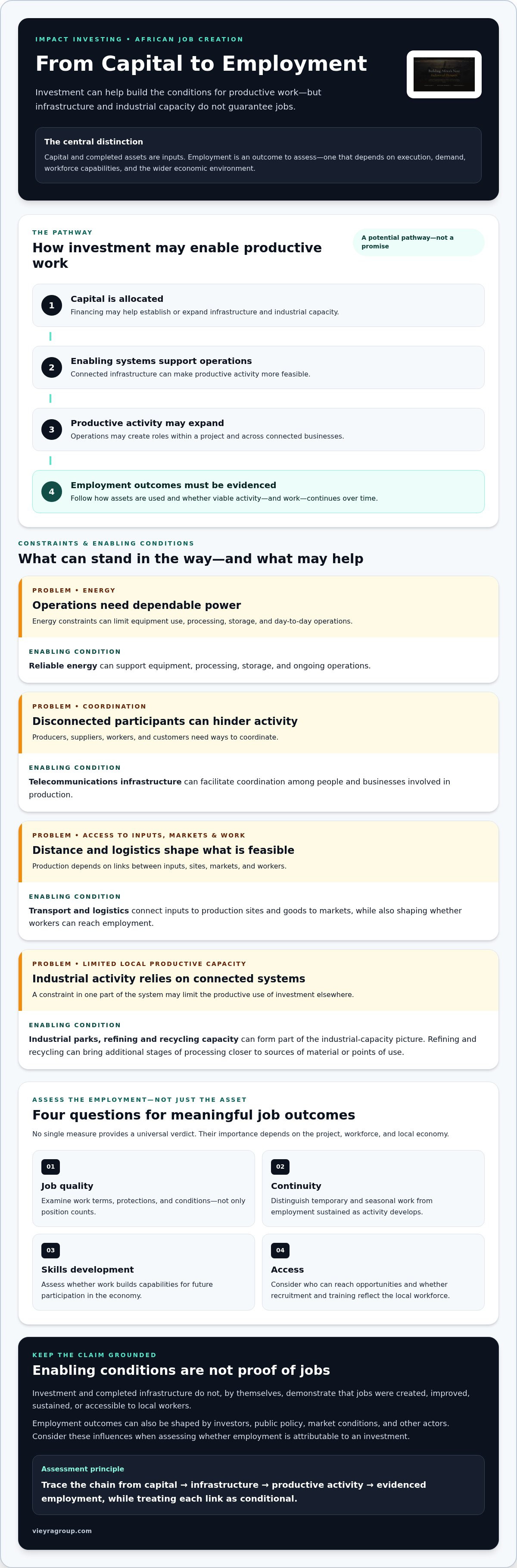
A meaningful assessment looks beyond the number of positions and considers several dimensions together. Their relative importance depends on the project, workforce, and local economy. No single measure provides a universal verdict.
- Job quality: Examine the terms, protections, and conditions associated with work, rather than treating every position as equivalent.
- Continuity: Distinguish temporary and seasonal employment from work sustained as productive activity develops.
- Skills development: Assess whether work builds capabilities that can support workers’ future participation in the economy.
- Access: Identify who can reach the opportunities and whether recruitment and training pathways reflect the relevant local workforce.
Local context gives these dimensions their meaning. The significance of a role may depend on available alternatives, required capabilities, and links to surrounding enterprises and supply chains. State whose employment outcomes are being assessed and why they matter in that setting. Job totals remain useful evidence, but without this context they cannot establish quality, durability, or additionality: whether employment would have occurred without the investment.
How Can Investment Build the Conditions for African Job Creation?
Capital may support employment through a sequence of enabling conditions, not through a direct or automatic conversion of investment into jobs. Financing may help establish or expand infrastructure; infrastructure can make productive operations more feasible; and those operations may generate roles within a project or across connected businesses. Each link depends on execution, demand, workforce capabilities, and the wider economic environment. This is a pathway to assess, not a guarantee of employment.
Enabling infrastructure can make employment more feasible by supporting productive activity, but it cannot guarantee that jobs will be created, sustained, or accessible to local workers. This distinction is central to evaluating investment: capital inputs and completed assets are not employment outcomes. Follow how an asset is used and whether it supports viable activity over time.
Why do infrastructure and industrial capacity matter for employment?
Industrial activity relies on connected systems. Reliable energy can support equipment, processing, storage, and day-to-day operations. Telecommunications infrastructure can facilitate coordination among producers, suppliers, workers, and customers. Transport and logistics connect inputs to production sites and goods to markets, while also shaping whether workers can reach employment. A constraint in one part of this system may limit the productive use of investment elsewhere.
Refining and recycling capacity can bring additional stages of processing closer to sources of material or points of use. This represents localized industrial capacity, not evidence of a particular employment result. The roles, skills, and continuity associated with such activity depend on the operating model, demand, technology, and wider supply chain.
How do sector linkages shape employment pathways?
Consider how connected sectors may function. Agricultural production can rely on energy for processing and storage, telecommunications for coordination, and logistics to reach buyers. Mining and resources may connect with energy, transport, refining, and recycling. Logistics, in turn, supports the movement of inputs and outputs across these activities. These relationships show where employment could arise, but they do not establish how many jobs will result.
For disciplined analysis, distinguish employment categories rather than combining them into a single headline total:
- Direct roles arise within the project’s own operations, such as production, maintenance, or administration.
- Supply-chain roles may occur among suppliers and service providers whose activity is linked to project demand.
- Wider or induced effects may follow when workers and businesses spend income within the local economy. These effects require careful evidence and should not be inferred through unsupported multipliers.
The strength of each pathway depends on project design and local conditions, including whether suppliers can participate, relevant skills are available, and markets can absorb output. Test the assumptions connecting infrastructure to operating activity and employment, and report direct results separately from broader effects. For a longer-term institutional perspective on African industrial development, explore Vieyra Family Office’s industrial development focus.
How Should Investors Compare Job Creation Claims and Impact?
A reported job total can describe the scale of employment associated with a project, but it cannot show by itself whether those roles are well compensated, sustained, accessible to local workers, or attributable to the investment. In impact investing in African job creation, compare the count with evidence about the nature and duration of work and the project’s contribution relative to what might otherwise have occurred.
Impact intent does not prove employment impact, and financial performance does not establish social results. Financial discipline and impact assessment address complementary questions: one concerns the investment’s financial characteristics, while the other examines whether intended employment outcomes occurred and how the investment contributed. Each requires evidence suited to the claim being made.
What should a credible employment-impact framework examine?
Separate roles within the project from employment connected to it elsewhere. Direct employment refers to roles in the project’s own operations. Indirect employment refers to jobs supported among suppliers and service providers. Induced employment describes wider roles associated with spending from income generated by the project. Report these categories distinctly, make assumptions explicit, and avoid combining them into an apparently precise headline figure.
The comparison below helps identify what a count leaves unanswered:
| Dimension | What to assess |
|---|---|
| Job count | Define which roles are included, the reporting period, and whether figures represent people, positions, or full-time equivalents. |
| Job quality | Examine working conditions, compensation, protections, and the evidence available about workers’ experience. |
| Durability | Distinguish temporary or construction-phase roles from continuing employment tied to operations. |
| Additionality | Assess whether the investment contributed to employment beyond what would likely have occurred without it. |
| Local economic contribution | Consider local access to roles, skills development, and connections with domestic suppliers and productive activity. |
Read these dimensions together. A project may support substantial hiring during construction but fewer ongoing roles; another may employ fewer people while developing skills or supplier relationships. Neither profile is inherently superior in every context. The relevant judgment depends on the stated objective and the evidence gathered.
How can investors avoid overstating attribution?
Begin with a baseline: describe employment and relevant operating conditions before the investment, or use a clearly stated comparison point. Then explain the counterfactual, meaning the plausible employment path without the investment. If direct comparison is not possible, state the limits of the analysis rather than presenting contribution as certain.
Employment may also reflect public policy, other investors, market demand, management decisions, and wider economic conditions. Reporting should disclose assumptions, data gaps, the period covered, and the boundary between direct results and estimated wider effects. A capital provider may have contributed to an outcome without being its sole cause. This precision strengthens impact claims and allows financial performance and employment evidence to be considered on their own terms.
What Due Diligence Helps Assess African Job-Creation Impact?
Employment diligence should begin before capital is deployed, with a testable account of how the project may support work in its operating context. For impact investing in African job creation, ask whether the investment addresses a real constraint on productive capacity and whether that change can plausibly lead to employment. A project rationale should identify the constraint, such as limited processing capacity or unreliable connectivity, without treating its removal as proof of jobs created.
A disciplined process can be organized into five connected steps:
- Define the employment objective. Specify the intended outcome, the workers or communities in scope, and the period over which results will be assessed.
- Test the local context. Examine whether the project addresses a material productive-capacity constraint, considering local skills, infrastructure, market access, and supply-chain dependencies.
- Map the employment pathway. Explain how investment is expected to support operations and how those operations may influence direct roles, supplier employment, or wider effects. Make assumptions explicit.
- Set the evidence plan. Establish consistent definitions, data sources, collection responsibilities, and reporting intervals before presenting results.
- Review and report findings. Compare observed evidence with the objective, describe limitations, and distinguish achieved results from estimates or expectations.
Which questions clarify the employment thesis before capital deployment?
Ask what productive activity the investment enables, what currently constrains it, and why resolving that constraint may support employment. Test whether workers with relevant skills can access the roles, suppliers can participate, and reliable infrastructure and market demand are present. Set clear boundaries too: project management may influence recruitment and training, while broader policy, market shifts, or external infrastructure conditions may remain beyond its control.
How should employment evidence be monitored and reported?
Assign data collection to those closest to reliable records. Project operators can document hiring, role type, and employment periods; workforce or supplier records can inform broader effects where accessible. The investor should establish reporting definitions and review the evidence against the stated objective. Assess workers’ conditions, skills development, continuity, and access where suitable evidence exists. Disaggregate results only when data is reliable, appropriate, and responsibly collected.
For each figure, reports should state the source, period covered, definitions, and known limitations. A forecast is not an achieved result, and an estimate of wider employment should not be presented as a verified count. Standards and reporting requirements can vary by jurisdiction, investment structure, and reporting purpose. Explain how the selected approach fits the project and name or apply frameworks only with due attention to their current requirements.
For sovereign entities, global institutional investors, and Tier 1 development banks considering long-term industrial development, explore institutional engagement with Vieyra Family Office. Institutional inquiries are Access by Invitation.
How Does Vieyra Family Office Connect Investment with African Industrialization?
Vieyra Family Office is a multi-generational African family institution focused on industrial development. Its approach places industrial capacity within a broader investment perspective: infrastructure and productive capabilities shape the conditions in which enterprises operate and connect with markets, and may support employment. This is a strategic framework, not a claim that investment activity has produced a measured number or quality of jobs.
For those assessing impact investing in African job creation, that distinction matters. Industrial capacity provides a way to examine the link between investment strategy and employment potential, while job outcomes still require evidence assessed in their specific operating context.
What is the African Industrialization Platform designed to encompass?
The African Industrialization Platform encompasses industrial parks, energy and telecommunications infrastructure, and refining and recycling capacity. Together, these elements represent complementary forms of productive capacity: industrial parks can provide a setting for activity, energy and telecommunications infrastructure can support operations and connectivity, and refining and recycling can enable additional processing capacity.
The platform’s stated purpose includes building localized capacity and reducing external dependency. These priorities describe the industrial-development rationale; they are not evidence of quantified employment results, a specified timeline, or guaranteed economic effects. Employment potential depends on how the capacity is developed and used, as well as the local conditions surrounding productive activity.
Vieyra’s nine investment verticals are Infrastructure, Mining & Resources, Energy, Technology, Telecommunications, Real Estate, AI & Quantitative Finance, Agriculture, and Logistics. These areas indicate the breadth of its investment scope. They do not, individually or collectively, establish that jobs have been created or imply particular employment outcomes in any vertical.
How does institutional engagement reflect a long-term mandate?
A multi-generational perspective emphasizes the durability and interdependence of industrial systems, rather than treating a single asset or activity as the full measure of development. Institutional partnerships are exclusively with sovereign entities, global institutional investors, and Tier 1 development banks. This partner framework reflects the institutional character of the work and its orientation toward long-term industrial development.
The Vieyra Foundation has separately defined philanthropic focus areas. Those priorities belong to its philanthropic work and should not be conflated with investment activity or represented as investment employment outcomes. Maintaining that distinction supports clear reporting on what is financed as investment and what is pursued through philanthropy.
For institutional partners considering how long-term capital may relate to African industrial capacity, Vieyra Family Office’s investment perspective can inform a careful assessment of employment potential, without substituting strategic intent for evidence of results. Institutional inquiries are Access by Invitation, for sovereign entities, global institutional investors, and Tier 1 development banks.
Carry Employment Evidence Into Long-Term Capital Decisions
Make employment evidence part of capital allocation from the outset, so future decisions can draw on clearly stated objectives, credible operating data, and an honest account of what the investment can influence. This discipline helps distinguish a contribution to productive capacity from a headline claim, while allowing assessment to develop as local conditions and evidence evolve.
Research can also strengthen that judgment. The Vieyra Global Institute produces research reports, whitepapers, and commodity analyses on African macro-economics, industrial policy, strategic resource management, AI-driven data infrastructure, energy transition, and mineral refining economics. This research contributes to a deeper understanding of the economic and industrial context in which capital is considered. The enduring question is not simply whether employment is anticipated, but whether conditions for productive work can be built and assessed carefully over time.
For sovereign entities, global institutional investors, and Tier 1 development banks considering long-term African industrial development, explore Vieyra Family Office’s institutional mandate. Institutional inquiries are Access by Invitation. Thoughtful capital, guided by evidence and a long horizon, can help advance a more durable foundation for employment.


