

A diversified portfolio can still lose purchasing power when its assets respond differently from the liabilities it must meet. For institutions, asset allocation for inflationary environments is not simply a matter of adding assets commonly associated with inflation protection. It requires understanding how portfolio resources and obligations may behave as prices, costs, and financing conditions change.
Inflation can affect income, operating costs, investment values, and long-term commitments in different ways. Broad diversification alone may not reveal where exposures are concentrated or whether portfolio resources remain aligned with future obligations. Institutions need a disciplined basis for reviewing these relationships without relying on a single forecast or assuming any asset class will provide a reliable hedge.
This article sets out a framework for assessing inflation through purchasing power, liabilities, and long-term objectives. It explains how to compare allocation scenarios across distinct inflation regimes, identify implications for portfolio resilience, and connect investment governance with multi-generational stewardship. The aim is not to prescribe a universal allocation, but to clarify the questions that support considered decisions over time.
Key Takeaways
- Begin allocation analysis with purchasing power, liabilities, liquidity needs, and investment horizon, not headline inflation alone.
- Assess how equities, fixed income, cash, and real assets may respond to different inflation drivers. Distinguish an asset’s inflation sensitivity from its wider portfolio role.
- Use persistent, easing, and renewed inflation pressure as scenarios for testing asset allocation for inflationary environments, not as predictions.
- Review the mandate and liabilities first, then map exposures, compare scenarios, establish oversight, and document decisions.
- Connect portfolio review to long-term stewardship, recognizing how institutional governance can help anchor decisions across generations.
Asset Allocation for Inflationary Environments: Start With Purchasing Power
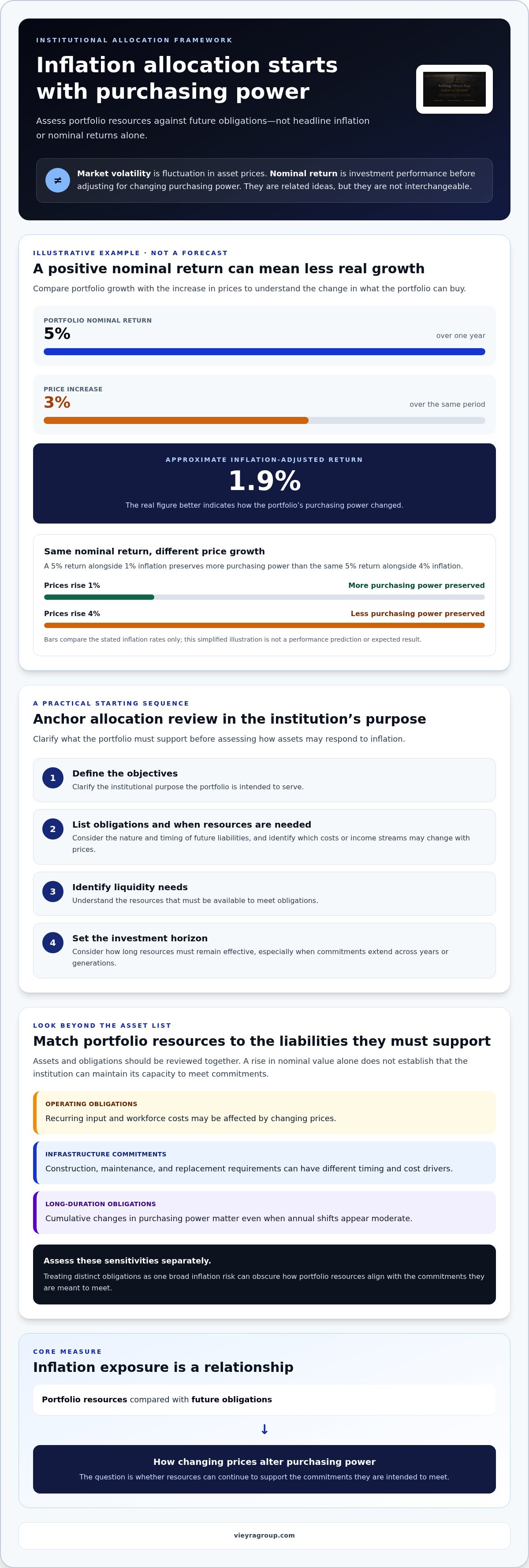
Inflation changes what a unit of currency can buy over time. Market volatility describes fluctuations in asset prices, while nominal return records an investment result before adjusting for changes in purchasing power. These concepts can overlap, but they are not interchangeable. A portfolio may show positive nominal performance even as its capacity to meet future obligations weakens in real terms.
Institutional inflation exposure is the extent to which changing prices alter the purchasing power of portfolio resources relative to the institution’s future obligations. This definition puts the focus not only on the assets held, but also on whether those assets can support the commitments they are intended to meet.
For this reason, asset allocation for inflationary environments begins with institutional purpose. Decision-makers should clarify the objectives the portfolio serves, the nature and timing of liabilities, the liquidity needed to meet them, and the investment horizon over which resources must remain effective. These questions provide a practical starting point: list the obligations, note when resources will be needed, and identify which costs or income streams may change with prices. Understanding Asset Allocation provides an introduction to how portfolio resources may be distributed. Institutional analysis must also account for the obligations and governance that shape that distribution.
How inflation changes the meaning of nominal returns
Illustrative example, not a forecast: assume a portfolio earns a nominal return of 5% over one year while prices rise by 3% over the same period. The inflation-adjusted return is approximately 1.9%, calculated by comparing the growth in the portfolio with the increase in prices. The nominal figure describes the change in account value; the real figure better indicates the change in what that value can purchase.
The same nominal outcome can have different implications under different inflation conditions. A 5% return alongside 1% inflation preserves more purchasing power than the same return alongside 4% inflation. This simplified illustration does not predict investment performance or represent an expected result. It shows why institutional reporting and allocation review should distinguish nominal growth from real capacity, particularly when commitments extend across years or generations.
Why liabilities belong in the allocation conversation
Assets are the resources available to an institution; liabilities are the future spending obligations those resources must help meet. Reviewing one without the other can obscure whether a portfolio is aligned with its purpose. The key question is not simply whether an asset rises in nominal value, but whether the institution can maintain its capacity to meet obligations as prices, revenues, and financing conditions change.
Operating obligations may be affected by recurring input and workforce costs. Infrastructure commitments can involve construction, maintenance, and replacement requirements, each with different timing and cost drivers. Long-duration obligations are exposed to cumulative changes in purchasing power, even when annual shifts appear moderate. Assess these sensitivities separately rather than treating them as a single inflation risk.
This liabilities-first perspective also helps distinguish a temporary change in market prices from a structural mismatch between resources and commitments. Broader global investment management principles place allocation within a wider institutional framework of mandate, governance, and enduring objectives.
How Inflation Reaches Equities, Fixed Income, Cash, and Real Assets
Inflation does not pass through every asset class by the same route or at the same speed. Its effects depend on what drives price increases, how monetary policy responds, the valuation already reflected in an asset, and the period over which an institution must hold or use it. An allocation review should examine these transmission channels instead of assigning each category a permanent label as either protected or exposed.
No asset class offers uniform protection across inflation regimes; its contribution depends on the source, pace, and persistence of inflation, as well as the portfolio’s obligations and time horizon. An asset’s sensitivity to changing prices is also distinct from its broader portfolio role. It may contribute liquidity, income, growth potential, or diversification without serving as a dependable inflation offset. Fidelity’s perspective on inflation-resilient portfolios offers additional practical context. Institutional analysis must also account for mandate-specific exposures.
What inflation can mean for equities and fixed income
For equities, the relationship between selling prices and input costs matters. A company able to adjust prices may experience a different margin effect from one facing rising costs without comparable pricing flexibility. Valuation, financing conditions, sector exposure, and the period over which earnings are assessed also influence sensitivity. Evaluate equity exposure through the underlying businesses rather than treating it as a single response to inflation.
Nominal bonds may face price pressure when inflation expectations or policy-rate expectations rise. Sensitivity is shaped in part by duration, income, and issuer characteristics. A bond’s contractual cash flows can also relate to inflation differently from its market value. The balance of these forces varies across securities and regimes.
How cash, commodities, and real assets differ
Cash can support near-term payments and operational liquidity, but its purchasing power may decline if the income it earns does not keep pace with rising prices. Assess its usefulness against the timing and currency of expected obligations, rather than dismissing it solely because of inflation exposure. Liquidity has institutional value when resources must be available on a defined schedule.
Commodity prices may respond to supply conditions, demand, and geopolitical or policy developments, which can differ from broader consumer-price movements. Real assets, including real estate, also vary in their operating, financing, valuation, and income characteristics. Neither category is an automatic hedge. Consider how the particular asset’s cash flows and risks relate to the institution’s inflation exposure.
| Asset class | Exposure channel | Potential sensitivity and principal uncertainty |
|---|---|---|
| Equities | Company revenues, input costs, and earnings | Pricing power may matter; margins, valuation, financing, and sector conditions can alter the effect. |
| Fixed income | Contractual income, market yields, and issuer credit | Duration and rate expectations influence price sensitivity; inflation and policy paths remain uncertain. |
| Cash | Nominal balances and liquidity | Supports near-term needs, while purchasing power depends partly on the relationship between prices and earned income. |
| Commodities | Supply, demand, and market pricing | May respond to particular price pressures, but movements can diverge from institutional liabilities. |
| Real assets | Operating income, financing, and underlying asset values | Exposure varies by asset and structure; costs, valuation, and cash-flow adjustment may not move together. |
These distinctions help institutions compare portfolio exposures with their obligations. Vieyra Family Office connects long-horizon capital with African industrialisation through strategic capital deployment and sovereign infrastructure financing. Institutional inquiries are Access by Invitation.
Comparing Inflation Scenarios Without Turning Allocation Into a Forecast
Scenario analysis allows institutions to examine allocation choices without pretending to know the next path of prices. Persistent inflation, easing inflation, and renewed inflation pressure are not predictions or probabilities. They are distinct conditions for testing how purchasing power, liquidity requirements, liabilities, and portfolio concentrations might interact.
For asset allocation for inflationary environments, the value of this exercise lies in disciplined comparison. Assess each scenario against the same institutional objectives and assumptions, so differences in outcomes reflect the conditions being tested rather than a shifting analytical standard. Indicators can inform the review, but none should be treated as a reliable standalone timing signal.
What to examine across different inflation regimes
First, distinguish broad-based price pressure from increases concentrated in particular inputs or sectors. Then consider how potential policy responses and financing conditions could affect both portfolio assets and obligations. For example, higher borrowing costs may influence financing-sensitive exposures while also changing the cost or timing of planned commitments. The effect depends on the institution’s actual exposures and liability structure.
Price trends, financing conditions, and changes in input costs are evidence to monitor, not instructions to trade. Scenario analysis is more useful when it asks what the institution would need to understand or govern if conditions persisted, eased, or intensified.
| Analytical scenario | Observed evidence to monitor | Portfolio and liability questions | Decisions requiring governance |
|---|---|---|---|
| Persistent inflation | Price increases remain broad or continue across relevant inputs. | How might purchasing power, operating needs, and long-duration obligations be affected? Are exposures concentrated in assets or income streams sensitive to sustained price pressure? | Whether existing strategic assumptions remain appropriate, and what reporting or review cadence is warranted. |
| Easing inflation | Price pressure moderates, including in areas relevant to institutional costs. | Do liabilities adjust at the same pace as prices? Could portfolio exposures remain vulnerable to other conditions, including changes in financing costs? | Whether any proposed change reflects the long-term mandate or a temporary response to new information. |
| Renewed inflation pressure | Price increases re-emerge or become more concentrated in key inputs. | Which obligations are most sensitive, what liquidity may be required, and where could concentration amplify the effect? | How decision rights, escalation thresholds, and documented review procedures apply. |
Why diversification is not the same as an inflation hedge
Diversification spreads exposure across different sources of risk; it does not eliminate the possibility that portfolio purchasing power will fall short of future needs. Assets that behaved differently under one set of conditions may become more closely linked when inflation drivers or policy responses change. Similar categories may also respond differently because of valuation, financing, or cash-flow characteristics.
Adding a single asset category cannot, by itself, establish resilience. Use scenario results to inform institutional deliberation, not to dictate an allocation. Sovereign investment risk management offers related context for considering uncertainty, oversight, and long-horizon stewardship together.
A Governance-Led Review of Inflation-Sensitive Allocation
A durable allocation review is an exercise in institutional judgment, not a reflexive response to each new inflation reading. It connects the mandate and obligations to portfolio exposures, compares how those relationships may behave under alternative conditions, and establishes who has authority to consider change. A disciplined allocation review is a documented comparison of portfolio exposures and institutional obligations under clearly stated assumptions.
This structure helps distinguish strategic decisions, which concern enduring objectives and risk capacity, from temporary responses to evolving market information. Implementation depends on the institution’s mandate, constraints, and governing processes. The sequence below provides a common basis for deliberation, not a prescribed allocation.
- Mandate: Restate the objectives the portfolio is intended to serve, its relevant time horizon, and the institution’s tolerance for uncertainty. Use these as the standard for assessing any proposed change.
- Liabilities: Inventory future obligations, their timing, liquidity requirements, and sensitivity to changes in prices or financing conditions. Separate recurring operating needs from longer-duration commitments.
- Exposures: Map how portfolio assets, income, and liquidity may respond to different inflation drivers. Consider concentration and indirect sensitivities, not only broad asset-class labels.
- Scenarios: Compare persistent, easing, and renewed inflation pressure using consistent assumptions. Record how each scenario could affect purchasing power, obligations, liquidity, and portfolio concentration.
- Governance: Identify the authority responsible for review, the evidence required for deliberation, and the process for approving strategic changes. Strong family office governance for wealth preservation can help preserve continuity between present decisions and enduring institutional aims.
- Documented decisions: Record the rationale, alternatives considered, uncertainties, and any follow-up review. A clear record helps future decision-makers understand not only what was decided, but why.
Map objectives, obligations, and constraints before changing exposures
Before considering a change, bring the mandate, liquidity needs, investment horizon, relevant liabilities, and applicable constraints into one review. Clarify which governing body or delegated authority may evaluate a proposal and what analysis it requires. This helps prevent a market observation from being mistaken for an institutional instruction. Make assumptions and gaps in the analysis explicit, so uncertainty is considered rather than concealed.
Record scenarios, decision triggers, and review rationale
For each scenario, document the assumptions being tested, the exposures most sensitive to them, and the uncertainties that could change the interpretation. Questions for the review might include: has the liability profile changed, does the scenario reveal a concentration, and does the evidence challenge a strategic assumption? Monitoring indicators inform these questions; they are not binding instructions or promises of portfolio results. Interpret a single inflation release within this framework rather than letting it determine allocation by itself.
This discipline gives asset allocation for inflationary environments an accountable institutional foundation. Decisions remain connected to mandate, evidence, and obligations, while market developments are assessed without displacing long-term purpose. Institutional inquiries are Access by Invitation.
Vieyra Family Office: Inflation Resilience Within Generational Stewardship
Vieyra Family Office is a multi-generational African family office with a strategic focus on African industrialisation. For an institution, inflation resilience is a question of stewardship: how purchasing power, future obligations, and governance inform decisions over long horizons. This perspective does not prescribe a particular allocation. It places investment considerations within the institution’s broader purpose and responsibilities across generations.
Connect allocation discipline with institutional purpose
A changing price environment can alter the resources an institution needs to fulfil future commitments. Considering those obligations alongside portfolio exposures helps frame the questions decision-makers bring to their governance processes. The discipline is not to assume that a particular asset will protect purchasing power, but to assess how assumptions, exposures, and commitments relate to institutional objectives.
African industrialisation is Vieyra Family Office’s strategic focus, not a promised investment outcome or an inflation-hedging claim. Its institutional scope includes strategic capital deployment and sovereign infrastructure financing. These activities sit within a broader approach to long-term capital stewardship, where mandate and governance provide context for evaluating opportunities and obligations without implying a specific allocation policy.
The institution’s nine investment verticals are Infrastructure; Mining & Resources; Energy; Technology; Telecommunications; Real Estate; AI & Quantitative Finance; Agriculture; and Logistics. These names describe the verticals, not particular holdings, portfolio weights, or inflation-protection results. They reflect the fields within the institution’s stated investment scope; allocation judgments remain distinct from the existence of those verticals.
Research, institutional engagement, and next steps
Research can bring relevant economic and sector context into institutional deliberation. The Vieyra Global Institute produces research reports, whitepapers, and commodity analyses on African macro-economics, industrial policy, strategic resource management, AI-driven data infrastructure, energy transition, and mineral refining economics. These publications provide subject-matter context; they are not evidence of specific portfolio holdings, performance, or guaranteed protection from inflation.
For institutions considering inflation resilience, the enduring lesson is procedural: connect changes in purchasing power to obligations, examine assumptions carefully, and distinguish strategic purpose from a tactical response to market information. Vieyra Family Office’s governance includes a Family Constitution and a multi-generational council, providing a foundation for continuity without implying a particular allocation rule.
Institutional inquiries are Access by Invitation. Learn more about Vieyra Family Office.
Make Inflation Review Part of Long-Term Institutional Stewardship
Make inflation analysis a durable part of institutional decision-making, rather than an exercise undertaken only when price pressures become prominent. Set a clear review cadence, define what evidence merits renewed consideration, and preserve the rationale behind decisions. This helps future stewards distinguish enduring principles from responses shaped by a particular moment.
The enduring value of asset allocation for inflationary environments is not a promise that uncertainty can be removed. It is a disciplined way to examine how capital decisions relate to institutional purpose over time. The standard is continuity of judgment, supported by evidence and governance, as conditions and responsibilities evolve.
Explore Vieyra Family Office to learn about its long-horizon capital approach and institutional purpose. Institutional inquiries are Access by Invitation.
With thoughtful governance and a clear sense of purpose, institutions can approach an uncertain inflation outlook with greater deliberation and confidence in the integrity of their decision-making.


