
Development does not always follow the timetable of immediate returns. Patient capital is investment made with a longer horizon, giving businesses time to pursue innovation and sustainable practices whose value may take years to emerge. Understanding the benefits of patient capital for development means weighing the time it allows against the accountability needed to direct capital toward durable outcomes.
Investment should produce measurable financial results; patience does not remove that expectation, but changes how progress and timing are assessed. This article explains what patient capital means, how it can support long-term economic development, and why financial accountability must remain central.
It considers how longer-term capital can support business decisions, sustainable investment, employment, and local incomes, while explaining how oversight keeps investment disciplined and purposeful. The result is a practical view of where patient capital can contribute to development and what makes that contribution credible.
Key Takeaways
- Learn how patient capital differs from investment that prioritizes a quick exit, and why the time horizon matters.
- Identify why businesses in underserved markets may need financing that can accommodate gradual growth and sustained investment.
- Connect development goals with financial accountability so progress can be assessed alongside the use of capital.
- Understand how longer-term investment can support strategic decisions, innovation, and sustainable business practices.
- Examine the pathways through which business growth can contribute to employment and local incomes.
What is Patient Capital?
Patient capital is investment structured to give businesses more time to develop before returns are expected. It can be relevant where underserved markets, infrastructure needs, or climate projects require sustained investment.
For development, the benefits of patient capital depend on matching the investment horizon to the work required and maintaining clear financial discipline.
Resilience and Market Development
Patient capital can support resilience by giving businesses room to manage market fluctuations without abandoning long-term plans. This is particularly relevant in underserved markets, where a company may need to build customer demand, supply chains, and essential services before revenues mature.
For example, a local enterprise serving customers with limited access to finance may need time to establish trust and reliable operations. A longer investment horizon can give it room to adapt to changing conditions instead of prioritizing immediate returns. It may also help create a market where none existed, or challenge an established market with a more accessible product or service. Innovation can strengthen a company’s position when it addresses a persistent need and keeps improving its offering.
Comparing Capital Sources
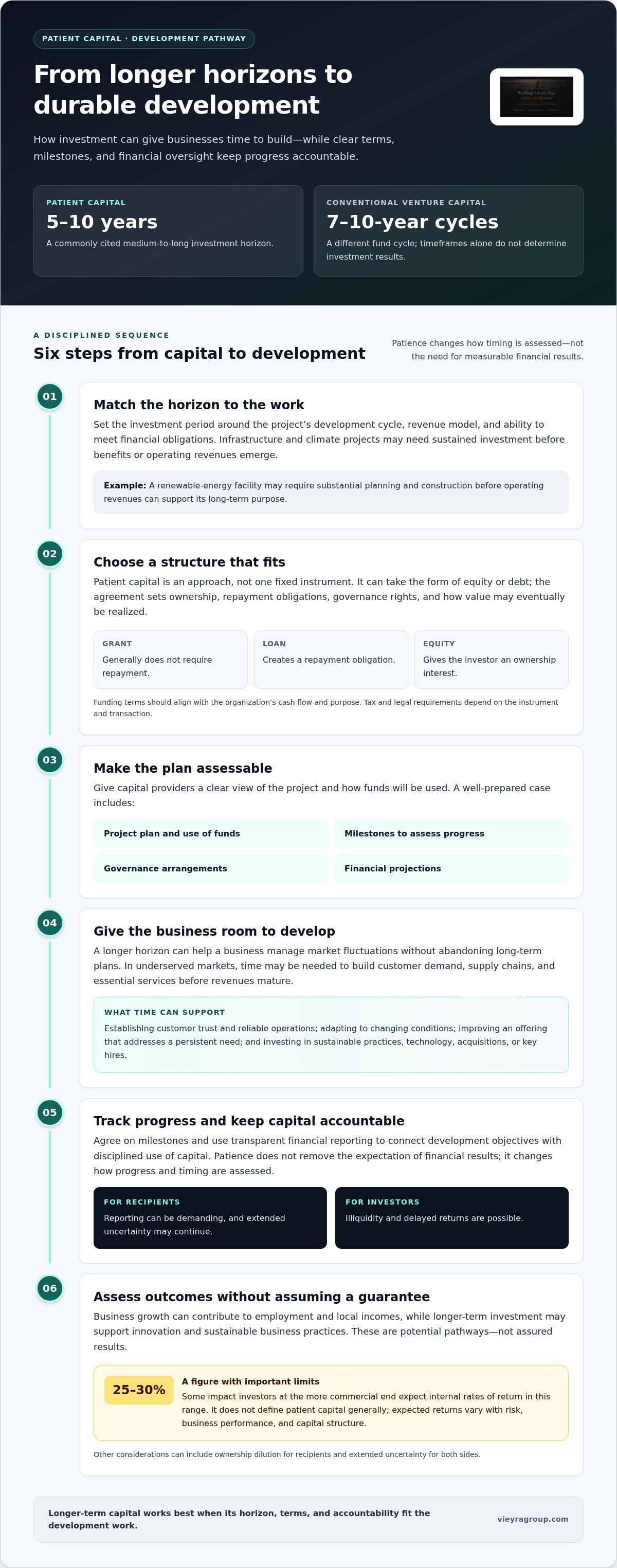
Patient capital differs from grants, loans, and conventional equity in its structure, repayment expectations, and tolerance for time. A grant generally does not require repayment, while a loan creates a repayment obligation. Equity gives an investor an ownership interest, and patient investors accept a longer path to returns.
This distinction matters when choosing financing for a development project: funding terms should align with the organization’s cash flow and purpose. In the United States, tax treatment depends on the investment structure and parties involved. Equity investments may also be subject to securities rules, while loans and grants raise different legal and tax considerations. Requirements therefore depend on the instrument and transaction, not on a single rule for all patient capital.
Organizations seeking capital can prepare a clear project plan, explain how funds will be used, and present milestones, governance arrangements, and financial projections. These materials help capital providers assess the project’s fit and accountability.
Development Projects and Investment Horizons
Patient capital can support infrastructure and climate projects by financing development whose benefits accrue over time. A renewable-energy facility, for example, may require substantial planning and construction before operating revenues can support its long-term purpose.
The investment horizon should reflect the project’s development cycle, revenue model, and capacity to meet financial obligations. Patient capital is commonly invested over a medium-to-long term of 5 to 10 years, while conventional venture-capital funds operate on 7-10-year cycles. Investors’ expected returns depend on risk, business performance, and the capital structure; no single return applies to every patient-capital investment. Some impact investors at the more commercial end expect internal rates of return of 25 to 30 percent, but that figure does not define patient capital generally.
Recipients should also weigh the limitations: patient capital can involve ownership dilution, extended uncertainty, and demanding reporting. Investors may face illiquidity and delayed returns. For both sides, agreed milestones and transparent financial reporting help connect development objectives with disciplined use of capital.
Definition of patient capital
Patient capital is a financial investment made without expecting a quick profit. Its defining feature is an investor’s willingness to let value develop over an extended period, rather than requiring a near-term sale. A family office may hold a company for 20 years without a mandated sale. The term describes an investment approach, not one fixed financial instrument or standard contract.
Patient capital can take different forms, including equity and debt. The agreement determines ownership, repayment obligations, governance rights, and how an investor may eventually realize value. A business considering this funding should assess those terms alongside its operating plans. For example, equity may support expansion without scheduled loan repayments, while a loan requires a credible repayment plan.
Patient capital is also defined by what it gives an organization time to do. Sustainable practices may require upfront spending on technology, business acquisitions, or key hires, and those investments can take time to contribute to performance. A longer horizon can give businesses room to strengthen their brands, attract talent, and adapt to industry shifts without judging every decision by immediate results.
WaterHealth International offers a development-oriented example. Founded in 1996, it sought to raise $11 million in capital over the next two years. In 2009, it approached existing investors for a fourth financing round. Those details illustrate how a company may return to capital providers as its work develops; they do not establish a guaranteed result for other enterprises.
Investment horizons vary by investor and structure. Some limited partners take five to fifteen years to invest, while a family office may retain a company for decades without a mandated sale. The central question is whether the capital terms allow the business to execute its strategy while giving investors a clear account of progress and risk.
For organizations assessing long-term industrial development, strategic capital solutions can be relevant when financing needs must align with a sustained operating plan. Patient capital remains accountable capital: the purpose, governance, financial reporting, and eventual return expectations still need definition.
The Panel proposed requiring defined-contribution pension schemes to offer members the option of allocating a small proportion of their pension to the proposed PCIV. This would make the choice part of a pension arrangement while leaving the allocation optional. It also connects patient capital to a defined investment vehicle rather than treating the term as a single standard contract. The proposal concerns access to an option; it does not, by itself, describe the vehicle’s terms or establish what outcomes an investment would produce.
For a member considering such an allocation, the central issue is whether the investment’s time horizon and risk suit their circumstances. For a business, the question is whether capital supplied through the vehicle can support a sustained plan while maintaining accountability for progress and use of funds. Offering an option is not the same as requiring an allocation: a choice can make long-term investment available without making it suitable for every member. Assessment should consider the investment terms, the investor’s expectations, and the organization’s operating needs. Patience over time does not remove the need for clear expectations about governance, reporting, risk, and eventual returns. The proposal illustrates how a long-term approach may be offered within a pension context while preserving the importance of informed decisions.
Impact alongside financial accountability
Patient capital connects development aims with financial oversight, allowing social progress and use of funds to be assessed together. Relevant evidence includes business and service outcomes, although examples alone cannot prove that patient capital caused each result.
Balancing Impact and Accountability
Balancing impact and accountability means tracking development outcomes alongside an investment’s financial performance. A stated social purpose is meaningful only when the use of capital and the results can be examined.
For each investment, organizations can define the intended outcome, record a baseline, and report changes over time. A school-financing initiative, for example, could track access to finance, repayment performance, and whether schools continue operating. Investors can then assess how well the financial structure supports the intended purpose.
Return expectations may also reflect an investment’s impact objectives. Some social investment funds accept a multiple of 1x or simply the real return of principal. That approach still requires financial discipline: budgets, cash flows, and project progress should remain visible to capital providers.
Jobs and Local Incomes
Patient capital can support employment and local incomes by giving enterprises time to expand their services and operations. Job creation depends on a business’s ability to sustain demand, fund its activities, and retain workers.
A healthcare entrepreneur described building four companies, including a clinic-funded healthcare business that grew to 50 staff and served 4,000 patients monthly without venture capital. The example shows how an operating enterprise can connect service delivery with employment. It does not, by itself, prove that one financing model produced the outcome.
Local effects can also be examined through access. In East Africa, 41% of school owners served by Ed Partners had never accessed financing. That figure points to a financing barrier; evaluating development progress also requires tracking whether access leads to durable operations, jobs, and improved services.
Evidence of Development Outcomes
Evidence of development outcomes combines measurable results with transparent financial records. This helps investors and communities distinguish observed progress from claims about impact.
Ziqitza Healthcare Limited in India reached people below the poverty line, who represented 78% of those served. This is a concrete service-access measure, but it should be read alongside operating performance and continued delivery. For a development project, useful evidence can include service reach, jobs supported, business continuity, and financial results.
To interpret the evidence, compare outcomes with an initial baseline and review them throughout the investment period. Record the funding used, operational changes, and results achieved, then distinguish documented outcomes from conclusions about causation. This gives patient-capital decisions a clearer account of both development value and financial responsibility.
How does patient capital support long-term economic development?
Patient capital prioritizes a business’s long-term success over immediate financial returns. Its medium-to-long investment horizon is 5 to 10 years, allowing organizations to plan around development needs rather than short-term performance alone. The benefits of patient capital for development are clearest when a project’s financing timeline matches its path toward sustainable operations. For decision-makers, that alignment helps connect investment terms with the time required to build capacity and serve customers.
Longer-term financing can support sound decisions and strategic growth. A business may need to strengthen its operations before expanding, or invest in systems before serving more customers. Patient capital can give management room to assess these steps, maintain quality, and adjust plans as conditions change. The goal is not delay for its own sake, but a disciplined sequence of investment and execution. For example, a company might improve its operations before committing to wider expansion.
Sustainable practices show why investment timing matters. Adopting them can require upfront spending on technology, business acquisitions, or key hires, while benefits develop over time. Patient capital can bridge that gap, allowing a company to consider long-term effects alongside immediate financial demands. For instance, investing in more efficient production systems may require changes to processes and staff responsibilities before the business sees the value.
Longer horizons can support innovation and customer satisfaction. A company developing a product or improving service quality can invest in testing, staff capability, and reliable delivery instead of focusing exclusively on immediate gains. Patient capital investors may also contribute expertise and networks alongside funding. Strategic partnerships can help a business respond to challenges and identify opportunities, extending the value of capital beyond the funds themselves.
A Kenyan bank’s expansion into South Sudan illustrates the patience development can require. The bank began operations there in 2006 and expected profits in 10-20 years. It later held more than a 50% market share in South Sudan. Its experience shows how establishing operations, building a customer base, and reaching commercial scale can unfold over an extended period. The benefits of patient capital for development, in such cases, relate to the time available to build enduring economic activity.
When evaluating a development project, consider whether its financing horizon fits its operating cycle, whether investment priorities support durable performance, and whether management can report progress. These factors connect capital allocation with lasting economic activity. They also help determine whether innovation, business growth, or sustainable practices can contribute to financial and broader development outcomes. Financing aligned with these conditions gives decision-makers a clearer basis for assessing progress over time.
How does patient capital create jobs and increase local incomes?
Patient capital can support employment when a business invests in operating capacity before revenues fully mature. Consider a manufacturer planning a new production line: it may need to train workers, establish supplier relationships, and build reliable distribution. Capital that accommodates this sequence can help the enterprise move from planning to sustained operations, rather than making hiring dependent on immediate returns.
Local incomes can grow through more than direct hiring. An expanding enterprise may pay employees, buy inputs from local suppliers, and create demand for services such as transport, maintenance, and logistics. To understand the effect, trace project spending: identify locally based roles, suppliers receiving contracts, and how recurring business activity supports household earnings.
Employment growth is more durable when recruitment follows a credible operating plan. A business can connect each hiring phase to production needs, staff training, and expected customer demand. For example, a food-processing enterprise might first strengthen procurement and quality control, then add production staff as supplies and orders become reliable. Patient financing can give these stages room to develop without making premature expansion the only route to progress.
Access to capital can also affect who participates in local economies. Ed Partners serves school owners in East Africa, and 41% of those served had never accessed financing. That figure illustrates a financing barrier facing a defined group. For development assessment, examine whether funding helps such enterprises maintain services, retain staff, and build the capacity needed for continued operation.
Job totals alone do not show whether incomes or livelihoods have improved. Track recruitment and retention, wage payments, staff training, local procurement, and business continuity alongside financial performance. Project records can show whether planned roles were filled and suppliers received repeat orders. These measures help distinguish temporary expansion hiring from employment supported by an enduring enterprise.
Capital providers and businesses should also examine the risks behind employment projections. Weak demand, interrupted supply, or rising operating needs can strain payroll and threaten continuity. A sound plan links hiring commitments to cash-flow forecasts, operating milestones, and transparent reporting. For development-focused investment that supports African enterprise growth, explore capital for African industrial development.
A healthcare entrepreneur says their four companies were built, and that a clinic-funded healthcare business grew to 50 staff and 4,000 patients monthly without venture capital. This example shows how patient capital can support both staffing and service reach as an enterprise develops. For local-income assessment, such growth can be considered alongside the employment, wage, and supplier measures already described, rather than treating patient volume as a substitute for them.
Vieyra Family Office: Global Investment Management
Vieyra Family Office connects global investment management with a focus on African industrialisation and long-term economic development. For organizations considering patient capital, this perspective is relevant when projects require strategic alignment between investment objectives, operating plans, and durable growth.
Vieyra Family Office’s African Industrialization Capital and Strategic Capital Solutions support long-term growth in businesses and projects. Global Investment Management provides the broader investment context, while the Vieyra Foundation pursues a distinct philanthropic mission. Each serves a different purpose: investment management, industrial development, strategic capital, or philanthropy.
To discuss how these areas relate to your development priorities, contact Vieyra Family Office.
Shape a Capital Mandate for Lasting Development
The next step is to translate a development ambition into a capital mandate: define the intended outcomes, establish how progress will be measured, and align investment duration with the work required. This makes the benefits of patient capital for development more tangible, bringing purpose, financial discipline, and execution together from the outset.
For organizations considering long-term investment in African growth, the central question is how capital strategy can serve economic priorities and durable enterprise development. Vieyra Family Office offers Global Investment Management, African Industrialization Capital, and Strategic Capital Solutions for these distinct but related needs.
Begin a considered discussion about your development priorities and capital strategy by contacting Vieyra Family Office. A clearly defined mandate can help establish a thoughtful foundation for the work ahead.
Frequently Asked Questions
What is patient capital in development finance?
Patient capital is development finance structured to accommodate a longer path from investment to mature operations or returns. To assess whether funding fits, examine the agreement’s investment horizon, governance arrangements, reporting expectations, and approach to returns. For example, a project developing local production capacity may need capital aligned with equipment commissioning and customer adoption, rather than terms that assume immediate revenue growth.
What benefits does patient capital provide to startups and small businesses in developing countries?
Patient capital can give startups and small businesses room to validate products, train staff, and establish dependable distribution before expanding. A small manufacturer, for example, could use staged investment to test production quality, refine processes, and build supplier relationships before increasing output. Linking each stage to clear operating milestones helps founders manage funds deliberately and show investors how the enterprise is progressing.


