
Approximately 70% of family wealth is lost by the second generation, and approximately 90% by the third. Building a national legacy through investment means directing capital toward enduring financial, institutional, and social impact, while shaping the values and opportunities passed to future generations. A legacy is not only what remains; it is also the influence carried forward by people, communities, and institutions.
Wealth can lay a foundation for lasting impact, but its purpose matters as much as its preservation. A considered approach starts with a clear view of the change you want to support and the principles that should guide decisions across generations.
This article explores how to build a national legacy through investment, align long-term capital with defined goals, and sustain progress through governance and continuity. It also considers how investment across sectors and regions can serve a broader purpose.
Key Takeaways
- Understand how national investment vehicles can connect long-term capital with a country’s development priorities.
- Clarify the values and outcomes you want to carry forward before choosing sectors, regions, or investment approaches.
- Consider how investment across sectors and regions can be coordinated around shared objectives and interdependent needs.
- Assess social and economic impact by defining intended outcomes and tracking relevant indicators over time.
- Explore how global investment management, strategic capital, and philanthropic initiatives can support distinct legacy aims.
Sovereign wealth funds and national investment
Sovereign wealth funds invest public assets over long horizons, linking national capital with strategic development priorities. Family wealth can pursue a related legacy when investment decisions reflect defined purposes and future generations.
Large-scale national projects face market, execution, governance, and political risks. Infrastructure and industrial investments can lose principal if demand, costs, or implementation differ from expectations. Careful oversight and clear selection criteria are essential.
The United States’ Executive Order 14196, dated February 3, 2025, directs the Treasury and Commerce Departments to develop a plan for establishing a United States sovereign wealth fund. A proposed National Investment Authority is designed to identify structural bottlenecks, set development priorities, translate them into investment decisions, and implement those decisions over time.
Transparency is central to that proposed model: annual reporting, audits, public-interest oversight, and procedural project-selection rules are intended to support accountability and democratic control. Temasek announced plans to invest another $30 billion in the United States, illustrating how a sovereign investment institution can direct capital across national borders. Canada announced the Canada Strong Fund, billed as the country’s first national sovereign wealth fund, on April 27, 2026.
Generational wealth also depends on how private assets pass between heirs. Approximately 70% of family wealth is lost by the second generation, and approximately 90% by the third. A family discussion about financial literacy, investment responsibilities, and shared priorities can help heirs understand both the assets they receive and the purpose those assets are meant to serve.
Estate planning can include trusts and arrangements that transfer wealth according to family wishes. Life insurance may also be part of that planning, but withdrawals from the described contracts may be subject to taxation within the first fifteen years of the contract. The timing and structure of a transfer matter alongside the intended beneficiary.
Managing Wealth With a Purpose
Purpose-driven wealth management aligns investment, estate decisions, and philanthropy with a defined legacy objective. It matters because a clear purpose helps families compare choices across assets, income, and generations. A written mission statement, for example, can guide discussion about whether capital should support family continuity, charitable giving, or economic development, and how those priorities should influence investment decisions.
Balancing National Investment Ambitions and Risks
Building a national legacy through investment means directing capital toward durable public or economic outcomes while remaining accountable for how funds are used. Large projects can commit public assets for long periods, and their results depend on demand, execution, and oversight. Transparent project selection and regular audits help national investment institutions review progress against strategic aims; for families, estate plans and informed heirs can support continuity.
Identifying the legacy and impact you want to leave
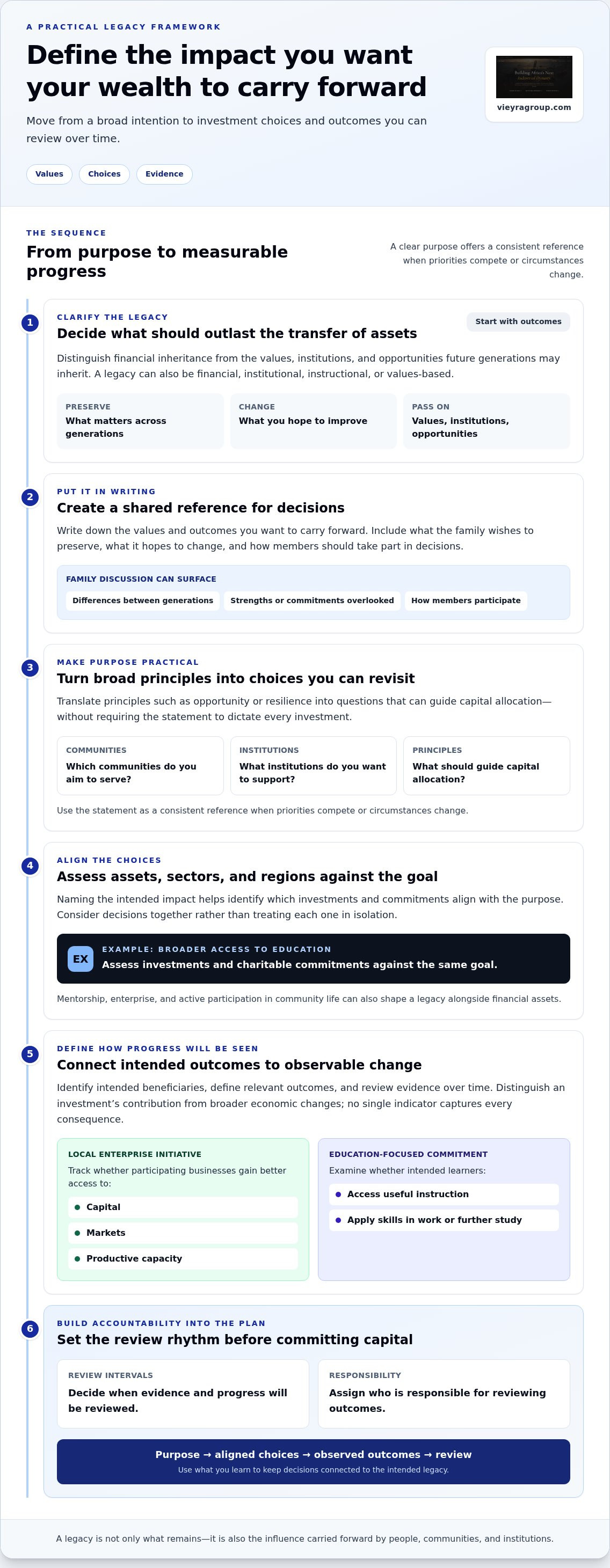
Define the outcomes you want your wealth and decisions to carry forward. Start by distinguishing financial inheritance from the values, institutions, and opportunities future generations may inherit.
Defining the Legacy to Leave
A legacy is the financial, institutional, instructional, or values-based impact that continues beyond an individual’s lifetime. Naming the intended impact helps investors identify which assets, sectors, and regions align with their purpose. For example, a family seeking broader access to education can assess investments and charitable commitments against that goal instead of treating each decision in isolation.
Begin with a written statement of values and desired outcomes. Include what the family wishes to preserve, what it hopes to change, and how members should take part in decisions. A family discussion can reveal differences between generations before those differences affect investment choices. Friends and relatives may also identify strengths or commitments that the investor has overlooked.
Make the statement practical. Translate broad principles such as opportunity or resilience into choices the family can revisit: which communities it aims to serve, what institutions it wants to support, and what principles should guide capital allocation. The statement need not dictate every investment. It should offer a consistent reference when priorities compete or circumstances change.
Personal success can also have an instructional dimension. Mentorship, enterprise, or active participation in community life can shape a legacy alongside the transfer of financial assets.
Measuring Social and Economic Impact
Impact measurement compares intended outcomes with observable changes for people, communities, or institutions. A clear purpose alone cannot show whether an investment is advancing its aims. Investors can identify intended beneficiaries, define relevant outcomes, and review evidence over time, while distinguishing an investment’s contribution from broader economic changes.
For example, an initiative to strengthen local enterprise could track whether participating businesses gain better access to capital, markets, or productive capacity. An education-focused commitment could examine whether intended learners access useful instruction and apply their skills in work or further study. These measures make the purpose assessable without assuming a single indicator captures every consequence.
Set review intervals and assign responsibility before committing capital. An advisor can help select indicators suited to the investment’s purpose, assess evidence, and explain trade-offs clearly. Include the perspectives of intended beneficiaries: their experience can show whether reported activity translates into meaningful change.
Keep the assessment connected to the original statement. If results diverge from the intended outcome, examine the project design, implementation, and assumptions before revising priorities. For a considered perspective on aligning capital with long-range objectives, explore strategic investment planning.
Coordinating investment across sectors and regions
A national investment vision becomes actionable when capital decisions across sectors and regions reinforce shared priorities. Coordination connects each project to its dependencies, intended beneficiaries, and contribution to long-term economic capacity.
Consider a hypothetical industrial corridor linking manufacturing, energy, transport, and workforce development. A factory may need reliable power, freight access, and trained workers before it can expand production. Assessing these dependencies together helps decision-makers identify which investments need to proceed in sequence and which can develop independently.
Start by defining a shared objective, such as strengthening productive capacity in a selected region. Then map the assets and institutions that affect it. A transport project, for example, may benefit manufacturers while improving local agricultural producers’ access to markets.
Coordination does not mean treating every proposal as equally valuable. Compare projects by how they support the shared vision, what resources they require, and how they may affect other investments. A regional power initiative may enable industrial activity, while an isolated facility could have limited value without transmission or demand.
Regional analysis adds another layer. A coastal logistics hub may have different needs from an inland agricultural area. Investment decisions should account for local infrastructure, workforce capabilities, market access, and community interests rather than applying one allocation model everywhere.
Sequencing matters. If a project depends on roads, energy, or skilled labor, align its timing with those enabling investments. For example, a workforce program linked to a planned manufacturing cluster can prepare workers for relevant roles, while employers clarify the skills required.
Coordination also requires clear accountability. Assign responsibility for each decision, establish how participating institutions will share information, and set review points before implementation. A regional development program involving public agencies, investors, and local institutions needs defined roles to prevent gaps and duplicated effort.
Capital allocation should consider financial returns and public benefit. These aims can complement each other, but they are not interchangeable. Set separate criteria for commercial viability and intended social outcomes, then assess each project against both. One does not automatically prove the other.
Cross-sector planning helps reveal trade-offs. A transport route may improve market access while increasing pressure on land use; an energy project may support industry while requiring careful assessment of local effects. Recording these considerations makes decisions more transparent and helps future generations understand why priorities were chosen.
Finally, review the portfolio as a connected set of investments, not a collection of isolated approvals. Track whether enabling projects are progressing, whether regional benefits reach intended communities, and whether assumptions remain sound. This makes it possible to adjust sequencing and allocation while keeping changes tied to the original national vision.
What does building a national legacy through investment mean?
Building a national legacy through investment means directing capital toward lasting economic and social outcomes. It connects investment choices to a vision that can extend beyond an individual or administration. For example, capital supporting productive industry may contribute to employment, institutional capacity, and future opportunities. Its impact depends both on what assets generate and on whom they benefit.
A national legacy can be financial, institutional, instructional, or grounded in values and life lessons. A financial legacy transfers assets; an institutional legacy strengthens organizations that serve communities. An instructional legacy passes on knowledge, while values-based giving demonstrates responsibility through action. These forms can coexist, but each involves distinct decisions about capital and stewardship.
Investment becomes legacy-oriented when its purpose guides the allocation of resources. Impact investing, for example, seeks positive, measurable social and environmental impact alongside financial return. An investor supporting an enterprise with a clear community benefit can assess both financial performance and its intended contribution. Evaluate these objectives separately: financial return alone does not establish social impact.
The national dimension adds a wider frame. A project may affect workers, suppliers, public institutions, and communities beyond its immediate location. With investment in industrial capacity, for example, the lasting contribution may depend on skills, infrastructure, and local participation as well as production. Mapping these relationships helps decision-makers assess whether a project builds lasting capability or delivers only an immediate output.
Legacy also includes the influence a person exercises during their lifetime. A family that funds education, mentors emerging leaders, or supports enterprise can shape opportunities before wealth passes to heirs. Those actions may teach future generations to use capital responsibly. The question is not only which assets remain, but also what knowledge and institutions continue to serve others.
A written mission statement can connect these intentions to investment decisions. It might set out a family’s priorities, such as resilient communities, productive employment, or access to education. The statement then provides a reference for assessing proposals, discussing trade-offs, and explaining choices to family members. Reviewing it as circumstances change keeps the investment approach connected to its purpose.
Building this kind of legacy does not require directing every asset toward one cause. Families and institutions can balance financial objectives, risk, liquidity needs, and social aims across a portfolio. Diversification can help manage concentration, but it does not protect investors from market risk. The appropriate balance depends on the purpose, time horizon, and needs the capital must serve.
Ultimately, a national legacy is reflected in what endures: capable institutions, stronger communities, shared knowledge, and capital serving a defined public or family purpose. A disciplined investment approach makes those intentions actionable by linking each commitment to an outcome and reviewing whether that outcome remains relevant. This is how investment can carry a vision into the future.
How can investors measure the social and economic impact of national investment?
Investors can measure impact by connecting each project to defined outcomes and credible evidence. A national rail investment, for example, can be assessed by its effects on travel access, freight reliability, and local economic activity. Measures should reflect the project’s purpose, not just the activity it funds.
Start with a clear chain of results: resources support activities, activities produce immediate outputs, and outputs may contribute to longer-term outcomes. For a vocational training initiative, course completion is an output; graduates gaining relevant employment is an outcome. Distinguishing these stages helps investors avoid treating spending or participation as proof of lasting impact.
Choose indicators that match the intended benefit. An industrial development project might track local supplier participation, workforce skills, and the durability of productive capacity. A transport project might assess access to markets and essential services. Define a source, a responsible party, and a consistent collection method for each measure.
Establish a baseline before implementation. If a regional investment aims to improve access to employment, document existing transport connections and relevant workforce conditions first. Compare later findings with that starting point, while recording external changes that could also affect results. This context makes reported progress easier to interpret.
Measure distribution as well as aggregate change. A project may expand economic activity while concentrating benefits among a narrow group. Breaking down findings by region, worker group, or participating business type can reveal who benefits and who remains underserved. This distinction matters when national outcomes depend on broad participation.
Assess contribution carefully. A new logistics facility might coincide with increased regional trade, but market demand, policy changes, and other infrastructure can also affect activity. Investors can document these influences, compare project assumptions with observed results, and avoid attributing every change to one investment.
Keep financial performance distinct from social outcomes. Revenue, operating costs, and commercial return describe a project’s financial position; employment quality and improved market access describe other dimensions. Reviewing both clarifies trade-offs without treating financial success as automatic evidence of public benefit.
Use a consistent review process. Assign responsibility for gathering evidence, document indicator definitions, and record changes to project design. For a regional enterprise initiative, periodic reviews can compare supplier participation and workforce outcomes with the original objectives. Clear records help decision-makers explain adjustments and retain lessons for future investments.
Transparent reporting should state the intended outcome, evidence collected, limitations, and decisions that follow. This gives communities and investors a basis for understanding progress rather than relying on broad claims. To align investment priorities with enduring economic objectives, explore a strategic investment approach.
A legacy includes the impact a person makes on others during their lifetime and that others carry into the future. This perspective can inform long-term assessments.
Vieyra Family Office: Global Investment Management
Vieyra Family Office offers Global Investment Management for investors aligning capital with long-term objectives across asset classes. Its Strategic Capital Solutions and African Industrialization Capital speak to distinct priorities: structuring capital around strategic aims and supporting African industrialisation. The Vieyra Foundation provides a philanthropic dimension for those whose legacy objectives include community impact.
These offerings are relevant when institutional priorities span investment stewardship, economic development, and philanthropic purpose. The appropriate focus depends on the outcomes the institution intends to advance and how capital can support them over time.
To discuss your investment objectives, contact Vieyra Family Office or visit vieyragroup.com.
Shape the Next Chapter of Your Investment Legacy
An enduring investment vision is not completed by a single allocation. It is renewed through decisions that align capital with changing priorities, preserve institutional learning, and keep intended outcomes visible to those who will carry them forward. That continuing stewardship is central to building a national legacy through investment: not a fixed monument, but a framework future generations can interpret and strengthen.
Vieyra Family Office offers Global Investment Management, African Industrialization Capital, and Strategic Capital Solutions. These offerings are relevant when your next deliberation concerns investment allocation, African industrial development, or strategic capital for long-term growth projects. Consider which objective deserves attention first, and how the associated investment decisions can remain connected to your wider vision.
Contact Vieyra Family Office to discuss your investment priorities and the legacy you intend to shape. A considered next step can help bring that vision into focus.
Frequently Asked Questions
What does it mean to leave a legacy?
Leaving a legacy means creating an influence that continues through people, institutions, or resources after your direct involvement ends. It can include wealth transferred to heirs, knowledge shared with colleagues, or an institution strengthened to serve its community. For example, an investor might preserve capital while setting clear principles for successors’ decisions. The lasting effect depends not only on what is passed on, but also on how others can use it.
How can investment support long-term national economic growth?
Investment can support national growth by expanding productive capacity and helping businesses operate more effectively. Financing reliable energy infrastructure, for example, can help manufacturers maintain production, while logistics investment can connect producers with customers. These effects depend on project quality, demand, and links to related capabilities. Assess whether a proposal addresses a real constraint and whether its benefits extend beyond the project into local supply chains and economic activity.
What steps can governments and investors take to build a lasting national legacy?
Governments and investors can begin by agreeing on a shared development objective, then assess which investments directly advance it. Establish transparent project-selection criteria, assign oversight responsibilities, and define how progress will be reviewed. For example, a national industrial initiative could coordinate financing with workforce preparation and infrastructure planning. Public reporting and independent audits can support accountability, while periodic reviews allow decision-makers to adjust priorities as economic conditions and public needs evolve.


