
A larger portfolio is not necessarily a more diversified one. Diversification means spreading capital across investments with different exposures, reducing dependence on any single asset, sector, or region. Capital allocation for economic diversification applies this principle to decisions about where an organization directs financial resources, while recognizing that diversification cannot eliminate investment risk.
It is natural to focus on the number of investments, but what matters more is what they are exposed to. Assets that respond similarly to economic events can concentrate risk even when they appear separate. Sound allocation connects investment choices to strategic objectives, risk tolerance, and the time horizon for results.
This article explains how capital allocation works, how economic conditions and financing costs influence decisions, and where common allocation mistakes arise. It also considers geographic, sector, and global diversification, with a practical framework for understanding how these dimensions shape long-term investment choices.
Key Takeaways
- Distinguish the capital decision from the asset or project it funds, then assess how each allocation advances organizational goals.
- Compare opportunities by risk, strategic fit, and time horizon rather than relying solely on past project performance.
- Account for interest rates, inflation, liquidity needs, and funding sources when assessing how economic conditions affect investment choices.
- Assess geographic and sector exposure beneath the surface: holdings that respond similarly to economic events may still concentrate risk.
- Consider global exposure as part of a broader portfolio strategy, weighing the opportunities of different markets alongside their distinct risks.
Capital allocation definition and goals
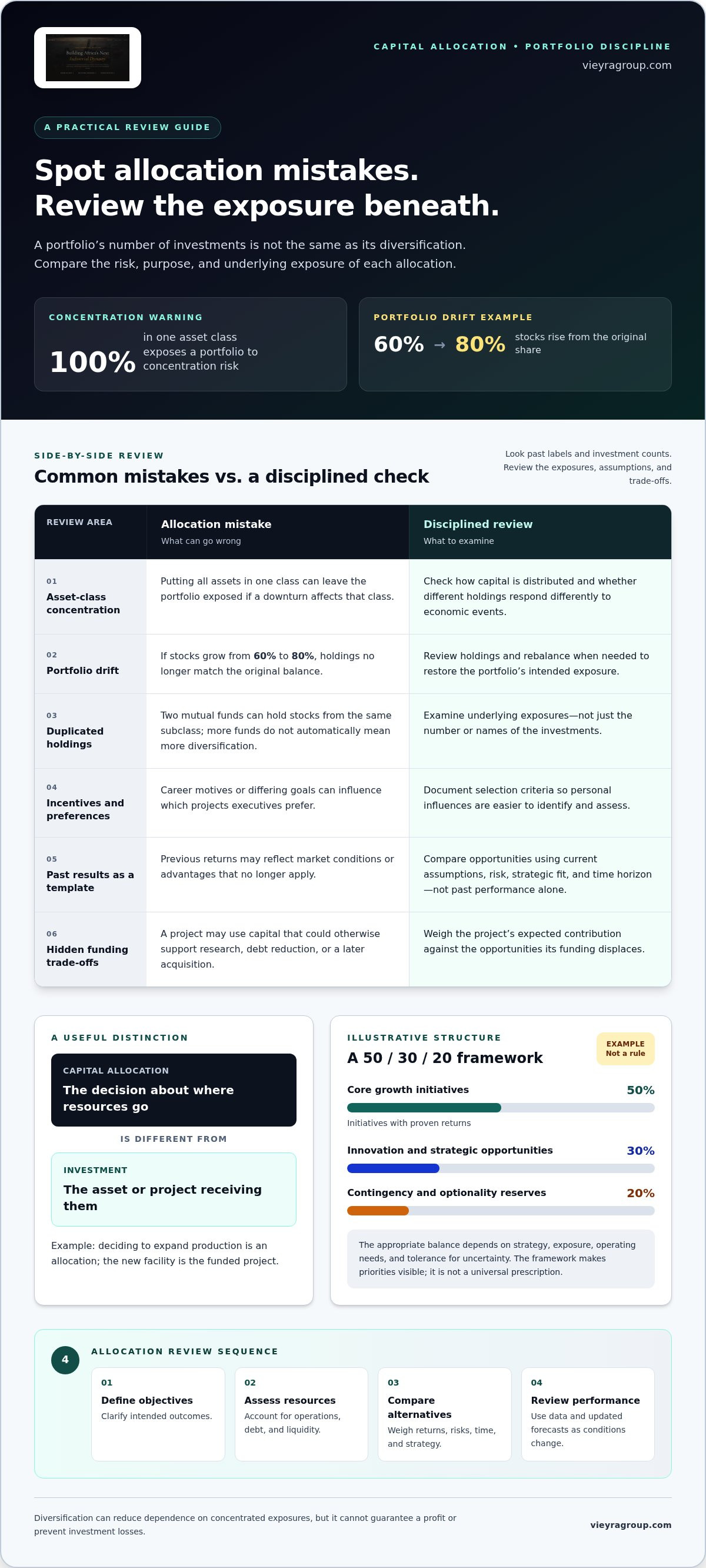
Capital allocation is how an organization directs financial resources toward its objectives. A company might fund research and development, pay dividends, reduce debt, or acquire another business. Each choice serves a different purpose and affects future capacity. Capital allocation is the decision about where resources go; an investment is the asset or project receiving them. For example, deciding to expand production is an allocation, while the new facility is the funded project.
For a government or organization, developing a capital allocation strategy means setting priorities, comparing possible uses of funds, assessing risk-adjusted returns, and reviewing results against strategic goals. This approach connects immediate obligations with longer-term development instead of assessing every proposal in isolation.
- Define objectives. Specify the intended outcomes, such as stronger operations, innovation, or broader economic activity.
- Assess available resources and obligations. Account for operating requirements, debt, and liquidity before committing capital.
- Compare alternatives. Evaluate expected returns, risks, time horizons, and alignment with the organization’s strategy.
- Review performance. Use data and updated forecasts to determine whether allocations remain appropriate as conditions change.
A portfolio of projects can balance immediate operating needs with medium-term efficiency improvements and long-term innovation. A manufacturer, for example, could fund essential maintenance, improve production processes, and invest in product research. These activities compete for capital but serve different time horizons. Evaluating them together clarifies the trade-offs, including which other opportunities may lose funding once a commitment is made.
A 50/30/20 framework offers one illustrative structure: 50% for core growth initiatives with proven returns, 30% for innovation and strategic opportunities, and 20% for contingency and optionality reserves. It is a framework, not a universal prescription. An organization’s strategy, exposure, operating needs, and tolerance for uncertainty determine whether that balance is suitable. The value lies in making priorities visible and clarifying how much capacity remains for emerging opportunities.
Asset allocation describes how investments are distributed among asset classes; diversification considers how their risks and responses to economic events differ. Holding stocks alongside other asset classes may increase the chance that some investments perform satisfactorily when others are flat or losing value. Diversification cannot guarantee a profit or prevent losses. For an organization pursuing capital allocation for economic diversification, the key discipline is to connect each funding decision to its intended role, risk profile, and contribution to durable strategic goals.
Common capital allocation mistakes
Fear of losses can push executives toward familiar, seemingly safer allocations, even when stronger growth opportunities merit consideration. The opposite mistake is committing capital to a promising project without comparing its risk, strategic fit, or time horizon with other options. Funding a new facility, for example, may leave less capacity for research, debt reduction, or a later acquisition. Weigh both the project’s expected contribution and the opportunities its funding displaces.
Past performance is also an unreliable basis for setting future targets. A previous project’s returns may reflect market conditions or advantages that no longer apply. Treating those results as a template can lead executives to set unrealistic expectations for a new investment. Compare projects using current assumptions, risks, and strategic purpose. A technology investment and a production expansion, for example, may support growth in different ways and over different time horizons.
- Concentration in one asset class: Investing 100 percent of assets in one asset class exposes the portfolio to concentration risk. A downturn affecting that class can weaken the entire allocation.
- Unnoticed portfolio drift: If stocks rise from 60% to 80% of a portfolio, the allocation no longer matches its original balance. Reviewing holdings and rebalancing can restore intended exposure.
- Duplicated holdings: Two mutual funds holding stocks from the same subclass do not necessarily diversify a portfolio. Examine underlying exposures, not only the number of funds.
- Personal incentives shaping decisions: Executives’ career motives or differing goals can influence preferred projects. Documenting selection criteria makes those influences easier to identify.
These errors can reinforce one another. An executive who fears visible losses may favor familiar assets and then defend that choice with past performance, while committed funds remain unavailable for a better opportunity. A review should test the original rationale, identify changed assumptions, and compare current alternatives using consistent measures of risk and strategic value.
For an individual investor, asset allocation should reflect the investment horizon and tolerance for risk. A portfolio designed for long-term growth may be unsuitable when funds are needed soon. Review the underlying assets and consider whether market movements have shifted the portfolio away from its intended purpose. Diversification reduces dependence on concentrated exposures, but cannot guarantee returns or prevent losses.
Organizations facing complex trade-offs can make their decision criteria explicit before committing resources. For example, a proposal can be assessed for strategic contribution, downside exposure, liquidity implications, and the alternatives forgone. This disciplined comparison helps distinguish a sound opportunity from a familiar preference. Explore capital allocation decisions through this broader strategic lens.
Economic conditions and cost of capital
In the United States, tax policy, public-budget priorities, and rules for particular industries can shape investment decisions. They may affect project eligibility, reporting obligations, or the relative appeal of different investments. Organizations should incorporate applicable requirements into their planning.
Main sources of capital include retained earnings, borrowing, equity investment, public funding, and institutional capital. Before expanding production or developing technology, for example, a company can compare the use of internal funds with debt financing. Governments may direct public budgets toward infrastructure or economic-development priorities, while private organizations assess funding options against their mandates and expected returns.
The cost of capital is the required return associated with financing an investment. Borrowing costs affect debt-funded projects, while equity investors weigh expected returns against risk. If financing becomes more expensive, a project that once seemed viable may no longer offer sufficient value. A company assessing a new production line, for example, should compare its expected cash flows with current financing costs and project risks.
Economic conditions also affect those projected cash flows. Inflation can raise input and operating costs; weaker demand can reduce expected sales. Interest-rate changes influence financing decisions and the value of future returns. In 2025, US CFOs faced persistent inflation, fluctuating interest rates, geopolitical risks, and technological disruption affecting capital allocation. Those pressures made assumptions about costs, demand, and funding particularly consequential.
Organizations can test plans against distinct scenarios instead of relying on a single forecast. A recession may reduce expected revenue, while an inflation spike may raise material costs. A supply disruption could delay production or restrict access to essential inputs. Comparing scenarios helps leaders identify which projects remain viable and where liquidity buffers or diversified funding sources could support resilience.
Cost-of-capital analysis belongs alongside assessments of strategic value, risk, and operational capacity. A technology initiative may promise efficiency but depend on skills or infrastructure the organization cannot deploy promptly. Decision-makers can compare its expected benefits, financing needs, and implementation risks with those of alternative projects. This helps distinguish investments that remain attractive as conditions change from those reliant on optimistic assumptions.
For a portfolio of projects, scenario modelling and predictive forecasting can reveal shared exposures. Several projects may seem distinct but depend on the same supplier, energy input, or financing source. Reviewing these connections can reveal concentration and guide adjustments as conditions evolve. Regular reassessment matters because changes in inflation, interest rates, or geopolitical risks can alter project economics and funding availability.
In practice, economic diversification depends on matching sources of capital to project characteristics. Long-lived infrastructure may need financing suited to extended development and repayment periods; a technology project may rely more on innovation funding and adaptable planning. Comparing these needs with funding costs, liquidity, and scenario outcomes supports more durable investment decisions.
Tax policy, public-budget priorities, and rules for particular industries can shape which investments organizations pursue. They may affect project eligibility, reporting obligations, and the relative appeal of investments. Public budgets can also direct funding toward infrastructure or economic-development priorities.
Geographic and sector diversification
Geographic and sector diversification spread investment exposure across regions and industries. The goal is to reduce dependence on a single economic driver while maintaining clear strategic priorities.
Comparing Project Risk, Returns, and Jobs
Comparing projects means weighing potential returns against risks and employment effects. A project may generate profit while adding little workforce capacity, or create jobs while carrying substantial financial exposure.
Investors can compare projected income, market sensitivity, implementation risks, and the number and quality of jobs a project supports. A technology venture and a consumer-goods expansion, for example, may have different demand patterns, operating requirements, and employment profiles. Assess both against the same criteria: how returns may change during economic stress and whether workforce benefits last beyond construction.
Geographic exposure matters alongside sector choice. A portfolio with 60% allocated to stocks can spread those holdings across regions and industries, reducing dependence on one market or economic driver. Investors should consider whether different assets respond independently to events; holdings that move together may provide less protection than their labels suggest.
Allocating Public Investment Across Industries
Public investment allocation means distributing government resources among industries according to public objectives, economic needs, and project performance. This matters because concentrated public funding can leave an economy dependent on a narrow range of activities.
Governments can compare industries by their expected economic contribution, employment potential, delivery risk, and links to other sectors. Public investment might support infrastructure that enables manufacturing while also addressing capabilities that help technology or health care businesses grow. Allocation should reflect each industry’s constraints and how projects complement one another, rather than divide funds evenly without regard to outcomes.
Metrics make these comparisons more accountable. Decision-makers can track realized returns, income generated, jobs created and sustained, and changes in exposure across sectors or regions. They can also assess whether a project has broadened economic activity or merely shifted resources among existing industries. A review of business lending, for example, could examine whether funding reaches multiple industries or remains concentrated in a few.
A corporate portfolio can distinguish seven possible industries, while loan exposure may vary across business units. In one example, three units hold loans across five industries, while a fourth covers two. This breakdown can reveal where concentration lies and help investors or public bodies assess whether allocations support broader economic resilience.
For governments, the central discipline is to connect each allocation to an explicit objective and measure progress against it. For investors, the same discipline clarifies how sector and regional exposure affect risk, returns, and income. Considering these dimensions together gives diversification decisions a more practical basis than simply counting investments.
Global diversification
Global diversification spreads capital across countries and markets with distinct economic drivers. It can broaden investment opportunities while reducing dependence on a single domestic economy.
Diversification Across Global Markets
Global diversification means holding investments across international markets rather than relying solely on domestic assets. It matters because economic cycles, industries, and sources of growth vary between countries.
Roughly 85% of the world’s GDP is generated outside the United States. International exposure can therefore broaden an investor’s access to economic activity beyond the US market. Carefully chosen funds can provide exposure to hundreds of established and emerging global leaders, sometimes through one or two funds.
Fund labels alone do not establish diversification. A fund concentrated in one industry or country may leave investors exposed to similar economic pressures. Assess its holdings, regions, sectors, and underlying companies. Then consider how currency movements, political conditions, and local demand could affect returns and losses. A portfolio spanning markets with different economic drivers may be better able to withstand local disruption.
Private Capital and Foreign Direct Investment
Private capital and foreign direct investment can support diversification by financing businesses, infrastructure, and productive capacity in new or expanding industries. Their role matters because long-term projects may need capital, expertise, and market access beyond domestic funding.
For example, an overseas investor could finance a manufacturing facility while a local business expands its supplier capacity. The investment may support production capabilities, technical knowledge, and employment. Its contribution depends on how effectively the capital strengthens local activity rather than remaining isolated from the wider economy.
Private investors can assess a project’s commercial prospects, operating requirements, governance, and exposure to local conditions. Foreign direct investment can bring capital and business relationships that connect local producers with international markets. These inputs can help a country develop industries beyond established sources of income, while firms gain access to new markets and productive assets.
Long-term outcomes depend on how well a project fits local capabilities. A facility needs trained workers, reliable inputs, and routes to customers. When these connections develop, investment can support skills and supplier networks alongside production. If they remain weak, the project may contribute less to broader economic activity than expected. Assessments should examine the project and its links to local businesses, workers, and infrastructure.
Investors can compare international opportunities by examining country exposure, sector concentration, and the factors that influence each investment. This helps distinguish genuine global breadth from multiple holdings exposed to the same risks. To consider how international opportunities fit within a broader portfolio, explore global investment perspectives.
Vieyra Family Office: Global Investment Management
Vieyra Family Office provides Global Investment Management, managing global and African-centric assets for multi-generational wealth preservation. Its perspective is relevant when investment decisions need to connect global exposure with long-term growth priorities.
For initiatives focused on African industrial development, African Industrialization Capital and Strategic Capital Solutions align with the broader challenge of directing capital toward productive capacity and economic development. The Vieyra Foundation represents another distinct area of the organization’s work.
These offerings provide a relevant next point of consideration for readers assessing how global investment strategy and African industrialization relate to their objectives. To discuss your capital priorities, contact Vieyra Family Office or visit the Vieyra Group website.
Direct Capital Toward Enduring Opportunity
The next decision is not simply where capital can be placed, but what capabilities it can help establish over time. A disciplined approach to capital allocation for economic diversification connects investment priorities with durable productive capacity, while keeping strategic purpose and changing economic conditions in view.
For organizations assessing this direction, Vieyra Family Office provides Global Investment Management, African Industrialization Capital, and Strategic Capital Solutions. These offerings address distinct considerations, from global investment strategy to capital supporting African industrialization and long-term development. Institutional inquiries are Access by Invitation.
Consider which investment priorities require a broader global perspective, which support productive growth, and how each aligns with your long-term objectives. Contact Vieyra Family Office to discuss your capital priorities and the role these offerings may play in advancing them. Deliberate decisions made today can help shape a more resilient foundation for tomorrow.
Frequently Asked Questions
What is diversification?
Diversification means spreading investments across different assets, industries, or regions to reduce reliance on any single exposure. An investor holding shares in several companies from one industry, for example, may still face concentrated risk if that industry declines. Adding investments with different economic drivers can broaden exposure, although it cannot eliminate losses. The useful test is whether holdings respond differently to changing conditions, not simply how many investments appear in a portfolio.
What is Capital Allocation?
Capital allocation is the process of deciding how an organization uses its financial resources to pursue its objectives. A business might choose between improving an existing facility, funding research, paying down debt, or acquiring an asset. Each option uses resources that cannot be directed elsewhere at the same time. Comparing expected value, risk, timing, and organizational priorities helps decision-makers distinguish a strategic commitment from an attractive proposal with limited fit.
What does capital allocation for economic diversification mean?
Capital allocation for economic diversification means directing funding toward activities that broaden an economy’s sources of production, income, or employment. The decision concerns both where capital goes and the economic role of the funded activity. For instance, financing a local supplier network may complement investment in a major production facility. Assessing these connections helps distinguish projects that deepen domestic economic capability from those with few local links.
Which sectors offer the best opportunities for economic diversification in resource-dependent economies?
No single sector is best for every resource-dependent economy. Opportunities depend on infrastructure, workforce skills, market access, and existing capabilities. Energy, logistics, agriculture, technology, and resource processing may merit assessment because they can support production and connect businesses to customers or suppliers. A country with strong agricultural capacity may prioritize storage and transport, while another may assess local processing. Compare each opportunity’s feasibility and links to existing industries.
What are common risks and mistakes in allocating capital for economic diversification?
Common risks include concentrating funding in one project, misjudging demand, and overlooking the capabilities needed for delivery. A processing facility, for example, may underperform without reliable energy, skilled workers, or transport links. Decision-makers can reduce avoidable errors by testing assumptions against weaker-demand and higher-cost scenarios, assessing project dependencies, and tracking outcomes beyond financial returns. Job creation, local supplier participation, and durable productive capacity can show whether investment is broadening economic activity.
What policies and regulations influence capital allocation for economic diversification in the United States?
U.S. tax policy, public-budget priorities, and rules for particular industries can shape investment decisions by affecting project eligibility, reporting obligations, and the relative appeal of investments.


